

Systemic immune-inflammation index predicting chemoradiation resistance and poor outcome in patients with stage III non-small cell lung cancer
Open accessThe DOI matches its Crossref record; 37 of the 37 references it cites were found in a registry or an index.
Abstract
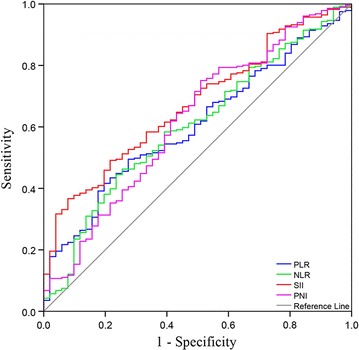
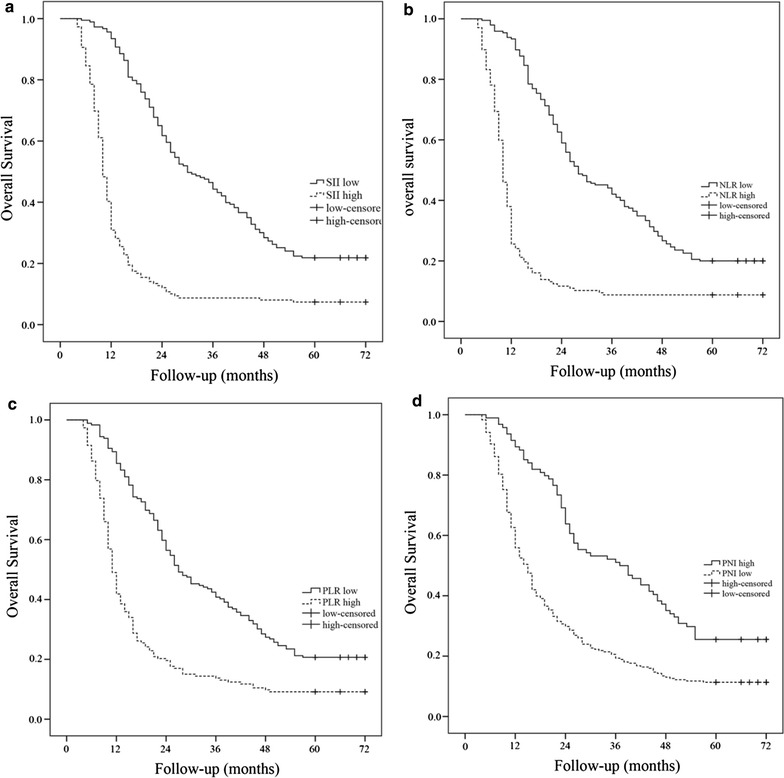
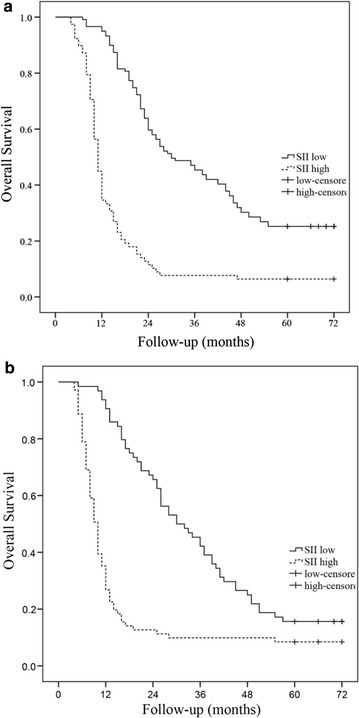
There is increasing evidence that the existence of systemic inflammation response is correlated with poor prognosis in several solid tumors. The aim of this retrospective study was to investigate the association between systemic immune-inflammation index (SII) and therapy response and overall survival in patients with stage III non-small cell lung cancer (NSCLC). The prognostic values of neutrophil to lymphocyte ratio (NLR), platelet to lymphocyte ratio (PLR), and prognostic nutritional index (PNI) were also evaluated. In total, 332 patients with new diagnosis of stage III NSCLC were included in this retrospective analysis. SII was defined as platelet counts × neutrophil counts/lymphocyte counts. Receiver operating characteristic (ROC) curve was used to evaluate the optimal cut-off value for SII, NLR, PLR and PNI. Univariate and multivariate survival analysis were performed to identify the factors correlated with overall survival. Applying cut-offs of ≥ 660 (SII), ≥ 3.57 (NLR), ≥ 147 (PLR), ≤ 52.95 (PNI), SII ≥ 660 was significantly correlated with worse ECOG PS (< 0.001), higher T stage (< 0.001), advanced clinical stage (p = 0.019), and lower response rate (p = 0.018). In univariate analysis, SII ≥ 660, NLR ≥ 3.57, PLR ≥ 147, and PNI ≤ 52.95 were significantly associated with worse overall survival (p all < 0.001). Patients with SII ≥ 660 had a median overall survival of 10 months, and patients with SII < 660 showed a median overall survival of 30 months. In multivariate analysis only ECOG PS (HR, 1.744; 95% CI 1.158–2.626; p = 0.008), T stage (HR, 1.332; 95% CI 1.032–1.718; p = 0.028), N stage (HR, 1.848; 95% CI 1.113–3.068; p = 0.018), SII (HR, 2.105; 95% CI 1.481–2.741; p < 0.001) and NLR ≥ 3.57 (HR, 1.934; 95% CI 1.448–2.585; p < 0.001) were independently correlated with overall survival. This study demonstrates that the SII is an independent prognostic indicator of poor outcomes for patients with stage III NSCLC and is superior to other inflammation-based factors in terms of prognostic ability.
Overview
The claims and statistics of this paper haven’t been checked yet.
Free: it reads the open-access text and checks the first 5 claims that cite a source we can check. Create a free account to check every claim.
Integrity signals
Registry
Cites
Statistics
Figures
Verification
Claims the paper makes
The claims and statistics of this paper haven’t been checked yet.
Free: it reads the open-access text and checks the first 5 claims that cite a source we can check. Create a free account to check every claim.
Claims other papers make about this one
Each is checked against this paper’s own text: does it say what the citing paper says it does?
In the citing paper
“The systemic immunity-inflammation index (SII) is a stable new inflammatory biomarker computed from platelet count × neutrophil count/lymphocyte count [7,8].”
From Association between Systemic Immunity-Inflammation Index and Hyperlipidemia: A Population-Based Study from the NHANES (2015–2020) (2023) · cites this paper as [8]
Self-check
Percentages, sums and reported differences re-computed from the paper’s own numbers.
The self-check needs the paper’s full text.
Citations
Cites
Hu, B., Yang, X.-R., Xu, Y., Sun, Y.-F., Sun, C., Guo, W., Zhang, X., Wang, W.-M., Qiu, S.-J., Zhou, J., et al. (2014) · Clinical Cancer Research · doi:10.1158/1078-0432.ccr-14-0442 · Cited by 2,493
Postmus, P. E., Kerr, K. M., Oudkerk, M., Senan, S., Waller, D. A., Vansteenkiste, J., Escriu, C., & Peters, S. (2017) · Annals of Oncology · doi:10.1093/annonc/mdx222 · Cited by 2,302
Proctor, M. J., Morrison, D. S., Talwar, D., Balmer, S. M., Fletcher, C. D., O’Reilly, D. S. J., Foulis, A. K., Horgan, P. G., & McMillan, D. C. (2011) · European Journal of Cancer · doi:10.1016/j.ejca.2011.03.028 · Cited by 757
Proctor, M. J., Morrison, D. S., Talwar, D., Balmer, S. M., O'Reilly, D. S. J., Foulis, A. K., Horgan, P. G., & McMillan, D. C. (2011) · British Journal of Cancer · doi:10.1038/sj.bjc.6606087 · Cited by 531 · cited 1×
“It is widely recognized that systemic inflammation plays an important role in the development and progression of many solid tumors [8].”
BackgroundVansteenkiste, J., De Ruysscher, D., Eberhardt, W. E. E., Lim, E., Senan, S., Felip, E., & Peters, S. (2013) · Annals of Oncology · doi:10.1093/annonc/mdt241 · Cited by 490
Pinato, D. J., North, B. V., & Sharma, R. (2012) · British Journal of Cancer · doi:10.1038/bjc.2012.92 · Cited by 421 · cited 1×
“PNI < 45 were more likely to have portal vein thrombosis and worse Child-Turcotte-Pugh class [17].”
BackgroundInduction chemoradiation in stage IIIA/N2 non-small-cell lung cancer: a phase 3 randomised trial
Pless, M., Stupp, R., Ris, H.-B., Stahel, R. A., Weder, W., Thierstein, S., Gerard, M.-A., Xyrafas, A., Früh, M., Cathomas, R., et al. (2015) · The Lancet · doi:10.1016/s0140-6736(15)60294-x · Cited by 390 · cited 1×
“For these patients, two standard treatment options are offered: the concurrent chemoradiotherapy (CRT) or induction chemotherapy followed by surgery [4, 5].”
BackgroundGebhardt, C., Sevko, A., Jiang, H., Lichtenberger, R., Reith, M., Tarnanidis, K., Holland-Letz, T., Umansky, L., Beckhove, P., Sucker, A., et al. (2015) · Clinical Cancer Research · doi:10.1158/1078-0432.ccr-15-0676 · Cited by 367
Sharaiha, R. Z., Halazun, K. J., Mirza, F., Port, J. L., Lee, P. C., Neugut, A. I., Altorki, N. K., & Abrams, J. A. (2011) · Annals of Surgical Oncology · doi:10.1245/s10434-011-1754-8 · Cited by 325
Paramanathan, A., Saxena, A., & Morris, D. L. (2014) · Surgical Oncology · doi:10.1016/j.suronc.2013.12.001 · Cited by 316 · cited 1×
“Relative neutrophilia increases the number of inflammatory factors such as pro-angiogenic factor (VEGF), growth factor (CXCL8), and anti-apoptotic factor (NFκB) which may establish a tumor microenvironment and promote tumor growth and progression [32, 33].”
BackgroundKinoshita, A., Onoda, H., Imai, N., Iwaku, A., Oishi, M., Fushiya, N., Koike, K., Nishino, H., & Tajiri, H. (2012) · British Journal of Cancer · doi:10.1038/bjc.2012.354 · Cited by 293
Platelets and cancer angiogenesis nexus
Wojtukiewicz, M. Z., Sierko, E., Hempel, D., Tucker, S. C., & Honn, K. V. (2017) · Cancer and Metastasis Reviews · doi:10.1007/s10555-017-9673-1 · Cited by 257 · cited 1×
“Thrombocytosis, a paraneoplastic syndrome, has been reported in as many as 10–57% of cancer patients [29].”
BackgroundExosomes miR-126a released from MDSC induced by DOX treatment promotes lung metastasis
Deng, Z., Rong, Y., Teng, Y., Zhuang, X., Samykutty, A., Mu, J., Zhang, L., Cao, P., Yan, J., Miller, D., et al. (2017) · Oncogene · doi:10.1038/onc.2016.229 · Cited by 207 · cited 1×
“MDSCs are heterogenic and immunosuppressive subpopulation of cells that enhance tumor progression through stimulating vasculogenesis [23].”
BackgroundDeng, Q., He, B., Liu, X., Yue, J., Ying, H., Pan, Y., Sun, H., Chen, J., Wang, F., Gao, T., et al. (2015) · Journal of Translational Medicine · doi:10.1186/s12967-015-0409-0 · Cited by 204 · cited 1×
“, NLR and PLR were significantly associated with tumor stage, deep of invasion, and lymph node metastasis in patients with gastric cancer [16].”
BackgroundThe prognostic impact of the neutrophil-to-lymphocyte ratio in patients with small-cell lung cancer
Kang, M. H., Go, S.-I., Song, H.-N., Lee, A., Kim, S.-H., Kang, J.-H., Jeong, B.-K., Kang, K. M., Ling, H., & Lee, G.-W. (2014) · British Journal of Cancer · doi:10.1038/bjc.2014.317 · Cited by 199
Cannon, N. A., Meyer, J., Iyengar, P., Ahn, C., Westover, K. D., Choy, H., & Timmerman, R. (2015) · Journal of Thoracic Oncology · doi:10.1097/jto.0000000000000399 · Cited by 194
The Long Noncoding RNA MEG3 Contributes to Cisplatin Resistance of Human Lung Adenocarcinoma
Liu, J., Wan, L., Lu, K., Sun, M., Pan, X., Zhang, P., Lu, B., Liu, G., & Wang, Z. (2015) · PLOS ONE · doi:10.1371/journal.pone.0114586 · Cited by 184 · cited 1×
“Although cisplatin-based concurrent CRT has been the standard treatment option for locally advanced NSCLC, chemotherapy resistance remains the main obstacle in cancer treatment [18, 19].”
BackgroundYao, Y., Yuan, D., Liu, H., Gu, X., & Song, Y. (2013) · Cancer Immunology, Immunotherapy · doi:10.1007/s00262-012-1347-9 · Cited by 175 · cited 1×
“A recent retrospective study found that high NLR was significantly correlated with chemotherapy resistance in patient with advanced NSCLC treated with first line platinum-based chemotherapy [20].”
BackgroundSelf-citationPinato, D. J., Shiner, R. J., Seckl, M. J., Stebbing, J., Sharma, R., & Mauri, F. A. (2014) · British Journal of Cancer · doi:10.1038/bjc.2014.145 · Cited by 167
van Soest, R. J., Templeton, A. J., Vera-Badillo, F., Mercier, F., Sonpavde, G., Amir, E., TOMBAL, B. F., Rosenthal, M. A., Eisenberger, M. A., Tannock, I. F., et al. (2014) · Annals of Oncology · doi:10.1093/annonc/mdu569 · Cited by 147
Guthrie, G. J. K., Roxburgh, C. S. D., Farhan-Alanie, O. M., Horgan, P. G., & McMillan, D. C. (2013) · British Journal of Cancer · doi:10.1038/bjc.2013.330 · Cited by 136
Mabuchi, S., Matsumoto, Y., Kawano, M., Minami, K., Seo, Y., Sasano, T., Takahashi, R., Kuroda, H., Hisamatsu, T., Kakigano, A., et al. (2014) · JNCI Journal of the National Cancer Institute · doi:10.1093/jnci/dju147 · Cited by 135 · cited 1×
“Similar findings have also been observed by Cho and Mabuchi that tumor-related leukocytosis (TRL) was significantly correlated with poor radiation response in patient with uterine cervical carcinoma [21, 22].”
ResultScilla, K. A., Bentzen, S. M., Lam, V. K. L., Mohindra, P., Nichols, E., Vyfhuis, M. A. L., Bhooshan, N., Feigenberg, S. J., Edelman, M. J., & Feliciano, J. L. (2017) · The Oncologist · doi:10.1634/theoncologist.2016-0443 · Cited by 113 · cited 1×
“Relative neutrophilia increases the number of inflammatory factors such as pro-angiogenic factor (VEGF), growth factor (CXCL8), and anti-apoptotic factor (NFκB) which may establish a tumor microenvironment and promote tumor growth and progression [32, 33].”
BackgroundKeizman, D., Gottfried, M., Ish‐Shalom, M., Maimon, N., Peer, A., Neumann, A., Rosenbaum, E., Kovel, S., Пили, Р., Sinibaldi, V. J., et al. (2012) · The Oncologist · doi:10.1634/theoncologist.2012-0125 · Cited by 94
Stinchcombe, T. E., Zhang, Y., Vokes, E. E., Schiller, J. H., Bradley, J. D., Kelly, K. L., Curran, W. J., Schild, S. E., Movsas, B., Clamon, G. H., et al. (2017) · Journal of Clinical Oncology · doi:10.1200/jco.2016.71.4758 · Cited by 89
Fortunato, O., Boeri, M., Moro, M., Verri, C., Mensah, M., Conte, D., Caleca, L., Roz, L., Pastorino, U., & Sozzi, G. (2014) · Cell Death and Disease · doi:10.1038/cddis.2014.507 · Cited by 86 · cited 1×
“Indeed, NSCLC is poorly chemosensitive to most of the available agents, the reported treatment response rates is only 10–25% [7].”
BackgroundYu, P., Li, Z., Zhang, S., Xiong, Y., Cun, Y., Qian, C., Li, M., Ren, T., Lei, X., Cheng, Y., et al. (2014) · International Journal of Cancer · doi:10.1002/ijc.28892 · Cited by 72 · cited 1×
“Complete response (CR) was defined as total regression of all assessable lesions; partial response (PR) was defined as the disappearance of at least of 30% in the sum of the longest diameters of the target lesions; progressive disease (PD) was defined as more than a 20% increase in primary tumor volume or appearance o…”
BackgroundCho, Y., Kim, K. H., Yoon, H. I., Kim, G. E., & Kim, Y. B. (2016) · Annals of Oncology · doi:10.1093/annonc/mdw308 · Cited by 69 · cited 1×
“Similar findings have also been observed by Cho and Mabuchi that tumor-related leukocytosis (TRL) was significantly correlated with poor radiation response in patient with uterine cervical carcinoma [21, 22].”
ResultElevated mean platelet volume predicts poor prognosis in colorectal cancer
Li, N., Yu, Z., Zhang, X., Liu, T., Sun, Y.-X., Wang, R.-T., & Yu, K.-J. (2017) · Scientific Reports · doi:10.1038/s41598-017-11053-y · Cited by 67 · cited 1×
“An elevated platelet counts could stimulate tumor angiogenesis and protect tumor cells from cytolysis, thereby contributing to tumor metastasis [31].”
BackgroundGao, L., Zhang, H., Zhang, B., Zhang, L., & Wang, C. (2017) · Oncotarget · doi:10.18632/oncotarget.14921 · Cited by 61
Zhou, X., Li, Y., Zhu, W.-G., Yu, C., Song, Y., Wang, W.-W., He, D.-C., Tao, G., & Tong, Y. (2017) · Scientific Reports · doi:10.1038/srep42581 · Cited by 54
Self-citationFeng, W., Fu, X., Cai, X.-W., Yang, H.-J., Wu, K., Fan, M., Xiang, J.-Q., Zhang, Y., & Chen, H. (2014) · International Journal of Radiation Oncology*Biology*Physics · doi:10.1016/j.ijrobp.2013.12.048 · Cited by 45 · cited 1×
“However, even after complete resection and postoperative consolidation chemotherapy, 20–40% patients still have a risk of local recurrence [6].”
BackgroundWarner, A., Dahele, M. R., Hu, B., Palma, D. A., Senan, S., Oberije, C., Tsujino, K., Moreno, M., Kim, T. H., Marks, L. B., et al. (2015) · International Journal of Radiation Oncology*Biology*Physics · doi:10.1016/j.ijrobp.2015.11.030 · Cited by 44 · cited 1×
“Although cisplatin-based concurrent CRT has been the standard treatment option for locally advanced NSCLC, chemotherapy resistance remains the main obstacle in cancer treatment [18, 19].”
BackgroundSheng, J., Yang, Y.-P., Ma, Y., Qin, T., Hu, Z.-H., Hong, S.-D., Zhou, T., Huang, Y., Zhao, H.-Y., & Zhang, L. (2016) · PLoS ONE · doi:10.1371/journal.pone.0147226 · Cited by 40
Shimizu, K., Okita, R., Saisho, S., Yukawa, T., Maeda, A., Nojima, Y., & Nakata, M. (2015) · Therapeutics and Clinical Risk Management · doi:10.2147/tcrm.s92961 · Cited by 23
Chemoradiotherapy of locally advanced nonsmall cell lung cancer
Antoni, D., & Mornex, F. (2016) · Current Opinion in Oncology · doi:10.1097/cco.0000000000000265 · Cited by 18 · cited 1×
“For these patients, two standard treatment options are offered: the concurrent chemoradiotherapy (CRT) or induction chemotherapy followed by surgery [4, 5].”
Background
Cited by
Prognostic value of Systemic immune-inflammation index in cancer: A meta-analysis
Yang, R., Chang, Q., Meng, X., Gao, N., & Wang, W. (2018) · Journal of Cancer · doi:10.7150/jca.25691 · Cited by 441
“Tong[22] 2017 China Asian non-small cell lung cancer 332 660 OS 9 M”
BackgroundMahemuti, N., Jing, X., Zhang, N., Liu, C., Li, C., Cui, Z., Liu, Y., & Chen, J. (2023) · Nutrients · doi:10.3390/nu15051177 · Cited by 260
You, Y., Chen, Y., Fang, W., Li, X., Wang, R., Liu, J., & Ma, X. (2023) · Frontiers in Immunology · doi:10.3389/fimmu.2022.1080782 · Cited by 241
Association between Systemic Immune-Inflammation Index and Diabetic Depression
Wang, J., Zhou, D., Dai, Z., & Li, X. (2021) · Clinical Interventions in Aging · doi:10.2147/cia.s285000 · Cited by 238
Jomrich, G., Paireder, M., Kristo, I., Baierl, A., Ilhan-Mutlu, A., Preusser, M., Asari, R., & Schoppmann, S. F. (2021) · Annals of Surgery · doi:10.1097/sla.0000000000003370 · Cited by 176
Metadata
- Authors
- Tong, Y.-S., Tan, J., Zhou, X.-L., Song, Y.-Q., & Song, Y.-J.
- Affiliations
- Huaian First People’s Hospital (CN)
- Venue
- Journal of Translational Medicine
- Published
- 2017-10-31
- Volume
- 15
- Issue
- 1
- Pages
- 221-221
- ISSN
- 1479-5876 (ISSN-L)
- PMC
- PMC5664920
- OpenAlex
- W2767077750
- Cited by
- 233
- References
- 37
- Citations by year
- 2026: 19 · 2025: 26 · 2024: 38 · 2023: 29 · 2022: 27 · 2021: 35 · 2020: 26 · 2019: 21 · 2018: 12
- FWCI
- 7.11
- Type
- journal article
- Language
- en
- Open access
- gold
- doi.org
- Licence
- cc-by
- Locations
- Journal of Translational Medicine (publishedVersion, cc-by)
- PubMed Central (publishedVersion, cc-by)
- PubMed (publishedVersion)
- DOAJ (DOAJ: Directory of Open Access Journals) (submittedVersion, cc-by-sa)
- Funders
- National Natural Science Foundation of China
- Topics
- Health Sciences › Medicine › Oncology › Inflammatory Biomarkers in Disease Prognosis
- Health Sciences › Medicine › Oncology › Lung Cancer Research Studies
- Health Sciences › Medicine › Pulmonary and Respiratory Medicine › Lung Cancer Diagnosis and Treatment
- Keywords
- systemic immune-inflammation index, non-small cell lung cancer, stage III NSCLC, systemic inflammation, chemoradiotherapy resistance, neutrophil-to-lymphocyte ratio, platelet-to-lymphocyte ratio, prognostic nutritional index, overall survival, prognostic factors, treatment response, ECOG performance status, T stage, N stage, prognostic cutoff values
- MeSH terms
- Adult, Aged, Carcinoma, Non-Small-Cell Lung, Female, Humans, Inflammation, Lung Neoplasms, Male, Middle Aged, Neoplasm Staging, Neutrophils, Platelet Count, ROC Curve, Nutrition Assessment, Multivariate Analysis, Treatment Outcome, Lymphocyte Count, Kaplan-Meier Estimate, Chemoradiotherapy
About these checks
Registry, retraction, Cites and statistics results are computed, not judged, with one exception: a printed reference that no index lists is read once by a model before it counts as a citation error. Claims are extracted by a model and kept only when their quote appears verbatim in the text; each cited source is then checked, with a model’s help, for whether it says what the claim relies on. Those verdicts can be wrong — read the claim’s quote and the cited source before relying on one.
Statistics and arithmetic are recomputed, not judged.
Confidence bands are shown only for fields calibrated on our annotated test set. None is calibrated yet, so no band is shown.
What counts as a claim ›How we measure confidence ›How we check this ›
Are you an author, or do you see a problem with this page? Request a review
Data sources
Bibliographic data: Semantic Scholar, OpenAlex, Crossref.
Contains information from the Semantic Scholar Academic Graph Datasets, made available under the ODC Attribution License (ODC-BY 1.0).
Semantic Scholar’s data is described in: Kinney, R., et al. (2023). The Semantic Scholar Open Data Platform. arXiv:2301.10140.
