

Microglial immunophenotype in dementia with Alzheimer’s pathology
Open accessThe DOI matches its Crossref record; 42 of the 42 references it cites were found in a registry or an index.
Abstract
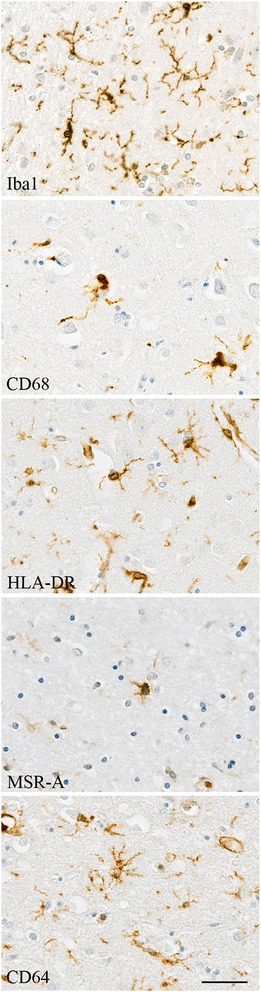
BACKGROUND: Genetic risk factors for Alzheimer's disease imply that inflammation plays a causal role in development of the disease. Experimental studies suggest that microglia, as the brain macrophages, have diverse functions, with their main role in health being to survey the brain parenchyma through highly motile processes. METHODS: Using the Medical Research Council Cognitive Function and Ageing Studies resources, we have immunophenotyped microglia to investigate their role in dementia with Alzheimer's pathology. Cerebral cortex obtained at post-mortem from 299 participants was analysed by immunohistochemistry for cluster of differentiation (CD)68 (phagocytosis), human leukocyte antigen (HLA)-DR (antigen-presenting function), ionized calcium-binding adaptor molecule (Iba1) (microglial motility), macrophage scavenger receptor (MSR)-A (plaque-related phagocytosis) and CD64 (immunoglobulin Fcγ receptor I). RESULTS: The presence of dementia was associated positively with CD68 (P < 0.001), MSR-A (P = 0.010) and CD64 (P = 0.007) and negatively with Iba1 (P < 0.001). Among participants without dementia, the cognitive function according to the Mini-Mental State Examination was associated positively with Iba1 (P < 0.001) and negatively with CD68 (P = 0.033), and in participants with dementia and Alzheimer's pathology, positively with all microglial markers except Iba1. Overall, in participants without dementia, the relationship with Alzheimer's pathology was negative or not significant, and positive in participants with dementia and Alzheimer's pathology. Apolipoprotein E (APOE) ε2 allele was associated with expression of Iba1 (P = 0.001) and MSR-A (P < 0.001) and APOE ε4 with CD68, HLA-DR and CD64 (P < 0.001). CONCLUSIONS: Our findings raise the possibility that in dementia with Alzheimer's pathology, microglia lose motility (Iba-1) necessary to support neurons. Conversely, other microglial proteins (CD68, MSR-A), the role of which is clearance of damaged cellular material, are positively associated with Alzheimer's pathology and impaired cognitive function. In addition, our data imply that microglia may respond differently to Aβ and tau in participants with and without dementia so that the microglial activity could potentially influence the likelihood of developing dementia, as supported by genetic studies, highlighting the complexity and diversity of microglial responses.
Overview
The claims and statistics of this paper haven’t been checked yet.
Free: it reads the open-access text and checks the first 5 claims that cite a source we can check. Create a free account to check every claim.
Integrity signals
Registry
Cites
Statistics
Figures
Verification
Claims the paper makes
The claims and statistics of this paper haven’t been checked yet.
Free: it reads the open-access text and checks the first 5 claims that cite a source we can check. Create a free account to check every claim.
Claims other papers make about this one
Each is checked against this paper’s own text: does it say what the citing paper says it does?
The cited source doesn’t support the claim as written.
In the citing paper
“No difference between AD and control was reported in the caudate nucleus,88 combined cerebellum and cerebral cortex,51 mediodorsal nucleus of the thalamus88 and the middle frontal gyrus.56”
From Markers of microglia in post-mortem brain samples from patients with Alzheimer’s disease: a systematic review (2018) · cites this paper as [56]
Checked by a reasoning model — may be wrong.
Experimental — accuracy not yet measuredThe cited source says what the claim attributes to it.
In the citing paper
“and 5 reported lower Iba1 in AD than controls32, 54, 56, 75, 76 in at least one of the regions measured.”
From Markers of microglia in post-mortem brain samples from patients with Alzheimer’s disease: a systematic review (2018) · cites this paper as [56]
The cited source says what the claim attributes to it.
In the citing paper
“APOE genotype can also impact the results, with the ε4 risk allele increasing HLA-DR-positive cells or area in the frontal and temporal cortices48 and middle frontal gyrus.56”
From Markers of microglia in post-mortem brain samples from patients with Alzheimer’s disease: a systematic review (2018) · cites this paper as [56]
The cited source says what the claim attributes to it.
In the citing paper
“It also increases with APOE ε4 genotype.56”
From Markers of microglia in post-mortem brain samples from patients with Alzheimer’s disease: a systematic review (2018) · cites this paper as [56]
The cited source says what the claim attributes to it.
In the citing paper
“Microglial activation appears to be affected by APOE genotype, with carriers of the ε4 risk allele exhibiting greater activation in some48, 56 but not all studies.82”
From Markers of microglia in post-mortem brain samples from patients with Alzheimer’s disease: a systematic review (2018) · cites this paper as [56]
1 more claim about this paper
Create a free account to see every claim other papers make about this one.
Self-check
Percentages, sums and reported differences re-computed from the paper’s own numbers.
The self-check needs the paper’s full text.
Citations
Cites
Folstein, M. F., Folstein, S. E., & McHugh, P. R. (1975) · Journal of Psychiatric Research · doi:10.1016/0022-3956(75)90026-6 · Cited by 88,282 · cited 1×
“The microglial data were analysed in relation to dementia status, cognition using the MMSE score [21] as a measurement of general cognition, specific pathological features of Alzheimer’s disease and APOE genotype.”
MethodKok, J. S., Berg, I. J., & Scherder, E. J. A. (2013) · Dementia and Geriatric Cognitive Disorders Extra · doi:10.1159/000353441 · Cited by 20,589
Older Adults' Reasons for Using Technology while Aging in Place
Peek, S. T. M., Luijkx, K. G., Rijnaard, M. D., Nieboer, M. E., van der Voort, C. S., Aarts, S., van Hoof, J., Vrijhoef, H. J. M., & Wouters, E. J. M. (2016) · Gerontology · doi:10.1159/000430949 · Cited by 19,690
Sensitivity and False Alarm Rate of a Fall Sensor in Long-Term Fall Detection in the Elderly
Kangas, M., Korpelainen, R., Vikman, I., Nyberg, L., & Jämsä, T. (2015) · Gerontology · doi:10.1159/000362720 · Cited by 18,909
Glutamate neurotoxicity and diseases of the nervous system
CHOI, D. (1988) · Neuron · doi:10.1016/0896-6273(88)90162-6 · Cited by 7,972
Neuroinflammation in Alzheimer's disease
Heneka, M. T., Carson, M. J., Khoury, J. E., Landreth, G. E., Brosseron, F., Feinstein, D. L., Jacobs, A. H., Wyss-Coray, T., Vitorica, J., Ransohoff, R. M., et al. (2015) · The Lancet Neurology · doi:10.1016/s1474-4422(15)70016-5 · Cited by 6,226 · cited 1×
“CD64 is the only high-affinity receptor for antibodies [30], reflecting the potential involvement of systemic immunity in the disease process [31].”
BackgroundResting microglial cells are highly dynamic surveillants of brain parenchyma in vivo
Nimmerjahn, A., Kirchhoff, F., & Helmchen, F. (2005) · Science · doi:10.1126/science.1110647 · Cited by 5,827 · cited 2×
“They are normally highly motile cells with numerous long processes through which they are constantly sensing the brain environment for change [3].”
BackgroundMirra, S. S., Heyman, A., McKeel, D., Sumi, S. M., Crain, B. J., Brownlee, L. M., Vogel, F. S., Hughes, J. P., Belle, G. V., Berg, L., et al. (1991) · Neurology · doi:10.1212/wnl.41.4.479 · Cited by 4,961
Nelson, P. T., Alafuzoff, I., Bigio, E. H., Bouras, C., Braak, H., Cairns, N. J., Castellani, R. J., Crain, B. J., Davies, P., Tredici, K. D., et al. (2012) · Journal of Neuropathology & Experimental Neurology · doi:10.1097/nen.0b013e31825018f7 · Cited by 2,050 · cited 1×
“Our analysis of MMSE score and neuropathology confirmed that tangles are a better marker of cognitive impairment than Aβ plaques [28].”
BackgroundBrain interleukin 1 and S-100 immunoreactivity are elevated in Down syndrome and Alzheimer disease.
Griffin, W. S., Stanley, L. C., Ling, C., White, L., MacLeod, V, Perrot, L. J., White, C. L., & Araoz, C. (1989) · Proceedings of the National Academy of Sciences · doi:10.1073/pnas.86.19.7611 · Cited by 1,777 · cited 1×
“cytokines, complement) produced by microglia are an important cause of neuronal damage, which then provokes further microglial activation resulting in a self-perpetuating positive feedback loop [4, 5].”
Background
Cited by
Items 201–219 of 219
Wang, S., Li, B., Solomon, V. A., Fonteh, A. N., Rapoport, S. I., Bennett, D. A., Arvanitakis, Z., Chui, H. C., Sullivan, P. M., & Yassine, H. N. (2022) · Figshare · doi:10.6084/m9.figshare.20080941
Wang, S., Li, B., Solomon, V. A., Fonteh, A. N., Rapoport, S. I., Bennett, D. A., Arvanitakis, Z., Chui, H. C., Sullivan, P. M., & Yassine, H. N. (2022) · Figshare · doi:10.6084/m9.figshare.20080938
Zhang, W.-B., Huang, Y., Guo, X.-R., Zhang, M.-Q., 袁向山, & Zu, H.-B. (2024) · Figshare · doi:10.6084/m9.figshare.26598869
Zhang, W.-B., Huang, Y., Guo, X.-R., Zhang, M.-Q., 袁向山, & Zu, H.-B. (2024) · Figshare · doi:10.6084/m9.figshare.26598866
Azevedo, A. G. C. D. (2022) · Portuguese National Funding Agency for Science, Research and Technology (RCAAP Project by FCT) · doi:10.34626/3c57-s807 · Cited by 1
Wang, S., Li, B., Solomon, V. A., Fonteh, A. N., Rapoport, S. I., Bennett, D. A., Arvanitakis, Z., Chui, H. C., Miller, C. A., Sullivan, P. M., et al. (2021) · Figshare · doi:10.6084/m9.figshare.14442868
van Wetering, J., Geut, H., Bol, J. G. J. M., Galis, Y., Timmermans, E., Twisk, J. W. R., Hepp, D. H., Morella, M. L., Pihlstrøm, L., Lemstra, A. W., et al. (2024) · Figshare · doi:10.6084/m9.figshare.26716930
Wenzel, T. J., Desjarlais, J. D., & Mousseau, D. D. (2024) · Figshare · doi:10.6084/m9.figshare.26759543
The In Vitro Pharmacology of Cannabidivarin (CBDV)
Le, J. (2023) · HARVEST (University of Saskatchewan)
Posterior cortical atrophy, a pathological characterisation
Abdi, Z. (2023) · UCL Discovery (University College London)
APOE, Inflammation, and T Cells in Translational Disease Models and Clinical Medicine
Adlimoghaddam, A., Cervantes, D., & Wheeler, C. J. (2026) · Springer eBooks · doi:10.1007/978-3-031-52641-1_35-1 · Cited by 2
Effects of Maternal High Fat Diet on Microglia Activation in Rat Offspring
Wu, J. (2023) · TSpace (University of Toronto)
Freyssin, A. (2020) · theses.fr (ABES) · doi:10.70675/0db2e37dz547bz4731z852dz9b843c062cba
Hemonnot-Girard, A.-L. (2021) · theses.fr (ABES) · doi:10.70675/9c8a4775zd774z494ez9bbazf7566faefa8f
Vontobel, D. S., Lai, K. O., Bacioglu, M., Nolan, G., Maddison, D. C., Adamski, A., Goddard, J., Shapiro, N. L., Crook, H., Fryer, T. D., et al. (2026) · medRxiv · doi:10.64898/2026.06.22.26356176 · Cited by 1
Yang, T., Xu, Y. R., Li, S., Bellier, J., Tao, Y., Francis, A. E., Stern, A. M., Jin, S., Ostaszewski, B. L., Lawton, T., et al. (2026) · Cell Reports · doi:10.1016/j.celrep.2026.117599
Wang, X., Liu, Y., Liu, J., Wang, R., Zheng, J., Deng, Z., Song, K., Zhang, D., Wang, C., Zhu, K., et al. (2026) · Nuclear Medicine and Biology · doi:10.1016/j.nucmedbio.2026.109675 · Cited by 2
Riluzole shifts glial responses to protect synapses and memory in Aβ oligomer–treated rats
Min-Kaung-Wint-Mon, Kida, H., Kimura, R., & Mitsushima, D. (2026) · Journal of Neuroinflammation · doi:10.1186/s12974-026-03972-3
“CD68 reactivity has been shown to correlate positively with C3-expressing A1 astrocytes, amyloid burden, and cognitive impairment in AD [71, 74, 85, 86].”
Bayraktaroğlu, I., Eschborn, M., Zwiers, I., van Vliet, K., Fischer, R., Dam, D. V., Deyn, P. P. D., & Eisel, U. L. M. (2026) · Alzheimer s Research & Therapy · doi:10.1186/s13195-026-02217-y
Metadata
- Authors
- CFAS, M., Minett, T., Classey, J., Matthews, F. E., Fahrenhold, M., Taga, M., Brayne, C., Ince, P. G., Nicoll, J. A. R., & Boche, D.
- Affiliations
- University of Cambridge (GB)
- Southampton General Hospital (GB)
- University Hospital Southampton NHS Foundation Trust (GB)
- Corresponding author
- Boche, Delphine
- Venue
- Journal of Neuroinflammation
- Published
- 2016-06-02
- Volume
- 13
- Issue
- 1
- Pages
- 135-135
- ISSN
- 1742-2094 (ISSN-L)
- PMC
- PMC4890505
- OpenAlex
- W2414662940
- Cited by
- 219
- References
- 42
- Citations by year
- 2026: 16 · 2025: 19 · 2024: 21 · 2023: 31 · 2022: 22 · 2021: 29 · 2020: 26 · 2019: 23 · 2018: 17 · 2017: 14 · 2016: 1
- FWCI
- 10.04
- Type
- journal article
- Language
- en
- Open access
- gold
- doi.org
- Licence
- cc-by
- Locations
- Journal of Neuroinflammation (publishedVersion, cc-by)
- Europe PMC (PubMed Central) (publishedVersion, cc-by)
- PubMed Central (publishedVersion, cc-by)
- PubMed (publishedVersion)
- ePrints Soton (University of Southampton) (acceptedVersion)
- White Rose Research Online (University of Leeds, The University of Sheffield, University of York) (acceptedVersion)
- Apollo (University of Cambridge) (submittedVersion, cc-by)
- Repository@Hull (Worktribe) (University of Hull) (submittedVersion, cc-by)
- Apollo (cc-by)
- Funders
- Medical Research Council (G0900582)
- Topics
- Life Sciences › Neuroscience › Neurology › Neuroinflammation and Neurodegeneration Mechanisms
- Life Sciences › Neuroscience › Cellular and Molecular Neuroscience › Alzheimer's disease research and treatments
- Health Sciences › Medicine › Psychiatry and Mental health › Dementia and Cognitive Impairment Research
- Keywords
- microglia, Alzheimer's disease, dementia, immunophenotyping, microglial motility, Iba1, CD68, CD64, HLA-DR, APOE ε4, APOE ε2, amyloid-beta, tau protein, neuroinflammation, cognitive function, cerebral cortex, postmortem brain
- MeSH terms
- CD68 Molecule, Aged, Aged, 80 and over, Alzheimer Disease, Calcium-Binding Proteins, Dementia, Diagnosis, DNA-Binding Proteins, Female, HLA-DR Antigens, Humans, Male, Mental Status Schedule, Microfilament Proteins, Neuropsychological Tests, Antigens, Differentiation, Myelomonocytic, Cohort Studies, Antigens, CD, Cytokines, Receptors, IgG, Microglia, Methionine Sulfoxide Reductases
About these checks
Registry, retraction, Cites and statistics results are computed, not judged, with one exception: a printed reference that no index lists is read once by a model before it counts as a citation error. Claims are extracted by a model and kept only when their quote appears verbatim in the text; each cited source is then checked, with a model’s help, for whether it says what the claim relies on. Those verdicts can be wrong — read the claim’s quote and the cited source before relying on one.
Statistics and arithmetic are recomputed, not judged.
Confidence bands are shown only for fields calibrated on our annotated test set. None is calibrated yet, so no band is shown.
What counts as a claim ›How we measure confidence ›How we check this ›
Are you an author, or do you see a problem with this page? Request a review
Data sources
Bibliographic data: Semantic Scholar, OpenAlex, Crossref.
Contains information from the Semantic Scholar Academic Graph Datasets, made available under the ODC Attribution License (ODC-BY 1.0).
Semantic Scholar’s data is described in: Kinney, R., et al. (2023). The Semantic Scholar Open Data Platform. arXiv:2301.10140.
