

The DOI matches its Crossref record; 97 of the 97 references it cites were found in a registry or an index.
Bidirectional gut-brain-microbiota axis as a potential link between inflammatory bowel disease and ischemic stroke
Open accessAbstract
Emerging evidence suggests that gut-brain-microbiota axis (GBMAx) may play a pivotal role linking gastrointestinal and neuronal disease. In this review, we summarize the latest advances in studies of GBMAx in inflammatory bowel disease (IBD) and ischemic stroke. A more thorough understanding of the GBMAx could advance our knowledge about the pathophysiology of IBD and ischemic stroke and help to identify novel therapeutic targets via modulation of the GBMAx.
Overview
The claims and statistics of this paper haven’t been checked yet.
Run the check — free, no account needed. It reads the open-access text and checks the sources it cites.
Integrity signals
Registry
Cites
Statistics
Figures
Verification
Claims the paper makes
The claims and statistics of this paper haven’t been checked yet.
Run the check — free, no account needed. It reads the open-access text and checks the sources it cites.
Claims other papers make about this one
Each is checked against this paper’s own text: does it say what the citing paper says it does?
In the citing paper
“Bacterial metabolites, also known as post-antibiotics (121) or postbiotics, were treated with the bacterial product butyrate, an SCFA, in a study with SOD1G93A mice (50).”
From Modulation of the gut–brain axis via the gut microbiota: a new era in treatment of amyotrophic lateral sclerosis (2023) · cites this paper as [50]
In the citing paper
“Butyrate treatment improves intestinal integrity and microbial homeostasis, acting along the brain–gut axis, and was found to have beneficial effects in SOD1G93A mice in terms of extending the lifespan and delaying the progression of ALS.”
From Modulation of the gut–brain axis via the gut microbiota: a new era in treatment of amyotrophic lateral sclerosis (2023) · cites this paper as [50]
Self-check
Percentages, sums and reported differences re-computed from the paper’s own numbers.
The self-check needs the paper’s full text.
Citations
Cites
Pattern Recognition Receptors and Inflammation
Takeuchi, O., & Akira, S. (2010) · Cell · doi:10.1016/j.cell.2010.01.022 · Cited by 8,895
The Microbial Metabolites, Short-Chain Fatty Acids, Regulate Colonic T reg Cell Homeostasis
Smith, P. M., Howitt, M. R., Panikov, N., Michaud, M., Gallini, C. A., Bohlooly-Y, M., Glickman, J. N., & Garrett, W. S. (2013) · Science · doi:10.1126/science.1241165 · Cited by 5,413
Induction of Colonic Regulatory T Cells by Indigenous Clostridium Species
Atarashi, K., Tanoue, T., Shima, T., Imaoka, A., Kuwahara, T., Momose, Y., Cheng, G., Yamasaki, S., Saito, T., Ohba, Y., et al. (2011) · Science · doi:10.1126/science.1198469 · Cited by 3,752
Host microbiota constantly control maturation and function of microglia in the CNS
Erny, D., Hrabě de Angelis, A. L., Jaitin, D., Wieghofer, P., Staszewski, O., David, E., Keren-Shaul, H., Mahlakoiv, T., Jakobshagen, K., Buch, T., et al. (2015) · Nature Neuroscience · doi:10.1038/nn.4030 · Cited by 3,569
The gut microbiota influences blood-brain barrier permeability in mice
Braniste, V., Al-Asmakh, M., Kowal, C., Anuar, F., Abbaspour, A., Tóth, M., Korecka, A., Bakocevic, N., Ng, L. G., Kundu, P., et al. (2014) · Science Translational Medicine · doi:10.1126/scitranslmed.3009759 · Cited by 2,530
Gut–brain axis: How the microbiome influences anxiety and depression
Foster, J. A., & McVey Neufeld, K.-A. (2013) · Trends in Neurosciences · doi:10.1016/j.tins.2013.01.005 · Cited by 2,460
Intestinal homeostasis and its breakdown in inflammatory bowel disease
Maloy, K. J., & Powrie, F. M. (2011) · Nature · doi:10.1038/nature10208 · Cited by 1,911
Clarke, G., Grenham, S., Scully, P., Fitzgerald, P., Moloney, R. D., Shanahan, F., Dinan, T. G., & Cryan, J. F. (2013) · Molecular Psychiatry · doi:10.1038/mp.2012.77 · Cited by 1,893
Gut microbiota and IBD: causation or correlation?
Ni, J., Wu, G. D., Albenberg, L., & Tomov, V. T. (2017) · Nature Reviews Gastroenterology & Hepatology · doi:10.1038/nrgastro.2017.88 · Cited by 1,778
Stroke-Associated Pneumonia: Major Advances and Obstacles
Hannawi, Y., Hannawi, B., Rao, C. P. V., Suárez, J. I., & Bershad, E. M. (2013) · Cerebrovascular Diseases · doi:10.1159/000350199 · Cited by 1,664
Cited by
Sorted by citations
Items 101–113 of 113
Upregulation of CXCL1 and FCGR1A is Associated With the ischemic stroke and Crohn’s DiseasePreprint
Zhang, W., Li, Y., Xu, H., Li, C., Zhang, Y., & Han, B. (2023) · Research Square · doi:10.21203/rs.3.rs-2676536/v1
Boamah, V. E., Ekuadzi, E., & Mante, P. K. (2023) · Research Square · doi:10.21203/rs.3.rs-2775005/v1
Microbiome and multiple sclerosis
Durán, M. J. O., Rodríguez, T., López‐Nevot, M. Á., & Cobo, F. (2023) · Elsevier eBooks · doi:10.1016/b978-0-443-18578-6.00005-2
(2023) · International Journal of Biology Pharmacy and Allied Sciences · doi:10.31032/ijbpas/2023/12.10.1031
Probiotic: Global Market, Mechanisms of Action, and Beneficial Effects on Health
Cissé, H., Oumar, D. A., Ouédraogo, G. A., Sawadogo, A., Zongo, C., Tidjani, A., & Savadogo, A. (2024) · IntechOpen eBooks · doi:10.5772/intechopen.1007311
Crosstalk between gut-brain axis and brain components along with associated neurological disorders
Bindal, P., Kaushal, S., Singh, C., & Singh, A. (2025) · Elsevier eBooks · doi:10.1016/b978-0-443-21680-0.00005-5
Schmid, G. B. (2025) · Springer eBooks · doi:10.2991/978-3-662-70243-7_7
GETECCU position paper on fragility, advanced age and inflammatory bowel disease
Mañosa, M., Calafat, M., Francia, E., Riba, F., Mesonero, F., Suárez, C., García-López, S., Callau, F. L., Calvet, X., Domènech, E., et al. (2025) · Gastroenterología y Hepatología (English Edition) · doi:10.1016/j.gastre.2025.502529
Stroke in paediatric Crohn’s disease
Kambala, S. A., Sindgikar, S. P., Hameed, D., & Sorake, C. J. (2025) · BMJ Case Reports · doi:10.1136/bcr-2025-269145
Koroma, M. M., Chan, J., Michaux, M., Kasanda, B., & Jacobson, K. (2026) · Systematic Reviews · doi:10.1186/s13643-026-03106-z
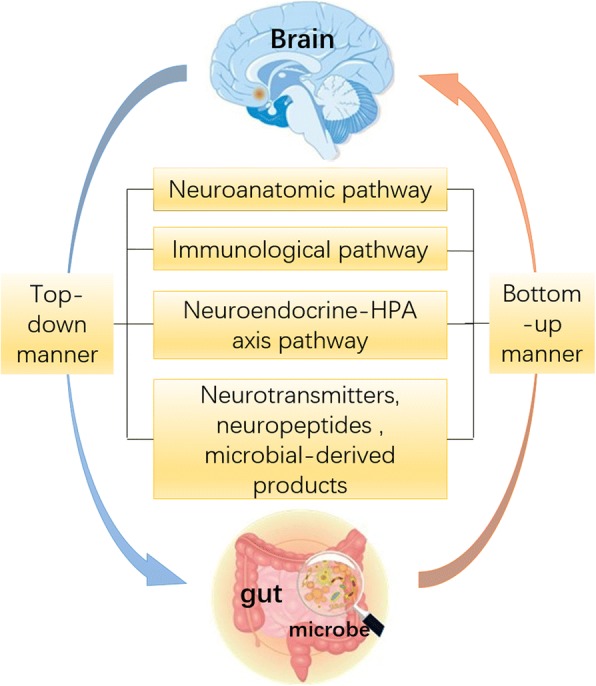
“In fact, studies have shown a bidirectional relationship between the gut and the brain via multiple communication pathways [30–32].”
Li, Z., Fu, J., Pu, J., Qian, Y., Gai, X., & Li, L. (2026) · Frontiers in Neuroscience · doi:10.3389/fnins.2026.1773086
Wei, C., Zhou, X., Xia, X., Feng, W. L., Wang, L., & Li, X. (2026) · BMC Microbiology · doi:10.1186/s12866-026-05013-8
Kuang, X., & Zheng, X. (2026) · International Journal of Molecular Sciences · doi:10.3390/ijms27167291
“Within the brainstem, these signals are primarily integrated into the nucleus tractus solitarius (NTS) and the dorsal motor nucleus of the vagus (DMV) [56].”
Metadata
- Authors
- Zhao, L., Xiong, Q., Stary, C. M., Mahgoub, O. K., Ye, Y., Gu, L., Xiong, X., & Zhu, S.
- Affiliations
- Renmin Hospital of Wuhan University (CN)
- Stanford Medicine (US)
- First Affiliated Hospital Zhejiang University (CN)
- Corresponding author
- Xiong, Xiaoxing
- Zhu, Shengmei
- Venue
- Journal of Neuroinflammation
- Published
- 2018-12
- Volume
- 15
- Issue
- 1
- Pages
- 339-339
- ISSN
- 1742-2094 (ISSN-L)
- PMC
- PMC6290529
- OpenAlex
- W2904712122
- Cited by
- 113
- References
- 97
- Citations by year
- 2026: 5 · 2025: 11 · 2024: 13 · 2023: 23 · 2022: 23 · 2021: 17 · 2020: 14 · 2019: 7
- FWCI
- 0.93
- Type
- journal article
- Language
- en
- Open access
- gold
- doi.org
- Licence
- Locations
- Journal of Neuroinflammation (publishedVersion, cc-by)
- Europe PMC (PubMed Central) (publishedVersion, other-oa)
- PubMed Central (publishedVersion, cc-by)
- PubMed (publishedVersion)
- DOAJ (DOAJ: Directory of Open Access Journals) (submittedVersion, cc-by-sa)
- Funders
- National Natural Science Foundation of China (81571147, 81870939)
- American Heart Association (14FTF19970029)
- Topics
- Life Sciences › Biochemistry, Genetics and Molecular Biology › Molecular Biology › Gut microbiota and health
- Health Sciences › Medicine › Gastroenterology › Inflammatory Bowel Disease
- Health Sciences › Medicine › Gastroenterology › Gastrointestinal motility and disorders
- Keywords
- gut-brain-microbiota axis, inflammatory bowel disease, ischemic stroke, gut microbiota, neuroinflammation, two-way communication, therapeutic target
- MeSH terms
- Gastrointestinal Microbiome, Animals, Brain Ischemia, Humans, Inflammatory Bowel Diseases
About these checks
Registry, retraction, Cites and statistics results are computed, not judged, with one exception: a printed reference that no index lists is read once by a model before it counts as a citation error. Claims are extracted by a model and kept only when their quote appears verbatim in the text; each cited source is then checked, with a model’s help, for whether it says what the claim relies on. Those verdicts can be wrong — read the claim’s quote and the cited source before relying on one.
Statistics and arithmetic are recomputed, not judged.
Confidence bands are shown only for fields calibrated on our annotated test set. None is calibrated yet, so no band is shown.
What counts as a claim ›How we measure confidence ›How we check this ›
Are you an author, or do you see a problem with this page? Request a review
