

Socio-cultural and economic factors influencing adolescents’ resilience against the threat of teenage pregnancy: a cross-sectional survey in Accra, Ghana
Open accessThe DOI matches its Crossref record; 34 of the 35 references it cites were found in a registry or an index.
Abstract
BACKGROUND: Adolescent pregnancy exposes female adolescents to medical, social and economic risks. In Ghana, adolescent mothers are more likely to experience complications during pregnancy and delivery as compared to older mothers. This study examined the competencies of adolescent girls to either proactively prevent teenage pregnancy or reactively cope effectively with it. METHODS: A cross-sectional survey approach was used to interview 820 adolescent girls aged 15-19 years in Accra, Ghana. The main focus of the study was to examine how social capital (various kinds of valued relations with significant others), economic capital (command over economic resources, mainly cash and assets), cultural capital (personal dispositions and habits; knowledge and tradition stored in material forms and institutionalized) and symbolic capital (honour, recognition and prestige) contribute to the development of competencies of adolescents to deal with the threat of teenage pregnancy and childbirth. RESULTS: Out of 820 adolescents interviewed, 128 (16%) were pregnant or mothers. Adolescents in both groups (62% never pregnant girls and 68% pregnant/young mothers) have access to social support, especially from their parents. Parents are taking the place of aunts and grandmothers in providing sexual education to their adolescent girls due to changing social structures where extended families no longer reside together in most cases. More (79%) pregnant girls and young mothers compared to never pregnant girls (38%) have access to economic support (P = <0.001). Access to social, economic and cultural capitals was associated with high competence to either prevent or deal with pregnancy among adolescent girls. CONCLUSION: Findings showed that adolescent girls, especially those that get pregnant should not be viewed as weak and vulnerable because many of them have developed competencies to cope with pregnancy and childbirth effectively. Thus, focusing on developing the competencies of girls to access social, economic and cultural capitals may be an effective way of tackling the threat of teenage pregnancy than focusing only on their vulnerability and associated risks.
Overview
The claims and statistics of this paper haven’t been checked yet.
Free: it reads the open-access text and checks the first 5 claims that cite a source we can check. Create a free account to check every claim.
Integrity signals
Registry
Cites
Statistics
Figures
Verification
Claims the paper makes
The claims and statistics of this paper haven’t been checked yet.
Free: it reads the open-access text and checks the first 5 claims that cite a source we can check. Create a free account to check every claim.
Self-check
Percentages, sums and reported differences re-computed from the paper’s own numbers.
The self-check needs the paper’s full text.
Citations
Cites
Bourdieu, P. (2002) · Readings in Economic Sociology · doi:10.1002/9780470755679.ch15 · Cited by 13,906
Bonanno, G. A. (2004) · American Psychologist · doi:10.1037/0003-066x.59.1.20 · Cited by 6,851 · cited 1×
“Over 70 % of the never pregnant girls said they knew how to prevent pregnancy, however, it has been reported in several studies from Ghana that being knowledgeable about contraceptives and birth control in general does not always translate into actual protection [9, 24, 27, 37].”
BackgroundGhana Demographic and Health Survey 2008
Macro, I. (2009) · Cited by 1,593
Population and Housing Census.
Tobago (2011) · Cited by 1,384
Protective Factors and Individual Resilience
Werner, E. E. (2000) · Handbook of Early Childhood Intervention · doi:10.1017/cbo9780511529320.008 · Cited by 935
Well-Being: Positive Development Across the Life Course
(2003) · doi:10.4324/9781410607171 · Cited by 799
Bearinger, L. H., Sieving, R. E., Ferguson, J., & Sharma, V. (2007) · The Lancet · doi:10.1016/s0140-6736(07)60367-5 · Cited by 762
Resilience in Children's Adaptation to Negative Life Events and Stressed Environments
Garmezy, N. (1991) · Pediatric Annals · doi:10.3928/0090-4481-19910901-05 · Cited by 752 · cited 1×
“Research on resilience (adaptive capacity) has a long history among Western psychologists and social workers, mostly in the United States [13, 14].”
BackgroundWiegand, H. (1968) · Biometrische Zeitschrift · doi:10.1002/bimj.19680100122 · Cited by 508
Unique pathways to resilience across cultures.
Ungar, M. T., Brown, M., Liebenberg, L., Othman, R., Kwong, W. M., Armstrong, M. I., & Gilgun, J. F. (2007) · PubMed · Cited by 486
Research works printed but not linked: 6
- 4. UNAIDS. Report on the Global AIDS epidemic. Geneva: UNAIDS; 2008.
- 15. Liebenberg L, Ungar M. Researching resilience. Toronto: University of Toronto Press; 2008.
- 17. Collins B. Resilience in teenage mothers: a follow-up study. Wellington: Ministry of Social Development; 2010.
- 20. Kish, L. Survey Sampling. New York: John Wiley & Sons Inc.; 1965.
- 23. World Health Organization. The sexual and reproductive health of younger adolescents: research issues in developing countries: background paper for a consultation. Geneva: World Health Organization; 2011.
- 32. Mlangwa S, Obrist Van Eeuwijk B. Competing ideologies: adolescence, knowledge and silence in Dar es Salaam. In: Harcourt S (Ed.). Power, reproduction and gender. The inter-generational transfer of knowledge. London: Zed Books Ltd; 1997. p. 35-57.
Cited by
Determinants of adolescent pregnancy in sub-Saharan Africa: a systematic review
Yakubu, I., & Salisu, W. J. (2018) · Reproductive Health · doi:10.1186/s12978-018-0460-4 · Cited by 634
“Factors associated with unintended pregnancies amongst adolescents are early marriages, culture, religion, gender [12], poor social and economic support [13, 14].”
BackgroundGirls’ Empowerment and Adolescent Pregnancy: A Systematic Review
Nkhoma, D., Lin, C.-P., Katengeza, H. L., Soko, C. J., Estinfort, W., Wang, Y., Juan, S.-H., Jian, W., & Iqbal, U. (2020) · International Journal of Environmental Research and Public Health · doi:10.3390/ijerph17051664 · Cited by 123
Resilience of sub-Saharan children and adolescents: A scoping review
Theron, L. C. (2020) · Transcultural Psychiatry · doi:10.1177/1363461520938916 · Cited by 97
Socio-cultural factors influencing adolescent pregnancy in Ghana: a scoping review
Amoadu, M., Ansah, E. W., Assopiah, P., Acquah, P., Ansah, J. E., Berchie, E., Hagan, D., & Amoah, E. (2022) · BMC Pregnancy and Childbirth · doi:10.1186/s12884-022-05172-2 · Cited by 93
“Moreover, only one of the included studies adjusted for confounding variables (Ahorlu et al., 2015).”
BackgroundYakubu, I., Garmaroudi, G., Sadeghi, R., Tol, A., Yekaninejad, M. S., & Yidana, A. (2019) · Reproductive Health · doi:10.1186/s12978-019-0784-8 · Cited by 101
“These factors include early marriages [5], inadequate social and economic support [5, 6].”
BackgroundContraceptive use and unintended pregnancy among young women and men in Accra, Ghana
Grindlay, K., Dako‐Gyeke, P., Ngo, T. D., Eva, G., Gobah, L., Reiger, S. T., Chandrasekaran, S., & Blanchard, K. (2018) · PLoS ONE · doi:10.1371/journal.pone.0201663 · Cited by 84
Mochache, V., Wanje, G., Nyagah, L., Lakhani, A., El‐Busaidy, H., Temmerman, M., & Gichangi, P. (2020) · Reproductive Health · doi:10.1186/s12978-020-00919-6 · Cited by 69
An evolution of socioeconomic related inequality in teenage pregnancy and childbearing in Malawi
Chirwa, G. C., Mazalale, J., Likupe, G., Nkhoma, D., Chiwaula, L. S., & Chintsanya, J. (2019) · PLoS ONE · doi:10.1371/journal.pone.0225374 · Cited by 70
“In addition to this, personal dispositions and habits [22] have been cited as potential confounders.”
BackgroundResultTang, Y., Diao, H., Jin, F., Pu, Y., & Wang, H. (2022) · PLoS ONE · doi:10.1371/journal.pone.0263012 · Cited by 61
“According to the influencing factors of resilience [49, 50], following sociodemographic characteristics were collected through self-designed questionnaires: age (continuous variable); participants’ education level (primary school/middle school); sex (male/female); whether the individual is an only child (Yes/No); rela…”
MethodKotoh, A. M., Amekudzie, B. S., Opoku-Mensah, K., Baku, E. A., & Glozah, F. N. (2022) · BMC Public Health · doi:10.1186/s12889-022-13318-2 · Cited by 48
Kangwana, B. P., Austrian, K., Soler‐Hampejsek, E., Maddox, N., Sapire, R., Wado, Y. D., Abuya, B. A., Muluve, E., Mbushi, F., Koech, J., et al. (2022) · PLoS ONE · doi:10.1371/journal.pone.0262858 · Cited by 51
“Low socioeconomic status is a risk factor for early pregnancy because adolescents with limited access to economic resources are less able to afford basic care and family planning and are more vulnerable to experiencing child sexual exploitation [5, 23, 24], including having sex in exchange for money or gifts.”
BackgroundPfeiffer, C., Ahorlu, C., Alba, S., & Obrist, B. (2017) · Reproductive Health · doi:10.1186/s12978-017-0338-x · Cited by 41
“Findings from the urban setting in Ghana have been presented elsewhere [32].”
BackgroundResultSelf-citationAyamolowo, L. B., Ayamolowo, S. J., Adelakun, D. O., & Adesoji, B. A. (2024) · BMC Public Health · doi:10.1186/s12889-024-19005-8 · Cited by 47
Adolescent Pregnancy in South Asia: A Systematic Review of Observational Studies
Poudel, S., Razee, H., Dobbins, T., & Akombi-Inyang, B. J. (2022) · International Journal of Environmental Research and Public Health · doi:10.3390/ijerph192215004 · Cited by 48
Senkyire, E. K., Boateng, D., Boakye, F. O., Logo, D. D., & Ohaja, M. (2022) · PLoS ONE · doi:10.1371/journal.pone.0272131 · Cited by 36
“Collectively, adolescent pregnancy contributes to about 9% of maternal mortality in Ghana [12].”
BackgroundHashemi, N., Sebar, B., & Harris, N. (2018) · Public Health · doi:10.1016/j.puhe.2018.07.020 · Cited by 36
Aluga, D., & Okolie, E. A. (2021) · Health Promotion Perspectives · doi:10.34172/hpp.2021.52 · Cited by 31
An Integrative Review of the Research on Teen Mothers’ Resilience
SmithBattle, L., & Phengnum, W. (2022) · Western Journal of Nursing Research · doi:10.1177/01939459221106989 · Cited by 29
Morgan, A. K., Ibrahim, R., Owusu, A. F. S., Awafo, B. A., Quartey, T., Aziire, M. A., Katsekpor, J. T., Owusu, A., & Katey, D. (2023) · International Journal of Adolescence and Youth · doi:10.1080/02673843.2023.2242476 · Cited by 21
“The lack of social and economic support for adolescent mothers may predispose them to greater danger than the pregnancy itself (Ahorlu et al., 2015).”
BackgroundCorrelates of sexual inactivity and met need for contraceptives among young women in Ghana
Atiglo, D. Y., & Biney, A. A. E. (2018) · BMC Women s Health · doi:10.1186/s12905-018-0630-0 · Cited by 17
Estrategias para mejorar el nivel de resiliencia en adolescentes embarazadas
Castro, Á. M., Ulloque-Caamaño, L., & Arteta-Acosta, C. (2018) · Investigación en Enfermería Imagen y Desarrollo · doi:10.11144/javeriana.ie20-2.emnr · Cited by 24
Manguro, G., Mwaisaka, J., Okoro, D., Korir, K., Owira, P., Githinji, G., Olajide, A., & Temmerman, M. (2021) · International Journal of Human Rights in Healthcare · doi:10.1108/ijhrh-11-2020-0099 · Cited by 14
Packer, C. A., Ridgeway, K., Lenzi, R., Gonzaléz‐Calvo, L., Moon, T. D., Green, A. F., & Burke, H. M. (2020) · Journal of Adolescent Research · doi:10.1177/0743558419897385 · Cited by 17
“Increasingly, efforts to help adolescents thrive worldwide are incorporating PYD approaches (Ahorlu et al., 2015; Blum et al., 2012; Gavin et al., 2010; Mathur et al., 2001; Rew & Horner, 2003).”
BackgroundExploring the influence of repeat pregnancy on the lives of teenage mothers
Okine, L., Dako‐Gyeke, M., Baiden, P., & Mort, K. S. (2020) · Journal of Human Behavior in the Social Environment · doi:10.1080/10911359.2020.1763226 · Cited by 16
Monterrosa-Castro, Á. D. J., Ulloque-Caamaño, L., Iriarte, C. M. C., & Payares, E. P. P. (2020) · IATREIA · doi:10.17533/udea.iatreia.51 · Cited by 11
“IATREIA Vol 33(3) julio-septiembre 2020 suficientemente capacitados (10,11).”
BackgroundInfluentialSocioeconomic characteristics influence attitudes towards sexuality in adolescents
Alves, J. D. S. A., da Gama, S. G. N., Viana, M. C., Martinelli, K. G., & Neto, E. T. D. S. (2021) · Journal of Human Growth and Development · doi:10.36311/jhgd.v31.11084 · Cited by 11
Bosire, E. N., Chiseri, K., Comeau, D. L., Richter, L., Stein, A. D., & Norris, S. A. (2021) · PLOS Global Public Health · doi:10.1371/journal.pgph.0000044 · Cited by 10
“Our findings are in line with previous studies which have reported that parents are key social actors in advising adolescents on matters relating to sex [31].”
ResultEstrada, F., Atienzo, E. E., Cruz-Jiménez, L., & Campero, L. (2021) · Journal of Pediatric and Adolescent Gynecology · doi:10.1016/j.jpag.2021.01.022 · Cited by 11
Maina, B. W., Juma, K. O., Igonya, E. K., Osindo, J., Wao, H., & Kabiru, C. W. (2021) · BMJ Open · doi:10.1136/bmjopen-2020-044398 · Cited by 10
A critical review of adolescent sexual and reproductive health and rights in Kenya
Manguro, G., & Temmerman, M. (2022) · Med · doi:10.1016/j.medj.2022.05.007 · Cited by 9
Teenage Pregnancy in Rural Indonesia: Does Education Level Have a Role?
Wulandari, R. D., Laksono, A. D., & Matahari, R. (2023) · Jurnal PROMKES · doi:10.20473/jpk.v11.i1.2023.101-108 · Cited by 8
Nursing Scientific Production on Teenage Pregnancy: An Integrative Review
Fernandes, D. E. R., Medeiros, M., Santos, W. S., & dos Santos, M. G. (2020) · Aquichan · doi:10.5294/aqui.2020.20.2.5 · Cited by 7
“Os adolescentes podem ser vistos como agentes sociais ativos que não somente sofrem com as características do meio no qual estão inseridos, mas que também podem transformar suas realidades no âmbito doméstico e no comunitário (55).”
BackgroundCorwith, A., & Ali, F. (2022) · Journal on Education in Emergencies · doi:10.33682/81c2-vkk4 · Cited by 8
Panda, A., Parida, J., Jena, S., Pradhan, A., Pati, S., Kaur, H., & Acharya, S. K. (2024) · Journal of Family Medicine and Primary Care · doi:10.4103/jfmpc.jfmpc_1674_22 · Cited by 7
Tembo, C. P., Portsmouth, L., & Burns, S. K. (2024) · BMC Health Services Research · doi:10.1186/s12913-024-11469-z · Cited by 8
“For adolescent mothers, this period can be more challenging and may complicate social roles [9, 10].”
BackgroundAmenah, M. A., Novignon, J., Fenny, A. P., Agyepong, I. A., & Ensor, T. (2025) · Reproductive Health · doi:10.1186/s12978-025-01955-w · Cited by 4
Experiência de educação em saúde sobre sexualidade com adolescentes institucionalizados
Zukowsky-Tavares, C., de Souza, A. C., Braga, N. G. D. S., Lima, A. S., dos Santos, D. D. C., Francica, J. O., & da Costa, E. M. S. (2017) · Revista Brasileira em Promoção da saúde · doi:10.5020/18061230.2017.p135 · Cited by 4
Albaar, M., & Umanailo, D. (2020) · Jurnal Sehat Mandiri · doi:10.33761/jsm.v15i2.279 · Cited by 4
Exploring the Pillars of Sustainable Development in the Context of Ghanaian SMEs
Okeniyi, J. O., Samuel, S. E., Okecha, C., & Igirigi, S. (2019) · Journal of Economics and Sustainable Development · doi:10.7176/jesd/10-14-04 · Cited by 6
Lotse, C. W. (2016) · NVA (Nasjonalt vitenarkiv) · Cited by 12
Erasmus, M. O. (2017) · University of the Western Cape Electronic Theses and Dissertations Repository (University of the Western Cape) · Cited by 10
Menda, D. M., Zimba, R. K., Mulikita, C. M., Nawa, M., Mwandia, J., Shamazubaula, S. F., Musonda, H., & Sichinga, K. S. (2023) · medRxiv · doi:10.1101/2023.10.13.23296957 · Cited by 6
“This finding was also corroborated by studies done in schools in the Africa region where adolescent mothers who reenter schools develop resilience and will to compete school despite the pregnancy experience (61, 65).”
ResultChamane, S. C., & Mabaso, M. (2025) · International Journal of Research in Business and Social Science (2147-4478) · doi:10.20525/ijrbs.v14i5.4262 · Cited by 3
Prevalence of teenage pregnancy and its associated factors among adolescent girls in Ghana
Osborne, A., Aboagye, R. G., Wongnaah, F. G., Bangura, C., & Ahinkorah, B. O. (2026) · Journal of the Egyptian Public Health Association · doi:10.1186/s42506-026-00206-5 · Cited by 3
Komasawa, M., Sato, M., Ssekitoleko, R., Waiswa, P., Gitta, S. N., Nabugoomu, J., Honda, S., Saito, K., & Aung, M. N. (2024) · BMJ Open · doi:10.1136/bmjopen-2024-084539 · Cited by 3
Arias, L. M., & Obregón, Y. G. (2024) · Acta Médica Costarricense · doi:10.51481/amc.v66i1.1380 · Cited by 2
Tembo, C. P., Portsmouth, L., & Burns, S. K. (2025) · PLOS mental health. · doi:10.1371/journal.pmen.0000044 · Cited by 2
“Similarly, a study in Ghana among adolescent mothers, where pre-birth ceremonies are also common, found these ceremonies assisted mothers in developing competencies to deal with postnatal challenges, and they felt prepared to take a new role as mothers [68].”
Komasawa, M., Sato, M., Saito, K., Honda, S., Ssekitoleko, R., Waiswa, P., Muluya, K. M., Gitta, S. N., & Aung, M. N. (2025) · Reproductive Health · doi:10.1186/s12978-025-02235-3 · Cited by 2
“Parental involvement has been identified as a critical factor influencing unintended pregnancy in adolescents across several SSA countries [31, 32, 35].”
Alves, J. D. S. A., Martinelli, K. G., Viana, M. C., da Gama, S. G. N., & Neto, E. T. D. S. (2021) · Research Society and Development · doi:10.33448/rsd-v10i13.21494 · Cited by 2
Pregnancy Risks of Young Mothers in Medical Discourse and Cultural Settings
Rani, A. P., Nugroho, H., & Asriani, D. D. (2023) · Sawwa Jurnal Studi Gender · doi:10.21580/sa.v18i1.17689 · Cited by 2
Gyan, S. E., & Boafo, I. M. (2024) · SAGE Open Medicine · doi:10.1177/20503121231224660 · Cited by 2
“14,23,24 This paper thus explores alternative strategies that adolescents (15–19 years) use in their bid to prevent unwanted pregnancies and their perceptions of these strategies.”
BackgroundAlupo, P., Nteziyaremye, J. G., Nabirye, R. C., Ssenyonga, L. V. N., Adongo, P. R., Epuitai, J., & Mbwali, I. (2024) · African Health Sciences · doi:10.4314/ahs.v24i2.28 · Cited by 2
Prevalencia de gestación con recién nacido vivo en adolescentes de Tunja, Colombia, 2011-2015
Díaz, J., Sánchez, L. F. B., & López-Ortega, C. L. (2016) · Revista Colombiana de Obstetricia y Ginecología · doi:10.18597/rcog.1075 · Cited by 2
“Por esta razón, este grupo de edad en particular es de alto riesgo en términos de salud sexual y reproductiva, habida cuenta de la existencia de condiciones subjetivas que pueden llevar a la toma de decisiones apresuradas capaces de modificar la vida, generando pérdida de oportunidades y modificando las expectativas h…”
BackgroundAdomako, E. B., Frimpong‐Manso, K., Munemo, P., Duah, H. O., & Agbadi, P. (2021) · Heliyon · doi:10.1016/j.heliyon.2021.e06265 · Cited by 2
Alyai, J., Acanga, A., & Mwesigwa, D. (2023) · Journal of Gender Related Studies · doi:10.47941/jgrs.1478 · Cited by 1
“Ahorlu, Pfeiffer& Obrist (2015) states that Parents and Guardians are reluctant or do not understand the need to educate adolescents about the vice and sexual reproductive behavior which leave the adolescents not properly guided during their adolescent stage of development yet this is the critical…”
BackgroundEstratégias de educação sexual a partir da percepção de estudantes de uma escola pública
dos Santos, M. K. L. F., Queiroz, L. D. A., Saltirio, I. L. S., Rios, J. D. S. C., Pinho, H. M. L. D. S., da Silva, K. W. L., & Rocha, T. J. M. (2018) · Arquivos Médicos dos Hospitais e da Faculdade de Ciências Médicas da Santa Casa de São Paulo · doi:10.26432/1809-3019.2018.63.2.90 · Cited by 1
“Portanto, é um local ideal para promover ações de educação em saúde(3).”
BackgroundPrevalence of Gestation in School Adolescents in Brazil and Associated Factors
Maestri, T., Merini, F. L., Walber, T. A., Avosani, P. M., Freitas, S. S., Vignatti, L. J., Freitas, P. F., & Kretzer, M. R. (2019) · Open Access Journal of Gynecology and Obstetrics · doi:10.22259/2638-5244.0202001 · Cited by 1
Odewusi, T. A. (2020) · ERA · doi:10.7488/era/395 · Cited by 2
Wannemaeker, P. P. G. D., & Ruíz-Matuk, C. B. (2021) · Ciencia y Salud · doi:10.22206/cysa.2021.v5i1.pp69-78
Journal on Education in Emergencies: Volume 8, Number 3 (Complete)
Dunlop, E., Ginsburg, M., Elliott, K. E., Mathew, K. A., Fan, Y., Mattson, D., Falisse, J.-B., Brandt, C., Mukengere Basengezi, J., Gupta, S., et al. (2022) · Journal on Education in Emergencies · doi:10.33682/bch2-xsuh
Corwith, A., & Ali, F. (2022) · Journal on Education in Emergencies · doi:10.33682/qtj5-k9c7
Leiva, M. G., Landa, S. U., Castro, J. L. G., Puente-Martínez, A., & Rodríguez, G. A. (2023) · European Journal of Child Development Education and Psychopathology · doi:10.32457/ejpad.v10i1.2093
Ghosh, A., & Mistri, B. (2024) · The International Journal of Health Planning and Management · doi:10.1002/hpm.3805
Adewuyi, H. O. (2023) · International Journal of Home Economics Hospitality and Allied Research · doi:10.57012/ijhhr.v3n1.001
Comparison of perinatal and neonatal outcomes of adolescent and adult pregnant women
Durmuş, U., Yıldız, Ş., Dura, M. C., Durmuş, K. E., Gürsoy, B., Aslan, Ö., & Ekin, M. (2024) · Ahi Evran Medical Journal · doi:10.46332/aemj.1351015
Berehe, F. A., & Mfidi, F. H. (2024) · Research Square · doi:10.21203/rs.3.rs-5289465/v1
Mtoi, E. H. (2025) · International Journal For Multidisciplinary Research · doi:10.36948/ijfmr.2025.v07i02.41966
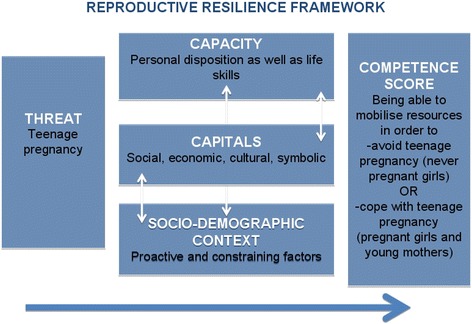
“The reproductive resilience framework analyses how these capitals work, together with the capacities influence the competence and adaptation of adolescents to pregnancy and motherhood (Ahorlu et al., 2015).”
Kim, J., Olsen, W. K., & Ibrahim, M. (2025) · Children & Society · doi:10.1111/chso.12999
Teenage Pregnancies in Indonesia: Does Socio-Economic Matter?
Hasyim, M., Prasetyo, J., Laksono, A. D., & Rohmah, N. (2025) · Journal Of Nursing Practice · doi:10.30994/jnp.v9i1.947
“…and Sri Lanka) and in Malawi, showing that low socio-economic status was a risk factor for the occurrence of teenage pregnancy (McHunu et al., 2012; Ahorlu, Pfeiffer and Obrist, 2015; Parsons et al., 2015; Yidana et al., 2015; Poudel et al., 2018; Chijere et al., 2019; Kassa, Arowojolu and…”
Amoadu, M., Ansah, E. W., Assopiah, P., Acquah, P., Ansah, J. E., Berchie, E., Hagan, D., & Amoah, E. (2022) · Figshare · doi:10.6084/m9.figshare.21546792
Tembo, C. P., Portsmouth, L., & Burns, S. K. (2024) · Figshare · doi:10.6084/m9.figshare.26943219
Tembo, C. P., Portsmouth, L., & Burns, S. K. (2024) · Figshare · doi:10.6084/m9.figshare.26839117
Tembo, C. P., Portsmouth, L., & Burns, S. K. (2024) · Figshare · doi:10.6084/m9.figshare.26839016
Política transcultural para la prevención del embarazo en adolescentes región Amazonas 2019
Araujo, J. M. (2020) · LA Referencia (Red Federada de Repositorios Institucionales de Publicaciones Científicas) · Cited by 1
El rol del capital social institucional en la continuidad de los estudios de las madres adolescentes
Otero Flores, A. M. (2024) · Communities in DSpace (Pontifical Catholic University of Peru)
Otegbayo Bolajoko, E. (2023) · University of Malaya Students Repository
Assessment of nutritional status and nutrient intake of teenage pregnant women in the Philippines
Emily, O. R., Jette, S. G. J., Ferrer, E. B., Viajar, R. V., Georgina, S. C., & Julieta, B. D. (2026) · Malaysian Journal of Nutrition · doi:10.31246/mjn-2025-0066
Akagwire, P., Singh, B., Kaba, J., Krakani, P. O., Abdulai, S. B., Asore, M. A., & Adangabe, E. (2026) · Research Square · doi:10.21203/rs.3.rs-9995780/v1
Kashyap, P., Jablonski, B. B. R., & Bovay, J. (2026) · Applied Economic Perspectives and Policy · doi:10.1002/aepp.70128
Ntiruvakule, A. J., Mkonongwa, L., & Nsolezi, F. S. (2026) · International Journal of Adolescence and Youth · doi:10.1080/02673843.2026.2730647
The role of digital media in motivating teenage pregnancy prevention among teenagers in Ghana
Malik, K. A. (2025) · K-State Research Exchange (Kansas State University) · Cited by 1
Against all odds: a qualitative exploration of how adolescent mothers become career women
Ngafeeson, V. (2025) · K-State Research Exchange (Kansas State University)
Education with Adolescent Pregnancy in Developed and Developing Countries
Purnamasari, A. R. A. (2022) · Jurnal Medika Hutama
Bosire, E. N., Chiseri, K., Comeau, D. L., Richter, L., Stein, A. D., & Norris, S. A. (2021) · doi:10.1371/journal.pgph.0000044.r001
Senkyire, E. K., Boateng, D., Boakye, F. O., Logo, D. D., & Ohaja, M. (2022) · doi:10.1371/journal.pone.0272131.r004
Metadata
- Authors
- Ahorlu, C. K., Pfeiffer, C., & Obrist, B.
- Affiliations
- University of Ghana (GH)
- Swiss Tropical and Public Health Institute (CH)
- Corresponding author
- Ahorlu, Collins K
- Venue
- Reproductive Health
- Published
- 2015-12
- Volume
- 12
- Issue
- 1
- Pages
- 117-117
- ISSN
- 1742-4755 (ISSN-L)
- PMC
- PMC4690282
- OpenAlex
- W2205654916
- Cited by
- 70
- References
- 35
- Citations by year
- 2026: 2 · 2025: 6 · 2024: 11 · 2023: 7 · 2022: 11 · 2021: 10 · 2020: 9 · 2019: 4 · 2018: 6 · 2017: 3 · 2016: 1
- FWCI
- 6.09
- Type
- journal article
- Language
- en
- Open access
- gold
- doi.org
- Licence
- Locations
- Reproductive Health (publishedVersion, cc-by)
- PubMed Central (publishedVersion, cc-by)
- PubMed (publishedVersion)
- edoc (University of Basel) (acceptedVersion)
- Funders
- National Science Foundation
- Schweizerischer Nationalfonds zur Förderung der Wissenschaftlichen Forschung
- Direktion für Entwicklung und Zusammenarbeit
- Topics
- Health Sciences › Medicine › Public Health, Environmental and Occupational Health › Adolescent Sexual and Reproductive Health
- Health Sciences › Medicine › Public Health, Environmental and Occupational Health › Reproductive Health and Contraception
- Health Sciences › Medicine › Public Health, Environmental and Occupational Health › Adolescent Health and Behaviors
- Keywords
- adolescent pregnancy, adolescent pregnancy prevention, adolescent girls, social capital, economic capital, cultural capital, symbolic capital, social support, parental support, sex education, adolescent mothers, Accra, Ghana
- MeSH terms
- Adaptation, Psychological, Adolescent, Adolescent Behavior, Cross-Sectional Studies, Culture, Female, Ghana, Humans, Health Knowledge, Attitudes, Practice, Pregnancy, Pregnancy in Adolescence, Sexual Behavior, Social Support, Socioeconomic Factors, Resilience, Psychological, Young Adult
About these checks
Registry, retraction, Cites and statistics results are computed, not judged, with one exception: a printed reference that no index lists is read once by a model before it counts as a citation error. Claims are extracted by a model and kept only when their quote appears verbatim in the text; each cited source is then checked, with a model’s help, for whether it says what the claim relies on. Those verdicts can be wrong — read the claim’s quote and the cited source before relying on one.
Statistics and arithmetic are recomputed, not judged.
Confidence bands are shown only for fields calibrated on our annotated test set. None is calibrated yet, so no band is shown.
What counts as a claim ›How we measure confidence ›How we check this ›
Are you an author, or do you see a problem with this page? Request a review
Data sources
Bibliographic data: Semantic Scholar, OpenAlex, Crossref.
Contains information from the Semantic Scholar Academic Graph Datasets, made available under the ODC Attribution License (ODC-BY 1.0).
Semantic Scholar’s data is described in: Kinney, R., et al. (2023). The Semantic Scholar Open Data Platform. arXiv:2301.10140.
