

Socio-cultural and economic factors influencing adolescents’ resilience against the threat of teenage pregnancy: a cross-sectional survey in Accra, Ghana
Open accessThe DOI matches its Crossref record; 34 of the 35 references it cites were found in a registry or an index.
Abstract
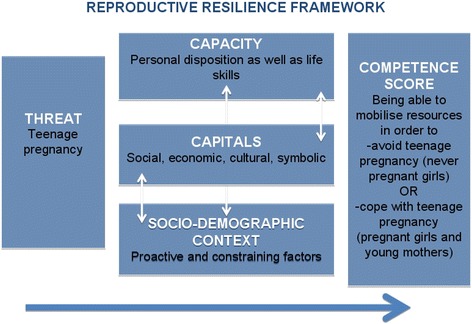
BACKGROUND: Adolescent pregnancy exposes female adolescents to medical, social and economic risks. In Ghana, adolescent mothers are more likely to experience complications during pregnancy and delivery as compared to older mothers. This study examined the competencies of adolescent girls to either proactively prevent teenage pregnancy or reactively cope effectively with it. METHODS: A cross-sectional survey approach was used to interview 820 adolescent girls aged 15-19 years in Accra, Ghana. The main focus of the study was to examine how social capital (various kinds of valued relations with significant others), economic capital (command over economic resources, mainly cash and assets), cultural capital (personal dispositions and habits; knowledge and tradition stored in material forms and institutionalized) and symbolic capital (honour, recognition and prestige) contribute to the development of competencies of adolescents to deal with the threat of teenage pregnancy and childbirth. RESULTS: Out of 820 adolescents interviewed, 128 (16%) were pregnant or mothers. Adolescents in both groups (62% never pregnant girls and 68% pregnant/young mothers) have access to social support, especially from their parents. Parents are taking the place of aunts and grandmothers in providing sexual education to their adolescent girls due to changing social structures where extended families no longer reside together in most cases. More (79%) pregnant girls and young mothers compared to never pregnant girls (38%) have access to economic support (P = <0.001). Access to social, economic and cultural capitals was associated with high competence to either prevent or deal with pregnancy among adolescent girls. CONCLUSION: Findings showed that adolescent girls, especially those that get pregnant should not be viewed as weak and vulnerable because many of them have developed competencies to cope with pregnancy and childbirth effectively. Thus, focusing on developing the competencies of girls to access social, economic and cultural capitals may be an effective way of tackling the threat of teenage pregnancy than focusing only on their vulnerability and associated risks.
Overview
The claims and statistics of this paper haven’t been checked yet.
Free: it reads the open-access text and checks the first 5 claims that cite a source we can check. Create a free account to check every claim.
Integrity signals
Registry
Cites
Statistics
Figures
Verification
Claims the paper makes
The claims and statistics of this paper haven’t been checked yet.
Free: it reads the open-access text and checks the first 5 claims that cite a source we can check. Create a free account to check every claim.
Self-check
Percentages, sums and reported differences re-computed from the paper’s own numbers.
The self-check needs the paper’s full text.
Citations
Cites
Bourdieu, P. (2002) · Readings in Economic Sociology · doi:10.1002/9780470755679.ch15 · Cited by 13,906
Bonanno, G. A. (2004) · American Psychologist · doi:10.1037/0003-066x.59.1.20 · Cited by 6,851 · cited 1×
“Over 70 % of the never pregnant girls said they knew how to prevent pregnancy, however, it has been reported in several studies from Ghana that being knowledgeable about contraceptives and birth control in general does not always translate into actual protection [9, 24, 27, 37].”
BackgroundGhana Demographic and Health Survey 2008
Macro, I. (2009) · Cited by 1,593
Population and Housing Census.
Tobago (2011) · Cited by 1,384
Protective Factors and Individual Resilience
Werner, E. E. (2000) · Handbook of Early Childhood Intervention · doi:10.1017/cbo9780511529320.008 · Cited by 935
Well-Being: Positive Development Across the Life Course
(2003) · doi:10.4324/9781410607171 · Cited by 799
Bearinger, L. H., Sieving, R. E., Ferguson, J., & Sharma, V. (2007) · The Lancet · doi:10.1016/s0140-6736(07)60367-5 · Cited by 762
Resilience in Children's Adaptation to Negative Life Events and Stressed Environments
Garmezy, N. (1991) · Pediatric Annals · doi:10.3928/0090-4481-19910901-05 · Cited by 752 · cited 1×
“Research on resilience (adaptive capacity) has a long history among Western psychologists and social workers, mostly in the United States [13, 14].”
BackgroundWiegand, H. (1968) · Biometrische Zeitschrift · doi:10.1002/bimj.19680100122 · Cited by 508
Unique pathways to resilience across cultures.
Ungar, M. T., Brown, M., Liebenberg, L., Othman, R., Kwong, W. M., Armstrong, M. I., & Gilgun, J. F. (2007) · PubMed · Cited by 486
Multi‐layered social resilience: a new approach in mitigation research
Obrist, B., Pfeiffer, C., & Henley, R. (2010) · Progress in Development Studies · doi:10.1177/146499340901000402 · Cited by 389
Self-citationA review of studies of parent-child communication about sexuality and HIV/AIDS in sub-Saharan Africa
Bastien, S., Kajula, L., & Muhwezi, W. (2011) · Reproductive Health · doi:10.1186/1742-4755-8-25 · Cited by 360 · cited 2×
“However, due to societal changes, where individuals have moved away from their ancestral homes to work in urban areas with weak or severed kinship ties, the parents and most importantly mothers are being consulted on sexual matters [35, 36].”
The state of the world's children 2011 - adolescence: an age of opportunity.
Anthony, D. (2011) · Cited by 346
Handbook for Working with Children and Youth: Pathways to Resilience across Cultures and Contexts
Ungar, M. (2005) · Sage eBooks · doi:10.4135/9781412976312 · Cited by 344
Urban health in developing countries: What do we know and where do we go?
Harpham, T. (2009) · Health & Place · doi:10.1016/j.healthplace.2008.03.004 · Cited by 254
MacLachlan, M. F., & Mannan, H. (2013) · SUNScholar (Stellenbosch University) · Cited by 248
Global Health: Why Cultural Perceptions, Social Representations, and Biopolitics Matter
Wilson, D. R. (2009) · The Social Science Journal · doi:10.1016/j.soscij.2009.04.009 · Cited by 226
Global Health: Why Cultural Perceptions, Social Representations, and Biopolitics Matter
Nichter, M. (2008) · Project Muse (Johns Hopkins University) · Cited by 154
Resilience in parenting among young mothers: Family and ecological risks and opportunities
Easterbrooks, M. A., Chaudhuri, J. H., Bartlett, J. D., & Copeman, A. (2010) · Children and Youth Services Review · doi:10.1016/j.childyouth.2010.08.010 · Cited by 137
Resilience and coping strategies in adolescents
Ahern, N. R., Ark, P., & Byers, J. F. (2008) · Nursing Children and Young People · doi:10.7748/paed2008.12.20.10.32.c6903 · Cited by 125
Irreconcilable differences: Health professionals’ constructions of adolescence and motherhood
Breheny, M., & Stephens, C. V. (2006) · Social Science & Medicine · doi:10.1016/j.socscimed.2006.08.026 · Cited by 118 · cited 1×
“This finding contradicts the generally held view that adolescent mothers are vulnerable children who are having children at a time that they are not supposed to [4–6, 18, 32].”
ResultBoothroyd, R. A., Stiles, P. G., & Best, K. A. (2009) · University of Toronto Press eBooks · doi:10.3138/9781442697669 · Cited by 91
Ricchiardi, P. (2013) · Institutional Research Information System University of Turin (University of Turin) · Cited by 55
Macleod, C. I. (2001) · Feminism & Psychology · doi:10.1177/0959353501011004004 · Cited by 45 · cited 1×
“It must be acknowledged that teenage pregnancy could have a negative effect on adolescents as it may truncate their education and other social and economic developments [33].”
BackgroundFund, U. N. P. (2003) · The state of world population/The State of world population · doi:10.18356/4884acb4-en · Cited by 43
Coping with Pregnancy Experiences of Adolescents in Ga Mashi, Accra
Henry, R., & Fayorsey, C. K. (2002) · Cited by 39
Studying Fathering Trajectories: In-depth Interviewing and Sensitizing Concepts
Day, R. D., & Lamb, M. E. (2003) · doi:10.4324/9781410609380-11 · Cited by 37
Adolescents sexual and reproductive health: qualitative evidence from Ghana.
Kumi-Kyereme, A., Awusabo‐Asare, K., & Biddlecom, A. (2007) · Cited by 22
By and for young women and men
Berer, M. (2001) · Reproductive Health Matters · doi:10.1016/s0968-8080(01)90002-3 · Cited by 12 · cited 1×
“The period of adolescence is a transitional one in which an individual goes through a lot of physical, emotional, psychological, cognitive and social changes [2, 3].”
BackgroundBecause of temptations: children, sex and HIV/AIDS in Tanzania
van Reeuwijk, M. A. J. (2004) · UvA-DARE (University of Amsterdam) · Cited by 12
Population, Health and Development in Ghana. Attaining the Millennium Development Goals
Chuks, J., & Kwankye, S. O. (2007) · Publication Server of Goethe University Frankfurt am Main (Goethe University Frankfurt) · Cited by 8
Helping Tanzanian teenage girls avoid pregnancy
Pfeiffer, C., Sambaiga, R., Ahorlu, C., & Obrist, B. (2012) · Cited by 4
Self-citationKwankye, S. O. (2007) · Cited by 3
Helping Tanzanian teenage girls avoid pregnancy
Pfeiffer, C., Sambaiga, R., Ahorlu, C., et al. (2012) · Cited by 2
Self-citation
Research works printed but not linked: 6
- 4. UNAIDS. Report on the Global AIDS epidemic. Geneva: UNAIDS; 2008.
- 15. Liebenberg L, Ungar M. Researching resilience. Toronto: University of Toronto Press; 2008.
- 17. Collins B. Resilience in teenage mothers: a follow-up study. Wellington: Ministry of Social Development; 2010.
- 20. Kish, L. Survey Sampling. New York: John Wiley & Sons Inc.; 1965.
- 23. World Health Organization. The sexual and reproductive health of younger adolescents: research issues in developing countries: background paper for a consultation. Geneva: World Health Organization; 2011.
- 32. Mlangwa S, Obrist Van Eeuwijk B. Competing ideologies: adolescence, knowledge and silence in Dar es Salaam. In: Harcourt S (Ed.). Power, reproduction and gender. The inter-generational transfer of knowledge. London: Zed Books Ltd; 1997. p. 35-57.
Cited by
Determinants of adolescent pregnancy in sub-Saharan Africa: a systematic review
Yakubu, I., & Salisu, W. J. (2018) · Reproductive Health · doi:10.1186/s12978-018-0460-4 · Cited by 634
“Factors associated with unintended pregnancies amongst adolescents are early marriages, culture, religion, gender [12], poor social and economic support [13, 14].”
BackgroundGirls’ Empowerment and Adolescent Pregnancy: A Systematic Review
Nkhoma, D., Lin, C.-P., Katengeza, H. L., Soko, C. J., Estinfort, W., Wang, Y., Juan, S.-H., Jian, W., & Iqbal, U. (2020) · International Journal of Environmental Research and Public Health · doi:10.3390/ijerph17051664 · Cited by 123
Resilience of sub-Saharan children and adolescents: A scoping review
Theron, L. C. (2020) · Transcultural Psychiatry · doi:10.1177/1363461520938916 · Cited by 97
Socio-cultural factors influencing adolescent pregnancy in Ghana: a scoping review
Amoadu, M., Ansah, E. W., Assopiah, P., Acquah, P., Ansah, J. E., Berchie, E., Hagan, D., & Amoah, E. (2022) · BMC Pregnancy and Childbirth · doi:10.1186/s12884-022-05172-2 · Cited by 93
“Moreover, only one of the included studies adjusted for confounding variables (Ahorlu et al., 2015).”
BackgroundYakubu, I., Garmaroudi, G., Sadeghi, R., Tol, A., Yekaninejad, M. S., & Yidana, A. (2019) · Reproductive Health · doi:10.1186/s12978-019-0784-8 · Cited by 101
“These factors include early marriages [5], inadequate social and economic support [5, 6].”
Background
Metadata
- Authors
- Ahorlu, C. K., Pfeiffer, C., & Obrist, B.
- Affiliations
- University of Ghana (GH)
- Swiss Tropical and Public Health Institute (CH)
- Corresponding author
- Ahorlu, Collins K
- Venue
- Reproductive Health
- Published
- 2015-12
- Volume
- 12
- Issue
- 1
- Pages
- 117-117
- ISSN
- 1742-4755 (ISSN-L)
- PMC
- PMC4690282
- OpenAlex
- W2205654916
- Cited by
- 70
- References
- 35
- Citations by year
- 2026: 2 · 2025: 6 · 2024: 11 · 2023: 7 · 2022: 11 · 2021: 10 · 2020: 9 · 2019: 4 · 2018: 6 · 2017: 3 · 2016: 1
- FWCI
- 6.09
- Type
- journal article
- Language
- en
- Open access
- gold
- doi.org
- Licence
- Locations
- Reproductive Health (publishedVersion, cc-by)
- PubMed Central (publishedVersion, cc-by)
- PubMed (publishedVersion)
- edoc (University of Basel) (acceptedVersion)
- Funders
- National Science Foundation
- Schweizerischer Nationalfonds zur Förderung der Wissenschaftlichen Forschung
- Direktion für Entwicklung und Zusammenarbeit
- Topics
- Health Sciences › Medicine › Public Health, Environmental and Occupational Health › Adolescent Sexual and Reproductive Health
- Health Sciences › Medicine › Public Health, Environmental and Occupational Health › Reproductive Health and Contraception
- Health Sciences › Medicine › Public Health, Environmental and Occupational Health › Adolescent Health and Behaviors
- Keywords
- adolescent pregnancy, adolescent pregnancy prevention, adolescent girls, social capital, economic capital, cultural capital, symbolic capital, social support, parental support, sex education, adolescent mothers, Accra, Ghana
- MeSH terms
- Adaptation, Psychological, Adolescent, Adolescent Behavior, Cross-Sectional Studies, Culture, Female, Ghana, Humans, Health Knowledge, Attitudes, Practice, Pregnancy, Pregnancy in Adolescence, Sexual Behavior, Social Support, Socioeconomic Factors, Resilience, Psychological, Young Adult
About these checks
Registry, retraction, Cites and statistics results are computed, not judged, with one exception: a printed reference that no index lists is read once by a model before it counts as a citation error. Claims are extracted by a model and kept only when their quote appears verbatim in the text; each cited source is then checked, with a model’s help, for whether it says what the claim relies on. Those verdicts can be wrong — read the claim’s quote and the cited source before relying on one.
Statistics and arithmetic are recomputed, not judged.
Confidence bands are shown only for fields calibrated on our annotated test set. None is calibrated yet, so no band is shown.
What counts as a claim ›How we measure confidence ›How we check this ›
Are you an author, or do you see a problem with this page? Request a review
Data sources
Bibliographic data: Semantic Scholar, OpenAlex, Crossref.
Contains information from the Semantic Scholar Academic Graph Datasets, made available under the ODC Attribution License (ODC-BY 1.0).
Semantic Scholar’s data is described in: Kinney, R., et al. (2023). The Semantic Scholar Open Data Platform. arXiv:2301.10140.
