

Determinants of adolescent pregnancy in sub-Saharan Africa: a systematic review
Open accessThe DOI matches its Crossref record; 49 of the 49 references it cites were found in a registry or an index; 61 of the 173 sources its claims cite were checked for support.
Abstract
BACKGROUND: Adolescent pregnancy has been persistently high in sub-Saharan Africa. The objective of this review is to identify factors influencing adolescent pregnancies in sub-Saharan Africa in order to design appropriate intervention program. METHODS: A search in MEDLINE, Scopus, Web of science, and Google Scholar databases with the following keywords: determinants, factors, reasons, sociocultural factors, adolescent pregnancy, unintended pregnancies, and sub- Saharan Africa. Qualitative and cross-sectional studies intended to assess factors influencing adolescent pregnancies as the primary outcome variable in sub- Saharan Africa were included. Our search was limited to, articles published from the year 2000 to 2017 in English. Twenty-four (24) original articles met the inclusion criteria. RESULTS: The study identified Sociocultural, environmental and Economic factors (Peer influence, unwanted sexual advances from adult males, coercive sexual relations, unequal gender power relations, poverty, religion, early marriage, lack of parental counseling and guidance, parental neglect, absence of affordable or free education, lack of comprehensive sexuality education, non-use of contraceptives, male's responsibility to buy condoms, early sexual debut and inappropriate forms of recreation). Individual factors (excessive use of alcohol, substance abuse, educational status, low self-esteem, and inability to resist sexual temptation, curiosity, and cell phone usage). Health service-related factors (cost of contraceptives, Inadequate and unskilled health workers, long waiting time and lack of privacy at clinics, lack of comprehensive sexuality education, misconceptions about contraceptives, and non-friendly adolescent reproductive services,) as influencing adolescent pregnancies in Sub-Saharan Africa CONCLUSION: High levels of adolescent pregnancies in Sub-Saharan Africa is attributable to multiple factors. Our study, however, categorized these factors into three major themes; sociocultural and economic, individual, and health service related factors as influencing adolescent pregnancies. Community sensitization, comprehensive sexuality education and ensuring girls enroll and stay in schools could reduce adolescent pregnancy rates. Also, provision of adolescent-friendly health services in schools and healthcare centers and initiating adolescent empowerment programs could have a positive impact.
Overview
CoChat Summary
TL;DR
This systematic review identifies sociocultural/economic, individual, and health service-related factors as determinants of adolescent pregnancy in sub-Saharan Africa. It concludes that community sensitization, comprehensive sexuality education, school retention, adolescent-friendly services, and empowerment programs could reduce adolescent pregnancy rates.
Key findings
- The review included 24 original articles: 8 qualitative studies, 15 cross-sectional studies, and 1 mixed-method study, with an approximated total population of 11,651 participants and per-study samples ranging from 10 to 3122.
- Determinants were grouped into three themes: sociocultural/environmental/economic factors (e.g., peer influence reported by 11 studies, poverty, early marriage, lack of parental counseling/guidance, lack of comprehensive sexuality education, non-use of contraceptives, early sexual debut), individual factors (e.g., excessive alcohol use, substance abuse, low self-esteem, inability to resist sexual temptation, curiosity, cell phone usage), and health service-related factors (e.g., cost of contraceptives, inadequate/unskilled health workers, long waiting time and lack of privacy at clinics, non-friendly adolescent reproductive services).
- The review found no published data within the review years from the top five sub-Saharan African countries with adolescent pregnancy above 140 births per 100,000 adolescents; further research is required in Niger, Mali, Angola, Mozambique, and Guinea.
Methods
- Systematic review searching MEDLINE, Scopus, Web of Science, and Google Scholar in July 2017 using keywords including determinants, factors, reasons, sociocultural factors, adolescent pregnancy, unintended pregnancies, and sub-Saharan Africa.
- Included qualitative and cross-sectional studies assessing factors influencing adolescent pregnancy as the primary outcome in sub-Saharan Africa, published in English from 2000 to 2017; 24 articles met inclusion criteria.
- Articles were appraised independently by both authors using the Joanna Briggs appraisal tool, with consensus reached before inclusion; findings were categorized into three major themes.
Limitations
- Stated: diverse disciplines deal with adolescent pregnancy, so some articles may have been missed because their findings were not published in scientific journals; grey literature, reports, and unpublished studies were excluded; some included articles reported findings from small sample sizes.
- Evident from the text: the search was limited to English-language articles published from 2000 to 2017, and the inclusion criteria focused on qualitative and cross-sectional studies, which may restrict the range of evidence captured.
Model-written summary. Check it against the paper before relying on it.
Integrity signals
Registry
Cites
Statistics
Figures
Verification
Claims the paper makes
25 Valid · 3 Not valid · 15 Not checked · 9 Own results and interpretations
Some cited sources support this claim and some don’t — read each source’s verdict below.
In the paper
“Also, unequal gender power relations [19, 27, 28, 30, 31, 35, 38, 39]”
§ Determinants of adolescent pregnancy in sub-Saharan Africa: a systematic review > Results > Sociocultural, environmental and economic factors
What the sources say
- Partly supportedcites [19] Atuyambe LM Kibira SP Bukenya J Muhumuza C Apolot RR Mulogo E Understanding sexual and reproductive health needs of adolescents: evidence from a formative evaluation in Wakiso district, Uganda Reprod Health 2015 12 35 25896066 PMC4416389 sourceExperimental — accuracy not yet measured
The Discussion (page unavailable) reports that female adolescents in Wakiso face unwanted pregnancies, sexual abuse, and advances from older men, supporting a gender-related vulnerability. It does not identify unequal gender power relations as a determinant of pregnancy or establish that relationship across sub-Saharan Africa. (LLM, conf=0.78)
- Partly supportedcites [27] Hokororo A Kihunrwa AF Kalluvya S Changalucha J Fitzgerald DW Downs JA Barriers to access reproductive health care for pregnant adolescent girls: a qualitative study in Tanzania Acta Paediatrica (Oslo, Norway: 1992) 2015 104 12 1291 1297 PMC4456338 25473729 sourceExperimental — accuracy not yet measured
In the Results (page unavailable), a participant describes older, more experienced suitors getting girls pregnant when the girls lack reproductive-health information. The Discussion (page unavailable) also describes norms that restrict girls’ access to that information. These passages are consistent with unequal gender power playing a role in this Tanzanian setting, but the paper does not establish it as a determinant of adolescent pregnancy across sub-Saharan Africa. (LLM, conf=0.72)
- Supportedcites [28] McCleary-Sills J Douglas Z Rwehumbiza A Hamisi A Mabala R Gendered norms, sexual exploitation and adolescent pregnancy in rural Tanzania Reprod Health Matters. 2013 21 41 97 105 23684192 source
The introductory passages link unintended pregnancy to social and structural inequalities that limit girls’ sexual decision-making, and describe transactional sex as common among adolescent girls across sub-Saharan Africa. The Abstract and Discussion connect gender norms and girls’ limited power to their risk of early pregnancy, supporting the broad claim without implying a region-wide estimate. (LLM, conf=0.87)
- Partly supportedcites [30] Wood K Jewkes R Blood blockages and scolding nurses: barriers to adolescent contraceptive use in South Africa Reprod Health Matters. 2006 14 27 109 118 16713885 sourceExperimental — accuracy not yet measured
Our copy supports the substance for its own setting: the Introduction (p. 109-110) lists 'the role of gender inequalities and multiple forms of coercion in undermining women's capacity for making autonomous decisions about controlling their fertility' among the barriers to effective contraceptive use, and the Findings section ('Pressure to prevent, pressure to conceive') reports male partners demanding contraception be stopped, at times with threats or use of physical violence, so that 'as a result of this coercion, some girls became pregnant'; the Discussion likewise identifies 'pressure on adolescent girls to conceive as one of the factors underlying the high adolescent pregnancy rate'. However, this is a qualitative study of girls aged 14-20 in Limpopo Province, South Africa in 1997 (Abstract), so the claim's generalisation to adolescent pregnancy across sub-Saharan Africa as a whole is not stated by the source. The paper also frames non-use of contraception and pregnancy as shaped by several co-equal barriers (nurses' scolding and coercion, inaccurate beliefs about conception, fear of side effects, and family/community pressure to prove fertility), not by gender power asymmetry alone. (LLM, conf=0.80)
- Not checked — no full text of the sourcecites [31] Wood L Hendricks F A participatory action research approach to developing youth-friendly strategies for the prevention of teenage pregnancy Educ Action Res 2017 25 1 103 118 source
- Not checked — no full text of the sourcecites [35] Jewkes R Vundule C Maforah F Jordaan E Relationship dynamics and teenage pregnancy in South Africa Soc Sci Med 2001 52 5 733 744 11218177 source
- Disputedcites [38] McHunu G Peltzer K Tutshana B Seutlwadi L Adolescent pregnancy and associated factors in south African youth Afr Health Sci 2012 12 4 426 434 23515418 PMC3598281 sourceExperimental — accuracy not yet measured
Mchunu et al. (2013) do document unequal gender power relations among their South African sample ('Gender related perceptions': 55.9% endorsed greater hardship than men, 70.8% that women have more responsibilities, four in five believed women always vulnerable to violence), but they do not establish these as a determinant of adolescent pregnancy. Their own multivariable analysis ('Predictors of adolescent pregnancy', Table 2) found the gender-power measures non-significant — women vulnerability index OR 1.03 (0.98–1.09), lack of relationship control OR 1.05 (0.91–1.21), female role pressure OR 0.87 (0.35–2.19) — with only employment/unemployment, poverty and sexually permissive attitudes associated. The Discussion adds that 87.4% of young women did not feel pressured or coerced to fall pregnant, explicitly contrary to previous studies. The only power-asymmetry-to-pregnancy link in the paper appears in the Introduction, hedged ('may result in high risk of becoming pregnant') and credited to other works (refs 14,15 and [10]–[13]), and refers to condom negotiation rather than to pregnancy as an outcome of this study. (LLM, conf=0.72)
Checked by a reasoning model — may be wrong.
- Not matchedcites [39] Ogori AF, Ajeya SHiTU fatima, Yunusa AR. The cause and effect of teenage pregnancy: case of Kontagora local government area in Niger state, northern part of Nigeria. J Educ Res 2013;Vol. 1,(No. 7): 01-15.
Its entry has no title and year that we can search by.
plainstates a cause- Asserted: passes — The authors put it forward as true.
- Checkable: passes — It can be checked against evidence.
- Load-bearing: passes — The paper’s conclusions depend on it.
- Based: passes — The paper gives a reason why it holds.
- Rests on 2 assumptions not shown here.
- Partly supported
At least one cited source doesn’t support this claim or points to a different paper, and none confirmed it — see the verdicts below.
In the paper
“low self-esteem and inability to resist sexual temptation [23, 28, 30, 31, 35, 38, 39]”
§ Determinants of adolescent pregnancy in sub-Saharan Africa: a systematic review > Results > Individual factors
What the sources say
- Could not verifycites [23] Krugu JK Mevissen FE Prinsen A Ruiter RA Who's that girl? A qualitative analysis of adolescent girls' views on factors associated with teenage pregnancies in Bolgatanga, Ghana Reprod Health 2016 13 39 27080996 PMC4832526 sourceExperimental — accuracy not yet measured
In the Results (Environmental factors; page unavailable), some girls said they would protect themselves against pregnancy if they could not resist the urge to have sex. The Background and Discussion address contraceptive use and safer-sex decisions, but the passages found do not identify inability to resist sexual temptation as a determinant of adolescent pregnancy. (LLM, conf=0.72)
- Disputedcites [28] McCleary-Sills J Douglas Z Rwehumbiza A Hamisi A Mabala R Gendered norms, sexual exploitation and adolescent pregnancy in rural Tanzania Reprod Health Matters. 2013 21 41 97 105 23684192 sourceExperimental — accuracy not yet measured
The Discussion (page unavailable) describes girls’ limited power to decide whether to have sex, rather than an inability to resist sexual temptation. The Sexual expectations on the part of men section says adults blamed girls for failing to avoid pressure from men, but the authors identify that pressure and gendered norms as determinants of sexual behaviour. The paper therefore makes a contrary point to the claimed explanation for pregnancy. (LLM, conf=0.82)
Checked by a reasoning model — may be wrong.
- Could not verifycites [30] Wood K Jewkes R Blood blockages and scolding nurses: barriers to adolescent contraceptive use in South Africa Reprod Health Matters. 2006 14 27 109 118 16713885 sourceExperimental — accuracy not yet measured
Our copy of Wood & Jewkes (2006) never frames 'inability to resist sexual temptation' (or low self-esteem) as a determinant of adolescent pregnancy; searches on 'inability to resist sexual temptation', 'self-esteem', and 'unable to abstain/resist sex' returned only passages on service-related barriers. The factors the paper does attribute high adolescent pregnancy to are structural and relational: nurses' stigmatisation and scolding (Stigmatising adolescent sex), male partner coercion to stop contraception and pressure to prove fertility (Research methods and setting), and 'pressure on adolescent girls to conceive as one of the factors underlying the high adolescent pregnancy rate' (Discussion). Since our copy simply does not address the claim's point (and the study is confined to rural South Africa rather than sub-Saharan Africa broadly), the attribution can be neither confirmed nor contradicted. (LLM, conf=0.72)
- Not checked — no full text of the sourcecites [31] Wood L Hendricks F A participatory action research approach to developing youth-friendly strategies for the prevention of teenage pregnancy Educ Action Res 2017 25 1 103 118 source
- Not checked — no full text of the sourcecites [35] Jewkes R Vundule C Maforah F Jordaan E Relationship dynamics and teenage pregnancy in South Africa Soc Sci Med 2001 52 5 733 744 11218177 source
- Disputedcites [38] McHunu G Peltzer K Tutshana B Seutlwadi L Adolescent pregnancy and associated factors in south African youth Afr Health Sci 2012 12 4 426 434 23515418 PMC3598281 sourceExperimental — accuracy not yet measured
Our copy of Mchunu et al. (2013) operationalises the nearest construct to 'inability to resist sexual temptation' as partner risk reduction self-efficacy ('Would you be able to avoid sex any time you didn't want it?', Measures) alongside Rosenberg self-esteem, and in Table 2 (Predictors of adolescent pregnancy) neither was associated with adolescent pregnancy in young women (low self-esteem AOR not reported — OR 0.98, 0.48-2.01; partner risk reduction self-efficacy 0.98, 0.88-1.10), with the same null pattern in Table 3 for male partners (0.80, 0.25-2.54 and 0.96, 0.81-1.13). The paper's stated significant determinants among women were employment/unemployment status, greater poverty, high sexually permissive attitudes and a higher contraceptive or condom use index (Predictors of adolescent pregnancy; Abstract), not an inability to resist sex. The phrase 'sexual temptation' does not appear in our copy, and the sample is South African loveLife-survey youth, so the paper contradicts rather than supports the attributed determinant. (LLM, conf=0.70)
Checked by a reasoning model — may be wrong.
- Not matchedcites [39] Ogori AF, Ajeya SHiTU fatima, Yunusa AR. The cause and effect of teenage pregnancy: case of Kontagora local government area in Niger state, northern part of Nigeria. J Educ Res 2013;Vol. 1,(No. 7): 01-15.
Its entry has no title and year that we can search by.
plainstates a cause- Asserted: passes — The authors put it forward as true.
- Checkable: passes — It can be checked against evidence.
- Load-bearing: unclear — It is unclear whether the paper’s conclusions depend on it.
- Based: passes — The paper gives a reason why it holds.
- Rests on 2 assumptions not shown here.
- Could not verify
The cited sources support only part of this claim — read each source’s verdict below.
In the paper
“religion and early marriage [28, 39, 40].”
§ Determinants of adolescent pregnancy in sub-Saharan Africa: a systematic review > Results > Sociocultural, environmental and economic factors
What the sources say
- Could not verifycites [28] McCleary-Sills J Douglas Z Rwehumbiza A Hamisi A Mabala R Gendered norms, sexual exploitation and adolescent pregnancy in rural Tanzania Reprod Health Matters. 2013 21 41 97 105 23684192 sourceExperimental — accuracy not yet measured
The Abstract and Findings identify poverty, sexual expectations, coercion and unintended pregnancy as risks, but do not identify religion as a determinant of adolescent pregnancy. A passage in “Sexual expectations on the part of men” mentions a church and mosque as places perceived to be safe; it does not link religion to pregnancy risk. Searches for religion, religious beliefs and early marriage found no such link in our copy. (LLM, conf=0.76)
- Not matchedcites [39] Ogori AF, Ajeya SHiTU fatima, Yunusa AR. The cause and effect of teenage pregnancy: case of Kontagora local government area in Niger state, northern part of Nigeria. J Educ Res 2013;Vol. 1,(No. 7): 01-15.
Its entry has no title and year that we can search by.
- Partly supportedcites [40] Okigbo CC Speizer IS Determinants of sexual activity and pregnancy among unmarried young women in urban Kenya: a cross-sectional study PLoS One 2015 10 6 e0129286 26047505 PMC4457813 sourceExperimental — accuracy not yet measured
The Discussion describes religiosity as a protective factor in a study of unmarried young women in urban Kenya. But the Results (Table 4) show no statistically significant association between religion or religiosity and time to first pregnancy. The source therefore does not establish religion as a determinant of adolescent pregnancy across sub-Saharan Africa. (LLM, conf=0.84)
plainstates an association- Asserted: passes — The authors put it forward as true.
- Checkable: passes — It can be checked against evidence.
- Load-bearing: unclear — It is unclear whether the paper’s conclusions depend on it.
- Based: passes — The paper gives a reason why it holds.
- Rests on 2 assumptions not shown here.
- Could not verify
The sources with a verdict support this claim; the rest weren’t checked yet, have no full text we could read, or their verdicts aren’t rated yet.
In the paper
“Peer influence was reported by 11 studies [15, 23, 26, 31, 34–36, 39, 41, 45, 46]”
§ Determinants of adolescent pregnancy in sub-Saharan Africa: a systematic review > Results > Sociocultural, environmental and economic factors
What the sources say
- Not checked yetcites [15] Mushwana L Monareng L Richter S Muller H Factors influencing the adolescent pregnancy rate in the Greater Giyani municipality, Limpopo Province - South Africa Int J Afr Nurs Sci 2015 2 10 18 source
A check is scheduled.
- Supportedcites [23] Krugu JK Mevissen FE Prinsen A Ruiter RA Who's that girl? A qualitative analysis of adolescent girls' views on factors associated with teenage pregnancies in Bolgatanga, Ghana Reprod Health 2016 13 39 27080996 PMC4832526 source
The Results (Behavioural factors; page unavailable) report that sexually active girls initiated sex partly because they perceived their peers were doing it. This supports citing the Ghana study as one that reported peer influence, though the passage concerns sexual initiation rather than directly measuring pregnancy outcomes. (LLM, conf=0.87)
- Not matchedcites [26] Gyan C The effects of teenage pregnancy on the educational attainment of girls at Chorkor, a suburb of Accra J Educ Soc Res 2013 3 3 53
Its entry has no title and year that we can search by.
- Not checked — no full text of the sourcecites [31] Wood L Hendricks F A participatory action research approach to developing youth-friendly strategies for the prevention of teenage pregnancy Educ Action Res 2017 25 1 103 118 source
- Not matchedcites [34] Alhassan E. Early pregnancy of junior high school girls: causes and implications on academic progression in the Talensi District of the upper east region of Ghana. UDS Int J Dev. 2015;2(2):47–59.
Its entry has no title and year that we can search by.
- Not checked — no full text of the sourcecites [35] Jewkes R Vundule C Maforah F Jordaan E Relationship dynamics and teenage pregnancy in South Africa Soc Sci Med 2001 52 5 733 744 11218177 source
- Not matchedcites [36] Lambani MN Poverty the cause of teenage pregnancy in Thulamela municipality 2015
We searched by its title and found no matching paper.
- Not matchedcites [39] Ogori AF, Ajeya SHiTU fatima, Yunusa AR. The cause and effect of teenage pregnancy: case of Kontagora local government area in Niger state, northern part of Nigeria. J Educ Res 2013;Vol. 1,(No. 7): 01-15.
Its entry has no title and year that we can search by.
- Supportedcites [41] Salami KK Ayegboyin M Adedeji IA Unmet social needs and teenage pregnancy in Ogbomosho, South-western Nigeria Afr Health Sci 2014 14 4 959 966 25834508 PMC4370078 source
Our copy reports peer/friend influence among the factors that predispose teenagers to unplanned pregnancy: the Results ('Level of education and pregnancy resolution') state that 'inability to provide needful restriction against peer influence (12.1%)' was an unmet familial social need and that 'lack of discouragement from friends not to have boyfriends' was expressed by 66.1% of respondents, and Table 2 lists both items under unmet needs before pregnancy. The Abstract likewise attributes 'discouragement from friends not to have boyfriend (66.1%)' as prone-ness to unplanned pregnancy. The study is single-site (Ogbomosho, south-western Nigeria, 174 respondents), so the 'sub-Saharan Africa' framing belongs to the citing review's pooling of 11 studies rather than to this paper alone; what is attributed here — that this study reported peer influence as a determinant of adolescent pregnancy — is stated in our copy. (LLM, conf=0.85)
- Not checked — no full text of the sourcecites [45] Were M Determinants of teenage pregnancies: the case of Busia District in Kenya Econ Hum Biol 2007 5 2 322 339 17446148 source
plainstates an association- Asserted: passes — The authors put it forward as true.
- Checkable: passes — It can be checked against evidence.
- Load-bearing: passes — The paper’s conclusions depend on it.
- Based: passes — The paper gives a reason why it holds.
- Rests on 2 assumptions not shown here.
- Not checked yet
The cited sources support only part of this claim — read each source’s verdict below.
In the paper
“Unwanted sexual advances from adult males which often led to coercive sexual relations [19, 28, 31, 35].”
§ Determinants of adolescent pregnancy in sub-Saharan Africa: a systematic review > Results > Sociocultural, environmental and economic factors
What the sources say
- Partly supportedcites [19] Atuyambe LM Kibira SP Bukenya J Muhumuza C Apolot RR Mulogo E Understanding sexual and reproductive health needs of adolescents: evidence from a formative evaluation in Wakiso district, Uganda Reprod Health 2015 12 35 25896066 PMC4416389 sourceExperimental — accuracy not yet measured
The Main health problems affecting adolescents section reports sexual advances toward female adolescents by adult males, alongside unwanted pregnancies, defilement and rape in Wakiso district, Uganda. It does not say that the advances often led to coercive sexual relations or establish them as a determinant of adolescent pregnancy across sub-Saharan Africa. (LLM, conf=0.84)
- Partly supportedcites [28] McCleary-Sills J Douglas Z Rwehumbiza A Hamisi A Mabala R Gendered norms, sexual exploitation and adolescent pregnancy in rural Tanzania Reprod Health Matters. 2013 21 41 97 105 23684192 sourceExperimental — accuracy not yet measured
In “Rape and coercive sex,” girls describe persistent advances from men and say coercive sex frequently follows repeated refusals. The Findings also identify coercive sex and early pregnancy as risks in the communities studied. The evidence comes from rural Tanzania, however, and does not establish this pattern as a determinant of adolescent pregnancy across sub-Saharan Africa. (LLM, conf=0.84)
- Not checked — no full text of the sourcecites [31] Wood L Hendricks F A participatory action research approach to developing youth-friendly strategies for the prevention of teenage pregnancy Educ Action Res 2017 25 1 103 118 source
- Not checked — no full text of the sourcecites [35] Jewkes R Vundule C Maforah F Jordaan E Relationship dynamics and teenage pregnancy in South Africa Soc Sci Med 2001 52 5 733 744 11218177 source
plainstates a cause- Asserted: passes — The authors put it forward as true.
- Checkable: passes — It can be checked against evidence.
- Load-bearing: passes — The paper’s conclusions depend on it.
- Based: passes — The paper gives a reason why it holds.
- Rests on 2 assumptions not shown here.
- Partly supported
34 more claims · 23 with their cited sources checked
Create a free account to see all 52 claims and to verify the 26 references still open.
- Probably not a substantial claim. 10
- It may state two separate claims as one. 4
Self-check
Percentages, sums and reported differences re-computed from the paper’s own numbers.
Rated minor: it would not touch a result — a value no result rests on, a p-value that stays on the same side of the significance level, or a conflict that is clerical, resolved elsewhere in the paper, or outside its own findings.
In the paper
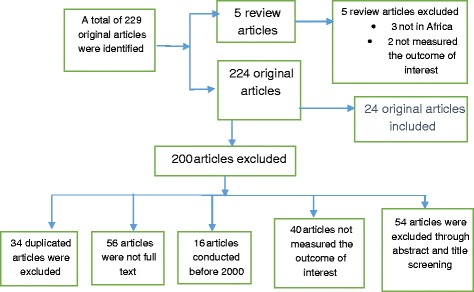
“The search identified a total of 229 articles, which composed of 244 original research articles and 5 review articles.”
§ Determinants of adolescent pregnancy in sub-Saharan Africa: a systematic review > Methods > Identification of reviews
Reported 229 · recomputed 249
Citations
Cites
Ganchimeg, T., Ota, E., Morisaki, N., Laopaiboon, M., Lumbiganon, P., Zhang, J., Yamdamsuren, B., Temmerman, M., Say, L., Tunçalp, Ö., et al. (2014) · BJOG: An International Journal of Obstetrics & Gynaecology · doi:10.1111/1471-0528.12630 · Cited by 1,014
Adolescent Pregnancy, Birth, and Abortion Rates Across Countries: Levels and Recent Trends
Sedgh, G., Finer, L. B., Bankole, A., Eilers, M. A., & Singh, S. (2015) · Journal of Adolescent Health · doi:10.1016/j.jadohealth.2014.09.007 · Cited by 812
Chandra-Mouli, V., Camacho, A. V., & Michaud, P.-A. (2013) · Journal of Adolescent Health · doi:10.1016/j.jadohealth.2013.03.002 · Cited by 593 · cited 2×
“WHO’s guidelines on prevention of unintended pregnancy stressed on policies to reduce early marriage [6].”
BackgroundAge-disparate and intergenerational sex in southern Africa: the dynamics of hypervulnerability
Leclerc-Madlala, S. (2008) · AIDS · doi:10.1097/01.aids.0000341774.86500.53 · Cited by 385 · cited 1×
“Rape, coerced sex, sexual advances from adult men and unequal gender power in relationships identified in this review, undermines adolescents’ decision-making ability to either reject sex or negotiate the use of contraceptives [55].”
BackgroundEconomic Impacts of Child Marriage: A Review of the Literature
Parsons, J., Edmeades, J., Kes, A., Petroni, S., Sexton, M., & Wodon, Q. (2015) · The Review of Faith & International Affairs · doi:10.1080/15570274.2015.1075757 · Cited by 375
Relationship dynamics and teenage pregnancy in South Africa
Jewkes, R., Vundule, C., Maforah, F., & Jordaan, E. (2001) · Social Science & Medicine · doi:10.1016/s0277-9536(00)00177-5 · Cited by 354 · cited 7×
“Sociocultural, environmental and economic factors Peer influence was reported by 11 studies [15, 23, 26, 31, 34–36, 39, 41, 45, 46], Unwanted sexual advances from adult males which often led to coercive sexual relations [19, 28, 31, 35].”
BackgroundInfluentialBlood Blockages and Scolding Nurses: Barriers to Adolescent Contraceptive Use in South Africa
Wood, K., & Jewkes, R. (2006) · Reproductive Health Matters · doi:10.1016/s0968-8080(06)27231-8 · Cited by 330 · cited 6×
“Also, inadequate comprehensive sexuality education and misconceptions about contraceptives [15, 19, 23, 27, 29, 30, 34, 35, 38, 40, 45, 46] were identified.”
BackgroundInfluentialAge of sexual debut among US adolescents
Cavazos-Rehg, P. A., Krauss, M. J., Spitznagel, E. L., Schootman, M., Bucholz, K. K., Peipert, J. F., Sanders-Thompson, V., Cottler, L. B., & Bierut, L. J. (2009) · Contraception · doi:10.1016/j.contraception.2009.02.014 · Cited by 315
Addressing the Mental Health Needs of Pregnant and Parenting Adolescents
Hodgkinson, S., Beers, L., Southammakosane, C., & Lewin, A. (2014) · Pediatrics · doi:10.1542/peds.2013-0927 · Cited by 314
Silberschmidt, M., & Rasch, V. (2001) · Social Science & Medicine · doi:10.1016/s0277-9536(00)00299-9 · Cited by 307
The Determinants of First Sex by Age 14 in a High-Risk Adolescent Population
Mott, F. L., Fondell, M. M., Hu, P. N., Kowaleski-Jones, L., & Menaghan, E. G. (1996) · Family Planning Perspectives · doi:10.2307/2135957 · Cited by 169
Homma, Y., Wang, N., Saewyc, E., & Kishor, N. (2012) · Journal of Adolescent Health · doi:10.1016/j.jadohealth.2011.12.032 · Cited by 160
Adolescent pregnancy and associated factors in South African youth
Mchunu, G., Peltzer, K., Tutshana, B., & Seutlwadi, L. (2013) · African Health Sciences · doi:10.4314/ahs.v12i4.5 · Cited by 159
Lohman, B. J., & Billings, A. (2008) · Journal of Youth and Adolescence · doi:10.1007/s10964-008-9283-x · Cited by 158
Warenius, L. U., Faxelid, E. A., Chishimba, P. N., Musandu, J. O., Ong'any, A. A., & Nissen, E. B.-M. (2006) · Reproductive Health Matters · doi:10.1016/s0968-8080(06)27242-2 · Cited by 148
Tilahun, M., Mengistie, B., Egata, G., & Reda, A. A. (2012) · Reproductive Health · doi:10.1186/1742-4755-9-19 · Cited by 136 · cited 4×
“Inadequate and unskilled health workers [19, 27, 43].”
BackgroundInfluentialAtuyambe, L. M., Kibira, S. P. S., Bukenya, J., Muhumuza, C., Apolot, R. R., & Mulogo, E. (2015) · Reproductive Health · doi:10.1186/s12978-015-0026-7 · Cited by 133
Experiences of pregnant adolescents--voices from Wakiso district, Uganda.
Atuyambe, L. M., Mirembe, F. M., Johansson, A., Kirumira, E. K., & Faxelid, E. (2005) · African Health Sciences · doi:10.5555/afhs.2005.5.4.304 · Cited by 131
Determinants of teenage pregnancies: The case of Busia District in Kenya
Were, M. (2007) · Economics & Human Biology · doi:10.1016/j.ehb.2007.03.005 · Cited by 119 · cited 8×
“These expose adolescents to early sex since they socialize easily with men [45].”
BackgroundInfluentialPredictors of Sexual Debut Among Young Adolescents in Nairobi’s Informal Settlements
Marston, M., Beguy, D., Kabiru, C., & Cleland, J. (2013) · International Perspectives on Sexual and Reproductive Health · doi:10.1363/3902213 · Cited by 108 · cited 3×
“Lack of comprehensive sexuality education, both in schools and at home with family members [15, 19, 23, 26, 29, 31, 32, 34, 36, 37, 41, 45, 46].”
BackgroundAtuyambe, L., Mirembe, F., Annika, J., Kirumira, E. K., & Faxelid, E. (2009) · Journal of Adolescence · doi:10.1016/j.adolescence.2008.10.012 · Cited by 95
Female Education in Sub‐Saharan Africa: the key to development?
(1991) · doi:10.1080/0305006910270303 · Cited by 94
Krugu, J. K., Mevissen, F. E. F., Prinsen, A., & Ruiter, R. A. C. (2016) · Reproductive Health · doi:10.1186/s12978-016-0161-9 · Cited by 82
Gendered norms, sexual exploitation and adolescent pregnancy in rural Tanzania
McCleary-Sills, J., Douglas, Z., Rwehumbiza, A., Hamisi, A., & Mabala, R. (2013) · Reproductive Health Matters · doi:10.1016/s0968-8080(13)41682-8 · Cited by 76 · cited 3×
“Individual factors Excessive use of alcohol and substance abuse [19, 31], educational status [26, 32, 37, 42], low self-esteem and inability to resist sexual temptation [23, 28, 30, 31, 35, 38, 39], and curiosity [31, 32, 35].”
BackgroundAhlberg, B. M., Jylkäs, E., & Krantz, I. (2001) · Reproductive Health Matters · doi:10.1016/s0968-8080(01)90005-9 · Cited by 71
Ahorlu, C. K., Pfeiffer, C., & Obrist, B. (2015) · Reproductive Health · doi:10.1186/s12978-015-0113-9 · Cited by 70 · cited 1×
“Factors associated with unintended pregnancies amongst adolescents are early marriages, culture, religion, gender [12], poor social and economic support [13, 14].”
BackgroundHokororo, A., Kihunrwa, A. F., Kalluvya, S., Changalucha, J., Fitzgerald, D. W., & Downs, J. A. (2015) · Acta Paediatrica · doi:10.1111/apa.12886 · Cited by 69
Okigbo, C. C., & Speizer, I. S. (2015) · PLOS ONE · doi:10.1371/journal.pone.0129286 · Cited by 64 · cited 5×
“Also, inadequate comprehensive sexuality education and misconceptions about contraceptives [15, 19, 23, 27, 29, 30, 34, 35, 38, 40, 45, 46] were identified.”
BackgroundInfluentialFearon, E., Wiggins, R. D., Pettifor, A. E., & Hargreaves, J. R. (2015) · Social Science & Medicine · doi:10.1016/j.socscimed.2015.09.039 · Cited by 60 · cited 1×
“reported peers to be influential in romantic and sexual behaviors of adolescents [48].”
BackgroundPhillips, S. J., & Mbizvo, M. T. (2016) · International Journal of Gynecology & Obstetrics · doi:10.1016/j.ijgo.2015.10.005 · Cited by 53
Wood, L., & Hendricks, F. (2017) · Educational Action Research · doi:10.1080/09650792.2016.1169198 · Cited by 41 · cited 7×
“Studies from Ghana [23], South Africa [31] and Tanzania [29] demonstrate how poverty leads adolescents to engage in sexual relations with elderly men in order to meet their basic needs.”
BackgroundInfluentialEbeigbe, P. N., & Gharoro, E. P. (2007) · Tropical Doctor · doi:10.1177/004947550703700206 · Cited by 39
Vulnerability and sexual and reproductive health among Zambian secondary school students
Warenius, L., Pettersson, K. O., Nissen, E., Höjer, B., Chishimba, P., & Faxelid, E. (2007) · Culture, Health & Sexuality · doi:10.1080/13691050601106679 · Cited by 37 · cited 1×
“Factors associated with unintended pregnancies amongst adolescents are early marriages, culture, religion, gender [12], poor social and economic support [13, 14].”
BackgroundThe Role of Parents and Families in Teen Pregnancy Prevention: An Analysis of Programs and Policies
Silk, J., & Romero, D. (2014) · Journal of Family Issues · doi:10.1177/0192513x13481330 · Cited by 37
(2011) · African Journal of Reproductive Health · Cited by 36
(2014) · African Journal of Reproductive Health · Cited by 36
Management of teenage pregnancy
Horgan, R., & Kenny, L. C. (2007) · The Obstetrician & Gynaecologist · doi:10.1576/toag.9.3.153.27334 · Cited by 31
Mushwana, L., Monareng, L., Richter, S., & Muller, H. (2015) · International Journal of Africa Nursing Sciences · doi:10.1016/j.ijans.2015.01.001 · Cited by 24
Unmet social needs and teenage pregnancy in Ogbomosho, South-western Nigeria
Salami, K., Ayegboyin, M., & Adedeji, I. (2015) · African Health Sciences · doi:10.4314/ahs.v14i4.27 · Cited by 23 · cited 4×
“Particularly mentioned in a study from Nigeria [41], peers encourage their friends to get boyfriends.”
BackgroundInfluentialFamily and community support to adolescent mothers in Swaziland
Mngadi, P. T., Zwane, I. T., Ahlberg, B. M., & Ransjö‐Arvidson, A. (2003) · Journal of Advanced Nursing · doi:10.1046/j.1365-2648.2003.02688.x · Cited by 22
Teenage pregnancy experiences in rural Kenya
Taffa, & Matthews (2003) · International Journal of Adolescent Medicine and Health · doi:10.1515/ijamh.2003.15.4.331 · Cited by 16
Adolescent contraception: survey of attitudes and practice of health professionals.
Adekunle, A. O., Arowojolu, A. O., Adedimeji, A., et al. (2001) · PubMed · Cited by 14
Aransiola, J. O., Asa, S., Obinjuwa, P., et al. (2013) · African Journal of Reproductive Health · Cited by 12
Contraception in teenage Nigerian school girls
Adinma, J. I. B., Agbai, A. O., Okeke, A., et al. (1999) · Advances in Contraception · doi:10.1023/a:1006732222373 · Cited by 12
(2015)
Research works printed but not linked: 5
- Officials NAoCCH Meeting the needs of pregnant and parenting teens 2009 Washington Local Health Department Programs and Services
- A Yidana, SD Ziblim, TB Azongo, Abass YI. Socio-cultural determinants of contraceptives use among adolescents in northern Ghana. Public Health Res. 2015;5(4):83–89.
- The Joanna Briggs Institute Joanna Briggs institute reviewers’ manual 2011
- Adzitey SP Adzitey F Suuk L Teenage pregnancy in the Builsa District: a focus study in Fumbisi 2011
- Ogori AF, Ajeya SHiTU fatima, Yunusa AR. The cause and effect of teenage pregnancy: case of Kontagora local government area in Niger state, northern part of Nigeria. J Educ Res 2013;Vol. 1,(No. 7): 01-15.
Cited by
Prevalence and determinants of adolescent pregnancy in Africa: a systematic review and Meta-analysis
Kassa, G. M., Arowojolu, A. O., Odukogbe, A. A., & Yalew, A. W. (2018) · Reproductive Health · doi:10.1186/s12978-018-0640-2 · Cited by 569
Zickafoose, A., Ilesanmi, O., Diaz-Manrique, M., Adeyemi, A. E., Walumbe, B., Strong, R., Wingenbach, G., Rodriguez, M. T., & Dooley, K. (2024) · Sustainability · doi:10.3390/su16072657 · Cited by 218
“Globally, over 200 million girls and women have been subjected to FGM, and 70 million girls aged 0–14 years face the risk of undergoing the same trauma each year [49].”
Wado, Y. D., Sully, E. A., & Mumah, J. N. (2019) · BMC Pregnancy and Childbirth · doi:10.1186/s12884-019-2204-z · Cited by 208
Factors influencing contraception choice and use globally: a synthesis of systematic reviews
D’Souza, P., Bailey, J. V., Stephenson, J., & Oliver, S. (2022) · The European Journal of Contraception & Reproductive Health Care · doi:10.1080/13625187.2022.2096215 · Cited by 181
“In Sub-Saharan Africa, young women found health services unfriendly, with health workers holding negative attitudes towards adolescents.”
BackgroundInfluentialAhinkorah, B. O., Kang, M., Perry, L., Brooks, F., & Hayen, A. (2021) · PLOS ONE · doi:10.1371/journal.pone.0246308 · Cited by 166
Metadata
- Authors
- Yakubu, I., & Salisu, W. J.
- Affiliations
- Tehran University of Medical Sciences (IR)
- Corresponding author
- Yakubu, Ibrahim
- Venue
- Reproductive Health
- Published
- 2018-01-27
- Volume
- 15
- Issue
- 1
- Pages
- 15-15
- ISSN
- 1742-4755 (ISSN-L)
- PMC
- PMC5787272
- OpenAlex
- W2789619380
- Semantic Scholar
- e415e9ec126911812a6c985f5d75a8df649cb27a
- Cited by
- 634
- References
- 49
- Citations by year
- 2026: 81 · 2025: 96 · 2024: 105 · 2023: 92 · 2022: 101 · 2021: 82 · 2020: 42 · 2019: 26 · 2018: 9
- FWCI
- 6.01
- Type
- journal article
- Language
- en
- Open access
- gold
- doi.org
- Licence
- cc-by
- Locations
- Reproductive Health (publishedVersion, cc-by)
- PubMed Central (publishedVersion, cc-by)
- PubMed (publishedVersion)
- DOAJ (DOAJ: Directory of Open Access Journals) (submittedVersion)
- Funders
- Tehran University of Medical Sciences and Health Services
- Topics
- Health Sciences › Medicine › Public Health, Environmental and Occupational Health › Adolescent Sexual and Reproductive Health
- Health Sciences › Medicine › Public Health, Environmental and Occupational Health › Reproductive Health and Contraception
- Health Sciences › Medicine › Public Health, Environmental and Occupational Health › Adolescent Health and Behaviors
- Keywords
- adolescent pregnancy, sub-Saharan Africa, sociocultural factors, economic factors, individual risk factors, health service barriers, comprehensive sexuality education, contraceptive use, early marriage, gender and power, peer influence, alcohol and drug use, adolescent reproductive health services, student enrollment
- MeSH terms
- Adolescent, Adult, Cross-Sectional Studies, Female, Humans, Health Knowledge, Attitudes, Practice, Male, Pregnancy, Pregnancy in Adolescence, Risk Factors, Sexual Behavior, Socioeconomic Factors, Adolescent Health Services, Africa South of the Sahara
About these checks
Registry, retraction, Cites and statistics results are computed, not judged, with one exception: a printed reference that no index lists is read once by a model before it counts as a citation error. Claims are extracted by a model and kept only when their quote appears verbatim in the text; each cited source is then checked, with a model’s help, for whether it says what the claim relies on. Those verdicts can be wrong — read the claim’s quote and the cited source before relying on one.
The claim verdicts this report counts are experimental: their accuracy is not yet measured.
A language model drew the claims from the paper on 2026-10-10, under version 3 of the claim definition (model deepseek-v4.1-flash, prompt extract-v3).
A second model labelled each claim on 2026-10-10 (model jev-1.13-20260917, definition revision gold-guideline-v0.2).
Cited sources are checked with a language model’s help (gpt-6-sol and qwen3.8-omni-flash).
Statistics and arithmetic are recomputed, not judged.
Confidence bands are shown only for fields calibrated on our annotated test set. None is calibrated yet, so no band is shown.
What counts as a claim ›How we measure confidence ›How we check this ›
Are you an author, or do you see a problem with this page? Request a review
Data sources
Bibliographic data: Semantic Scholar, OpenAlex, Crossref.
Contains information from the Semantic Scholar Academic Graph Datasets, made available under the ODC Attribution License (ODC-BY 1.0).
Semantic Scholar’s data is described in: Kinney, R., et al. (2023). The Semantic Scholar Open Data Platform. arXiv:2301.10140.
