

Socio-cultural and economic factors influencing adolescents’ resilience against the threat of teenage pregnancy: a cross-sectional survey in Accra, Ghana
Open accessThe DOI matches its Crossref record; 34 of the 35 references it cites were found in a registry or an index.
Abstract
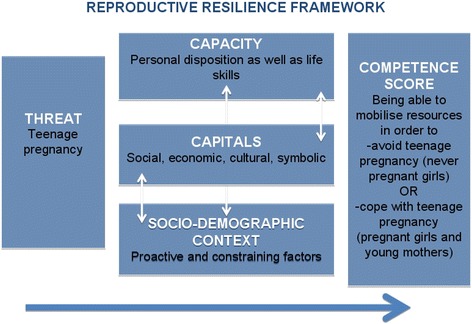
BACKGROUND: Adolescent pregnancy exposes female adolescents to medical, social and economic risks. In Ghana, adolescent mothers are more likely to experience complications during pregnancy and delivery as compared to older mothers. This study examined the competencies of adolescent girls to either proactively prevent teenage pregnancy or reactively cope effectively with it. METHODS: A cross-sectional survey approach was used to interview 820 adolescent girls aged 15-19 years in Accra, Ghana. The main focus of the study was to examine how social capital (various kinds of valued relations with significant others), economic capital (command over economic resources, mainly cash and assets), cultural capital (personal dispositions and habits; knowledge and tradition stored in material forms and institutionalized) and symbolic capital (honour, recognition and prestige) contribute to the development of competencies of adolescents to deal with the threat of teenage pregnancy and childbirth. RESULTS: Out of 820 adolescents interviewed, 128 (16%) were pregnant or mothers. Adolescents in both groups (62% never pregnant girls and 68% pregnant/young mothers) have access to social support, especially from their parents. Parents are taking the place of aunts and grandmothers in providing sexual education to their adolescent girls due to changing social structures where extended families no longer reside together in most cases. More (79%) pregnant girls and young mothers compared to never pregnant girls (38%) have access to economic support (P = <0.001). Access to social, economic and cultural capitals was associated with high competence to either prevent or deal with pregnancy among adolescent girls. CONCLUSION: Findings showed that adolescent girls, especially those that get pregnant should not be viewed as weak and vulnerable because many of them have developed competencies to cope with pregnancy and childbirth effectively. Thus, focusing on developing the competencies of girls to access social, economic and cultural capitals may be an effective way of tackling the threat of teenage pregnancy than focusing only on their vulnerability and associated risks.
Overview
The claims and statistics of this paper haven’t been checked yet.
Free: it reads the open-access text and checks the first 5 claims that cite a source we can check. Create a free account to check every claim.
Integrity signals
Registry
Cites
Statistics
Figures
Verification
Claims the paper makes
The claims and statistics of this paper haven’t been checked yet.
Free: it reads the open-access text and checks the first 5 claims that cite a source we can check. Create a free account to check every claim.
Self-check
Percentages, sums and reported differences re-computed from the paper’s own numbers.
The self-check needs the paper’s full text.
Citations
Cites
Bourdieu, P. (2002) · Readings in Economic Sociology · doi:10.1002/9780470755679.ch15 · Cited by 13,906
Bonanno, G. A. (2004) · American Psychologist · doi:10.1037/0003-066x.59.1.20 · Cited by 6,851 · cited 1×
“Over 70 % of the never pregnant girls said they knew how to prevent pregnancy, however, it has been reported in several studies from Ghana that being knowledgeable about contraceptives and birth control in general does not always translate into actual protection [9, 24, 27, 37].”
BackgroundGhana Demographic and Health Survey 2008
Macro, I. (2009) · Cited by 1,593
Population and Housing Census.
Tobago (2011) · Cited by 1,384
Protective Factors and Individual Resilience
Werner, E. E. (2000) · Handbook of Early Childhood Intervention · doi:10.1017/cbo9780511529320.008 · Cited by 935
Well-Being: Positive Development Across the Life Course
(2003) · doi:10.4324/9781410607171 · Cited by 799
Bearinger, L. H., Sieving, R. E., Ferguson, J., & Sharma, V. (2007) · The Lancet · doi:10.1016/s0140-6736(07)60367-5 · Cited by 762
Resilience in Children's Adaptation to Negative Life Events and Stressed Environments
Garmezy, N. (1991) · Pediatric Annals · doi:10.3928/0090-4481-19910901-05 · Cited by 752 · cited 1×
“Research on resilience (adaptive capacity) has a long history among Western psychologists and social workers, mostly in the United States [13, 14].”
BackgroundWiegand, H. (1968) · Biometrische Zeitschrift · doi:10.1002/bimj.19680100122 · Cited by 508
Unique pathways to resilience across cultures.
Ungar, M. T., Brown, M., Liebenberg, L., Othman, R., Kwong, W. M., Armstrong, M. I., & Gilgun, J. F. (2007) · PubMed · Cited by 486
Research works printed but not linked: 6
- 4. UNAIDS. Report on the Global AIDS epidemic. Geneva: UNAIDS; 2008.
- 15. Liebenberg L, Ungar M. Researching resilience. Toronto: University of Toronto Press; 2008.
- 17. Collins B. Resilience in teenage mothers: a follow-up study. Wellington: Ministry of Social Development; 2010.
- 20. Kish, L. Survey Sampling. New York: John Wiley & Sons Inc.; 1965.
- 23. World Health Organization. The sexual and reproductive health of younger adolescents: research issues in developing countries: background paper for a consultation. Geneva: World Health Organization; 2011.
- 32. Mlangwa S, Obrist Van Eeuwijk B. Competing ideologies: adolescence, knowledge and silence in Dar es Salaam. In: Harcourt S (Ed.). Power, reproduction and gender. The inter-generational transfer of knowledge. London: Zed Books Ltd; 1997. p. 35-57.
Cited by
Determinants of adolescent pregnancy in sub-Saharan Africa: a systematic review
Yakubu, I., & Salisu, W. J. (2018) · Reproductive Health · doi:10.1186/s12978-018-0460-4 · Cited by 634
“Factors associated with unintended pregnancies amongst adolescents are early marriages, culture, religion, gender [12], poor social and economic support [13, 14].”
BackgroundGirls’ Empowerment and Adolescent Pregnancy: A Systematic Review
Nkhoma, D., Lin, C.-P., Katengeza, H. L., Soko, C. J., Estinfort, W., Wang, Y., Juan, S.-H., Jian, W., & Iqbal, U. (2020) · International Journal of Environmental Research and Public Health · doi:10.3390/ijerph17051664 · Cited by 123
Resilience of sub-Saharan children and adolescents: A scoping review
Theron, L. C. (2020) · Transcultural Psychiatry · doi:10.1177/1363461520938916 · Cited by 96
Socio-cultural factors influencing adolescent pregnancy in Ghana: a scoping review
Amoadu, M., Ansah, E. W., Assopiah, P., Acquah, P., Ansah, J. E., Berchie, E., Hagan, D., & Amoah, E. (2022) · BMC Pregnancy and Childbirth · doi:10.1186/s12884-022-05172-2 · Cited by 93
“Moreover, only one of the included studies adjusted for confounding variables (Ahorlu et al., 2015).”
BackgroundYakubu, I., Garmaroudi, G., Sadeghi, R., Tol, A., Yekaninejad, M. S., & Yidana, A. (2019) · Reproductive Health · doi:10.1186/s12978-019-0784-8 · Cited by 101
“These factors include early marriages [5], inadequate social and economic support [5, 6].”
Background
Metadata
- Authors
- Ahorlu, C. K., Pfeiffer, C., & Obrist, B.
- Affiliations
- University of Ghana (GH)
- Swiss Tropical and Public Health Institute (CH)
- Corresponding author
- Ahorlu, Collins K
- Venue
- Reproductive Health
- Published
- 2015-12
- Volume
- 12
- Issue
- 1
- Pages
- 117-117
- ISSN
- 1742-4755 (ISSN-L)
- PMC
- PMC4690282
- OpenAlex
- W2205654916
- Cited by
- 70
- References
- 35
- Citations by year
- 2026: 2 · 2025: 6 · 2024: 11 · 2023: 7 · 2022: 11 · 2021: 10 · 2020: 9 · 2019: 4 · 2018: 6 · 2017: 3 · 2016: 1
- FWCI
- 6.09
- Type
- journal article
- Language
- en
- Open access
- gold
- doi.org
- Licence
- Locations
- Reproductive Health (publishedVersion, cc-by)
- PubMed Central (publishedVersion, cc-by)
- PubMed (publishedVersion)
- edoc (University of Basel) (acceptedVersion)
- Funders
- National Science Foundation
- Schweizerischer Nationalfonds zur Förderung der Wissenschaftlichen Forschung
- Direktion für Entwicklung und Zusammenarbeit
- Topics
- Health Sciences › Medicine › Public Health, Environmental and Occupational Health › Adolescent Sexual and Reproductive Health
- Health Sciences › Medicine › Public Health, Environmental and Occupational Health › Reproductive Health and Contraception
- Health Sciences › Medicine › Public Health, Environmental and Occupational Health › Adolescent Health and Behaviors
- Keywords
- adolescent pregnancy, adolescent pregnancy prevention, adolescent girls, social capital, economic capital, cultural capital, symbolic capital, social support, parental support, sex education, adolescent mothers, Accra, Ghana
- MeSH terms
- Adaptation, Psychological, Adolescent, Adolescent Behavior, Cross-Sectional Studies, Culture, Female, Ghana, Humans, Health Knowledge, Attitudes, Practice, Pregnancy, Pregnancy in Adolescence, Sexual Behavior, Social Support, Socioeconomic Factors, Resilience, Psychological, Young Adult
About these checks
Registry, retraction, Cites and statistics results are computed, not judged, with one exception: a printed reference that no index lists is read once by a model before it counts as a citation error. Claims are extracted by a model and kept only when their quote appears verbatim in the text; each cited source is then checked, with a model’s help, for whether it says what the claim relies on. Those verdicts can be wrong — read the claim’s quote and the cited source before relying on one.
Statistics and arithmetic are recomputed, not judged.
Confidence bands are shown only for fields calibrated on our annotated test set. None is calibrated yet, so no band is shown.
What counts as a claim ›How we measure confidence ›How we check this ›
Are you an author, or do you see a problem with this page? Request a review
How to cite
Cite CoChat for the checks on this page, and the paper for its own findings.
- This page
- CoChat. (2026). Citation check: Socio-cultural and economic factors influencing adolescents’ resilience against the threat of teenage pregnancy: a cross-sectional survey in Accra, Ghana. https://app.cochat.ai/papers/10.1186/s12978-015-0113-9
- The paper
- Ahorlu, C. K., Pfeiffer, C., & Obrist, B. (2015). Socio-cultural and economic factors influencing adolescents’ resilience against the threat of teenage pregnancy: a cross-sectional survey in Accra, Ghana. Reproductive Health. https://doi.org/10.1186/s12978-015-0113-9
Data sources
Bibliographic data: Semantic Scholar, OpenAlex, Crossref.
Contains information from the Semantic Scholar Academic Graph Datasets, made available under the ODC Attribution License (ODC-BY 1.0).
Semantic Scholar’s data is described in: Kinney, R., et al. (2023). The Semantic Scholar Open Data Platform. arXiv:2301.10140.
