

Toward communities as systems: a sequential mixed methods study to understand factors enabling implementation of a skilled birth attendance intervention in Nampula Province, Mozambique
Open accessThe DOI matches its Crossref record; 51 of the 51 references it cites were found in a registry or an index.
Abstract
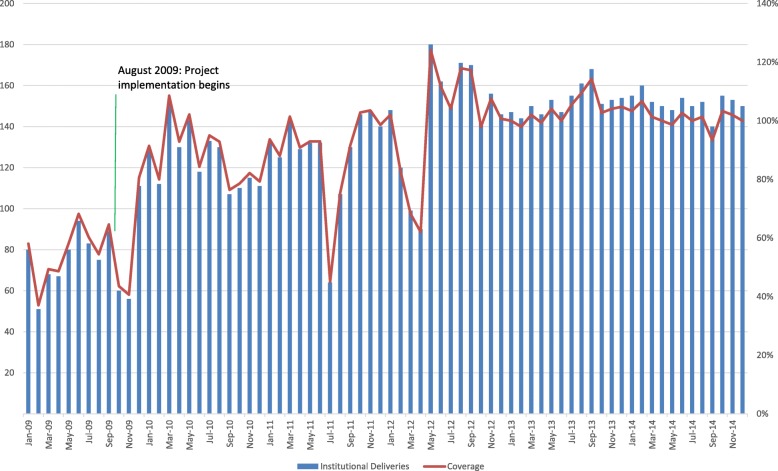
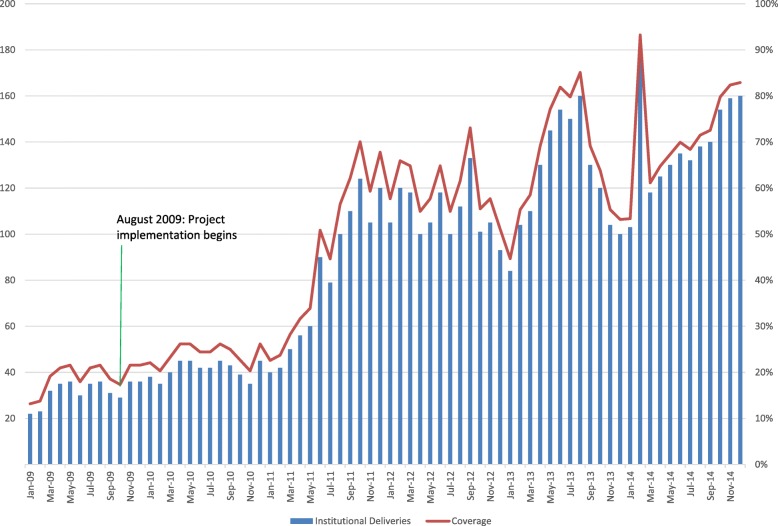
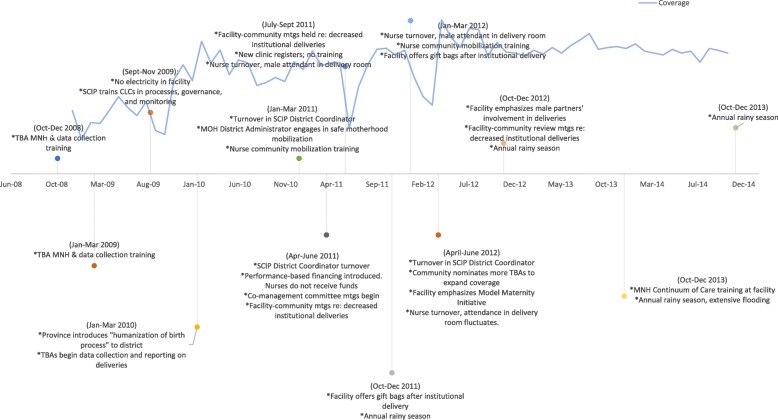
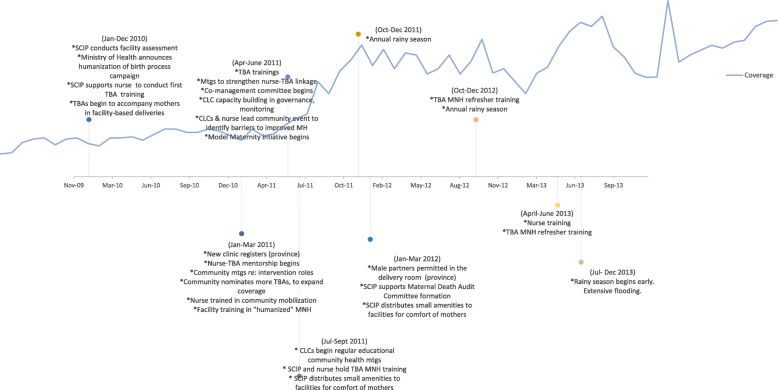
BACKGROUND: Skilled birth attendance, institutional deliveries, and provision of quality, respectful care are key practices to improve maternal and neonatal health outcomes. In Mozambique, the government has prioritized improved service delivery and demand for these practices, alongside "humanization of the birth process." An intervention implemented in Nampula province beginning in 2009 saw marked improvement in institutional delivery rates. This study uses a sequential explanatory mixed methods case study design to explore the contextual factors that may have contributed to the observed increase in institutional deliveries. METHODS: A descriptive time series analysis was conducted using clinic register data from 2009 to 2014 to assess institutional delivery coverage rates in two primary health care facilities, in two districts of Nampula province. Site selection was based on facilities exhibiting an initial increase in institutional deliveries from 2009 to 2011, similarity of health system attributes, and accessibility for study participation. Using a modified Delphi technique, two expert panels-each composed of ten stakeholders familiar with maternal health implementation at facility, district, provincial, and national levels-were convened to formulate the "story" of the implementation and to identify contextual factors to use in developing semi-structured interview guides. Thirty-four key informant interviews with facility MCH nurses, facility managers, traditional birth attendants, community leaders, and beneficiaries were then conducted and analyzed using the Consolidated Framework for Implementation Research through inductive and deductive coding. RESULTS: The two sites' skilled birth attendance coverage of estimated live births reached 80 and 100%, respectively. Eight contextual and human factors were found as dominant themes. Though both sites achieved increases, implementation context differed significantly with compelling examples of both respectful and disrespectful care. In one site, facility and community actors worked together as complementary systems to sustain improved care and institutional deliveries. In the other, community actors sustained implementation and institutional deliveries largely in absence of health system counterparts. CONCLUSION: Findings support global health recommendations for combined health system and community interventions for improved MNH outcomes including delivery of respectful care, and further suggest the capacity of communities to act as systems both in partnership to and independent of the formal health system.
Overview
The claims and statistics of this paper haven’t been checked yet.
Free: it reads the open-access text and checks the first 5 claims that cite a source we can check. Create a free account to check every claim.
Integrity signals
Registry
Cites
Statistics
Figures
Verification
Claims the paper makes
The claims and statistics of this paper haven’t been checked yet.
Free: it reads the open-access text and checks the first 5 claims that cite a source we can check. Create a free account to check every claim.
Claims other papers make about this one
Each is checked against this paper’s own text: does it say what the citing paper says it does?
The source backs part of the claim, not all of it — or backs it for a different population, condition or comparison.
In the citing paper
“Construct names and definitions were updated in response to recommendations to make the framework more applicable across a range of innovations and settings [30–35].”
From The updated consolidated framework for implementation research based on user feedback (2022) · cites this paper as [35]
Experimental — accuracy not yet measured
Self-check
Percentages, sums and reported differences re-computed from the paper’s own numbers.
The self-check needs the paper’s full text.
Citations
Cites
Damschroder, L. J., Aron, D. C., Keith, R. E., Kirsh, S. R., Alexander, J. A., & Lowery, J. C. (2009) · Implementation Science · doi:10.1186/1748-5908-4-50 · Cited by 14,496 · cited 10×
“Knowledge & Beliefs about the Intervention Individuals’ attitudes toward and value placed in the intervention, as well as familiarity with its underlying facts and principles [24].”
BackgroundInfluentialSample Size in Qualitative Interview Studies: Guided by Information Power
Malterud, K., Siersma, V. D., & Guassora, A. D. (2016) · Qualitative Health Research · doi:10.1177/1049732315617444 · Cited by 12,703
Palinkas, L. A., Horwitz, S. M., Green, C. A., Wisdom, J. P., Duan, N., & Hoagwood, K. (2015) · Administration and Policy in Mental Health and Mental Health Services Research · doi:10.1007/s10488-013-0528-y · Cited by 12,038
Fereday, J., & Muir-Cochrane, E. (2006) · International Journal of Qualitative Methods · doi:10.1177/160940690600500107 · Cited by 11,829 · cited 21×
“Though the CFIR has been recognized for attempting to address the integrated nature of implementation and context [60], we found the framework to lack guidance on this, thereby somewhat lessening our findings’ ability to immediately inform implementers’ real-time decision-making because of the additional interpretatio…”
MethodInfluentialAwais, A. (2015) · Data Archiving and Networked Services (DANS) · doi:10.17632/zcvgc6m58h.1 · Cited by 6,707
The Delphi Technique: Making Sense of Consensus
Hsu, C.-C., & Sandford, B. A. (2007) · University of Massachusetts Amherst · doi:10.7275/pdz9-th90 · Cited by 4,500 · cited 1×
“From these inputs, preliminary timeline-based cases of implementation in the two sites were constructed, following a modified version of the Delphi technique [27].”
MethodGlasgow, R. E., Lichtenstein, E., & Marcus, A. C. (2003) · American Journal of Public Health · doi:10.2105/ajph.93.8.1261 · Cited by 1,836
Developmental Evaluation: Applying Complexity Concepts to Enhance Innovation and Use
Patton, M. Q. (2010) · Cited by 1,740
A systematic review of the use of the Consolidated Framework for Implementation Research
Kirk, M. A., Kelley, C., Yankey, N., Birken, S. A., Abadie, B., & Damschroder, L. (2015) · Implementation Science · doi:10.1186/s13012-016-0437-z · Cited by 1,496 · cited 2×
“The lead author and an additional analyst who did not participate directly in data collection were responsible for applying CFIR domains for deductive coding, for inductively identifying emerging themes, and for developing a codebook and corresponding code-tree with descriptions of all codes and sub-codes [30, 31].”
BackgroundMethodPluye, P., & Hong, Q. N. (2014) · Annual Review of Public Health · doi:10.1146/annurev-publhealth-032013-182440 · Cited by 1,363 · cited 2×
“To ensure thorough reporting of our approach, we describe it here in line with the Mixed Methods Appraisal Tool (MMAT), created in 2014 to support appropriate planning, execution, and appraisal of mixed methods research [20, 21].”
Method
Research works printed but not linked: 1
- Yin RK. Case Study Research: Design and Methods. 4th ed. Los Angeles, Calif.: Sage Publications; 2009. xiv, 219 p. (Applied social research methods series).
Cited by
The updated consolidated framework for implementation research based on user feedback
Damschroder, L. J., Reardon, C. M., Widerquist, M. A. O., & Lowery, J. (2022) · Implementation Science · doi:10.1186/s13012-022-01245-0 · Cited by 4,452
Means, A. R., Kemp, C. G., Gwayi-Chore, M.-C., Gimbel, S., Soi, C., Sherr, K., Wagenaar, B. H., Wasserheit, J. N., & Weiner, B. J. (2020) · Implementation Science · doi:10.1186/s13012-020-0977-0 · Cited by 418
Using implementation science theories and frameworks in global health
Ridde, V., Pérez, D., & Robert, E. (2020) · BMJ Global Health · doi:10.1136/bmjgh-2019-002269 · Cited by 169
Self-citationZuniga, J. A., García, A. A., Kyololo, O. M., Hamilton-Solum, P. L., Kabimba, A., Milimo, B., Abbyad, C. W., Reid, D., & Chelagat, D. (2021) · International Journal of Nursing Studies · doi:10.1016/j.ijnurstu.2021.103977 · Cited by 31
Sartas, M., van Asten, P., Schut, M., McCampbell, M., Awori, M., Muchunguzi, P., Tenywa, M. M., Namazzi, S., Amat, A. S., Thiele, G., et al. (2019) · PLoS ONE · doi:10.1371/journal.pone.0223044 · Cited by 28
“Existing studies on participation that uses a time series approach do not explicitly refer to MSPs and either have very limited in scope [29,30] or uses participation as an explanatory or independent factor rather than a dependent variable [31–36].”
Metadata
- Authors
- Cole, C. B., Pacca, J., Mehl, A., Tomasulo, A., van der Veken, L., Viola, A., & Ridde, V.
- Affiliations
- Population Services International (US)
- Pathfinder International (US)
- Inserm (FR)
- Corresponding author
- Cole, Claire B.
- Venue
- Reproductive Health
- Published
- 2018-08-03
- Volume
- 15
- Issue
- 1
- Pages
- 132-132
- ISSN
- 1742-4755 (ISSN-L)
- PMC
- PMC6091088
- OpenAlex
- W2887469899
- Cited by
- 21
- References
- 51
- Citations by year
- 2025: 2 · 2024: 1 · 2023: 4 · 2022: 6 · 2021: 3 · 2020: 4 · 2019: 1
- FWCI
- 2.21
- Type
- journal article
- Language
- en
- Open access
- gold
- doi.org
- Licence
- cc-by
- creativecommons.org/licenses/by/4.0/ (tdm)
- creativecommons.org/licenses/by/4.0/ (vor)
- Locations
- Reproductive Health (publishedVersion, cc-by)
- Europe PMC (PubMed Central) (publishedVersion, other-oa)
- PubMed Central (publishedVersion, cc-by)
- PubMed (publishedVersion)
- HAL (submittedVersion, other-oa)
- DOAJ (DOAJ: Directory of Open Access Journals) (submittedVersion, cc-by-sa)
- Funders
- United States Agency for International Development (656-A-00-09-00134-00)
- Topics
- Health Sciences › Medicine › Pediatrics, Perinatology and Child Health › Global Maternal and Child Health
- Health Sciences › Health Professions › General Health Professions › Health Policy Implementation Science
- Health Sciences › Medicine › Obstetrics and Gynecology › Maternal and Perinatal Health Interventions
- Keywords
- skilled birth attendance, institutional delivery, maternal and newborn health, respectful maternity care, humanized childbirth, implementation context, Consolidated Framework for Implementation Research, traditional birth attendants
- MeSH terms
- Female, Health Facilities, Humans, Maternal Health Services, Midwifery, Mozambique, Pregnancy, Global Health, Parturition, Delivery, Obstetric
About these checks
Registry, retraction, Cites and statistics results are computed, not judged, with one exception: a printed reference that no index lists is read once by a model before it counts as a citation error. Claims are extracted by a model and kept only when their quote appears verbatim in the text; each cited source is then checked, with a model’s help, for whether it says what the claim relies on. Those verdicts can be wrong — read the claim’s quote and the cited source before relying on one.
Statistics and arithmetic are recomputed, not judged.
Confidence bands are shown only for fields calibrated on our annotated test set. None is calibrated yet, so no band is shown.
What counts as a claim ›How we measure confidence ›How we check this ›
Are you an author, or do you see a problem with this page? Request a review
How to cite
Cite CoChat for the checks on this page, and the paper for its own findings.
- This page
- CoChat. (2026). Citation check: Toward communities as systems: a sequential mixed methods study to understand factors enabling implementation of a skilled birth attendance intervention in Nampula Province, Mozambique. https://app.cochat.ai/papers/10.1186/s12978-018-0574-8
- The paper
- Cole, C. B., Pacca, J., Mehl, A., Tomasulo, A., van der Veken, L., Viola, A., & Ridde, V. (2018). Toward communities as systems: a sequential mixed methods study to understand factors enabling implementation of a skilled birth attendance intervention in Nampula Province, Mozambique. Reproductive Health. https://doi.org/10.1186/s12978-018-0574-8
Data sources
Bibliographic data: Semantic Scholar, OpenAlex, Crossref.
Contains information from the Semantic Scholar Academic Graph Datasets, made available under the ODC Attribution License (ODC-BY 1.0).
Semantic Scholar’s data is described in: Kinney, R., et al. (2023). The Semantic Scholar Open Data Platform. arXiv:2301.10140.
