

Toward communities as systems: a sequential mixed methods study to understand factors enabling implementation of a skilled birth attendance intervention in Nampula Province, Mozambique
Open accessThe DOI matches its Crossref record; 51 of the 51 references it cites were found in a registry or an index.
Abstract
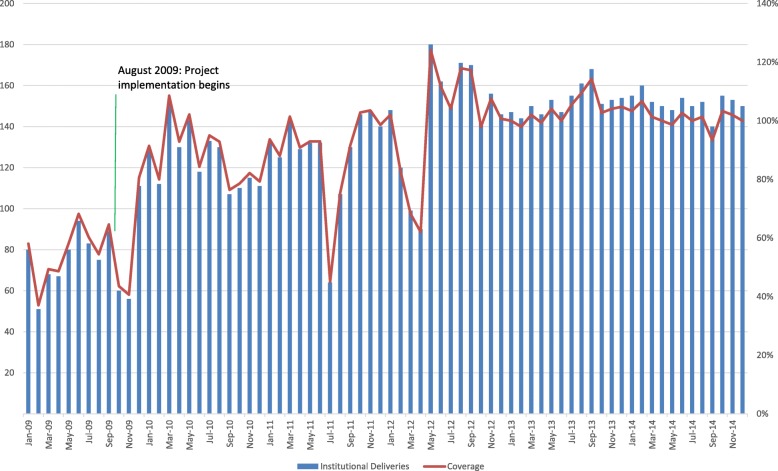
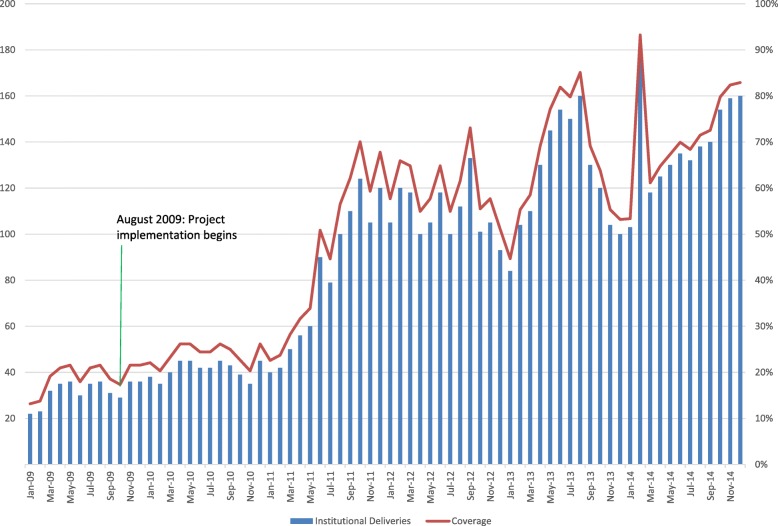
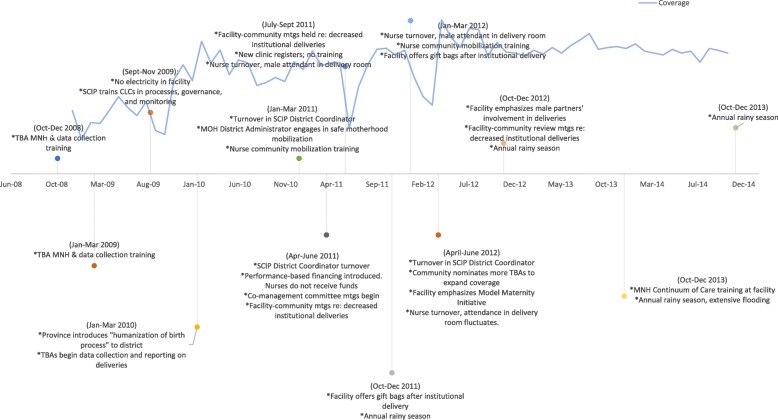
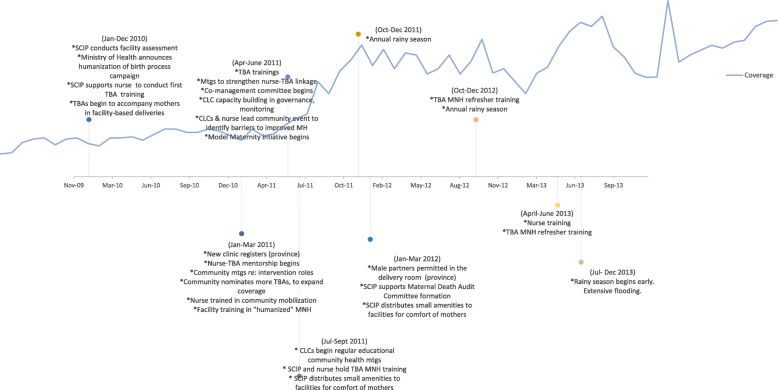
BACKGROUND: Skilled birth attendance, institutional deliveries, and provision of quality, respectful care are key practices to improve maternal and neonatal health outcomes. In Mozambique, the government has prioritized improved service delivery and demand for these practices, alongside "humanization of the birth process." An intervention implemented in Nampula province beginning in 2009 saw marked improvement in institutional delivery rates. This study uses a sequential explanatory mixed methods case study design to explore the contextual factors that may have contributed to the observed increase in institutional deliveries. METHODS: A descriptive time series analysis was conducted using clinic register data from 2009 to 2014 to assess institutional delivery coverage rates in two primary health care facilities, in two districts of Nampula province. Site selection was based on facilities exhibiting an initial increase in institutional deliveries from 2009 to 2011, similarity of health system attributes, and accessibility for study participation. Using a modified Delphi technique, two expert panels-each composed of ten stakeholders familiar with maternal health implementation at facility, district, provincial, and national levels-were convened to formulate the "story" of the implementation and to identify contextual factors to use in developing semi-structured interview guides. Thirty-four key informant interviews with facility MCH nurses, facility managers, traditional birth attendants, community leaders, and beneficiaries were then conducted and analyzed using the Consolidated Framework for Implementation Research through inductive and deductive coding. RESULTS: The two sites' skilled birth attendance coverage of estimated live births reached 80 and 100%, respectively. Eight contextual and human factors were found as dominant themes. Though both sites achieved increases, implementation context differed significantly with compelling examples of both respectful and disrespectful care. In one site, facility and community actors worked together as complementary systems to sustain improved care and institutional deliveries. In the other, community actors sustained implementation and institutional deliveries largely in absence of health system counterparts. CONCLUSION: Findings support global health recommendations for combined health system and community interventions for improved MNH outcomes including delivery of respectful care, and further suggest the capacity of communities to act as systems both in partnership to and independent of the formal health system.
Overview
The claims and statistics of this paper haven’t been checked yet.
Free: it reads the open-access text and checks the first 5 claims that cite a source we can check. Create a free account to check every claim.
Integrity signals
Registry
Cites
Statistics
Figures
Verification
Claims the paper makes
The claims and statistics of this paper haven’t been checked yet.
Free: it reads the open-access text and checks the first 5 claims that cite a source we can check. Create a free account to check every claim.
Claims other papers make about this one
Each is checked against this paper’s own text: does it say what the citing paper says it does?
The source backs part of the claim, not all of it — or backs it for a different population, condition or comparison.
In the citing paper
“Construct names and definitions were updated in response to recommendations to make the framework more applicable across a range of innovations and settings [30–35].”
From The updated consolidated framework for implementation research based on user feedback (2022) · cites this paper as [35]
Experimental — accuracy not yet measured
Self-check
Percentages, sums and reported differences re-computed from the paper’s own numbers.
The self-check needs the paper’s full text.
Citations
Cites
Damschroder, L. J., Aron, D. C., Keith, R. E., Kirsh, S. R., Alexander, J. A., & Lowery, J. C. (2009) · Implementation Science · doi:10.1186/1748-5908-4-50 · Cited by 14,496 · cited 10×
“Knowledge & Beliefs about the Intervention Individuals’ attitudes toward and value placed in the intervention, as well as familiarity with its underlying facts and principles [24].”
BackgroundInfluentialSample Size in Qualitative Interview Studies: Guided by Information Power
Malterud, K., Siersma, V. D., & Guassora, A. D. (2016) · Qualitative Health Research · doi:10.1177/1049732315617444 · Cited by 12,703
Palinkas, L. A., Horwitz, S. M., Green, C. A., Wisdom, J. P., Duan, N., & Hoagwood, K. (2015) · Administration and Policy in Mental Health and Mental Health Services Research · doi:10.1007/s10488-013-0528-y · Cited by 12,038
Fereday, J., & Muir-Cochrane, E. (2006) · International Journal of Qualitative Methods · doi:10.1177/160940690600500107 · Cited by 11,829 · cited 21×
“Though the CFIR has been recognized for attempting to address the integrated nature of implementation and context [60], we found the framework to lack guidance on this, thereby somewhat lessening our findings’ ability to immediately inform implementers’ real-time decision-making because of the additional interpretatio…”
MethodInfluentialAwais, A. (2015) · Data Archiving and Networked Services (DANS) · doi:10.17632/zcvgc6m58h.1 · Cited by 6,707
The Delphi Technique: Making Sense of Consensus
Hsu, C.-C., & Sandford, B. A. (2007) · University of Massachusetts Amherst · doi:10.7275/pdz9-th90 · Cited by 4,500 · cited 1×
“From these inputs, preliminary timeline-based cases of implementation in the two sites were constructed, following a modified version of the Delphi technique [27].”
MethodGlasgow, R. E., Lichtenstein, E., & Marcus, A. C. (2003) · American Journal of Public Health · doi:10.2105/ajph.93.8.1261 · Cited by 1,836
Developmental Evaluation: Applying Complexity Concepts to Enhance Innovation and Use
Patton, M. Q. (2010) · Cited by 1,740
A systematic review of the use of the Consolidated Framework for Implementation Research
Kirk, M. A., Kelley, C., Yankey, N., Birken, S. A., Abadie, B., & Damschroder, L. (2015) · Implementation Science · doi:10.1186/s13012-016-0437-z · Cited by 1,496 · cited 2×
“The lead author and an additional analyst who did not participate directly in data collection were responsible for applying CFIR domains for deductive coding, for inductively identifying emerging themes, and for developing a codebook and corresponding code-tree with descriptions of all codes and sub-codes [30, 31].”
BackgroundMethodPluye, P., & Hong, Q. N. (2014) · Annual Review of Public Health · doi:10.1146/annurev-publhealth-032013-182440 · Cited by 1,363 · cited 2×
“To ensure thorough reporting of our approach, we describe it here in line with the Mixed Methods Appraisal Tool (MMAT), created in 2014 to support appropriate planning, execution, and appraisal of mixed methods research [20, 21].”
MethodStill too far to walk: Literature review of the determinants of delivery service use
Gabrysch, S., & Campbell, O. M. (2009) · BMC Pregnancy and Childbirth · doi:10.1186/1471-2393-9-34 · Cited by 1,255 · cited 1×
“Communities at a distance equal to or closer than 5 km from the facility were excluded to ensure analysis focused on communities with distance as a common minimum barrier to institutional delivery [25].”
BackgroundPfadenhauer, L. M., Gerhardus, A., Mozygemba, K., Lysdahl, K. B., Booth, A., Hofmann, B., Wahlster, P., Polus, S., Burns, J., Brereton, L., et al. (2017) · Implementation Science · doi:10.1186/s13012-017-0552-5 · Cited by 1,016 · cited 2×
“First, many complex interventions in LMIC include volunteer-based implementation with actors outside of the formal health system, but the CFIR does not explicitly recognize these implementation settings [24, 30, 60].”
BackgroundLewin, S., Munabi-Babigumira, S., Glenton, C., Daniels, K., Bosch-Capblanch, X., van Wyk, B. E., Odgaard-Jensen, J., Johansen, M., Aja, G. N., Zwarenstein, M., et al. (2010) · Cochrane Database of Systematic Reviews · doi:10.1002/14651858.cd004015.pub3 · Cited by 985 · cited 1×
“Global dialogue has long pointed to the importance of communities’ involvement in global health programming, as lay health workers for MCH care [7], as participants in health care planning and quality improvement [50], and as decision-makers to address their own health needs [51].”
BackgroundImplementation, context and complexity
May, C. R., Johnson, M., & Finch, T. (2016) · Implementation Science · doi:10.1186/s13012-016-0506-3 · Cited by 978
Evaluation : methods for studying programs and policies
Weiss, C. H. (1997) · Cited by 924
Keith, R. E., Crosson, J. C., O’Malley, A. S., Cromp, D., & Taylor, E. F. (2017) · Implementation Science · doi:10.1186/s13012-017-0550-7 · Cited by 710
Thangaratinam, S., & Redman, C. W. (2005) · The Obstetrician & Gynaecologist · doi:10.1576/toag.7.2.120.27071 · Cited by 592
Community participation: lessons for maternal, newborn, and child health
Rosato, M., Laverack, G., Grabman, L. H., Tripathy, P., Nair, N., Mwansambo, C., Azad, K., Morrison, J., Bhutta, Z., Perry, H., et al. (2008) · The Lancet · doi:10.1016/s0140-6736(08)61406-3 · Cited by 379
Kruk, M. E., Kujawski, S., Mbaruku, G., Ramsey, K., Moyo, W., & Freedman, L. P. (2018) · Health Policy and Planning · doi:10.1093/heapol/czu079 · Cited by 367 · cited 1×
“The need for this additional influence beyond purely health system-based implementation for quality, respectful care has been well documented [57, 58].”
BackgroundGläser, J., & Laudel, G. (2012) · Forum qualitative Sozialforschung · doi:10.17169/fqs-14.2.1886 · Cited by 306 · cited 3×
“However, by following the recommended process for use of the CFIR—in which it is applied both to inform study design as well as to analyze and code data [31]—our process proved too lengthy and exhaustive for these initial purposes.”
BackgroundMethodUsing realist evaluation to open the black box of knowledge translation: a state-of-the-art review
Salter, K. L., & Kothari, A. (2014) · Implementation Science · doi:10.1186/s13012-014-0115-y · Cited by 279
D'Ambruoso, L., Abbey, M., & Hussein, J. (2005) · BMC Public Health · doi:10.1186/1471-2458-5-140 · Cited by 274
The prevalence of disrespect and abuse during facility-based childbirth in urban Tanzania
Sando, D., Ratcliffe, H., McDonald, K., Spiegelman, D., Lyatuu, G., Mwanyika-Sando, M., Emil, F., Wegner, M. N., Chalamilla, G., & Langer, A. (2016) · BMC Pregnancy and Childbirth · doi:10.1186/s12884-016-1019-4 · Cited by 227 · cited 1×
“The need for this additional influence beyond purely health system-based implementation for quality, respectful care has been well documented [57, 58].”
BackgroundBohren, M. A., Vogel, J. P., Tunçalp, Ö., Fawole, B., Titiloye, M. A., Olutayo, A. O., Ogunlade, M., Oyeniran, A. A., Osunsan, O. R., Metiboba, L., et al. (2017) · Reproductive Health · doi:10.1186/s12978-016-0265-2 · Cited by 215 · cited 1×
“Importantly, in Lower Province community actors sustained implementation and delivered respectful care often in absence or in spite of their health system counterparts, which many respondents recounted as having demonstrated neglectful and even unethical behavior toward beneficiaries, despite their training to the con…”
BackgroundWaiting too long: low use of maternal health services in Kalabo, Zambia
Stekelenburg, J., Kyanamina, S., Mukelabai, M., Wolffers, I., & van Roosmalen, J. (2004) · Tropical Medicine & International Health · doi:10.1111/j.1365-3156.2004.01202.x · Cited by 197
Debpuur, C., Phillips, J. F., Jackson, E. F., Nazzar, A., Ngom, P., & Binka, F. N. (2002) · Studies in Family Planning · doi:10.1111/j.1728-4465.2002.00141.x · Cited by 171
Olivier de Sardan, J.-P., Diarra, A., & Moha, M. (2017) · Health Research Policy and Systems · doi:10.1186/s12961-017-0213-9 · Cited by 167 · cited 1×
“have articulated the roles of congruence (or lack thereof ) between patients’ and health workers’ norms on implementation [47].”
BackgroundAlthabe, F., Bergel, E., Cafferata, M. L., Gibbons, L., Ciapponi, A., Alemán, A., Colantonio, L., & Palacios, A. R. (2008) · Paediatric and Perinatal Epidemiology · doi:10.1111/j.1365-3016.2007.00912.x · Cited by 164 · cited 1×
“As with beneficiaries, TBAs and CLC members’ belief in the intervention’s benefits to women and newborns supported their motivation to implement, and their use of a structured committee-like system for monitoring and feedback facilitated their implementation [9, 38].”
BackgroundCampbell, F., Johnson, M., Messina, J., Guillaume, L., & Goyder, E. (2011) · BMC Public Health · doi:10.1186/1471-2458-11-491 · Cited by 161
Shoveller, J., Viehbeck, S., Di Ruggiero, E., Greyson, D., Thomson, K., & Knight, R. (2016) · Critical Public Health · doi:10.1080/09581596.2015.1117577 · Cited by 130
Maternal death and delays in accessing emergency obstetric care in Mozambique
Chavane, L., Bailey, P., Loquiha, O., Dgedge, M., Aerts, M., & Temmerman, M. (2018) · BMC Pregnancy and Childbirth · doi:10.1186/s12884-018-1699-z · Cited by 119
Vellakkal, S., Reddy, H. M., Gupta, A., Chandran, A., Fledderjohann, J., & Stückler, D. (2017) · Social Science & Medicine · doi:10.1016/j.socscimed.2017.01.059 · Cited by 107
Collaborative, T. A. P. P., Gimbel, S., Mwanza, M., Nisingizwe, M. P., Michel, C., & Hirschhorn, L. (2017) · BMC Health Services Research · doi:10.1186/s12913-017-2660-y · Cited by 101 · cited 3×
“We join a discrete but growing body of studies that have applied the CFIR in low- and middle- income countries (LMIC), and have found the CFIR to offer a useful, evidence-based framework to organize and study complex implementation variations, to gain insight into how and why successful implementation could be achieve…”
BackgroundMoçambique Inquérito Demográfico e de Saúde 2003
Moçambique., da Saúde, M., Dhs, M., & Macro, O. (2005) · Cited by 92
Colvin, M., Gumede, L., Grimwade, K., Maher, D., & Wilkinson, D. (2003) · PubMed · Cited by 75
Amroussia, N., Hernandez, A., Vives-Cases, C., & Goicolea, I. (2017) · Reproductive Health · doi:10.1186/s12978-017-0290-9 · Cited by 74 · cited 1×
“Importantly, in Lower Province community actors sustained implementation and delivered respectful care often in absence or in spite of their health system counterparts, which many respondents recounted as having demonstrated neglectful and even unethical behavior toward beneficiaries, despite their training to the con…”
BackgroundBelaid, L., & Ridde, V. (2015) · Health Policy and Planning · doi:10.1093/heapol/czu012 · Cited by 67 · cited 3×
“Discussion Our research supports the relevance of human and contextual factors in the intervention’s successful implementation [24, 33].”
BackgroundSelf-citationde Vries, D. H., & Pool, R. (2017) · PLoS ONE · doi:10.1371/journal.pone.0170217 · Cited by 63 · cited 1×
“As with beneficiaries, TBAs and CLC members’ belief in the intervention’s benefits to women and newborns supported their motivation to implement, and their use of a structured committee-like system for monitoring and feedback facilitated their implementation [9, 38].”
BackgroundAllegri, M. D., Tiendrébeogo, J., Müller, O., Yé, M., Jahn, A., & Ridde, V. (2015) · BMC Pregnancy and Childbirth · doi:10.1186/s12884-015-0764-0 · Cited by 59
Self-citationMabuchi, S., Sesan, T., & Bennett, S. (2017) · Health Policy and Planning · doi:10.1093/heapol/czx146 · Cited by 50 · cited 1×
“The significance of their role in this study echoes the findings of studies in West Africa regarding community leaders’ roles in sustaining performance-based financing schemes [40], and in exercising control over quality and reliability of implementation [56].”
BackgroundGhazi Tabatabaie, M., Moudi, Z., & Vedadhir, A. (2012) · Reproductive Health · doi:10.1186/1742-4755-9-5 · Cited by 45
Jaffré, Y., & Suh, S. (2016) · Social Science & Medicine · doi:10.1016/j.socscimed.2016.03.036 · Cited by 44 · cited 1×
“Importantly, in Lower Province community actors sustained implementation and delivered respectful care often in absence or in spite of their health system counterparts, which many respondents recounted as having demonstrated neglectful and even unethical behavior toward beneficiaries, despite their training to the con…”
BackgroundCaesarean section rates in Mozambique
Long, Q., Kempas, T., Madede, T., Klemetti, R., & Hemminki, E. (2015) · BMC Pregnancy and Childbirth · doi:10.1186/s12884-015-0686-x · Cited by 43
Chouinard, J. A., & Cousins, J. B. (2013) · African Evaluation Journal · doi:10.4102/aej.v1i1.43 · Cited by 42
Improving emergency obstetric care in Mozambique: The story of Sofala
Santos, C., Diante, D., Baptista, A., Matediane, E., Bique, C., & Bailey, P. (2006) · International Journal of Gynecology & Obstetrics · doi:10.1016/j.ijgo.2006.05.024 · Cited by 41
Kiracho, E. E., Ghosh, U., Brahmachari, R., & Paina, L. (2017) · Health Research Policy and Systems · doi:10.1186/s12961-017-0271-z · Cited by 40 · cited 1×
“Global dialogue has long pointed to the importance of communities’ involvement in global health programming, as lay health workers for MCH care [7], as participants in health care planning and quality improvement [50], and as decision-makers to address their own health needs [51].”
BackgroundAugmenting frameworks for appraising the practices of community-based health interventions
Perez, D., Lefevre, P., Romero, M. I., Sanchez, L., De Vos, P., & Van der Stuyft, P. (2009) · Health Policy and Planning · doi:10.1093/heapol/czp028 · Cited by 35
Reducing maternal mortality in Mozambique: challenges, failures, successes and lessons learned
Jamisse, L., Songane, F., Libombo, A., Bique, C., & Faúndes, A. (2004) · International Journal of Gynecology & Obstetrics · doi:10.1016/j.ijgo.2004.01.005 · Cited by 35
Implementing tobacco use treatment guidelines in community health centers in Vietnam
Shelley, D., VanDevanter, N., Cleland, C. C., Nguyen, L., & Nguyen, N. T. (2015) · Implementation Science · doi:10.1186/s13012-015-0328-8 · Cited by 22 · cited 1×
“We join a discrete but growing body of studies that have applied the CFIR in low- and middle- income countries (LMIC), and have found the CFIR to offer a useful, evidence-based framework to organize and study complex implementation variations, to gain insight into how and why successful implementation could be achieve…”
BackgroundRidde, V., Rossier, C., Soura, A., Bazié, F., Kadio, K., & Faso, I. D. R. E. S. D. L. S. (. –. B. F. D. R. E. S. D. L. S. (. –. B. (2014) · International Journal for Equity in Health · doi:10.1186/1475-9276-13-31 · Cited by 20 · cited 1×
“The significance of their role in this study echoes the findings of studies in West Africa regarding community leaders’ roles in sustaining performance-based financing schemes [40], and in exercising control over quality and reliability of implementation [56].”
BackgroundSelf-citationThe growth of a culture of evidence-based obstetrics in South Africa: a qualitative case study
the Practihc Policy Group, Daniels, K., & Lewin, S. A. (2011) · Reproductive Health · doi:10.1186/1742-4755-8-5 · Cited by 13
Research works printed but not linked: 2
- Yin RK. Case Study Research: Design and Methods. 4th ed. Los Angeles, Calif.: Sage Publications; 2009. xiv, 219 p. (Applied social research methods series).
- Wallerstein N What is the evidence on effectiveness of empowerment to improve health? WHO regional Office for Europe 2006
Cited by
The updated consolidated framework for implementation research based on user feedback
Damschroder, L. J., Reardon, C. M., Widerquist, M. A. O., & Lowery, J. (2022) · Implementation Science · doi:10.1186/s13012-022-01245-0 · Cited by 4,452
Means, A. R., Kemp, C. G., Gwayi-Chore, M.-C., Gimbel, S., Soi, C., Sherr, K., Wagenaar, B. H., Wasserheit, J. N., & Weiner, B. J. (2020) · Implementation Science · doi:10.1186/s13012-020-0977-0 · Cited by 418
Using implementation science theories and frameworks in global health
Ridde, V., Pérez, D., & Robert, E. (2020) · BMJ Global Health · doi:10.1136/bmjgh-2019-002269 · Cited by 169
Self-citationZuniga, J. A., García, A. A., Kyololo, O. M., Hamilton-Solum, P. L., Kabimba, A., Milimo, B., Abbyad, C. W., Reid, D., & Chelagat, D. (2021) · International Journal of Nursing Studies · doi:10.1016/j.ijnurstu.2021.103977 · Cited by 37
Sartas, M., van Asten, P., Schut, M., McCampbell, M., Awori, M., Muchunguzi, P., Tenywa, M. M., Namazzi, S., Amat, A. S., Thiele, G., et al. (2019) · PLoS ONE · doi:10.1371/journal.pone.0223044 · Cited by 28
“Existing studies on participation that uses a time series approach do not explicitly refer to MSPs and either have very limited in scope [29,30] or uses participation as an explanatory or independent factor rather than a dependent variable [31–36].”
Metadata
- Authors
- Cole, C. B., Pacca, J., Mehl, A., Tomasulo, A., van der Veken, L., Viola, A., & Ridde, V.
- Affiliations
- Population Services International (US)
- Pathfinder International (US)
- Inserm (FR)
- Corresponding author
- Cole, Claire B.
- Venue
- Reproductive Health
- Published
- 2018-08-03
- Volume
- 15
- Issue
- 1
- Pages
- 132-132
- ISSN
- 1742-4755 (ISSN-L)
- PMC
- PMC6091088
- OpenAlex
- W2887469899
- Cited by
- 21
- References
- 51
- Citations by year
- 2025: 2 · 2024: 1 · 2023: 4 · 2022: 6 · 2021: 3 · 2020: 4 · 2019: 1
- FWCI
- 2.21
- Type
- journal article
- Language
- en
- Open access
- gold
- doi.org
- Licence
- cc-by
- creativecommons.org/licenses/by/4.0/ (tdm)
- creativecommons.org/licenses/by/4.0/ (vor)
- Locations
- Reproductive Health (publishedVersion, cc-by)
- Europe PMC (PubMed Central) (publishedVersion, other-oa)
- PubMed Central (publishedVersion, cc-by)
- PubMed (publishedVersion)
- HAL (submittedVersion, other-oa)
- DOAJ (DOAJ: Directory of Open Access Journals) (submittedVersion, cc-by-sa)
- Funders
- United States Agency for International Development (656-A-00-09-00134-00)
- Topics
- Health Sciences › Medicine › Pediatrics, Perinatology and Child Health › Global Maternal and Child Health
- Health Sciences › Health Professions › General Health Professions › Health Policy Implementation Science
- Health Sciences › Medicine › Obstetrics and Gynecology › Maternal and Perinatal Health Interventions
- Keywords
- skilled birth attendance, institutional delivery, maternal and newborn health, respectful maternity care, humanized childbirth, implementation context, Consolidated Framework for Implementation Research, traditional birth attendants
- MeSH terms
- Female, Health Facilities, Humans, Maternal Health Services, Midwifery, Mozambique, Pregnancy, Global Health, Parturition, Delivery, Obstetric
About these checks
Registry, retraction, Cites and statistics results are computed, not judged, with one exception: a printed reference that no index lists is read once by a model before it counts as a citation error. Claims are extracted by a model and kept only when their quote appears verbatim in the text; each cited source is then checked, with a model’s help, for whether it says what the claim relies on. Those verdicts can be wrong — read the claim’s quote and the cited source before relying on one.
Statistics and arithmetic are recomputed, not judged.
Confidence bands are shown only for fields calibrated on our annotated test set. None is calibrated yet, so no band is shown.
What counts as a claim ›How we measure confidence ›How we check this ›
Are you an author, or do you see a problem with this page? Request a review
Data sources
Bibliographic data: Semantic Scholar, OpenAlex, Crossref.
Contains information from the Semantic Scholar Academic Graph Datasets, made available under the ODC Attribution License (ODC-BY 1.0).
Semantic Scholar’s data is described in: Kinney, R., et al. (2023). The Semantic Scholar Open Data Platform. arXiv:2301.10140.
