

Contribution of inter-muscular synchronization in the modulation of tremor intensity in Parkinson’s disease
Open accessThe DOI matches its Crossref record; 46 of the 47 references it cites were found in a registry or an index.
Abstract
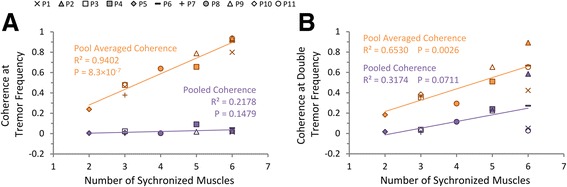
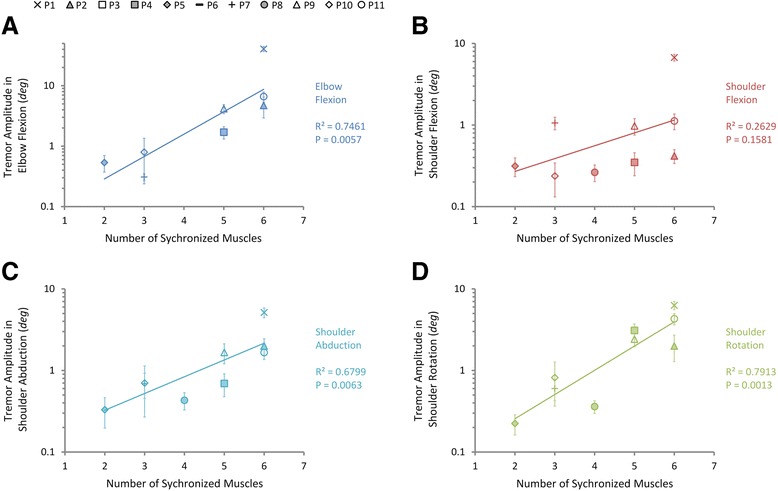
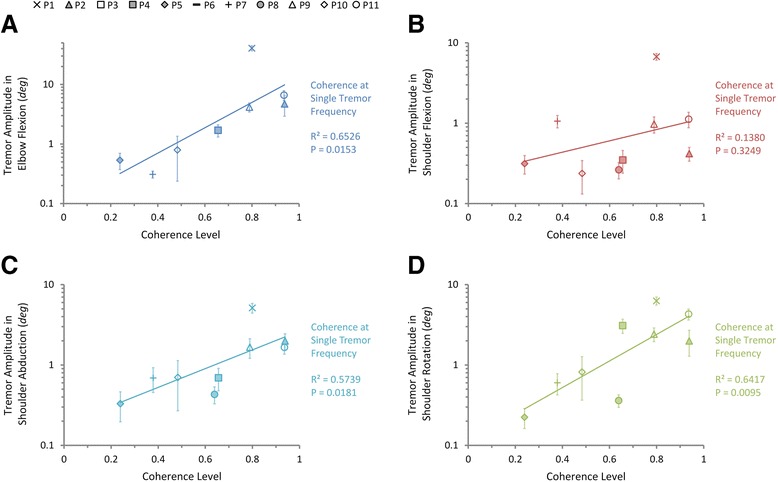
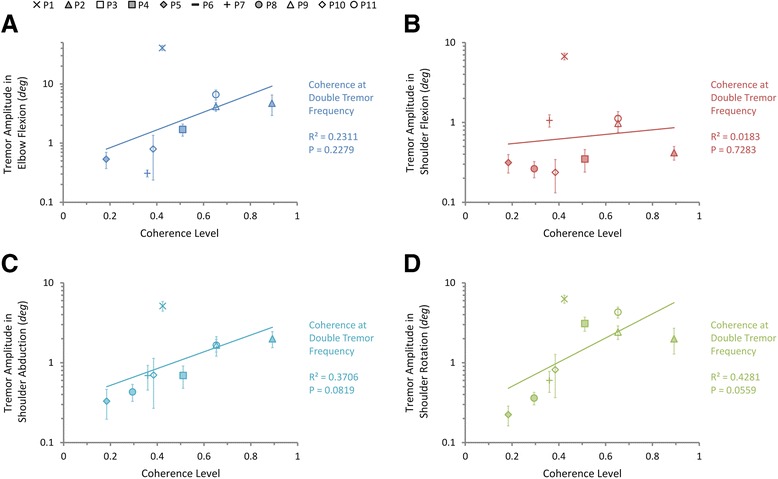
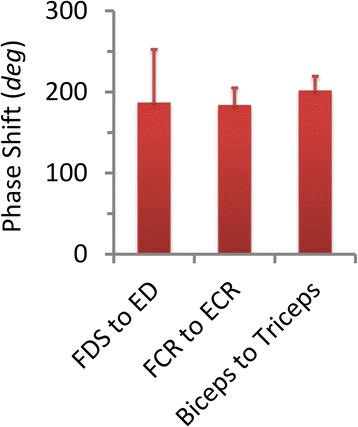
BACKGROUND: Involuntary central oscillations at single and double tremor frequencies drive the peripheral neuromechanical system of muscles and joints to cause tremor in Parkinson's disease (PD). The central signal of double tremor frequency was found to correlate more directly to individual muscle EMGs (Timmermann et al. 2003). This study is aimed at investigating what central components of oscillation contribute to inter-muscular synchronization in a group of upper extremity muscles during tremor in PD patients. METHODS: 11 idiopathic, tremor dominant PD subjects participated in this study. Joint kinematics during tremor in the upper extremity was recorded along with EMGs of six upper arm muscles using a novel experimental apparatus. The apparatus provided support for the upper extremity on a horizontal surface with reduced friction, so that resting tremor in the arm can be recorded with a MotionMonitor II system. In each subject, the frequencies of rhythmic firings in upper arm muscles were determined using spectral analysis. Paired and pool-averaged coherence analyses of EMGs for the group of muscles were performed to correlate the level of inter-muscular synchronization to tremor amplitudes at shoulder and elbow. The phase shift between synchronized antagonistic muscle pairs was calculated to aid coherence analysis in the muscle pool. RESULTS: Recorded EMG revealed that rhythmic firings were present in most recorded muscles, which were either synchronized to form phase-locked bursting cycles at a subject specific frequency, or unsynchronized with a random phase distribution. Paired coherence showed a stronger synchronization among a subset of recorded arm muscles at tremor frequency than that at double tremor frequency. Furthermore, the number of synchronized muscles in the arm was positively correlated to tremor amplitudes at elbow and shoulder. Pool-averaged coherence at tremor frequency also showed a better correlation with the amplitude of resting tremor than that of double tremor frequency, indicating that the neuromechanical coupling in peripheral neuromuscular system was stronger at tremor frequency. CONCLUSIONS: Both paired and pool-averaged coherences are more consistent indexes to correlate to tremor intensity in a group of upper extremity muscles of PD patients. The central drive at tremor frequency contributes mainly to synchronize peripheral muscles in the modulation of tremor intensity.
Overview
The claims and statistics of this paper haven’t been checked yet.
Free: it reads the open-access text and checks the first 5 claims that cite a source we can check. Create a free account to check every claim.
Integrity signals
Registry
Cites
Statistics
Figures
Verification
Claims the paper makes
The claims and statistics of this paper haven’t been checked yet.
Free: it reads the open-access text and checks the first 5 claims that cite a source we can check. Create a free account to check every claim.
Self-check
Percentages, sums and reported differences re-computed from the paper’s own numbers.
The self-check needs the paper’s full text.
Citations
Cites
Welch, P. (1967) · IEEE Transactions on Audio and Electroacoustics · doi:10.1109/tau.1967.1161901 · Cited by 12,277 · cited 1×
“The magnitude squared coherence matrix M [37–39] comprising the coherence of all muscle pairs were calculated using Welch PSD (power spectral density) method [40, 41]:”
MethodParkinsonism: onset, progression, and mortality
Hoehn, M. M., & Yahr, M. D. (1967) · Neurology · doi:10.1212/wnl.17.5.427 · Cited by 12,107
Parkinson's disease: clinical features and diagnosis
Jankovic, J. (2008) · Journal of Neurology, Neurosurgery & Psychiatry · doi:10.1136/jnnp.2007.131045 · Cited by 5,720 · cited 1×
“The tremor dominant patients suffer milder rigidity and bradykinesia [6–9] with less impairment of motor functions [10, 11].”
BackgroundOverdependence on degraded gist memory in Alzheimer's disease.
Gallo, D. A., Shahid, K. R., Olson, M. A., Solomon, T. M., Schacter, D. L., & Budson, A. E. (2006) · Neuropsychology · doi:10.1037/0894-4105.20.6.625 · Cited by 4,732
Theory and Application of Digital Signal Processing
Rabiner, L. R., Gold, B., & Yuen, C. K. (1978) · IEEE Transactions on Systems, Man, and Cybernetics · doi:10.1109/tsmc.1978.4309918 · Cited by 2,797
Theory and application of digital signal processing
Trick, T. N. (1975) · Proceedings of the IEEE · doi:10.1109/proc.1975.10027 · Cited by 1,878
Dynamic imaging of coherent sources: studying neural interactions in the human brain
Gross, J., Kujala, J., Hämäläinen, M., Timmermann, L., Schnitzler, A., & Salmelin, R. (2001) · Proceedings of the National Academy of Sciences · doi:10.1073/pnas.98.2.694 · Cited by 1,810 · cited 1×
“The magnitude squared coherence matrix M [37–39] comprising the coherence of all muscle pairs were calculated using Welch PSD (power spectral density) method [40, 41]:”
MethodVariable expression of Parkinson's disease: A base‐line analysis of the DAT ATOP cohort
Jankovic, J., McDermott, M., Carter, J., Gauthier, S., Goetz, C., Golbe, L., Huber, S., Koller, W., Olanow, C., Shoulson, I., et al. (1990) · Neurology · doi:10.1212/wnl.40.10.1529 · Cited by 1,285
Halliday, D. M., Rosenberg, J. R., Amjad, A. M., Breeze, P., Conway, B. A., & Farmer, S. F. (1995) · Progress in Biophysics and Molecular Biology · doi:10.1016/s0079-6107(96)00009-0 · Cited by 1,107 · cited 1×
“The upper 99 % confidence limit for significant coherency was determined by [38]:”
BackgroundA Clinicopathologic Study of 100 Cases of Parkinson's Disease
Hughes, A. J., Daniel, S. E., Blankson, S., & Lees, A. J. (1993) · Archives of Neurology · doi:10.1001/archneur.1993.00540020018011 · Cited by 956 · cited 1×
“The tremor dominant patients suffer milder rigidity and bradykinesia [6–9] with less impairment of motor functions [10, 11].”
Background
Cited by
Increased EMG intermuscular coherence and reduced signal complexity in Parkinson’s disease
Flood, M. W., Jensen, B. R., Malling, A. S. B., & Lowery, M. M. (2018) · Clinical Neurophysiology · doi:10.1016/j.clinph.2018.10.023 · Cited by 58
“Parkinsonian tremor is associated with oscillatory activity of central origin, with welldocumented correlations between cortical and muscle activity at frequencies linked to Parkinsonian tremor (4–6 Hz and 8–10 Hz) (Brown, 2003;He et al., 2015; Hurtado et al., 2000; Park et al., 2009).”
BackgroundHu, Z., Hao, M., Xu, S., Xiao, Q., & Lan, N. (2019) · Journal of NeuroEngineering and Rehabilitation · doi:10.1186/s12984-019-0505-0 · Cited by 38
Self-citationHao, M.-Z., Xu, S.-Q., Hu, Z.-X., Xu, F.-L., Niu, C.-X. M., Xiao, Q., & Lan, N. (2017) · Journal of NeuroEngineering and Rehabilitation · doi:10.1186/s12984-017-0286-2 · Cited by 29
“In an earlier analysis of EMG signals in patients with PD with tremor dominant symptom, we showed that the amplitude of tremor at joints is modulated by the number of muscles synchronized with rhythmic alternating bursts [16].”
BackgroundSelf-citationHigh-Frequency Intermuscular Coherence between Arm Muscles during Robot-Mediated Motor Adaptation
Pizzamiglio, S., Lillo, M. D., Naeem, U., Abdalla, H. S., & Turner, D. L. (2017) · Frontiers in Physiology · doi:10.3389/fphys.2016.00668 · Cited by 28
Development of a closed-loop system for tremor suppression in patients with Parkinson's disease
Xu, F. L., Hao, M. Z., Xu, S. Q., Hu, Z. X., Xiao, Q., & Lan, N. (2016) · 2016 38th Annual International Conference of the IEEE Engineering in Medicine and Biology Society (EMBC) · doi:10.1109/embc.2016.7591063 · Cited by 18
“The threshold value of TF for a tremor was determined by using EMG data of FDS muscle obtained in other 4 PD subjects of previous experiments [13].”
MethodSelf-citationHu, Z.-X., Xu, S., Hao, M., Xiao, Q., & Lan, N. (2019) · Journal of Neural Engineering · doi:10.1088/1741-2552/ab186f · Cited by 17
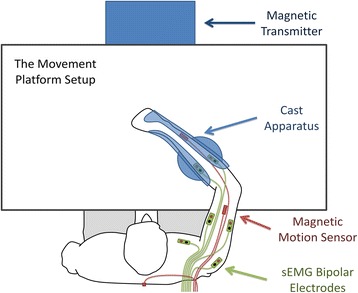
“3 supported by a plastic ball bearing basis to move frictionless on the lubricated plate [36].”
BackgroundSelf-citationParkinson's Disease Exhibits Amplified Intermuscular Coherence During Dynamic Voluntary Action
Laine, C. M., & Valero‐Cuevas, F. J. (2020) · Frontiers in Neurology · doi:10.3389/fneur.2020.00204 · Cited by 18
“Although the idea that tremor-generating neural drive in PD is inherently distributed to multiple muscles has received some support (21, 22), there has been less effort to identify the particular muscles/tasks in which an intermuscular action tremor is most reliably evoked and detected.”
BackgroundChen, X., Hou, X., Luo, X., Zhou, S., Liu, X., Liu, B., & Chen, J. (2019) · Frontiers in Aging Neuroscience · doi:10.3389/fnagi.2019.00319 · Cited by 14
Lanzani, V., Brambilla, C., & Scano, A. (2025) · Frontiers in Bioengineering and Biotechnology · doi:10.3389/fbioe.2024.1445447 · Cited by 22
Standring, D. J., Pigg, A. C., Thompson‐Westra, J., Mente, K., Maurer, C. W., Haubenberger, D., Hallett, M., & Charles, S. K. (2022) · Clinical Neurophysiology · doi:10.1016/j.clinph.2022.07.001 · Cited by 15
Xie, Q., Lan, N., Qu, H., Niu, C. M., Li, S., Hao, M., & Hu, Z.-X. (2017) · Neural Regeneration Research · doi:10.4103/1673-5374.221161 · Cited by 9
“In our previous studies (Lan and He, 2012; He et al., 2013, 2015), we developed a computational model that simulates the movement of the human arm, and which includes details of the spinal circuitry thought to contribute to the neural control of movement.”
MethodSelf-citationArruda, B. S., Reis, C., Sermon, J. J., Pogosyan, A. H., Brown, P., & Cagnan, H. (2021) · Journal of NeuroEngineering and Rehabilitation · doi:10.1186/s12984-021-00973-6 · Cited by 10
“It has recently been shown that intermuscular coherence can be used to distinguish between different tremor types and correlates with tremor intensity in Parkinson’s disease [32, 33].”
BackgroundFerenčík, N., Jaščur, M., Bundzel, M., & Zolotová, I. (2018) · IEEE World Symposium on Applied Machine Intelligence and Informatics (SAMI) · doi:10.1109/sami.2018.8323996 · Cited by 7
“Classification of tremors: Relax starting position – when body part is in relax position and is supported against gravity, Postural starting position - occurs while the affected limbs are kept against gravity and the patient tries to reach the position using muscle strength, like on Figure 3 [6].”
BackgroundOn the influence of input triggering on the dynamics of the Jansen–Rit oscillators network
Kazemi, S., & Jamali, Y. (2024) · Neurocomputing · doi:10.1016/j.neucom.2024.128590 · Cited by 5
Hu, Z.-X., Xu, S., Hao, M., Xiao, Q., & Lan, N. (2019) · International IEEE/EMBS Conference on Neural Engineering · doi:10.1109/ner.2019.8717168 · Cited by 4
Self-citationWang, X., Hao, M., Chou, C.-H., Zhang, X., Pan, Y., Sun, B., Bai, M., Dai, C., & Lan, N. (2022) · Annual International Conference of the IEEE Engineering in Medicine and Biology Society (EMBC) · doi:10.1109/embc48229.2022.9871976 · Cited by 2
“Chih-hong Chou, Manzhao Hao, and Ning Lan are with Laboratory of NeuroRehabilitation Engineering and Institute of Medical Robotics, School of Biomedical Engineering Shanghai Jiao Tong intensity [4].”
BackgroundSelf-citationDoença de Parkinson: efeito da terapia vibratória no recrutamento da musculatura postural
Araújo, H. A. G. D. O., Moreira, A., Silva, A. M., Kosour, C., & dos Reis, L. M. (2019) · Fisioterapia Brasil · doi:10.33233/fb.v20i1.1251
Early Detection of Parkinson’s Disease Using Machine Learning and Wearable Sensors
Biju, S. M., Chawla, M. D., & Al-Khatib, O. (2025) · Lecture notes in networks and systems · doi:10.1007/978-981-96-9242-2_44
Metadata
- Authors
- He, X., Hao, M.-Z., Wei, M., Xiao, Q., & Lan, N.
- Affiliations
- Shanghai Jiao Tong University (CN)
- University of Southern California (US)
- Corresponding author
- Lan, Ning
- Venue
- Journal of NeuroEngineering and Rehabilitation
- Published
- 2015-12
- Volume
- 12
- Issue
- 1
- Pages
- 108-108
- ISSN
- 1743-0003 (ISSN-L)
- PMC
- PMC4666195
- OpenAlex
- W2181855250
- Cited by
- 18
- References
- 47
- Citations by year
- 2025: 2 · 2024: 1 · 2022: 2 · 2021: 1 · 2020: 1 · 2019: 5 · 2018: 2 · 2017: 3 · 2016: 1
- FWCI
- 1.40
- Type
- journal article
- Language
- en
- Open access
- gold
- doi.org
- Licence
- cc-by
- Locations
- Journal of NeuroEngineering and Rehabilitation (publishedVersion, cc-by)
- PubMed Central (publishedVersion, cc-by)
- PubMed (publishedVersion)
- Funders
- National Natural Science Foundation of China (CN) (81271684, 61361160415)
- Ministry of Science and Technology of the People's Republic of China (CN) (2011CB013304)
- Topics
- Health Sciences › Medicine › Clinical Neurology › Deep Brain Stimulation and Movement Disorders
- Physical Sciences › Engineering › Biomedical Engineering › Muscle activation and electromyography studies
- Life Sciences › Neuroscience › Cognitive Neuroscience › Motor Control and Adaptation
- Keywords
- Parkinson's disease, resting tremor, tremor frequency, upper limb muscles, electromyography, coherence analysis, antagonistic muscle pairs, phase shift, tremor amplitude
- MeSH terms
- Aged, Biomechanical Phenomena, Electromyography, Female, Humans, Male, Middle Aged, Parkinson Disease, Tremor, Muscle, Skeletal
About these checks
Registry, retraction, Cites and statistics results are computed, not judged, with one exception: a printed reference that no index lists is read once by a model before it counts as a citation error. Claims are extracted by a model and kept only when their quote appears verbatim in the text; each cited source is then checked, with a model’s help, for whether it says what the claim relies on. Those verdicts can be wrong — read the claim’s quote and the cited source before relying on one.
Statistics and arithmetic are recomputed, not judged.
Confidence bands are shown only for fields calibrated on our annotated test set. None is calibrated yet, so no band is shown.
What counts as a claim ›How we measure confidence ›How we check this ›
Are you an author, or do you see a problem with this page? Request a review
Data sources
Bibliographic data: Semantic Scholar, OpenAlex, Crossref.
Contains information from the Semantic Scholar Academic Graph Datasets, made available under the ODC Attribution License (ODC-BY 1.0).
Semantic Scholar’s data is described in: Kinney, R., et al. (2023). The Semantic Scholar Open Data Platform. arXiv:2301.10140.
