

Identifying the reactive sites of hydrogen peroxide decomposition and hydroxyl radical formation on chrysotile asbestos surfaces
Open accessThe DOI matches its Crossref record; 62 of the 62 references it cites were found in a registry or an index; 16 of the 63 sources its claims cite were checked for support.
Abstract
Background: Fibrous chrysotile has been the most commonly applied asbestos mineral in a range of technical applications. However, it is toxic and carcinogenic upon inhalation. The chemical reactivity of chrysotile fiber surfaces contributes to its adverse health effects by catalyzing the formation of highly reactive hydroxyl radicals (HO•) from H 2 O 2. In this Haber-Weiss cycle, Fe on the fiber surface acts as a catalyst: Fe 3+ decomposes H 2 O 2 to reductants that reduce surface Fe 3+ to Fe 2+, which is back-oxidized by H 2 O 2 (Fenton-oxidation) to yield HO•. Chrysotile contains three structural Fe species: ferrous and ferric octahedral Fe and ferric tetrahedral Fe (Fe 3+tet). Also, external Fe may adsorb or precipitate onto fiber surfaces. The goal of this study was to identify the Fe species on chrysotile surfaces that catalyze H 2 O 2 decomposition and HO• generation. Results: We demonstrate that at the physiological pH 7.4 Fe 3+tet on chrysotile surfaces substantially contributes to H 2 O 2 decomposition and is the key structural Fe species catalyzing HO• generation. After depleting Fe from fiber surfaces, a remnant fiber-related H 2 O 2 decomposition mode was identified, which may involve magnetite impurities, remnant Fe or substituted redox-active transition metals other than Fe. Fe (hydr)oxide precipitates on chrysotile surfaces also contributed to H 2 O 2 decomposition, but were per mole Fe substantially less efficient than surface Fe 3+tet. Fe added to chrysotile fibers increased HO• generation only when it became incorporated and tetrahedrally coordinated into vacancy sites in the Si layer. Conclusions: Our results suggest that at the physiological pH 7.4, oxidative stress caused by chrysotile fibers largely results from radicals produced in the Haber-Weiss cycle that is catalyzed by Fe 3+tet. The catalytic role of Fe 3+tet in radical generation may also apply to other pathogenic silicates in which Fe 3+tet is substituted, e.g. quartz, amphiboles and zeolites. However, even if these pathogenic minerals do not contain Fe, our results suggest that the mere presence of vacancy sites may pose a risk, as incorporation of external Fe into a tetrahedral coordination environment can lead to HO• generation.
Overview
CoChat Summary
TL;DR
At pH 7.4, tetrahedral Fe³⁺ on chrysotile surfaces is the key structural Fe species catalyzing HO• generation and substantially contributes to H₂O₂ decomposition, while Fe (hydr)oxide precipitates are less efficient per mole Fe. A remnant H₂O₂ decomposition mode remains after Fe depletion, and external Fe increases HO• only when incorporated tetrahedrally into Si-layer vacancy sites.
Key findings
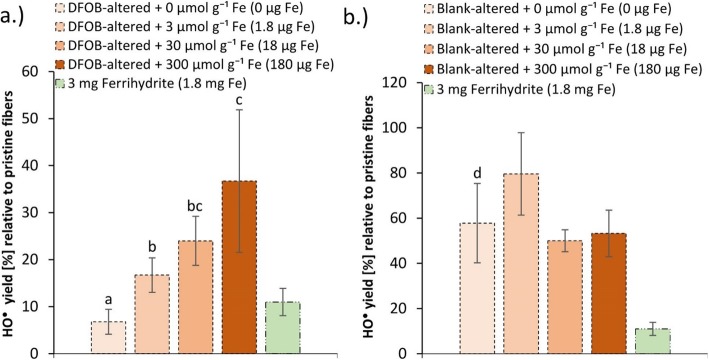
- Fe³⁺tet governs HO• generation: blank-altered fibers with preserved Fe³⁺tet had HO• yield 50 ± 10% of pristine fibers, whereas DFOB-altered fibers had 9%; adding Fe to DFOB-altered fibers increased HO• yield from 7% (+ 0 μmol g⁻¹ Fe) to 36% (+ 300 μmol g⁻¹ Fe), but did not reach blank-altered + 0 μmol g⁻¹ Fe (58 ± 6%).
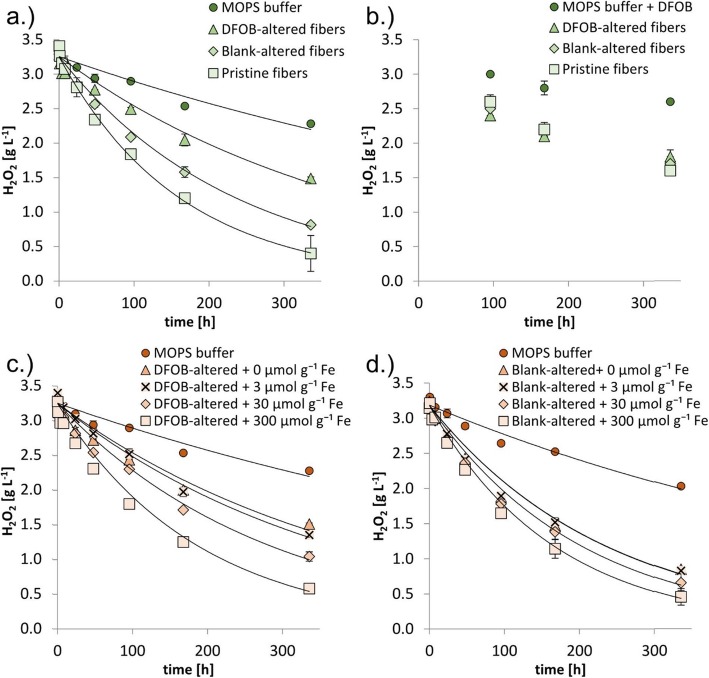
- H₂O₂ decomposition was fastest for pristine fibers (ktot = 6.2 × 10⁻³ h⁻¹), followed by blank-altered (4.2 × 10⁻³ h⁻¹) and DFOB-altered fibers (2.5 × 10⁻³ h⁻¹), versus MOPS buffer control (1.2 × 10⁻³ h⁻¹); Fe addition to DFOB-altered fibers raised ktot to 5.3 × 10⁻³ h⁻¹ at 300 μmol g⁻¹ Fe, and to blank-altered fibers to 6.0 × 10⁻³ h⁻¹ at 300 μmol g⁻¹ Fe.
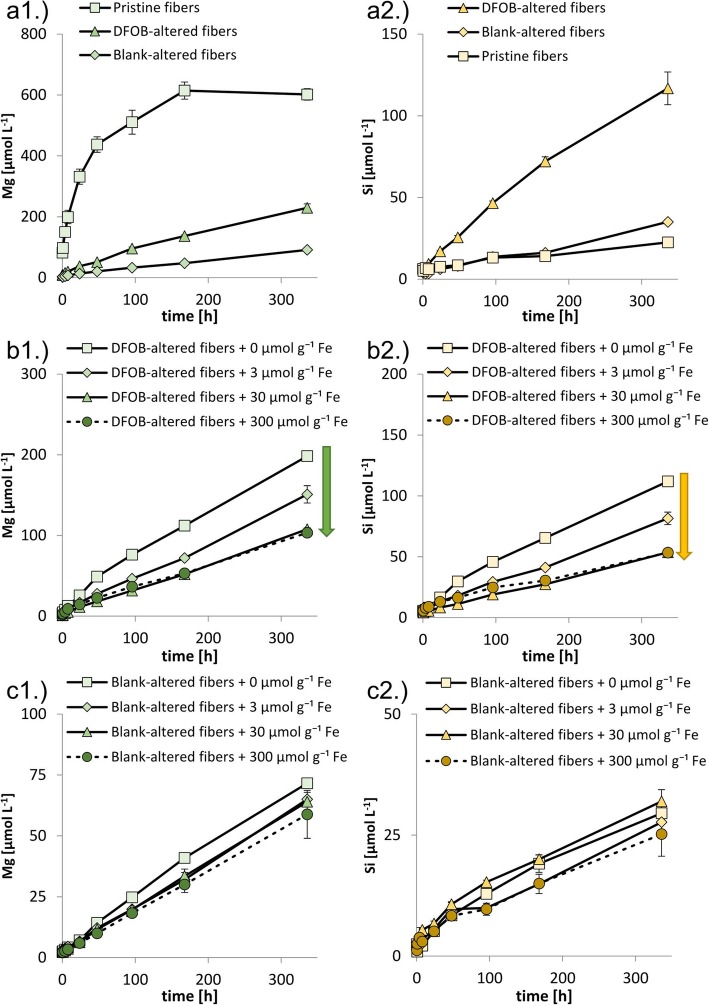
- For blank-altered fibers, the overall ktot (4.2 × 10⁻³ h⁻¹) was partitioned into MOPS buffer (1.2 × 10⁻³ h⁻¹), remnant H₂O₂ decomposition (1.3 × 10⁻³ h⁻¹), secondary Fe precipitates (0.7 × 10⁻³ h⁻¹), and tetrahedral Fe (1.0 × 10⁻³ h⁻¹).
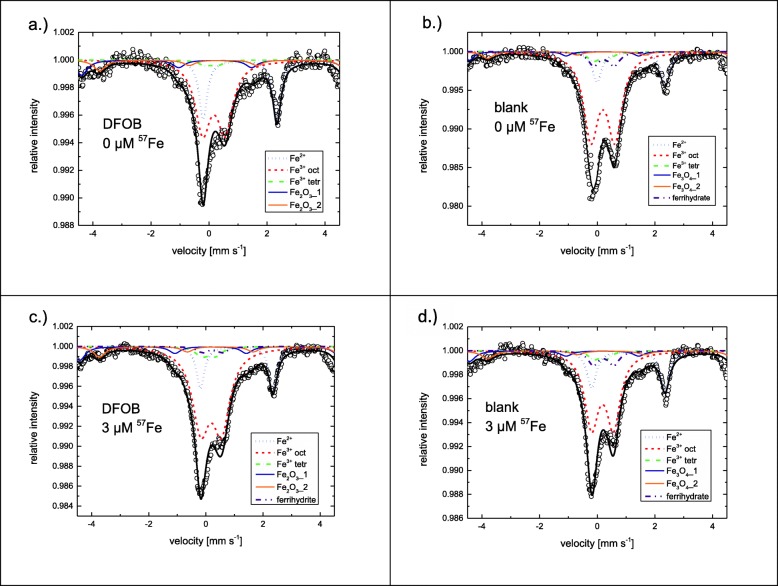
- Mössbauer analyses showed DFOB pretreatment lowered Fe³⁺tet from 15.0 to 7.7 μmol g⁻¹ Fe; adding 3 μmol g⁻¹ ⁵⁷Fe to DFOB-altered fibers increased the ⁵⁷Fe³⁺tet fraction from 2.2 to 3.8% and total Fe³⁺tet bulk content by 3%, with most added ⁵⁷Fe (~60%) retrieved as Fe³⁺oct, whereas added ⁵⁷Fe to blank-altered fibers was mostly retrieved as magnetite (~60%).
Methods
- Batch incubations used Shijiazhuang chrysotile at 1 g L⁻¹ in pH 7.4 MOPS buffer (50 mmol L⁻¹, ionic strength 300 mmol L⁻¹); fibers were preconditioned for 336 h as blank-altered or DFOB-altered (1 mmol L⁻¹ DFOB), then DFOB-altered and blank-altered fibers received 0, 3, 30, or 300 μmol g⁻¹ Fe²⁺ under anoxic conditions followed by oxygenation.
- H₂O₂ decomposition experiments used an initial 3.34 g L⁻¹ H₂O₂, destructive sampling from 0.5 to 336 h, H₂O₂ measurement by titanium sulfate spectrophotometry, and Mg/Fe/Si analysis by ICP-OES; additional experiments used 0.1 mol L⁻¹ NaOH.
- HO• was quantified by DMPO spin-trapping EPR, Fe speciation by ⁵⁷Fe Mössbauer spectroscopy, and EPR data analyzed in SPSS with square-root transformation, Levene’s test, univariate general linear model, and Tukey post-hoc tests.
Limitations
- Stated: the tiered H₂O₂ decomposition contribution calculation assumes independent mechanisms and linear additivity; Mössbauer recovery of Fe³⁺tet assumes no Fe-isotope exchange, and isotope exchange over the experiment timescale may have caused underestimation of recovered Fe³⁺tet.
- Stated: the remnant H₂O₂ decomposition mode is not definitively identified and may involve magnetite impurities, remnant Fe, or substituted redox-active transition metals other than Fe; Fe concentrations in the dissolution experiments were sub-micromolar, and the authors note Ghio et al. reported higher mobilized Fe from a different chrysotile preparation.
- Evident: experiments use one chrysotile source (Shijiazhuang) and in vitro batch systems, and HO• yields are expressed relative to pristine fibers rather than as absolute radical quantities, so extrapolation to other asbestos materials or in vivo conditions is not directly tested.
Model-written summary. Check it against the paper before relying on it.
Integrity signals
Registry
Cites
Statistics
Figures
Verification
Claims the paper makes
16 Valid · 0 Not valid · 17 Not checked · 86 Own results and interpretations
Every source the paper cites for this claim was checked and supports it.
In the paper
“Magnetite (1.5 ± 0.2% in Shijiazhuang chrysotile) hosts approximately 32% of the total bulk Fe (Table 1).”
§ Identifying the reactive sites of hydrogen peroxide decomposition and hydroxyl radical formation on chrysotile asbestos surfaces > Methods > Chemical reagents and asbestos characterization
What the sources say
- Supportedcites [21] Walter M Schenkeveld WDC Reissner M Gille L Kraemer SM The Effect of pH and Biogenic Ligands on the Weathering of Chrysotile Asbestos: The Pivotal Role of Tetrahedral Fe in Dissolution Kinetics and Radical Formation Chem Eur J 2019 25 3386 10.1002/chem.201804319 PMC6582442 30417458 source
The Results and Discussion section on magnetite contamination states that Mössbauer analysis found 32% of bulk Fe in magnetite in Shijiazhuang chrysotile fibers after visible magnetite particles were removed. The same section reports a magnetite content of 1.5 ± 0.2%, matching the citing sentence. (LLM, conf=0.95)
plain- Asserted: passes — The authors put it forward as true.
- Checkable: passes — It can be checked against evidence.
- Load-bearing: unclear — It is unclear whether the paper’s conclusions depend on it.
- Based: passes — The paper gives a reason why it holds.
- Supported
Every source the paper cites for this claim was checked and supports it.
In the paper
“Pretreatment of Shijiazhuang chrysotile asbestos decreased the HO• yield relative to pristine fibers to 50 ± 10% for blank-altered fibers and to 9% for DFOB-altered fibers [21].”
§ Identifying the reactive sites of hydrogen peroxide decomposition and hydroxyl radical formation on chrysotile asbestos surfaces > Results > Effect of Fe addition to preconditioned chrysotile fibers on HO• generation
What the sources say
- Supportedcites [21] Walter M Schenkeveld WDC Reissner M Gille L Kraemer SM The Effect of pH and Biogenic Ligands on the Weathering of Chrysotile Asbestos: The Pivotal Role of Tetrahedral Fe in Dissolution Kinetics and Radical Formation Chem Eur J 2019 25 3386 10.1002/chem.201804319 PMC6582442 30417458 source
In “HO• yield in relation to fiber weathering kinetics at pH 7.5,” the paper reports that blank-treated fibers remained at approximately 50 ± 10% of the pristine-fiber yield, while DFOB-treated fibers fell to 9% after 336 hours. Figure 7 identifies pristine fibers as the 100% reference; the Results and Discussion identifies the asbestos as Shijiazhuang chrysotile. (LLM, conf=0.93)
plainstates a cause- Asserted: passes — The authors put it forward as true.
- Checkable: passes — It can be checked against evidence.
- Load-bearing: passes — The paper’s conclusions depend on it.
- Based: passes — The paper gives a reason why it holds.
- Supported
The cited sources support only part of this claim — read each source’s verdict below.
In the paper
“At elevated concentrations H2O2 and O2•- may, however, interact with Fe on the fiber surface.”
- Also stated in: § Background · plain
“This interaction induces cyclical redox reactions generating hydroxyl radicals (HO•), which have a high potency to damage DNA, proteins and lipids [2, 24–27].”
§ Identifying the reactive sites of hydrogen peroxide decomposition and hydroxyl radical formation on chrysotile asbestos surfaces > Background
What the sources say
- Not checked — no full text of the sourcecites [2] Hardy JA Aust AE Iron in asbestos chemistry and carcinogenicity Chem Rev 1995 95 1 97 118 10.1021/cr00033a005 source
- Not checked — no full text of the sourcecites [24] Winterbourn CC Toxicity of iron and hydrogen peroxide: The Fenton reaction Toxicol Lett 1995 82 969 974 10.1016/0378-4274(95)03532-x 8597169 source
- Not checked — no full text of the sourcecites [25] Kamp DW Graceffa P Pryor WA Weitzman SA The role of free-radicals in asbestos-induced diseases Free Radic Biol Med 1992 12 4 293 315 10.1016/0891-5849(92)90117-y 1577332 source
- Not checked — no full text of the sourcecites [26] Gazzano E Turci F Foresti E Putzu MG Aldieri E Silvagno F Iron-loaded synthetic chrysotile: a new model solid for studying the role of iron in asbestos toxicity Chem Res Toxicol 2007 20 3 380 387 10.1021/tx600354f 17315889 source
- Partly supportedcites [27] Fenoglio I Prandi L Tomatis M Fubini B Free radical generation in the toxicity of inhaled mineral particles: the role of iron speciation at the surface of asbestos and silica Redox Rep 2001 6 4 235 241 10.1179/135100001101536382 11642714 sourceExperimental — accuracy not yet measured
The ‘Kinetics of free radical release’ section says surface-bound iron supports a slow, probably catalytic process in which H2O2 helps generate hydroxyl radicals. ‘Asbestos modified by thermal treatments’ also describes surface iron reducing oxygen to superoxide. The copy does not establish that elevated concentrations of both H2O2 and superoxide interact with surface iron to drive the proposed cycle. (LLM, conf=0.84)
plainstates a possible cause- Asserted: passes — The authors put it forward as true.
- Checkable: passes — It can be checked against evidence.
- Load-bearing: passes — The paper’s conclusions depend on it.
- Based: passes — The paper gives a reason why it holds.
- Also stated in: § Background · plain
The cited sources support only part of this claim — read each source’s verdict below.
In the paper
“During this process, enzymatically formed reactive oxygen species (ROS) like hydrogen peroxide (H2O2) and superoxide anions (O2•-) are released into the immediate extracellular environment [7].”
§ Identifying the reactive sites of hydrogen peroxide decomposition and hydroxyl radical formation on chrysotile asbestos surfaces > Background
What the sources say
- Partly supportedcites [7] Kamp DW Weitzman SA The molecular basis of asbestos induced lung injury Thorax. 1999 54 7 638 652 10.1136/thx.54.7.638 10377212 PMC1745526 sourceExperimental — accuracy not yet measured
The section “Generation of ROS by asbestos stimulated inflammatory and parenchymal cells” (page unavailable) says asbestos stimulates macrophages and neutrophils to release superoxide and hydrogen peroxide. It discusses frustrated phagocytosis and possible activation of ROS-producing enzymes, but says frustrated phagocytosis is not the only mechanism and does not establish that these enzymatically formed ROS are released specifically into the immediate extracellular environment during that process. (LLM, conf=0.84)
plainstates a cause- Asserted: passes — The authors put it forward as true.
- Checkable: passes — It can be checked against evidence.
- Load-bearing: passes — The paper’s conclusions depend on it.
- Based: passes — The paper gives a reason why it holds.
- Partly supported
The cited sources support only part of this claim — read each source’s verdict below.
In the paper
“Depletion of all Fe surface species (including Fe3+tet) from chrysotile surfaces by ligands like DFOB decreased the radical yield of the fibers, almost to background values [21, 33].”
§ Identifying the reactive sites of hydrogen peroxide decomposition and hydroxyl radical formation on chrysotile asbestos surfaces > Background
What the sources say
- Partly supportedcites [21] Walter M Schenkeveld WDC Reissner M Gille L Kraemer SM The Effect of pH and Biogenic Ligands on the Weathering of Chrysotile Asbestos: The Pivotal Role of Tetrahedral Fe in Dissolution Kinetics and Radical Formation Chem Eur J 2019 25 3386 10.1002/chem.201804319 PMC6582442 30417458 sourceExperimental — accuracy not yet measured
In “The effect of chrysotile weathering on HO. yield” (page unavailable), the paper says DFOB complexed most Fe from the Mg and Si layers, leaving an Fe-depleted surface, and reduced radical yield to 9% at pH 7.5 and 17% at pH 8.5. It does not establish depletion of all surface Fe species; “most” is narrower than the claim’s “all.” (LLM, conf=0.85)
- Not checked — no full text of the sourcecites [33] Weitzman SA Graceffa P Asbestos catalyzes hydroxyl and superoxide radical generation from hydrogen-peroxide Arch Biochem Biophys 1984 228 1 373 376 10.1016/0003-9861(84)90078-x 6320737 source
plainstates a cause- Asserted: passes — The authors put it forward as true.
- Checkable: passes — It can be checked against evidence.
- Load-bearing: passes — The paper’s conclusions depend on it.
- Based: passes — The paper gives a reason why it holds.
- Partly supported
67 more claims
Create a free account to see all 119 claims and every source verdict.
- Probably not a substantial claim. 17
- It may state two separate claims as one. 39
Claims other papers make about this one
Each is checked against this paper’s own text: does it say what the citing paper says it does?
The source backs part of the claim, not all of it — or backs it for a different population, condition or comparison.
In the citing paper
“However, so far, the presence of the Fenton-active Fe 2+ tet on chrysotile surfaces has only been postulated 38 but never experimentally established.”
From Redox Cycling of Tetrahedral Iron Drives the Fenton Reactivity of Chrysotile Asbestos (2024) · cites this paper as [38]
Experimental — accuracy not yet measuredThe source backs part of the claim, not all of it — or backs it for a different population, condition or comparison.
In the citing paper
“In conclusion, this study together with previous studies 18,38,39 supports the notion that Fe tet in the exposed Si lattice of pathogenic silicate minerals such as chrysotile asbestos is the principal Fe species catalyzing particle-mediated HO • generation at the physiological pH of 7.4, through cycling between its ferric and ferrous redox states.”
From Redox Cycling of Tetrahedral Iron Drives the Fenton Reactivity of Chrysotile Asbestos (2024) · cites this paper as [38]
Experimental — accuracy not yet measuredThe source backs part of the claim, not all of it — or backs it for a different population, condition or comparison.
In the citing paper
“The ability of Fe tet to fully redox cycle drives its high potency in catalyzing Haber-Weiss cycles.18,38,39”
From Redox Cycling of Tetrahedral Iron Drives the Fenton Reactivity of Chrysotile Asbestos (2024) · cites this paper as [38]
Experimental — accuracy not yet measuredThe cited source says what the claim attributes to it.
In the citing paper
“Recently, tetrahedrally coordinated Fe (Fe tet ) in the fibers' Si sheets was identified as the principal Fe species to catalyze this process.”
From Redox Cycling of Tetrahedral Iron Drives the Fenton Reactivity of Chrysotile Asbestos (2024) · cites this paper as [38]
The cited source says what the claim attributes to it.
In the citing paper
“Increased dissolution kinetics of Fe tet from chrysotile, e.g.facilitated by chelating ligands, renders fiber surfaces depleted of Fe tet sites and consequently diminishes the fibers' Fenton reactivity.18,38,39”
From Redox Cycling of Tetrahedral Iron Drives the Fenton Reactivity of Chrysotile Asbestos (2024) · cites this paper as [38]
9 more claims about this paper
Create a free account to see every claim other papers make about this one.
Citations
Cites
Ferrozine---a new spectrophotometric reagent for iron
Stookey, L. L. (1970) · Analytical Chemistry · doi:10.1021/ac60289a016 · Cited by 4,661
Toxicity of iron and hydrogen peroxide: the Fenton reaction
Winterbourn, C. C. (1995) · Toxicology Letters · doi:10.1016/0378-4274(95)03532-x · Cited by 1,415
Colorimetric Determination of Hydrogen Peroxide
Eisenberg, G. (1943) · Industrial & Engineering Chemistry Analytical Edition · doi:10.1021/i560117a011 · Cited by 1,295
Arsenic, metals, fibres, and dusts.
(2012) · PubMed · Cited by 1,052
Mechanisms in the Pathogenesis of Asbestosis and Silicosis
MOSSMAN, B. T., & CHURG, A. (1998) · American Journal of Respiratory and Critical Care Medicine · doi:10.1164/ajrccm.157.5.9707141 · Cited by 971
Schwertmann, U., & Cornell, R. M. (1993) · Soil Science · doi:10.1097/00010694-199311000-00012 · Cited by 842
De Laat, J., & Gallard, H. (1999) · Environmental Science & Technology · doi:10.1021/es981171v · Cited by 749
The Serpentinite Multisystem Revisited: Chrysotile Is Metastable
Evans, B. W. (2004) · International Geology Review · doi:10.2747/0020-6814.46.6.479 · Cited by 613
�ber die Katalyse des Hydroperoxydes
Haber, F., & Weiss, J. (1932) · Die Naturwissenschaften · doi:10.1007/bf01504715 · Cited by 513
The role of free radicals in asbestos-induced diseases
Kamp, D. W., Graceffa, P., Pryor, W. A., & Weitzman, S. A. (1992) · Free Radical Biology and Medicine · doi:10.1016/0891-5849(92)90117-y · Cited by 428
Machala, Z., Tarabova, B., Hensel, K., Spetlikova, E., Sikurova, L., & Lukes, P. (2013) · Plasma Processes and Polymers · doi:10.1002/ppap.201200113 · Cited by 387
Mössbauer Spectroscopy of Environmental Materials and Their Industrial Utilization
Murad, E., & Cashion, J. (2004) · doi:10.1007/978-1-4419-9040-2 · Cited by 348
The molecular basis of asbestos induced lung injury
Kamp, D. W., & Weitzman, S. A. (1999) · Thorax · doi:10.1136/thx.54.7.638 · Cited by 345
Asbestos catalyzes hydroxyl and superoxide radical generation from hydrogen peroxide
Weitzman, S. A., & Graceffa, P. (1984) · Archives of Biochemistry and Biophysics · doi:10.1016/0003-9861(84)90078-x · Cited by 292
Kandegedara, A., & Rorabacher, D. B. (1999) · Analytical Chemistry · doi:10.1021/ac9902594 · Cited by 240
Iron in Asbestos Chemistry and Carcinogenicity
Hardy, J. A., & Aust, A. E. (1995) · Chemical Reviews · doi:10.1021/cr00033a005 · Cited by 222
The Möessbauer spectrum of ferrihydrite and its relations to those of other iron oxides
Murad, E., & Schwertmann, U. (1980) · American Mineralogist · Cited by 204
Free Radical Generation at the Solid/Liquid Interface in Iron Containing Minerals
Fubini, B., Mollo, L., & Giamello, E. (1995) · Free Radical Research · doi:10.3109/10715769509065280 · Cited by 177
Jaisi, D. P., Kukkadapu, R. K., Eberl, D. D., & Dong, H. (2005) · Geochimica et Cosmochimica Acta · doi:10.1016/j.gca.2005.07.008 · Cited by 167
Morphological and Chemical Mechanisms of Elongated Mineral Particle Toxicities
Aust, A. E., Cook, P. M., & Dodson, R. F. (2011) · Journal of Toxicology and Environmental Health, Part B · doi:10.1080/10937404.2011.556046 · Cited by 155
Dissolution kinetics of chrysotile at pH 7 to 10
Bales, R. C., & Morgan, J. J. (1985) · Geochimica et Cosmochimica Acta · doi:10.1016/0016-7037(85)90228-5 · Cited by 152
Olsen, N. J., Franklin, P. J., Reid, A., Klerk, N. H., Threlfall, T. J., Shilkin, K., & Musk, B. (2011) · Medical Journal of Australia · doi:10.5694/mja11.10125 · Cited by 138
Role of surface complexed iron in oxidant generation and lung inflammation induced by silicates
Ghio, A. J., Kennedy, T. P., Whorton, A. R., Crumbliss, A. L., Hatch, G. E., & Hoidal, J. R. (1992) · American Journal of Physiology-Lung Cellular and Molecular Physiology · doi:10.1152/ajplung.1992.263.5.l511 · Cited by 132
Role of iron in the reactivity of mineral fibers
Fubini, B., & Mollo, L. (1995) · Toxicology Letters · doi:10.1016/0378-4274(95)03531-1 · Cited by 125
ThomasArrigo, L. K., Mikutta, C., Byrne, J. M., Kappler, A. A., & Kretzschmar, R. (2017) · Environmental Science & Technology · doi:10.1021/acs.est.7b01495 · Cited by 113
Doulias, P., Christoforidis, S., Brunk, U. T., & Galaris, D. (2003) · Free Radical Biology and Medicine · doi:10.1016/s0891-5849(03)00396-4 · Cited by 110
Nishikawa, K., Takahashi, K., Karjalainen, A., Wen, C.-P., Furuya, S., Hoshuyama, T., Todoroki, M., Kiyomoto, Y., Wilson, D., Higashi, T., et al. (2008) · Environmental Health Perspectives · doi:10.1289/ehp.11272 · Cited by 106
Infrared and Mössbauer Studies of Reduced Nontronites
Russell, J. D., Goodman, B. A., & Fraser, A. R. (1979) · Clays and Clay Minerals · doi:10.1346/ccmn.1979.0270108 · Cited by 92
Asbestos use and asbestos‐related diseases in Asia: Past, present and future
LE, G. V., TAKAHASHI, K., PARK, E., DELGERMAA, V., OAK, C., QURESHI, A. M., & ALJUNID, S. M. (2011) · Respirology · doi:10.1111/j.1440-1843.2011.01975.x · Cited by 90
Gazzano, E., Turci, F., Foresti, E., Putzu, M. G., Aldieri, E., Silvagno, F., Lesci, I. G., Tomatis, M., Riganti, C., Romano, C., et al. (2007) · Chemical Research in Toxicology · doi:10.1021/tx600354f · Cited by 88
DEPOSITION AND CLEARANCE OF CHRYSOTILE ASBESTOS*
(1994) · The Annals of Occupational Hygiene · doi:10.1093/annhyg/38.4.625 · Cited by 86
Fenoglio, I., Prandi, L., Tomatis, M., & Fubini, B. (2001) · Redox Report · doi:10.1179/135100001101536382 · Cited by 84
Stoichiometric substitution in natural quartz
Dennen, W. H. (1966) · Geochimica et Cosmochimica Acta · doi:10.1016/0016-7037(66)90122-0 · Cited by 77
Landrigan, P. J. (1998) · New England Journal of Medicine · doi:10.1056/nejm199805283382209 · Cited by 70
The Carcinogenicity of Chrysotile Asbestos. A Review.
NICHOLSON, W. J. (2001) · INDUSTRIAL HEALTH · doi:10.2486/indhealth.39.57 · Cited by 65
Iron(III) complexation of Desferrioxamine B encapsulated in apoferritin
Dominguez-Vera, J. M. (2004) · Journal of Inorganic Biochemistry · doi:10.1016/j.jinorgbio.2003.12.015 · Cited by 62
Oxidation of Good’s buffers by hydrogen peroxide
Zhao, G., & Chasteen, N. D. (2005) · Analytical Biochemistry · doi:10.1016/j.ab.2005.10.005 · Cited by 61
Studies of Framework Iron in Zeolites by Pulsed ENDOR at 95 GHz
Goldfarb, D., Strohmaier, K. G., Vaughan, D. E. W., Thomann, H., Poluektov, O. G., & Schmidt, J. (1996) · Journal of the American Chemical Society · doi:10.1021/ja953903e · Cited by 54
The state of iron in natural zeolites: A Mössbauer study
Roque-Malherbe, R., Diaz-Aguila, C., Reguera-Ruiz, E., Fundora-Lliteras, J., López-Colado, L., & Hernández-Vélez, M. (1990) · Zeolites · doi:10.1016/0144-2449(90)90080-b · Cited by 49
A Biomimetic Approach to the Chemical Inactivation of Chrysotile Fibres by Lichen Metabolites
Turci, F., Favero‐Longo, S. E., Tomatis, M., Martra, G., Castelli, D., Piervittori, R., & Fubini, B. (2007) · Chemistry – A European Journal · doi:10.1002/chem.200600991 · Cited by 49
Surface charge and adsorption properties of chrysotile asbestos in natural waters
Bales, R. C., & Morgan, J. J. (1985) · Environmental Science & Technology · doi:10.1021/es00142a013 · Cited by 48
Asbestos-induced decomposition of hydrogen peroxide
Eberhardt, M. K., Román-Franco, A. A., & Quiles, M. R. (1985) · Environmental Research · doi:10.1016/0013-9351(85)90108-2 · Cited by 47
Spectroscopic characterization of chrysotile asbestos from different regions
Ristić, M., Czakó-Nagy, I., Musić, S., & Vértes, A. (2011) · Journal of Molecular Structure · doi:10.1016/j.molstruc.2010.10.005 · Cited by 45
The dissolution of asbestos fibres in water
Gronow, J. R. (1987) · Clay Minerals · doi:10.1180/claymin.1987.022.1.03 · Cited by 39
Interpretation of Mössbauer spectra with broadened lines
Mørup, S., & Both, E. (1975) · Nuclear Instruments and Methods · doi:10.1016/0029-554x(75)90595-9 · Cited by 36
A Fe K-edge XAS study of amethyst
Di Benedetto, F., D’Acapito, F., Fornaciai, G., Innocenti, M., Montegrossi, G., Pardi, L. A., Tesi, S., & Romanelli, M. (2010) · Physics and Chemistry of Minerals · doi:10.1007/s00269-009-0332-0 · Cited by 34
Mineralogy of Asbestos Minerals
Skinner, H. C. W. (2003) · Indoor and Built Environment · doi:10.1177/1420326x03037003 · Cited by 34
Mechanism of ascaridole activation in Leishmania
Geroldinger, G., Tonner, M., Hettegger, H., Bacher, M., Monzote, L., Walter, M., Staniek, K., Rosenau, T., & Gille, L. (2017) · Biochemical Pharmacology · doi:10.1016/j.bcp.2017.02.023 · Cited by 34
Self-citationDNA strand breaks following in vitro exposure to asbestos increase with surface-complexed [Fe3+]
Ghio, A. J., Kennedy, T. P., Stonehuerner, J. G., Crumbliss, A. L., & Hoidal, J. R. (1994) · Archives of Biochemistry and Biophysics · doi:10.1006/abbi.1994.1202 · Cited by 33
Carcinogenesis studies with iron oxides
Steinhoff, D., Mohr, U., & Hahnemann, S. (1991) · Experimental pathology · doi:10.1016/s0232-1513(11)80116-7 · Cited by 32
Enrico Favero-Longo, S., Turci, F., Tomatis, M., Compagnoni, R., Piervittori, R., & Fubini, B. (2009) · Journal of Toxicology and Environmental Health, Part A · doi:10.1080/15287390802529864 · Cited by 31
Andrew J. Ghio Ann LeFurgey, V. (1997) · Journal of Toxicology and Environmental Health · doi:10.1080/009841097160537 · Cited by 27
Moessbauer characteristics of UICC standard reference asbestos samples
Stroink, G., Blaauw, C., White, C., & Leiper, W. (1980) · The Canadian Mineralogist · Cited by 27
EPR of iron centres in silicon dioxide
Weil, J. A. (1994) · Applied Magnetic Resonance · doi:10.1007/bf03162478 · Cited by 25
Merola, R. B., & McGuire, M. M. (2009) · Clays and Clay Minerals · doi:10.1346/ccmn.2009.0570609 · Cited by 19
Baur, X. (2016) · Pneumologie · doi:10.1055/s-0042-103580 · Cited by 17
Walter, M., Schenkeveld, W. D. C., Reissner, M., Gille, L., & Kraemer, S. M. (2019) · Chemistry – A European Journal · doi:10.1002/chem.201804319 · Cited by 14
Self-citationThe effect of disc mill grinding on some rock-forming minerals
Reay, A. (1981) · Mineralogical Magazine · doi:10.1180/minmag.1981.044.334.10 · Cited by 13
Ghio, A. J., Taylor, D. E., Stonehuerner, J. G., Piantadosi, C. A., & Crumbliss, A. L. (1998) · Biometals · doi:10.1023/a:1009257323963 · Cited by 9
Cation site population in amphibole asbestos. A Mössbauer study
Luys, M.-J., De Roy, G. L., Adams, F., & Vansant, E. F. (1983) · Journal of the Chemical Society, Faraday Transactions 1: Physical Chemistry in Condensed Phases · doi:10.1039/f19837901451 · Cited by 6
The History of the Extraction and Uses of Asbestos
Frank, A. L. (2005) · CRC Press eBooks · doi:10.1201/9781420038149.ch1 · Cited by 6
(1997) · doi:10.1002/(sici)1097-0274(199712)32:6
Research works printed but not linked: 1
- WHO International programme on chemical safety: Chrysotile asbestos, ISBN: 978 92 4 156481 6 2014
Cited by
Rasool, A., Manzoor, R., Ullah, K., Afzal, R., Ul-Haq, A., Imran, H., Kaleem, I., Akhtar, T., Farrukh, A., Hameed, S., et al. (2023) · CNS & Neurological Disorders - Drug Targets · doi:10.2174/1871527322666230609141519 · Cited by 43
Effect of procyanidins on lipid metabolism and inflammation in rats exposed to alcohol and iron
Lobo, A., Liu, Y., Song, Y., Liu, S., Zhang, R., Liang, H., & Xin, H. (2020) · Heliyon · doi:10.1016/j.heliyon.2020.e04847 · Cited by 18
“The high presence of iron in the liver is a major cause of oxidative stress, as research shows that it induces and increases the Fenton reaction, resulting in high production of free radicals in large amounts [37, 38].”
BackgroundCytotoxicity of fibrous antigorite from New Caledonia
Gazzano, E., Petriglieri, J. R., Aldieri, E., Fubini, B., Laporte‐Magoni, C., Pavan, C., Tomatis, M., & Turci, F. (2022) · Environmental Research · doi:10.1016/j.envres.2022.115046 · Cited by 16
Walter, M., Geroldinger, G., Gille, L., Kraemer, S. M., & Schenkeveld, W. D. C. (2021) · Journal of Hazardous Materials · doi:10.1016/j.jhazmat.2021.128068 · Cited by 12
Self-citationGull, S., Shabbir, C. A., Khan, Z., Bukhari, D. A., & Rehman, A. (2024) · Arabian Journal of Chemistry · doi:10.1016/j.arabjc.2024.106069 · Cited by 11
Metadata
- Authors
- Walter, M., Schenkeveld, W. D. C., Geroldinger, G., Gille, L., Reissner, M., & Kraemer, S. M.
- Affiliations
- University of Vienna (AT)
- University of Veterinary Medicine Vienna (AT)
- TU Wien (AT)
- Corresponding author
- Schenkeveld, Walter D. C.
- Venue
- Particle and Fibre Toxicology
- Published
- 2020-01-20
- Volume
- 17
- Issue
- 1
- Pages
- 3-3
- ISSN
- 1743-8977 (ISSN-L)
- PMC
- PMC6971994
- OpenAlex
- W3005166741
- Cited by
- 12
- References
- 62
- Citations by year
- 2026: 1 · 2024: 3 · 2023: 3 · 2022: 3 · 2021: 1 · 2020: 1
- FWCI
- 1.12
- Type
- journal article
- Language
- en
- Open access
- gold
- doi.org
- Licence
- cc-by
- creativecommons.org/licenses/by/4.0/ (tdm)
- creativecommons.org/licenses/by/4.0/ (vor)
- Locations
- Particle and Fibre Toxicology (publishedVersion, cc-by)
- PubMed Central (publishedVersion, cc-by)
- PubMed (publishedVersion)
- Phaidra (Universität Wien) (submittedVersion, cc-by-nc-nd)
- DOAJ (DOAJ: Directory of Open Access Journals) (submittedVersion, cc-by-sa)
- Utrecht University Repository (Utrecht University) (submittedVersion, other-oa)
- Funders
- Universitat Wien (uni:docs program)
- Topics
- Health Sciences › Medicine › Pulmonary and Respiratory Medicine › Occupational and environmental lung diseases
- Physical Sciences › Environmental Science › Water Science and Technology › Advanced oxidation water treatment
- Physical Sciences › Chemistry › Organic Chemistry › Free Radicals and Antioxidants
- Keywords
- chrysotile, hydroxyl radical generation, hydrogen peroxide decomposition, iron catalysis, oxidative stress, vacancy sites, asbestos carcinogenicity
- MeSH terms
- Ferric Compounds, Ferrous Compounds, Hydrogen Peroxide, Hydrogen-Ion Concentration, Oxidation-Reduction, Surface Properties, Asbestos, Serpentine, Hydroxyl Radical
About these checks
Registry, retraction, Cites and statistics results are computed, not judged, with one exception: a printed reference that no index lists is read once by a model before it counts as a citation error. Claims are extracted by a model and kept only when their quote appears verbatim in the text; each cited source is then checked, with a model’s help, for whether it says what the claim relies on. Those verdicts can be wrong — read the claim’s quote and the cited source before relying on one.
The claim verdicts this report counts are experimental: their accuracy is not yet measured.
A language model drew the claims from the paper on 2026-10-10, under version 3 of the claim definition (model deepseek-v4.1-flash, prompt extract-v3).
A second model labelled each claim on 2026-10-10 (model jev-1.13-20260917, definition revision gold-guideline-v0.2).
Cited sources are checked with a language model’s help (gpt-6-sol).
Statistics and arithmetic are recomputed, not judged.
Confidence bands are shown only for fields calibrated on our annotated test set. None is calibrated yet, so no band is shown.
What counts as a claim ›How we measure confidence ›How we check this ›
Are you an author, or do you see a problem with this page? Request a review
Data sources
Bibliographic data: Semantic Scholar, OpenAlex, Crossref.
Contains information from the Semantic Scholar Academic Graph Datasets, made available under the ODC Attribution License (ODC-BY 1.0).
Semantic Scholar’s data is described in: Kinney, R., et al. (2023). The Semantic Scholar Open Data Platform. arXiv:2301.10140.
