

Emotional blunting in patients with depression. Part IV: differences between patient and physician perceptions
Open accessThe DOI matches its Crossref record; 29 of the 29 references it cites were found in a registry or an index.
Abstract
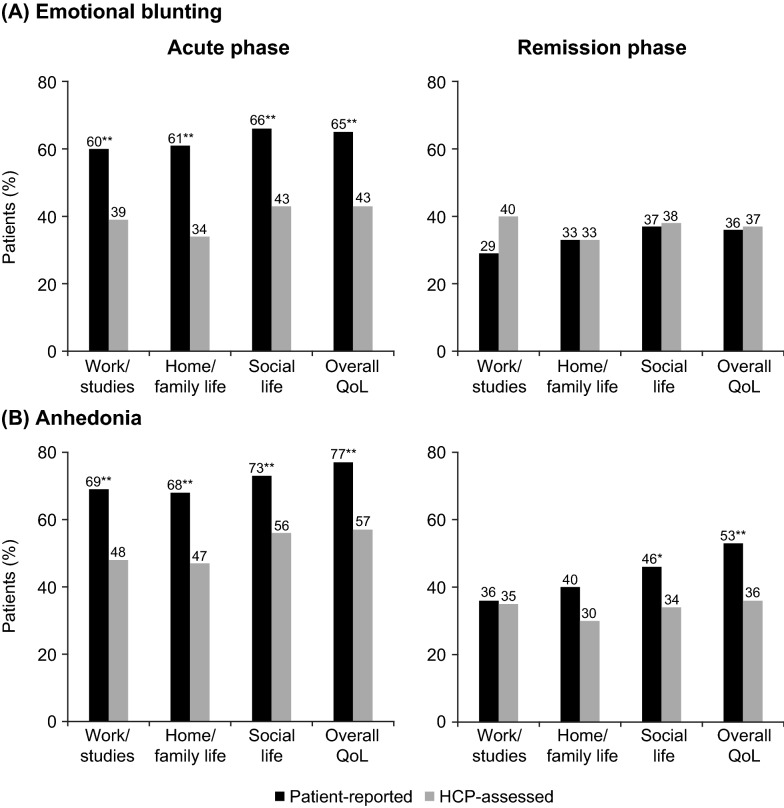
Background: Emotional blunting is common in patients with depression. An online survey was undertaken to assess the experience of emotional blunting, and its impact on functioning and quality of life, in the acute and remission phases of depression from the perspective of patients and healthcare providers (HCPs). This paper presents data on the level of concordance between patient and HCP perspectives. Methods: This was a cross-sectional, observational study. Patient respondents were adults with a diagnosis of depression, who were currently using a prescribed antidepressant, and who reported emotional blunting during the past 6 weeks. HCPs completed the survey for the last two eligible patients they had seen, one in each phase of depression. Assessments included the Oxford Depression Questionnaire (ODQ) ‘antidepressant as cause’ domain and the Functioning Assessment Short Test (FAST). Results: Mean ODQ ‘antidepressant as cause’ domain scores were significantly higher in the patient-reported cohort (n = 752) than in the HCP-assessed cohort (n = 766) in both the acute (18.0 vs 12.5, respectively; p < 0.01) and remission phases (17.6 vs 12.6; p < 0.01). Overall, 45% of patients believed that their antidepressant medication was negatively affecting their emotions and 39% were considering stopping or had stopped their antidepressant because of perceived emotion-related side effects. In the HCP-assessed cohort, the antidepressant was considered responsible for emotional blunting in 30% of patients and only 18% of patients were believed to be considering stopping their medication due to emotional blunting. Patients reported a greater impact of emotional blunting on activities of daily living than HCPs. Mean FAST score was significantly higher in each phase of depression in the patient-reported cohort than in the HCP-assessed cohort (acute phase, 47.0 vs 39.1; remission phase, 33.5 vs 19.4; both p < 0.01). Conclusions: Compared with previous studies, our results suggest that HCPs may underestimate the prevalence of emotional blunting in patients with depression. HCPs also appear to underestimate the severity and impact of emotional blunting on patient functioning and treatment adherence compared with patients’ own perspectives. Differences between patient and HCP perspectives were most pronounced during the acute phase of the disease.
Overview
The claims and statistics of this paper haven’t been checked yet.
Free: it reads the open-access text and checks the first 5 claims that cite a source we can check. Create a free account to check every claim.
Integrity signals
Registry
Cites
Statistics
Figures
Verification
Claims the paper makes
The claims and statistics of this paper haven’t been checked yet.
Free: it reads the open-access text and checks the first 5 claims that cite a source we can check. Create a free account to check every claim.
Claims other papers make about this one
Each is checked against this paper’s own text: does it say what the citing paper says it does?
The source backs part of the claim, not all of it — or backs it for a different population, condition or comparison.
In the citing paper
“Our findings correspond to those of Christensen et al.,[9] who reported emotional restriction in 45% of antidepressant users.”
From Emotional blunting with antidepressants in major depressive disorder patients: A hospital-based cross-sectional study (2026) · cites this paper as [9]
Experimental — accuracy not yet measuredThe source backs part of the claim, not all of it — or backs it for a different population, condition or comparison.
In the citing paper
“The prevalence of emotional blunting in our sample was consistent with international studies reporting rates between 45% and 60%.”
From Emotional blunting with antidepressants in major depressive disorder patients: A hospital-based cross-sectional study (2026) · cites this paper as [9]
Experimental — accuracy not yet measuredThe source backs part of the claim, not all of it — or backs it for a different population, condition or comparison.
In the citing paper
“A study showed that 45% of patients believed their antidepressant negatively influenced their emotions, and nearly 39% considered discontinuation.[9]”
From Emotional blunting with antidepressants in major depressive disorder patients: A hospital-based cross-sectional study (2026) · cites this paper as [9]
Experimental — accuracy not yet measuredThe cited source says what the claim attributes to it.
In the citing paper
“A study showed that 45% of patients believed their antidepressant negatively influenced their emotions, and nearly 39% considered discontinuation.[9]”
From Emotional blunting with antidepressants in major depressive disorder patients: A hospital-based cross-sectional study (2026) · cites this paper as [9]
Self-check
Percentages, sums and reported differences re-computed from the paper’s own numbers.
The self-check needs the paper’s full text.
Citations
Cites
Diagnostic and Statistical Manual of Mental Disorders
American Psychiatric Association (2013) · doi:10.1176/appi.books.9780890425596 · Cited by 116,369
Kennedy, S. H., Lam, R. W., McIntyre, R. S., Tourjman, S. V., Bhat, V., Blier, P., Hasnain, M., Jollant, F., Levitt, A. J., MacQueen, G. M., et al. (2016) · The Canadian Journal of Psychiatry · doi:10.1177/0706743716659417 · Cited by 1,181
Validity and reliability of the Functioning Assessment Short Test (FAST) in bipolar disorder
Rosa, A. R., Sánchez-Moreno, J., Martínez-Aran, A., Salamero, M., Torrent, C., Reinares, M., Comes, M., Colom, F., Van Riel, W., Ayuso-Mateos, J., et al. (2007) · Clinical Practice and Epidemiology in Mental Health · doi:10.1186/1745-0179-3-5 · Cited by 905
Emotional side-effects of selective serotonin reuptake inhibitors: qualitative study
Price, J., Cole, V., & Goodwin, G. M. (2009) · British Journal of Psychiatry · doi:10.1192/bjp.bp.108.051110 · Cited by 362 · cited 1×
“Emotional blunting is clinically important and burdensome for patients; for example, patients may report changes in their personality, reduced inspiration or motivation, general indifference to events and people that should matter to them, or a negative impact on decisionmaking, judgment, and relationships [1, 6].”
BackgroundEmotional blunting with antidepressant treatments: A survey among depressed patients
Goodwin, G. M., Price, J., De Bodinat, C., & Laredo, J. (2017) · Journal of Affective Disorders · doi:10.1016/j.jad.2017.05.048 · Cited by 202 · cited 1×
“feeling a restricted range of emotions and an inability to experience expected emotional responses [5].”
BackgroundRead, J., & Williams, J. (2018) · Current Drug Safety · doi:10.2174/1574886313666180605095130 · Cited by 175
What is important in being cured from depression? Discordance between physicians and patients (1)
Demyttenaere, K., Donneau, A., Albert, A., Ansseau, M., Constant, E., & van Heeringen, K. (2014) · Journal of Affective Disorders · doi:10.1016/j.jad.2014.12.004 · Cited by 170
Read, J., Cartwright, C., & Gibson, K. (2014) · Psychiatry Research · doi:10.1016/j.psychres.2014.01.042 · Cited by 150
Fagiolini, A., Florea, I., Loft, H., & Christensen, M. C. (2021) · Journal of Affective Disorders · doi:10.1016/j.jad.2020.11.106 · Cited by 127
Self-citation(2010) · PubMed Central · Cited by 101
Patient-Centered Care for Patients with Depression or Anxiety Disorder: An Integrative Review
de Pinho, L. G., Lopes, M. J., Correia, T., Sampaio, F., do Arco, H. M. D. S. L. R., Mendes, A. Q., Marques, M. D. C., & da Fonseca, C. J. V. (2021) · Journal of Personalized Medicine · doi:10.3390/jpm11080776 · Cited by 99
Corruble, E., de Bodinat, C., Belaïdi, C., & Goodwin, G. M. (2013) · International Journal of Neuropsychopharmacology · doi:10.1017/s1461145713000679 · Cited by 94
Rosenblat, J. D., Simon, G. E., Sachs, G. S., Deetz, I., Doederlein, A., DePeralta, D., Dean, M. M., & McIntyre, R. S. (2019) · Journal of Affective Disorders · doi:10.1016/j.jad.2018.09.027 · Cited by 92 · cited 1×
“In one study of 316 patients with major depressive disorder, 35% discontinued treatment due to emotional blunting [10].”
BackgroundAdherence to Depression Treatment in Primary Care: A Randomized Clinical Trial
Sirey, J. A., Banerjee, S., Marino, P., Bruce, M. L., Halkett, A., Turnwald, M., Chiang, C., Liles, B., Artis, A., Blow, F., et al. (2017) · JAMA Psychiatry · doi:10.1001/jamapsychiatry.2017.3047 · Cited by 87 · cited 1×
“The impact of emotional blunting on decision-making can also affect treatment adherence and therefore potentially increase the risk of relapse [9].”
BackgroundChristensen, M. C., Wong, C. M. J., & Baune, B. T. (2020) · Frontiers in Psychiatry · doi:10.3389/fpsyt.2020.00280 · Cited by 83 · cited 1×
“For example, in another recent online survey, patients with depression reported experiencing a wider range of symptoms, greater impairment of functioning, and different treatment priorities compared with HCPs across all phases of the disease [18, 19].”
BackgroundSelf-citationPrice, J., Cole, V., Doll, H., & Goodwin, G. M. (2012) · Journal of Affective Disorders · doi:10.1016/j.jad.2012.01.030 · Cited by 81 · cited 2×
“Our findings suggest that patients presenting with depression should be routinely assessed for emotional blunting using a validated screening question, such as that developed by Price and colleagues [25]: ‘Emotional effects of depression and treatment vary, but may include, for example, feeling emotionally “numbed” or…”
MethodThe Shared Decision-Making Process in the Pharmacological Management of Depression
Hopwood, M. (2019) · Patient · doi:10.1007/s40271-019-00383-w · Cited by 59
Emotional blunting in patients with depression. Part I: clinical characteristics
Christensen, M. C., Ren, H., & Fagiolini, A. (2022) · Annals of General Psychiatry · doi:10.1186/s12991-022-00387-1 · Cited by 53 · cited 3×
“Previous papers have presented data concerning the clinical characteristics of emotional blunting in depression [22], the impact of emotional blunting on overall functioning and quality of life in patients with depression [23], and its relationship with psychological trauma [24].”
BackgroundMethodSelf-citationChristensen, M. C., Fagiolini, A., Florea, I., Loft, H., Cuomo, A., & Goodwin, G. M. (2021) · Journal of Affective Disorders · doi:10.1016/j.jad.2021.07.099 · Cited by 52 · cited 1×
“The ODQ is a validated instrument for assessing emotional blunting in patients with depression over the previous 7 days [25, 26].”
MethodSelf-citationKan, K., Jörg, F., Buskens, E., Schoevers, R. A., & Alma, M. (2020) · BJPsych Open · doi:10.1192/bjo.2020.27 · Cited by 46
Patient-reported outcomes before and after treatment of major depressive disorder
IsHak, W. W., Mirocha, J., Pi, S., Tobia, G., Becker, B., Peselow, E. D., & Cohen, R. M. (2014) · Dialogues in Clinical Neuroscience · doi:10.31887/dcns.2014.16.2/rcohen · Cited by 45
Baune, B. T., & Christensen, M. C. (2019) · Frontiers in Psychiatry · doi:10.3389/fpsyt.2019.00335 · Cited by 41 · cited 1×
“For example, in another recent online survey, patients with depression reported experiencing a wider range of symptoms, greater impairment of functioning, and different treatment priorities compared with HCPs across all phases of the disease [18, 19].”
BackgroundSelf-citationCEDAR Study Group, Loos, S., Clarke, E., Jordan, H., Puschner, B., Fiorillo, A., Luciano, M., Ivánka, T., Magyar, E., Bording, M. K., et al. (2017) · BMC Psychiatry · doi:10.1186/s12888-017-1207-4 · Cited by 35
Christensen, M. C., Ren, H., & Fagiolini, A. M. (2022) · Annals of General Psychiatry · doi:10.1186/s12991-022-00392-4 · Cited by 24 · cited 1×
“Previous papers have presented data concerning the clinical characteristics of emotional blunting in depression [22], the impact of emotional blunting on overall functioning and quality of life in patients with depression [23], and its relationship with psychological trauma [24].”
BackgroundSelf-citationSandell, K., & Bornäs, H. (2017) · Sociology · doi:10.1177/0038038515591947 · Cited by 21 · cited 1×
“Emotional blunting is clinically important and burdensome for patients; for example, patients may report changes in their personality, reduced inspiration or motivation, general indifference to events and people that should matter to them, or a negative impact on decisionmaking, judgment, and relationships [1, 6].”
BackgroundWhat is important in being cured from: Does discordance between physicians and patients matter? (2)
Demyttenaere, K., Donneau, A., Albert, A., Ansseau, M., Constant, E., & van Heeringen, K. (2014) · Journal of Affective Disorders · doi:10.1016/j.jad.2014.12.002 · Cited by 21
‘The patient’: at the center of patient-reported outcomes
Awad, A. G. (2015) · Expert Review of Pharmacoeconomics & Outcomes Research · doi:10.1586/14737167.2015.1077118 · Cited by 20
Emotional blunting in patients with depression. Part III: relationship with psychological trauma
Christensen, M. C., Ren, H., & Fagiolini, A. M. (2022) · Annals of General Psychiatry · doi:10.1186/s12991-022-00395-1 · Cited by 13
Self-citationIshigooka, J., Hoshino, T., Imai, T., Yoshida, H., Ono, M., Ota, M., Moriguchi, Y., Fujikawa, K., Shintani, A., & Fernandez, J. L. (2021) · Neuropsychiatric Disease and Treatment · doi:10.2147/ndt.s324968 · Cited by 7
Cited by
Wong, S., Le, G. H., Phan, L., Rhee, T. G., Ho, R., Meshkat, S., Teopiz, K. M., Kwan, A. T. H., Mansur, R. B., Rosenblat, J. D., et al. (2024) · Journal of Affective Disorders · doi:10.1016/j.jad.2024.04.086 · Cited by 107
Jawad, M. Y., Fatima, M., Hassan, U., Zaheer, Z., Ayyan, M., Ehsan, M. T., Khan, M. H. A., Qadeer, A., Gull, A. R., Asif, M. T., et al. (2023) · Human Psychopharmacology Clinical and Experimental · doi:10.1002/hup.2871 · Cited by 17
“Numbness of feelings and emotions may result in indifference toward loved ones and friends, negatively impacting interpersonal relationships and social judgments (Christensen et al., 2022).”
BackgroundEmotional blunting in patients with depression. Part III: relationship with psychological trauma
Christensen, M. C., Ren, H., & Fagiolini, A. M. (2022) · Annals of General Psychiatry · doi:10.1186/s12991-022-00395-1 · Cited by 13
“Differences between patient and HCP perspectives concerning the experience of emotional blunting in MDD will be further explored in the final paper in this series [51].”
BackgroundSelf-citationHerr, K. J., Berk, M., Huang, W.-L., Kato, T., Lee, J. G., Ng, C. G., Wang, Z., Webb, T., Kasahara‐Kiritani, M., & Vandervoort, L. (2024) · Neuropsychiatric Disease and Treatment · doi:10.2147/ndt.s487747 · Cited by 8
“38 A survey among depressed patients and physicians reported that the physicians tend to underestimate the impact of emotional blunting on treatment discontinuation and daily functioning of patients compared to patients perspectives.”
Anhedonia in patients with major depressive disorder (MDD): State-of-the-art consensus review
Cutler, A. J., Clayton, A. H., Krystal, A. D., Maletic, V., McIntyre, R. S., & Nemeroff, C. B. (2026) · Psychiatry Research · doi:10.1016/j.psychres.2026.117225 · Cited by 4
Metadata
- Authors
- Christensen, M. C., Ren, H., & Fagiolini, A.
- Affiliations
- Lundbeck (Denmark) (DK)
- University of Siena (IT)
- Corresponding author
- Christensen, Michael Cronquist
- Venue
- Annals of General Psychiatry
- Published
- 2022-06-22
- Volume
- 21
- Issue
- 1
- Pages
- 22-22
- ISSN
- 1744-859X (ISSN-L)
- PMC
- PMC9215037
- OpenAlex
- W4283277510
- Semantic Scholar
- 65ce06a2fdf4531cf549d369069372f091769617
- Cited by
- 12
- References
- 29
- Citations by year
- 2026: 4 · 2025: 1 · 2024: 4 · 2023: 2 · 2022: 1
- FWCI
- 1.20
- Type
- journal article
- Language
- en
- Open access
- gold
- doi.org
- Licence
- cc-by
- creativecommons.org/licenses/by/4.0 (tdm)
- creativecommons.org/licenses/by/4.0 (vor)
- Locations
- Annals of General Psychiatry (publishedVersion, cc-by)
- PubMed Central (publishedVersion, cc-by)
- PubMed (publishedVersion)
- DOAJ (DOAJ: Directory of Open Access Journals) (submittedVersion, cc-by-sa)
- Use Siena air (University of Siena) (submittedVersion, other-oa)
- Funders
- H. Lundbeck A/S
- Topics
- Health Sciences › Medicine › Pharmacology (medical) › Treatment of Major Depression
- Health Sciences › Medicine › Psychiatry and Mental health › Bipolar Disorder and Treatment
- Social Sciences › Psychology › Experimental and Cognitive Psychology › Anxiety, Depression, Psychometrics, Treatment, Cognitive Processes
- Keywords
- emotional blunting, depression, antidepressant side effects, patient-physician concordance, patient-reported outcomes, antidepressant discontinuation, functioning, quality of life, remission, medication adherence
About these checks
Registry, retraction, Cites and statistics results are computed, not judged, with one exception: a printed reference that no index lists is read once by a model before it counts as a citation error. Claims are extracted by a model and kept only when their quote appears verbatim in the text; each cited source is then checked, with a model’s help, for whether it says what the claim relies on. Those verdicts can be wrong — read the claim’s quote and the cited source before relying on one.
Statistics and arithmetic are recomputed, not judged.
Confidence bands are shown only for fields calibrated on our annotated test set. None is calibrated yet, so no band is shown.
What counts as a claim ›How we measure confidence ›How we check this ›
Are you an author, or do you see a problem with this page? Request a review
Data sources
Bibliographic data: Semantic Scholar, OpenAlex, Crossref.
Contains information from the Semantic Scholar Academic Graph Datasets, made available under the ODC Attribution License (ODC-BY 1.0).
Semantic Scholar’s data is described in: Kinney, R., et al. (2023). The Semantic Scholar Open Data Platform. arXiv:2301.10140.
