

Corporate practices and health: a framework and mechanisms
Open accessThe DOI matches its Crossref record; 94 of the 94 references it cites were found in a registry or an index.
Abstract
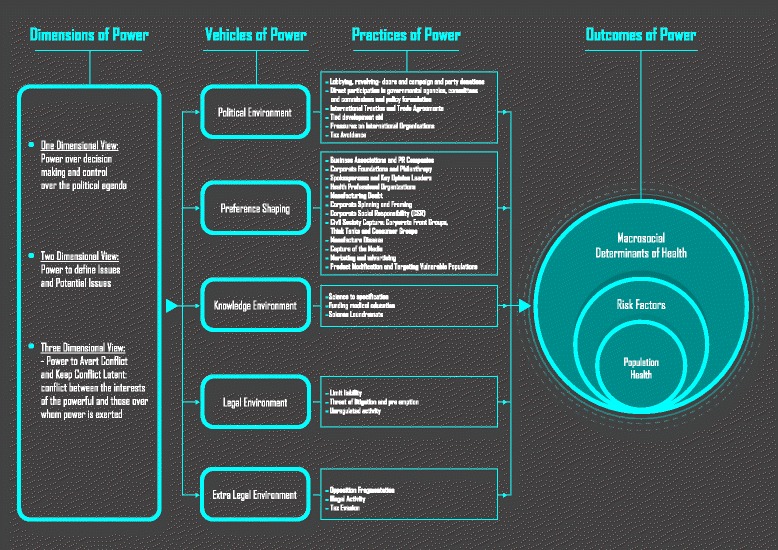
BACKGROUND: The Global Burden of Disease estimates that approximately a third of deaths worldwide are attributable to behavioural risk factors that, at their core, have the consumption of unhealthful products and exposures produced by profit driven commercial entities. We use Steven Lukes' three-dimensional view of power to guide the study of the practices deployed by commercial interests to foster the consumption of these commodities. Additionally, we propose a framework to systematically study corporations and other commercial interests as a distal, structural, societal factor that causes disease and injury. Our framework offers a systematic approach to mapping corporate activity, allowing us to anticipate and prevent actions that may have a deleterious effect on population health. CONCLUSION: Our framework may be used by, and can have utility for, public health practitioners, researchers, students, activists and other members of civil society, policy makers and public servants in charge of policy implementation. It can also be useful to corporations who are interested in identifying key actions they can take towards improving population health.
Overview
The claims and statistics of this paper haven’t been checked yet.
Free: it reads the open-access text and checks the first 5 claims that cite a source we can check. Create a free account to check every claim.
Integrity signals
Registry
Cites
Statistics
Figures
Verification
Claims the paper makes
The claims and statistics of this paper haven’t been checked yet.
Free: it reads the open-access text and checks the first 5 claims that cite a source we can check. Create a free account to check every claim.
Claims other papers make about this one
Each is checked against this paper’s own text: does it say what the citing paper says it does?
The cited source says what the claim attributes to it.
In the citing paper
“Power imbalances were described both between corporations (large, for-profit, often trans-national entities) and governments with conflicting interests [30, 33, 34, 39, 43]”
From Defining the commercial determinants of health: a systematic review (2020) · cites this paper as [33]
The cited source says what the claim attributes to it.
In the citing paper
“Corporate rights, including intellectual property rights, were described as presenting challenges to many interventions that could benefit public health [16, 33, 34, 43].”
From Defining the commercial determinants of health: a systematic review (2020) · cites this paper as [33]
In the citing paper
“Meanwhile, corporations being afforded similar rights as individuals, but with limited liability, was described as contributing to public health harms, and promoting unethical practice [25, 33, 43].”
From Defining the commercial determinants of health: a systematic review (2020) · cites this paper as [33]
In the citing paper
“The consequences of such agreements relate to occupational conditions, environmental conditions, health systems coverage, tax revenue lost via deregulated global finance systems, the affordability of pharmaceuticals, and national food systems and diets [24, 25, 33, 34, 41].”
From Defining the commercial determinants of health: a systematic review (2020) · cites this paper as [33]
In the citing paper
“This form of power was described as one of three proposed dimensions of power, alongside power to set agendas and make decisions, and power over conflict [33].”
From Defining the commercial determinants of health: a systematic review (2020) · cites this paper as [33]
19 more claims about this paper
Create a free account to see every claim other papers make about this one.
Self-check
Percentages, sums and reported differences re-computed from the paper’s own numbers.
The self-check needs the paper’s full text.
Citations
Cites
Lukes, S. (2005) · Power · doi:10.1007/978-0-230-80257-5_2 · Cited by 6,653
The truth about the drug companies: how they deceive us and what to do about it
(2005) · Choice Reviews Online · doi:10.5860/choice.42-5297 · Cited by 885
Uneasy alliance—clinical investigators and the pharmaceutical industry
Bodenheimer, T. (2000) · New England Journal of Medicine · doi:10.1056/nejm200005183422024 · Cited by 765
Als-Nielsen, B., Chen, W., Gluud, C., & Kjaergard, L. L. (2003) · JAMA · doi:10.1001/jama.290.7.921 · Cited by 746
The Perils of Ignoring History: Big Tobacco Played Dirty and Millions Died. How Similar Is Big Food?
BROWNELL, K. D., & WARNER, K. E. (2009) · The Milbank Quarterly · doi:10.1111/j.1468-0009.2009.00555.x · Cited by 678 · cited 3×
“Tobacco companies established the Centre for Tobacco Research Advisory Board [13] and beryllium companies established the Beryllium Industry Scientific Advisory Committee [18].”
BackgroundThe Truth About the Drug Companies: How They Deceive Us and What to Do About It
Angell, M. E. (2004) · DigitalGeorgetown (Georgetown University Library) · Cited by 678
Stuckler, D., McKee, M., Ebrahim, S., & Basu, S. (2012) · PLoS Medicine · doi:10.1371/journal.pmed.1001235 · Cited by 666 · cited 1×
“Consequently, multiple industries have turned to the developing world where disposable incomes are increasing and regulations are still weak to expand its consumer base [16, 86, 87].”
BackgroundMelander, H., Ahlqvist-Rastad, J., Meijer, G., & Beermann, B. (2003) · BMJ · doi:10.1136/bmj.326.7400.1171 · Cited by 635 · cited 1×
“The selective reporting of studies funded by the pharmaceutical industry to regulatory agencies was found to be the major cause of bias in estimates of a drug’s efficacy and safety when these studies were submitted for approval of new indications for existing drugs [91].”
BackgroundObesity. Halting the obesity epidemic: a public health policy approach
Nestle, M. (2000) · Public Health Reports · doi:10.1093/phr/115.1.12 · Cited by 557
Where Does the Money Go? Best and Worst Practices in Foreign Aid
Easterly, W., & Pfutze, T. (2008) · Journal of Economic Perspectives · doi:10.1257/jep.22.2.29 · Cited by 552 · cited 1×
“Tying food and medicines aid to purchases from corporations in donor countries acts as de facto export promotion and overcharges recipient countries for commodities they could procure elsewhere at lower prices [59, 60].”
Background
Research works printed but not linked: 17
- Nestlé M Influencing government: food lobbies and lobbyists. In: food politics. Second 2010 Berkeley University of California Press 95 111
- Goldacre B Bad Pharma: how medicine is broken and how we can fix it 2013 London Forth Estate
- Nestlé M. Food politics. 10th ed. Oakland: University of California Press; 2010.
- Brice VKS Superbug me: the FDA ’ S role in the fight against antibiotic resistance Legis Public Policy 2005 29 January 2002 521 534
- Hoffman B New FDA “Rules” not likely to reduce antibiotic use on farm 2013 New York The Wall Street Journal
- Dugger C U.S. jobs shape condoms’ role in foreign aid 2006 New York The New York Times
- Provost C Lawrence F US food aid programme criticised as “corporate welfare” for grain giants 2012 London The Guardian
- Pojda J Wiist WH Food and agriculture industry The bottom line or public health tactics that corporations use to influence health and health policy, and what we can do to counter them 2010 1 Oxford Oxford University Press 281 298
- White SK Wiist WH Corporations, public health, and the historical landscape that defines our challenge The bottom lime or public health tactics that corporations use to influence health and health policy, and what we can do to counter them 2010 1 Oxford Oxford University Press 73 96
- Oreskes N Conway E Merchants of doubt 2011 New York Bloomsbury Publishing
- Boseley S Big Pharma’s worst nightmare 2016 London The Guardian
- Robertson LS Wiist WH Motor vehicle industry The bottom line or public health tactics that corporations use to influence health and health policy, and what we can do to counter them 2010 1 Oxford Oxford University Press
- Armitage J Big tobacco puts countries on trial as concerns over TTIP deals mount 2014 London The Independent
- Hurst D Australia wins international legal battle with Philip Morris over plain packaging 2015 London The Guardian
- Tiez J Boss hog: the Drak side of America’s top pork produces 2006 New York Roling Stone
- Wike JR Federal Prosecutors Probe Food-Price Collusion 2008 New York The Wall Street Journal
- Wood M The history of China - the last empire 2016 UK BBC 4
Cited by
Defining and conceptualising the commercial determinants of health
Gilmore, A. B., Fabbri, A., Baum, F., Bertscher, A., Bondy, K., Chang, H.-J., Demaio, S., Erzse, A., Freudenberg, N., Friel, S., et al. (2023) · The Lancet · doi:10.1016/s0140-6736(23)00013-2 · Cited by 758
Gender equality in science, medicine, and global health: where are we at and why does it matter?
Shannon, G., Jansen, M., Williams, K., Cáceres, C., Motta, A., Odhiambo, A., Eleveld, A., & Mannell, J. (2019) · The Lancet · doi:10.1016/s0140-6736(18)33135-0 · Cited by 534
The problem with growing corporate concentration and power in the global food system
Clapp, J. (2021) · Nature Food · doi:10.1038/s43016-021-00297-7 · Cited by 359
An overview of the commercial determinants of health
Mialon, M. (2020) · Globalization and Health · doi:10.1186/s12992-020-00607-x · Cited by 276
Social media and the spread of misinformation: infectious and a threat to public health
Denniss, E., & Lindberg, R. (2025) · Health Promotion International · doi:10.1093/heapro/daaf023 · Cited by 263
Metadata
- Authors
- Madureira Lima, J., & Galea, S.
- Venue
- Globalization and Health
- Published
- 2018-02-15
- Volume
- 14
- Issue
- 1
- Pages
- 21-21
- ISSN
- 1744-8603 (ISSN-L)
- PMC
- PMC5815179
- OpenAlex
- W2794730059
- Cited by
- 192
- References
- 94
- FWCI
- 39.11
- Type
- journal article
- Language
- en
- Open access
- gold
- Funders
- Fundação para a Ciência e a Tecnologia
- Fulbright Commission
About these checks
Registry, retraction, Cites and statistics results are computed, not judged, with one exception: a printed reference that no index lists is read once by a model before it counts as a citation error. Claims are extracted by a model and kept only when their quote appears verbatim in the text; each cited source is then checked, with a model’s help, for whether it says what the claim relies on. Those verdicts can be wrong — read the claim’s quote and the cited source before relying on one.
Statistics and arithmetic are recomputed, not judged.
Confidence bands are shown only for fields calibrated on our annotated test set. None is calibrated yet, so no band is shown.
What counts as a claim ›How we measure confidence ›How we check this ›
Are you an author, or do you see a problem with this page? Request a review
Data sources
Bibliographic data: Semantic Scholar, OpenAlex, Crossref.
Contains information from the Semantic Scholar Academic Graph Datasets, made available under the ODC Attribution License (ODC-BY 1.0).
Semantic Scholar’s data is described in: Kinney, R., et al. (2023). The Semantic Scholar Open Data Platform. arXiv:2301.10140.
