

Corporate practices and health: a framework and mechanisms
Open accessThe DOI matches its Crossref record; 94 of the 94 references it cites were found in a registry or an index.
Abstract
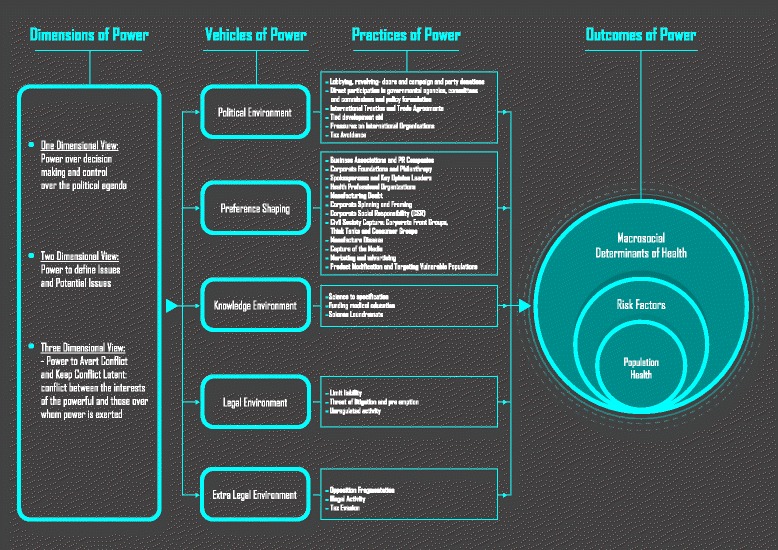
BACKGROUND: The Global Burden of Disease estimates that approximately a third of deaths worldwide are attributable to behavioural risk factors that, at their core, have the consumption of unhealthful products and exposures produced by profit driven commercial entities. We use Steven Lukes' three-dimensional view of power to guide the study of the practices deployed by commercial interests to foster the consumption of these commodities. Additionally, we propose a framework to systematically study corporations and other commercial interests as a distal, structural, societal factor that causes disease and injury. Our framework offers a systematic approach to mapping corporate activity, allowing us to anticipate and prevent actions that may have a deleterious effect on population health. CONCLUSION: Our framework may be used by, and can have utility for, public health practitioners, researchers, students, activists and other members of civil society, policy makers and public servants in charge of policy implementation. It can also be useful to corporations who are interested in identifying key actions they can take towards improving population health.
Overview
The claims and statistics of this paper haven’t been checked yet.
Free: it reads the open-access text and checks the first 5 claims that cite a source we can check. Create a free account to check every claim.
Integrity signals
Registry
Cites
Statistics
Figures
Verification
Claims the paper makes
The claims and statistics of this paper haven’t been checked yet.
Free: it reads the open-access text and checks the first 5 claims that cite a source we can check. Create a free account to check every claim.
Claims other papers make about this one
Each is checked against this paper’s own text: does it say what the citing paper says it does?
The cited source says what the claim attributes to it.
In the citing paper
“Power imbalances were described both between corporations (large, for-profit, often trans-national entities) and governments with conflicting interests [30, 33, 34, 39, 43]”
From Defining the commercial determinants of health: a systematic review (2020) · cites this paper as [33]
The cited source says what the claim attributes to it.
In the citing paper
“Corporate rights, including intellectual property rights, were described as presenting challenges to many interventions that could benefit public health [16, 33, 34, 43].”
From Defining the commercial determinants of health: a systematic review (2020) · cites this paper as [33]
In the citing paper
“Meanwhile, corporations being afforded similar rights as individuals, but with limited liability, was described as contributing to public health harms, and promoting unethical practice [25, 33, 43].”
From Defining the commercial determinants of health: a systematic review (2020) · cites this paper as [33]
In the citing paper
“The consequences of such agreements relate to occupational conditions, environmental conditions, health systems coverage, tax revenue lost via deregulated global finance systems, the affordability of pharmaceuticals, and national food systems and diets [24, 25, 33, 34, 41].”
From Defining the commercial determinants of health: a systematic review (2020) · cites this paper as [33]
In the citing paper
“This form of power was described as one of three proposed dimensions of power, alongside power to set agendas and make decisions, and power over conflict [33].”
From Defining the commercial determinants of health: a systematic review (2020) · cites this paper as [33]
19 more claims about this paper
Create a free account to see every claim other papers make about this one.
Self-check
Percentages, sums and reported differences re-computed from the paper’s own numbers.
The self-check needs the paper’s full text.
Citations
Cites
Lukes, S. (2005) · Power · doi:10.1007/978-0-230-80257-5_2 · Cited by 6,653
The truth about the drug companies: how they deceive us and what to do about it
(2005) · Choice Reviews Online · doi:10.5860/choice.42-5297 · Cited by 885
Uneasy alliance—clinical investigators and the pharmaceutical industry
Bodenheimer, T. (2000) · New England Journal of Medicine · doi:10.1056/nejm200005183422024 · Cited by 765
Als-Nielsen, B., Chen, W., Gluud, C., & Kjaergard, L. L. (2003) · JAMA · doi:10.1001/jama.290.7.921 · Cited by 746
The Perils of Ignoring History: Big Tobacco Played Dirty and Millions Died. How Similar Is Big Food?
BROWNELL, K. D., & WARNER, K. E. (2009) · The Milbank Quarterly · doi:10.1111/j.1468-0009.2009.00555.x · Cited by 678 · cited 3×
“Tobacco companies established the Centre for Tobacco Research Advisory Board [13] and beryllium companies established the Beryllium Industry Scientific Advisory Committee [18].”
BackgroundThe Truth About the Drug Companies: How They Deceive Us and What to Do About It
Angell, M. E. (2004) · DigitalGeorgetown (Georgetown University Library) · Cited by 678
Stuckler, D., McKee, M., Ebrahim, S., & Basu, S. (2012) · PLoS Medicine · doi:10.1371/journal.pmed.1001235 · Cited by 666 · cited 1×
“Consequently, multiple industries have turned to the developing world where disposable incomes are increasing and regulations are still weak to expand its consumer base [16, 86, 87].”
BackgroundMelander, H., Ahlqvist-Rastad, J., Meijer, G., & Beermann, B. (2003) · BMJ · doi:10.1136/bmj.326.7400.1171 · Cited by 635 · cited 1×
“The selective reporting of studies funded by the pharmaceutical industry to regulatory agencies was found to be the major cause of bias in estimates of a drug’s efficacy and safety when these studies were submitted for approval of new indications for existing drugs [91].”
BackgroundObesity. Halting the obesity epidemic: a public health policy approach
Nestle, M. (2000) · Public Health Reports · doi:10.1093/phr/115.1.12 · Cited by 557
Where Does the Money Go? Best and Worst Practices in Foreign Aid
Easterly, W., & Pfutze, T. (2008) · Journal of Economic Perspectives · doi:10.1257/jep.22.2.29 · Cited by 552 · cited 1×
“Tying food and medicines aid to purchases from corporations in donor countries acts as de facto export promotion and overcharges recipient countries for commodities they could procure elsewhere at lower prices [59, 60].”
BackgroundThe Truth About Drug Companies: How They Deceive Us and What to Do About It.
Henderson, S. W. (2005) · Journal of the American Academy of Child & Adolescent Psychiatry · doi:10.1097/01.chi.0000157547.41337.46 · Cited by 506
Kjaergard, L., & Als-Nielsen, B. (2002) · BMJ · doi:10.1136/bmj.325.7358.249 · Cited by 433 · cited 1×
“An analysis of published randomised control trials in 12 specialties showed that financial competing interests were significantly associated with authors’ conclusions [89, 90].”
BackgroundBias in published cost effectiveness studies: systematic review
Bell, C. M., Urbach, D. R., Ray, J. G., Bayoumi, A., Rosen, A. B., Greenberg, D., & Neumann, P. J. (2006) · BMJ · doi:10.1136/bmj.38737.607558.80 · Cited by 382 · cited 1×
“Furthermore, conclusions of metaanalyses [92] and cost effectiveness analysis [93] have also been shown to be biased towards the funding industry’s interests.”
BackgroundThe Impact of Transnational “Big Food” Companies on the South: A View from Brazil
Monteiro, C. A., & Cannon, G. (2012) · PLoS Medicine · doi:10.1371/journal.pmed.1001252 · Cited by 334 · cited 1×
“Consequently, multiple industries have turned to the developing world where disposable incomes are increasing and regulations are still weak to expand its consumer base [16, 86, 87].”
BackgroundThe Bill & Melinda Gates Foundation's grant-making programme for global health
McCoy, D., Kembhavi, G., Patel, J., & Luintel, A. (2009) · The Lancet · doi:10.1016/s0140-6736(09)60571-7 · Cited by 320
Mialon, M., Swinburn, B., & Sacks, G. (2015) · Obesity Reviews · doi:10.1111/obr.12289 · Cited by 318 · cited 1×
“Regulation can be averted through deregulation and non-enforcement of existing legislation [4], the promotion of self-regulation with the adoption of voluntary codes and non-regulatory initiatives [35], delaying implementation of existing regulations, and the perpetuation of loopholes that make tax avoidance legal and…”
BackgroundPublic health implications of meat production and consumption
Walker, P., Rhubart-Berg, P., McKenzie, S., Kelling, K., & Lawrence, R. S. (2005) · Public Health Nutrition · doi:10.1079/phn2005727 · Cited by 270
Financial Ties between DSM-IV Panel Members and the Pharmaceutical Industry
Cosgrove, L., Krimsky, S., Vijayaraghavan, M., & Schneider, L. (2006) · Psychotherapy and Psychosomatics · doi:10.1159/000091772 · Cited by 248 · cited 1×
“The financial ties between DSM-V panel members and the pharmaceutical industry have shed light on this mechanism [82, 83].”
BackgroundConstructing “Sound Science” and “Good Epidemiology”: Tobacco, Lawyers, and Public Relations Firms
Ong, E. K., & Glantz, S. A. (2001) · American Journal of Public Health · doi:10.2105/ajph.91.11.1749 · Cited by 243
Yank, V., Rennie, D., & Bero, L. A. (2007) · BMJ · doi:10.1136/bmj.39376.447211.be · Cited by 235 · cited 1×
“Furthermore, conclusions of metaanalyses [92] and cost effectiveness analysis [93] have also been shown to be biased towards the funding industry’s interests.”
BackgroundMichaels, D., & Jones, M. (2005) · Scientific American · doi:10.1038/scientificamerican0605-96 · Cited by 224
Trade and social determinants of health
Blouin, C., Chopra, M., & van der Hoeven, R. (2009) · The Lancet · doi:10.1016/s0140-6736(08)61777-8 · Cited by 220 · cited 1×
“Increased penetration of supermarkets in food retail, for instance, facilitates a shift towards the consumption of processed foods [54, 55].”
BackgroundCorporate strategy, corporate capture: Food and alcohol industry lobbying and public health
Miller, D., & Harkins, C. (2010) · Critical Social Policy · doi:10.1177/0261018310376805 · Cited by 195 · cited 1×
“Moreover, industry was allowed to contribute to the campaign in kind which led to the introduction of obesogenic foods into schools [11].”
BackgroundMarketing of menthol cigarettes and consumer perceptions: a review of tobacco industry documents
Anderson, S. J. (2011) · Tobacco Control · doi:10.1136/tc.2010.041939 · Cited by 194
Babor, T. F., & Robaina, K. (2013) · American Journal of Public Health · doi:10.2105/ajph.2012.300847 · Cited by 194
Physicians under the Influence: Social Psychology and Industry Marketing Strategies
Sah, S., & Fugh-Berman, A. (2013) · Journal of Law, Medicine & Ethics · doi:10.1111/jlme.12076 · Cited by 192 · cited 1×
“These unfiltered exposures fulfil the double objective of influencing prescription patterns and shaping the medical community’s attitude towards critically appraising what counts as evidence [97].”
BackgroundDisease-Mongers: How Doctors, Drug Companies, and Insurers Are Making You Feel Sick
Payer, L. J. (1992) · DigitalGeorgetown (Georgetown University Library) · Cited by 191
Wakefield, M., Terry-McElrath, Y., Emery, S., Saffer, H., Chaloupka, F. J., Szczypka, G., Flay, B., O’Malley, P. M., & Johnston, L. D. (2006) · American Journal of Public Health · doi:10.2105/ajph.2005.083352 · Cited by 190 · cited 1×
“What is more, they undermined effective tobacco control interventions such as those outlined in the WHO Framework Convention on Tobacco Control [70]:among youths, each additional viewing of a tobacco company parenttargeted advertisement is, on average, associated with lower perceived harm of smoking [71].”
Background‘A pill for every ill’: Explaining the expansion in medicine use
Busfield, J. (2010) · Social Science & Medicine · doi:10.1016/j.socscimed.2009.10.068 · Cited by 179
Schulman, K. A., Seils, D. M., Timbie, J. W., Sugarman, J., Dame, L. A., Weinfurt, K. P., Mark, D. B., & Califf, R. M. (2002) · New England Journal of Medicine · doi:10.1056/nejmsa020349 · Cited by 177 · cited 1×
“evaluate the accuracy of the analyses are thus often unable to do so [95].”
BackgroundInstitutional Corruption of Pharmaceuticals and the Myth of Safe and Effective Drugs
Light, D. W., Lexchin, J., & Darrow, J. J. (2013) · Journal of Law, Medicine & Ethics · doi:10.1111/jlme.12068 · Cited by 173 · cited 1×
“In the third mechanism, the funders may suppress or misreport unfavourable results through exclusive ownership of the data [24, 25, 94].”
BackgroundDe Vogli, R., Kouvonen, A., & Gimeno, D. (2014) · Bulletin of the World Health Organization · doi:10.2471/blt.13.120287 · Cited by 169
Soda and Tobacco Industry Corporate Social Responsibility Campaigns: How Do They Compare?
Dorfman, L., Cheyne, A., Friedman, L. C., Wadud, A., & Gottlieb, M. (2012) · PLoS Medicine · doi:10.1371/journal.pmed.1001241 · Cited by 169 · cited 1×
“Firstly, the voluntary nature of CSR prevents its meaningful formalization into statutory regulation [15, 64] removing incentives to protect public health.”
BackgroundBakke, Ø., & Endal, D. (2010) · Addiction · doi:10.1111/j.1360-0443.2009.02695.x · Cited by 166
Manufacturing Desire: The Commodification of Female Sexual Dysfunction
Fishman, J. R. (2004) · Social Studies of Science · doi:10.1177/0306312704043028 · Cited by 152 · cited 1×
“When diagnostic guidelines are not yet available, new conditions may be created by pathologizing complex behaviours and promoted directly to the public, as was the case of female sexual dysfunction [85].”
BackgroundLethal but legal: corporations, consumption, and protecting public health
(2014) · Choice Reviews Online · doi:10.5860/choice.185108 · Cited by 152
Sismondo, S. (2013) · The Journal of Law Medicine & Ethics · doi:10.1111/jlme.12073 · Cited by 137 · cited 1×
“Researchers on female sexual dysfunction held industry sponsored workshops and wrote position papers that solidified female sexual dysfunction as an illness, thereby positioning themselves as the very experts to whom the FDA would turn on for advice on drug submissions and to whom the media would turn to for interview…”
BackgroundThe impact of eliminating the global illicit cigarette trade on health and revenue
Joossens, L., Merriman, D., Ross, H., & Raw, M. (2010) · Addiction · doi:10.1111/j.1360-0443.2010.03018.x · Cited by 135 · cited 1×
“This category includes bribing [108], smuggling and illicit trade [4, 109], and price fixing [110] among others.”
BackgroundAssessing the health impact of transnational corporations: its importance and a framework
Baum, F. E., Sanders, D. M., Fisher, M., Anaf, J., Freudenberg, N., Friel, S., Labonté, R., London, L., Monteiro, C., Scott-Samuel, A., et al. (2016) · Globalization and Health · doi:10.1186/s12992-016-0164-x · Cited by 133 · cited 1×
“Neither do they include a measure of how corporations engage in changing the social discourse around the role of the state or the social value of regulation [32, 33].”
BackgroundMcCambridge, J., Hawkins, B., & Holden, C. (2013) · Addiction · doi:10.1111/add.12380 · Cited by 131 · cited 1×
“This is partly why it resists attempts to raise the price of alcohol, be it through minimum unit pricing or by increasing excise taxes, measures shown to discourage drinking [10].”
BackgroundMedicine Goes to School: Teachers as Sickness Brokers for ADHD
Phillips, C. B. (2006) · PLoS Medicine · doi:10.1371/journal.pmed.0030182 · Cited by 130 · cited 1×
“This is evidenced by the penetration of the pharmaceutical industry into the education sector by approaching teachers to diagnose Attention Deficit and Hyperactivity Disorder [84].”
BackgroundGagnon, M. (2013) · The Journal of Law Medicine & Ethics · doi:10.1111/jlme.12066 · Cited by 129 · cited 1×
“3 billion) in an out-of-court settlement for the off label promotion of several drugs only to be surpassed in 2012 by GSK with a $3 billion settlement after pleading guilty to unlawful promotion and failure to disclose drug safety data [111].”
BackgroundStuckler, D., Basu, S., & McKee, M. (2011) · PLoS Medicine · doi:10.1371/journal.pmed.1001020 · Cited by 127 · cited 1×
“For example, it holds significant shares in McDonald’s and Coca-Cola [72].”
BackgroundPatient Advocacy Organizations: Institutional Conflicts of Interest, Trust, and Trustworthiness
Rose, S. L. (2013) · The Journal of Law Medicine & Ethics · doi:10.1111/jlme.12078 · Cited by 122 · cited 1×
“Under the guise of a patient constituency, for instance, pharmaceutical industry founded and funded patient advocacy organisations may pressure third party payers to pay for certain drugs regardless of efficacy or efficiency or regulatory agencies for drugs to enter the marketplace more quickly despite the potential h…”
BackgroundSmith, K. E., Fooks, G., Collin, J., Weishaar, H., Mandal, S., & Gilmore, A. B. (2010) · PLoS Medicine · doi:10.1371/journal.pmed.1000202 · Cited by 109
Disease-Mongers: How Doctors, Drug Companies, and Insurers Are Making You Feel Sick
Kilwein, J. H. (1993) · American Journal of Health-System Pharmacy · doi:10.1093/ajhp/50.7.1506 · Cited by 104
Industrial Food Animal Production and Community Health
Casey, J. A., Kim, B. F., Larsen, J., Price, L. B., & Nachman, K. E. (2015) · Current Environmental Health Reports · doi:10.1007/s40572-015-0061-0 · Cited by 104
Bridging the divide: global governance of trade and health
Lee, K., Sridhar, D., & Patel, M. (2009) · The Lancet · doi:10.1016/s0140-6736(08)61776-6 · Cited by 102 · cited 1×
“Since 2001, every trade agreement signed or under negotiation by the US has increased the terms and scope of intellectual property right protection of pharmaceuticals, including patent terms beyond the 20 years provided for under the WTO eroding these hard-fought flexibilities [57].”
BackgroundRevolving Doors? A Network Analysis of Corporate Officers and U.S. Government Officials
Etzion, D., & Davis, G. F. (2008) · Journal of Management Inquiry · doi:10.1177/1056492608316918 · Cited by 101
Flavored Alcoholic Beverages: An International Marketing Campaign that Targets Youth
Mosher, J. F., & Johnsson, D. (2005) · Journal of Public Health Policy · doi:10.1057/palgrave.jphp.3200037 · Cited by 97 · cited 1×
“young people [9], women [88] or problem drinkers.”
BackgroundThe concentration of the global alcohol industry and its penetration in the African region
Jernigan, D. H., & Babor, T. F. (2015) · Addiction · doi:10.1111/add.12468 · Cited by 94 · cited 1×
“Consequently, multiple industries have turned to the developing world where disposable incomes are increasing and regulations are still weak to expand its consumer base [16, 86, 87].”
BackgroundMaximizing Profit and Endangering Health: Corporate Strategies to Avoid Litigation and Regulation
Bohme, S. R., Zorabedian, J., & Egilman, D. S. (2005) · International Journal of Occupational and Environmental Health · doi:10.1179/oeh.2005.11.4.338 · Cited by 94
Front-of-Package Nutrition Labeling — An Abuse of Trust by the Food Industry?
Brownell, K. D., & Koplan, J. P. (2011) · New England Journal of Medicine · doi:10.1056/nejmp1101033 · Cited by 93 · cited 1×
“5 billion lobbying against the European Union’s [EU] adoption of the traffic-light approach, opposing most aggressively the use of a red light suggesting that “any food was too high in anything” [36].”
BackgroundAll in this together: the corporate capture of public health
Mindell, J. S., Reynolds, L., Cohen, D., & McKee, M. (2012) · BMJ · doi:10.1136/bmj.e8082 · Cited by 90 · cited 1×
“Companies whose interests may conflict with the public’s may protect and expand their activities by becoming partners in the formulation of public policy [48].”
BackgroundBritish American Tobacco and the “insidious impact of illicit trade” in cigarettes across Africa
LeGresley, E., Lee, K., Muggli, M. E., Patel, P., Collin, J., & Hurt, R. D. (2008) · Tobacco Control · doi:10.1136/tc.2008.025999 · Cited by 87 · cited 3×
“This category includes bribing [108], smuggling and illicit trade [4, 109], and price fixing [110] among others.”
BackgroundAppetite for Profit: How the Food Industry Undermines Our Health and How to Fight Back
Simon, M. (2006) · Cited by 86
Philip Morris’s Project Sunrise: weakening tobacco control by working with it: Table 1
McDaniel, P. A., Smith, E. A., & Malone, R. E. (2006) · Tobacco Control · doi:10.1136/tc.2005.014977 · Cited by 85
(2010) · Choice Reviews Online · doi:10.5860/choice.48-0300 · Cited by 84
Wiist, W. H. (2010) · Cited by 77
Corporation-induced Diseases, Upstream Epidemiologic Surveillance, and Urban Health
Jahiel, R. I. (2008) · Journal of Urban Health · doi:10.1007/s11524-008-9283-x · Cited by 74
Meghani, Z., & Kuzma, J. (2010) · Journal of Agricultural and Environmental Ethics · doi:10.1007/s10806-010-9287-x · Cited by 70 · cited 1×
“Second, it guarantees industry a voice in the policymaking process, even though other stakeholders have no assurance that their concerns will be addressed by regulatory agencies [40].”
BackgroundAlcohol Marketing in the 21st Century: New Methods, Old Problems
Mart, S. M. (2011) · Substance Use & Misuse · doi:10.3109/10826084.2011.570622 · Cited by 70
Assessing the health impact of transnational corporations: a case study on McDonald’s Australia
Anaf, J., Baum, F. E., Fisher, M., Harris, E., & Friel, S. (2017) · Globalization and Health · doi:10.1186/s12992-016-0230-4 · Cited by 69 · cited 1×
“Neither do they include a measure of how corporations engage in changing the social discourse around the role of the state or the social value of regulation [32, 33].”
BackgroundSick Societies: Responding to the global challenge of chronic disease
Segura, A. (2013) · Australian and New Zealand Journal of Public Health · doi:10.1111/1753-6405.12074 · Cited by 65
Costa, H., Gilmore, A., Peeters, S., McKee, M., & Stückler, D. (2014) · Tobacco Control · doi:10.1136/tobaccocontrol-2014-051822 · Cited by 63
Sebrié, E. M., & Glantz, S. A. (2007) · American Journal of Public Health · doi:10.2105/ajph.2006.094128 · Cited by 61
Vulnerability of Health to Market Forces
Brezis, M., & Wiist, W. H. (2011) · Medical Care · doi:10.1097/mlr.0b013e31820ab638 · Cited by 57 · cited 3×
“Advertising strategies have drawn on advances in neuropsychology, anthropology, and neuroscience to capitalise on the susceptibilities of a developing brain to marketing messages [69].”
BackgroundInfluentialThe alcohol industry and trade agreements: a preliminary assessment
Zeigler, D. W. (2008) · Addiction · doi:10.1111/j.1360-0443.2008.02431.x · Cited by 57
Public Health and the Anticorporate Movement: Rationale and Recommendations
Wiist, W. H. (2006) · American Journal of Public Health · doi:10.2105/ajph.2005.072298 · Cited by 56 · cited 1×
“This framework will help guide the study of these practices in the wider social, political and economic context [27].”
BackgroundSick SocietiesResponding to the global challenge of chronic disease
Stuckler, D., & Siegel, K. (2011) · Oxford University Press eBooks · doi:10.1093/acprof:oso/9780199574407.001.0001 · Cited by 56
Stokes, A. Q., & Rubin, D. (2009) · Journal of Public Relations Research · doi:10.1080/10627260903150268 · Cited by 51 · cited 1×
“Tobacco companies have promoted campaigns to prevent violence against women and funded shelters for victims of domestic abuse [13, 78].”
BackgroundDrug Firms, the Codification of Diagnostic Categories, and Bias in Clinical Guidelines
Cosgrove, L., & Wheeler, E. E. (2013) · The Journal of Law Medicine & Ethics · doi:10.1111/jlme.12074 · Cited by 50 · cited 1×
“The financial ties between DSM-V panel members and the pharmaceutical industry have shed light on this mechanism [82, 83].”
BackgroundEconomic policies for tobacco control in developing countries
Ross, H., & Chaloupka, F. (2006) · Salud Pública de México · doi:10.1590/s0036-36342006000700014 · Cited by 47 · cited 1×
“For example, cigarette smuggling is often cited as an argument against a tobacco tax increase [79] even though the tobacco industry engages in the smuggling of its own products to avoid duty tax [4].”
BackgroundAccountability of the pharmaceutical industry.
Dukes, M. N. G. (2002) · The Lancet · doi:10.1016/s0140-6736(02)11599-6 · Cited by 46
Pharmaceuticals, Political Money, and Public Policy: A Theoretical and Empirical Agenda
Jorgensen, P. D. (2013) · The Journal of Law Medicine & Ethics · doi:10.1111/jlme.12065 · Cited by 43 · cited 1×
“Whilst other factors may explain voting patterns, pharmaceutical campaign donations were found to be the most important explanatory variable [46, 47].”
BackgroundCompeting with kreteks: transnational tobacco companies, globalisation, and Indonesia
Lawrence, S., & Collin, J. (2004) · Tobacco Control · doi:10.1136/tc.2004.009340 · Cited by 43 · cited 1×
“Similarly, the tobacco and alcohol industries have engaged in activism and advocacy against the smuggling of alcohol and tobacco products as a means to avoid regulation of their activities [6].”
BackgroundDust diseases and the legacy of corporate manipulation of science and law
Egilman, D. S., Bird, T., & Lee, C. (2014) · International Journal of Occupational and Environmental Health · doi:10.1179/1077352514z.000000000104 · Cited by 40
Drazen, J. M., & Wood, A. J. J. (2010) · New England Journal of Medicine · doi:10.1056/nejme1007445 · Cited by 40 · cited 1×
“The fact that commercial sponsors of the trial have direct access to these bodies, thwarts due course and prevents them to stop trials that endanger participants [96].”
BackgroundWiist, W. H. (2011) · American Journal of Public Health · doi:10.2105/ajph.2010.300043 · Cited by 40
Over a Barrel: Corporate Corruption of Science and Its Effects on Workers and the Environment
Egilman, D. S., & Bohme, S. R. (2005) · International Journal of Occupational and Environmental Health · doi:10.1179/oeh.2005.11.4.331 · Cited by 36
Understanding Pharmaceutical Research Manipulation in the Context of Accounting Manipulation
Brown, A. B. (2013) · The Journal of Law Medicine & Ethics · doi:10.1111/jlme.12070 · Cited by 36
Political context of the World Health Organization: sugar industry threatens to scupper the WHO
Boseley, S., & McMahon, J. (2003) · International Journal of Health Services · doi:10.2190/u0mw-wm82-n5bh-e20c · Cited by 29 · cited 1×
“Secretary of Health and Human Services to use his influence to get the WHO report withdrawn [13, 65].”
BackgroundCities of Consumption: The Impact of Corporate Practices on the Health of Urban Populations
Freudenberg, N., & Galea, S. (2008) · Journal of Urban Health · doi:10.1007/s11524-008-9278-7 · Cited by 29 · cited 1×
“For example, well-funded marketing strategies are applied to corporate social responsibility, as it becomes the only source of health education in some settings, namely in more economically deprived environments [30].”
BackgroundSelf-citationSalameh, M. G. (2004) · Cited by 27
U.S. Food Companies Access Foreign Markets Through Direct Investment
Bolling, C., & Somwaru, A. (2001) · RePEc: Research Papers in Economics · doi:10.22004/ag.econ.234552 · Cited by 26
MetLife and its corporate allies: dust diseases and the manipulation of science
Egilman, D. S., Bird, T., & Lee, C. G. L. (2013) · International Journal of Occupational and Environmental Health · doi:10.1179/2049396713y.0000000033 · Cited by 23
Miller, J. E. (2013) · The Journal of Law Medicine & Ethics · doi:10.1111/jlme.12069 · Cited by 20
Safe Food: The Politics of Food Safety
Nestle, M. (2019) · University of California Press eBooks · doi:10.1525/9780520946309 · Cited by 16
If FDA Does Not Regulate Food, Who Will? A Study of Hormones and Antibiotics in Meat Production
Donovan, C. (2015) · American Journal of Law & Medicine · doi:10.1177/0098858815591528 · Cited by 13 · cited 1×
“This is an important factor explaining why the antibiotic use for meat growth – a driver of antimicrobial resistance- is left to be voluntarily regulated by the meat and pharmaceutical industries as opposed to statutorily regulated by government agencies [49, 52, 53].”
BackgroundLimited Liability and the Public's Health
Rutkow, L., & Teret, S. P. (2007) · The Journal of Law Medicine & Ethics · doi:10.1111/j.1748-720x.2007.00183.x · Cited by 11
HOW DID THE 2003 PRESCRIPTION DRUG RE-IMPORTATION BILL PASS THE HOUSE?
Gökçekuş, Ö., ADAMS, M., Grabowski, H. G., & Tower, E. (2006) · Economics and Politics · doi:10.1111/j.1468-0343.2006.00161.x · Cited by 10
Public Protests, Private Lawsuits, and the Market: The Investor Response to the McLibel Case
Vick, D. W., & Campbell, K. (2001) · Journal of Law and Society · doi:10.1111/1467-6478.00187 · Cited by 10
Lobby groups call for closure of "revolving door" between drug regulators and industry
Hawkes, N. (2011) · BMJ · doi:10.1136/bmj.d8335 · Cited by 3
The Effect of Trade on Labour Conditions and Health
Earle, A., Shea, A., & Heymann, J. S. (2007) · McGill-Queen's University Press eBooks · doi:10.1515/9780773574496-008 · Cited by 2
Research works printed but not linked: 17
- Nestlé M Influencing government: food lobbies and lobbyists. In: food politics. Second 2010 Berkeley University of California Press 95 111
- Goldacre B Bad Pharma: how medicine is broken and how we can fix it 2013 London Forth Estate
- Nestlé M. Food politics. 10th ed. Oakland: University of California Press; 2010.
- Brice VKS Superbug me: the FDA ’ S role in the fight against antibiotic resistance Legis Public Policy 2005 29 January 2002 521 534
- Hoffman B New FDA “Rules” not likely to reduce antibiotic use on farm 2013 New York The Wall Street Journal
- Dugger C U.S. jobs shape condoms’ role in foreign aid 2006 New York The New York Times
- Provost C Lawrence F US food aid programme criticised as “corporate welfare” for grain giants 2012 London The Guardian
- Pojda J Wiist WH Food and agriculture industry The bottom line or public health tactics that corporations use to influence health and health policy, and what we can do to counter them 2010 1 Oxford Oxford University Press 281 298
- White SK Wiist WH Corporations, public health, and the historical landscape that defines our challenge The bottom lime or public health tactics that corporations use to influence health and health policy, and what we can do to counter them 2010 1 Oxford Oxford University Press 73 96
- Oreskes N Conway E Merchants of doubt 2011 New York Bloomsbury Publishing
- Boseley S Big Pharma’s worst nightmare 2016 London The Guardian
- Robertson LS Wiist WH Motor vehicle industry The bottom line or public health tactics that corporations use to influence health and health policy, and what we can do to counter them 2010 1 Oxford Oxford University Press
- Armitage J Big tobacco puts countries on trial as concerns over TTIP deals mount 2014 London The Independent
- Hurst D Australia wins international legal battle with Philip Morris over plain packaging 2015 London The Guardian
- Tiez J Boss hog: the Drak side of America’s top pork produces 2006 New York Roling Stone
- Wike JR Federal Prosecutors Probe Food-Price Collusion 2008 New York The Wall Street Journal
- Wood M The history of China - the last empire 2016 UK BBC 4
Cited by
Defining and conceptualising the commercial determinants of health
Gilmore, A. B., Fabbri, A., Baum, F., Bertscher, A., Bondy, K., Chang, H.-J., Demaio, S., Erzse, A., Freudenberg, N., Friel, S., et al. (2023) · The Lancet · doi:10.1016/s0140-6736(23)00013-2 · Cited by 758
Gender equality in science, medicine, and global health: where are we at and why does it matter?
Shannon, G., Jansen, M., Williams, K., Cáceres, C., Motta, A., Odhiambo, A., Eleveld, A., & Mannell, J. (2019) · The Lancet · doi:10.1016/s0140-6736(18)33135-0 · Cited by 534
The problem with growing corporate concentration and power in the global food system
Clapp, J. (2021) · Nature Food · doi:10.1038/s43016-021-00297-7 · Cited by 359
An overview of the commercial determinants of health
Mialon, M. (2020) · Globalization and Health · doi:10.1186/s12992-020-00607-x · Cited by 276
Social media and the spread of misinformation: infectious and a threat to public health
Denniss, E., & Lindberg, R. (2025) · Health Promotion International · doi:10.1093/heapro/daaf023 · Cited by 263
Metadata
- Authors
- Madureira Lima, J., & Galea, S.
- Venue
- Globalization and Health
- Published
- 2018-02-15
- Volume
- 14
- Issue
- 1
- Pages
- 21-21
- ISSN
- 1744-8603 (ISSN-L)
- PMC
- PMC5815179
- OpenAlex
- W2794730059
- Cited by
- 192
- References
- 94
- FWCI
- 39.11
- Type
- journal article
- Language
- en
- Open access
- gold
- Funders
- Fundação para a Ciência e a Tecnologia
- Fulbright Commission
About these checks
Registry, retraction, Cites and statistics results are computed, not judged, with one exception: a printed reference that no index lists is read once by a model before it counts as a citation error. Claims are extracted by a model and kept only when their quote appears verbatim in the text; each cited source is then checked, with a model’s help, for whether it says what the claim relies on. Those verdicts can be wrong — read the claim’s quote and the cited source before relying on one.
Statistics and arithmetic are recomputed, not judged.
Confidence bands are shown only for fields calibrated on our annotated test set. None is calibrated yet, so no band is shown.
What counts as a claim ›How we measure confidence ›How we check this ›
Are you an author, or do you see a problem with this page? Request a review
Data sources
Bibliographic data: Semantic Scholar, OpenAlex, Crossref.
Contains information from the Semantic Scholar Academic Graph Datasets, made available under the ODC Attribution License (ODC-BY 1.0).
Semantic Scholar’s data is described in: Kinney, R., et al. (2023). The Semantic Scholar Open Data Platform. arXiv:2301.10140.
