

Venlafaxine ameliorates the depression-like behaviors and hippocampal S100B expression in a rat depression model
Open accessThe DOI matches its Crossref record; 50 of the 50 references it cites were found in a registry or an index.
Abstract
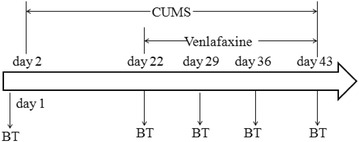
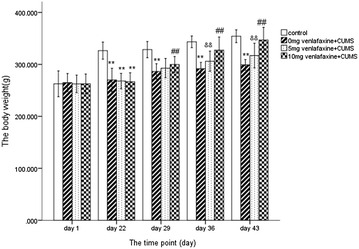
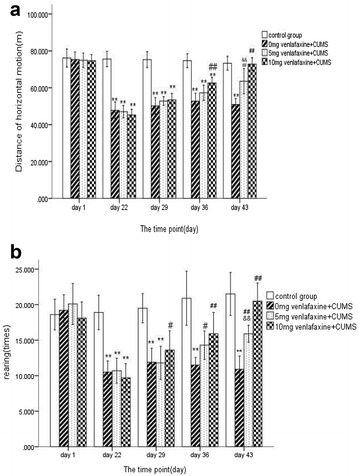
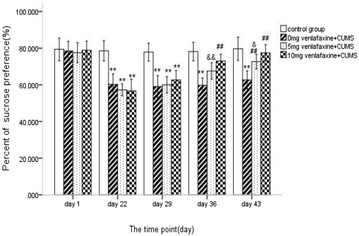
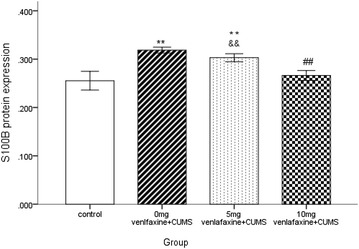
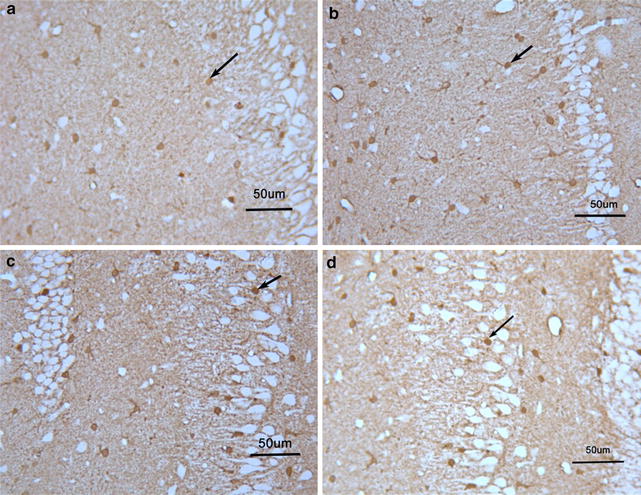
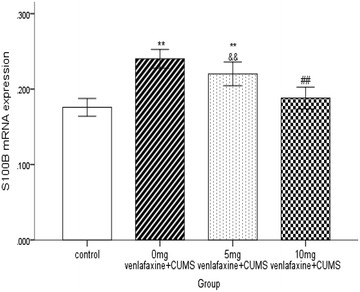
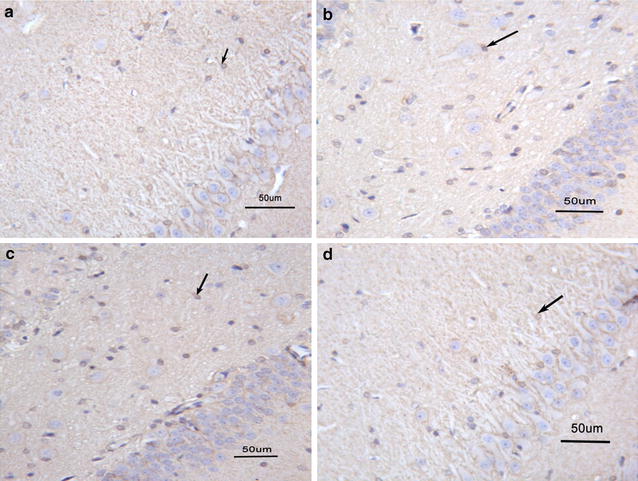
BACKGROUND: Accumulating evidence has indicated that S100B may be involved in the pathophysiology of depression. No published study has examined the effect of the antidepressant drug venlafaxine on S100B in animal models of depression. This study investigated S100B expression in the hippocampus and assessed the effect of venlafaxine on S100B mRNA level and protein expression in rats exposed to chronic unpredictable mild stress (CUMS). METHODS: Forty Sprague-Dawley rats were randomly divided into four groups as control, 0, 5 and 10 mg venlafaxine groups. The venlafaxine groups were exposed to CUMS from day 2 to day 43. Venlafaxine 0, 5 and 10 mg/kg were then administered from day 23 to day 43. We performed behavioral assessments with weight change, open-field and sucrose preference, and analyzed S100B protein expression and mRNA level in the hippocampus. RESULTS: The CUMS led to a decrease in body weight, locomotor activity and sucrose consumption, but venlafaxine treatment (10 mg) reversed these CUMS-induced decreases Also, CUMS increased S100B protein expression and mRNA level in the hippocampus, but venlafaxine treatment (10 mg) significantly decreased S100B protein expression and mRNA level, which were significantly lower than the other treatment groups, without significant difference between the 10 mg venlafaxine and the control groups. CONCLUSIONS: Our findings showed that venlafaxine treatment (10 mg) may improve the depression-like behaviors and decrease over-expression of S100B protein and mRNA in the hippocampus in a rat model of depression.
Overview
The claims and statistics of this paper haven’t been checked yet.
Free: it reads the open-access text and checks the first 5 claims that cite a source we can check. Create a free account to check every claim.
Integrity signals
Registry
Cites
Statistics
Figures
Verification
Claims the paper makes
The claims and statistics of this paper haven’t been checked yet.
Free: it reads the open-access text and checks the first 5 claims that cite a source we can check. Create a free account to check every claim.
Self-check
Percentages, sums and reported differences re-computed from the paper’s own numbers.
The self-check needs the paper’s full text.
Citations
Cites
Molecular Mechanisms of Depression: Perspectives on New Treatment Strategies
Lang, U. E., & Borgwardt, S. (2013) · Cellular Physiology and Biochemistry · doi:10.1159/000350094 · Cited by 8,475
A Meta-Analysis of Cytokines in Major Depression
Dowlati, Y., Herrmann, N., Swardfager, W., Liu, H., Sham, L., Reim, E. K., & Lanctôt, K. L. (2010) · Biological Psychiatry · doi:10.1016/j.biopsych.2009.09.033 · Cited by 4,729 · cited 1×
“It was reported that S100B protein stimulated secretion of pro-inflammatory cytokines including IL-1β, IL-6, IL-8 and tumor necrosis factor (TNF)-α through activated glial cells [37, 38], acting as proinflammatory molecule [39].”
The Economic Burden of Depression in the United States: How Did It Change Between 1990 and 2000?
Greenberg, P. E., Kessler, R. C., Birnbaum, H. G., Leong, S. A., Lowe, S. W., Berglund, P. A., & Corey-Lisle, P. K. (2003) · The Journal of Clinical Psychiatry · doi:10.4088/jcp.v64n1211 · Cited by 1,280
Liu, Y., Ho, R. C.-M., & Mak, A. (2012) · Journal of Affective Disorders · doi:10.1016/j.jad.2011.08.003 · Cited by 948 · cited 1×
“Some studies have indicated that higher blood levels of pro-inflammatory cytokines TNF-α and IL-6 in drug-free patients with depression [41, 42].”
Postmortem studies in mood disorders indicate altered numbers of neurons and glial cells
Rajkowska, G. (2000) · Biological Psychiatry · doi:10.1016/s0006-3223(00)00950-1 · Cited by 822 · cited 1×
“Recently, it has been suggested that mood disorders are characterized by disease-specific glial pathology [2, 3].”
Cotter, D., Mackay, D., Landau, S., Kerwin, R., & Everall, I. (2001) · Archives of General Psychiatry · doi:10.1001/archpsyc.58.6.545 · Cited by 766 · cited 1×
“Post mortem studies showed reductions in glial cell density or glial cell numbers in prefrontal brain regions in patients with mood disorders [4], mainly displaying alterations of astrocytes and oligodendrocytes [5].”
S100B's double life: Intracellular regulator and extracellular signal
Donato, R., Sorci, G., Riuzzi, F., Arcuri, C., Bianchi, R., Brozzi, F., Tubaro, C., & Giambanco, I. (2009) · Biochimica et Biophysica Acta (BBA) - Molecular Cell Research · doi:10.1016/j.bbamcr.2008.11.009 · Cited by 731 · cited 1×
“At nanomolar concentrations, S100B has been shown to have neurotrophic effects [30], whilst at elevated concentrations (micromolar) is neurotoxic participating in a cascade of events leading to cell death or apoptosis [31].”
Surget, A., Saxe, M., Leman, S., Ibarguen-Vargas, Y., Chalon, S., Griebel, G., Hen, R., & Belzung, C. (2008) · Biological Psychiatry · doi:10.1016/j.biopsych.2008.02.022 · Cited by 556 · cited 1×
“Discussion The CUMS-induced behavioral changes may simulate depression-like behaviors in individuals with depression, which is considered as one of the classical models [26].”
Kubera, M., Lin, A.-H., Kenis, G., Bosmans, E., van Bockstaele, D., & Maes, M. (2001) · Journal of Clinical Psychopharmacology · doi:10.1097/00004714-200104000-00012 · Cited by 343
Chronic Unpredictable Stress Decreases Cell Proliferation in the Cerebral Cortex of the Adult Rat
Banasr, M., Valentine, G. W., Li, X.-Y., Gourley, S. L., Taylor, J. R., & Duman, R. S. (2007) · Biological Psychiatry · doi:10.1016/j.biopsych.2007.02.006 · Cited by 342 · cited 1×
“Sucrose preference test The sucrose preference test was performed as described previously [19, 22, 23], with minor modification.”
Research works printed but not linked: 2
- Ambrée O Bergink V Grosse L Alferink J Drexhage HA Rothermundt M Serum markers support disease specific glial pathology in major depression J Affect Disord 2015 19 3 pyv103
- Haglid KG Yang Q Hamberger A Bergman S Widerberg A Danielsen N S-100beta stimulates neurite outgrowth in the rat sciatic nerve grafted with acellular muscle transplants Brain Res 1997 753 2 196 201 10.1016/S0006-8993(96)01463-1 9125403 · DOI
Cited by
Antoniuk, S., Bijata, M., Ponimaskin, E., & Wlodarczyk, J. (2019) · Neuroscience & Biobehavioral Reviews · doi:10.1016/j.neubiorev.2018.12.002 · Cited by 750
Hassamal, S. (2023) · Frontiers in Psychiatry · doi:10.3389/fpsyt.2023.1130989 · Cited by 578
“Venlafaxine reduced hippocampal S100b expression and reversed depressive-like behavior suggesting that high levels of S100b predict the risk for depression and antidepressant response (26).”
BackgroundThe S100B story: from biomarker to active factor in neural injury
Michetti, F., D'Ambrosi, N., Toesca, A., Puglisi, M. A., Serrano, A., Marchese, E., Corvino, V., & Geloso, M. C. (2019) · Journal of Neurochemistry · doi:10.1111/jnc.14574 · Cited by 410
Depression and sterile inflammation: essential role of danger associated molecular patterns
Franklin, T. C., Xu, C., & Duman, R. S. (2018) · Brain, Behavior, and Immunity · doi:10.1016/j.bbi.2017.10.025 · Cited by 204
Kim, J., Suh, Y.-H., & Chang, K.-A. (2021) · Molecular Brain · doi:10.1186/s13041-020-00726-x · Cited by 116
“Louis, MO, USA), a serotonin-norepinephrine reuptake inhibitor (SNRI) anti-depressant, was dissolved in normal saline [40].”
Background
Metadata
- Authors
- Wang, C.-H., Gu, J.-Y., Zhang, X.-L., Dong, J., Yang, J., Zhang, Y.-L., Ning, Q.-F., Shan, X.-W., & Li, Y.
- Affiliations
- Henan Psychiatric Hospital (CN)
- Zhengzhou University (CN)
- Corresponding author
- Li, Yan
- ORCID
- Li, Yan
- Venue
- Behavioral and Brain Functions
- Published
- 2016-12
- Volume
- 12
- Issue
- 1
- Pages
- 34-34
- ISSN
- 1744-9081 (ISSN-L)
- PMC
- PMC5146825
- OpenAlex
- W2560636583
- Cited by
- 33
- References
- 50
- Citations by year
- 2026: 1 · 2025: 1 · 2024: 7 · 2023: 2 · 2022: 3 · 2021: 6 · 2020: 4 · 2019: 3 · 2018: 4 · 2017: 2
- FWCI
- 2.42
- Type
- journal article
- Language
- en
- Open access
- gold
- doi.org
- Licence
- cc-by
- Locations
- Behavioral and Brain Functions (publishedVersion, cc-by)
- Europe PMC (PubMed Central) (publishedVersion, cc-by)
- PubMed Central (publishedVersion, cc-by)
- PubMed (publishedVersion)
- Funders
- The Medical Technology Foundation of Henan Province (142300410025, 112102310211)
- Scientific Research Fund of Xinxiang Medical University (2013ZD117)
- research innovation support plan project of Xinxiang Medical School graduate studen (YJSCX201243Y)
- Science Technology Department of Technology research projects in Henan Science (102101310400)
- National Natural Science Foundation of China (81671346)
- Topics
- Health Sciences › Medicine › Pharmacology (medical) › Treatment of Major Depression
- Life Sciences › Biochemistry, Genetics and Molecular Biology › Molecular Biology › S100 Proteins and Annexins
- Life Sciences › Neuroscience › Biological Psychiatry › Tryptophan and brain disorders
- Keywords
- venlafaxine, S100B, depression, hippocampus, chronic unpredictable mild stress, antidepressant effects, depression-like behavior, sucrose preference, locomotor activity, weight loss
- MeSH terms
- Venlafaxine Hydrochloride, Animals, Body Weight, Depression, Disease Models, Animal, Gene Expression Regulation, Hippocampus, Male, Random Allocation, Stress, Psychological, Rats, Sprague-Dawley, Antidepressive Agents, Second-Generation, Rats, S100 Calcium Binding Protein beta Subunit
About these checks
Registry, retraction, Cites and statistics results are computed, not judged, with one exception: a printed reference that no index lists is read once by a model before it counts as a citation error. Claims are extracted by a model and kept only when their quote appears verbatim in the text; each cited source is then checked, with a model’s help, for whether it says what the claim relies on. Those verdicts can be wrong — read the claim’s quote and the cited source before relying on one.
Statistics and arithmetic are recomputed, not judged.
Confidence bands are shown only for fields calibrated on our annotated test set. None is calibrated yet, so no band is shown.
What counts as a claim ›How we measure confidence ›How we check this ›
Are you an author, or do you see a problem with this page? Request a review
Data sources
Bibliographic data: Semantic Scholar, OpenAlex, Crossref.
Contains information from the Semantic Scholar Academic Graph Datasets, made available under the ODC Attribution License (ODC-BY 1.0).
Semantic Scholar’s data is described in: Kinney, R., et al. (2023). The Semantic Scholar Open Data Platform. arXiv:2301.10140.
