

What impact do personality traits have on self-perception of dental aesthetics?
Open accessThe DOI matches its Crossref record; 26 of the 28 references it cites were found in a registry or an index.
Abstract
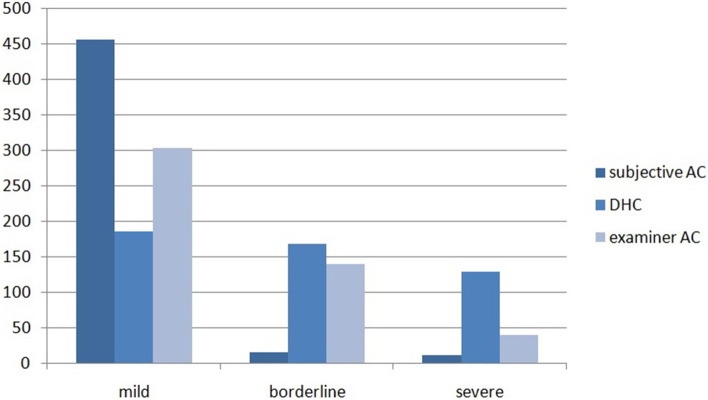
Background: Malocclusion has significant social, psychological and physical impacts on the quality of life. This study aimed to study psychosocial impact of dental aesthetics among students, and how it was modified by personality traits. Methods: Chinese version of Eysenck Personality Questionnaire Short Scale of (EPQ-RSC) and Chinese version of Psychosocial Impact of Dental Aesthetics Questionnaire (PIDAQ) were used to investigate 555 undergraduate students, aged 18 to 24 years. The participants and investigators self-rated their own dental aesthetics using the Aesthetic Component (AC) of the Index of Orthodontic Treatment Need (IOTN). The malocclusion was assessed by two independent investigators using the Dental Health Component (DHC) of IOTN. Results: No statistically significant difference was found for gender (p = 0.829) nor for majors (p = 0.598) in the psychosocial impact of dental aesthetics. Total and subscale PIDAQ scores differed significantly among the 3 IOTN grades. PIDAQ scores strongly correlated with Eysenck personality. The dimensions of extraversion and neuroticism, and dental health component grades had significant impact on participants' psychosocial well-being of dental aesthetics. Conclusions: Neurotic people with high self-concerns perceived greater psychosocial impact. Outgoing people appear to be less affected psychosocially by dental aesthetics.
Overview
The claims and statistics of this paper haven’t been checked yet.
Free: it reads the open-access text and checks the first 5 claims that cite a source we can check. Create a free account to check every claim.
Integrity signals
Registry
Cites
Statistics
Figures
Verification
Claims the paper makes
The claims and statistics of this paper haven’t been checked yet.
Free: it reads the open-access text and checks the first 5 claims that cite a source we can check. Create a free account to check every claim.
Claims other papers make about this one
Each is checked against this paper’s own text: does it say what the citing paper says it does?
The check wasn’t confident either way, so it gives no verdict — never disputed.
In the citing paper
“Research suggests that sleep deprivation may distort appearance perception, making individuals more likely to focus on perceived “flaws,” thereby reinforcing a harmful cycle [12].”
From Correlation between latent categories of body image and sleep quality in adolescent orthodontic patients. (2025) · cites this paper as [12]
Experimental — accuracy not yet measured
Self-check
Percentages, sums and reported differences re-computed from the paper’s own numbers.
The self-check needs the paper’s full text.
Citations
Cites
(1995) · Social Science & Medicine · doi:10.1016/0277-9536(95)00112-k · Cited by 7,643
Gender Similarities and Differences
Hyde, J. S. (2014) · Annual Review of Psychology · doi:10.1146/annurev-psych-010213-115057 · Cited by 1,262 · cited 1×
“The importance of culture in shaping these gender differences could be further investigated [21].”
BackgroundKlages, U., Claus, N., Wehrbein, H., & Zentner, A. (2006) · European Journal of Orthodontics · doi:10.1093/ejo/cji083 · Cited by 327 · cited 3×
“The four sub-domains of PIDAQ include items referring to latent unpleasant social issues, inferiority complexes, dislike of dental appearance and impacts on personal pride respectively [8].”
BackgroundInfluentialKragt, L., Dhamo, B., Wolvius, E. B., & Ongkosuwito, E. M. (2016) · Clinical Oral Investigations · doi:10.1007/s00784-015-1681-3 · Cited by 224 · cited 1×
“Oral Health-related Quality of life (OHrQol), a multidimensional construct to evaluate dental treatment needs and outcomes, is therefore introduced to meet the criteria of health [7].”
BackgroundOral health-related quality of life and orthodontic treatment seeking
Feu, D., de Oliveira, B. H., de Oliveira Almeida, M. A., Kiyak, H. A., & Miguel, J. A. M. (2010) · American Journal of Orthodontics and Dentofacial Orthopedics · doi:10.1016/j.ajodo.2008.09.033 · Cited by 214 · cited 1×
“However, clinical experience and other studies indicated that some patients were under critical psychosocial impacts even due to mild malocclusion [24].”
McManus, I. C., & Furnham, A. (2006) · British Journal of Psychology · doi:10.1348/000712606x101088 · Cited by 199 · cited 2×
“This may be a result of individual personalities affecting their aesthetic attitudes [9].”
BackgroundDental and social effects of malocclusion and effectiveness of orthodontic treatment: a review
Shaw, W. C., Addy, M., & Ray, C. (1980) · Community Dentistry and Oral Epidemiology · doi:10.1111/j.1600-0528.1980.tb01252.x · Cited by 195 · cited 2×
“Although malocclusion is neither conventionally accepted as a disease nor treated by professional as a lifethreatening condition, it has significant social, psychological and physical impacts on the quality of life, which is thought to worsen with the increased severity of misalignment [1, 2].”
BackgroundBadran, S. (2010) · European Journal of Orthodontics · doi:10.1093/ejo/cjq014 · Cited by 173 · cited 2×
“Although malocclusion is neither conventionally accepted as a disease nor treated by professional as a lifethreatening condition, it has significant social, psychological and physical impacts on the quality of life, which is thought to worsen with the increased severity of misalignment [1, 2].”
BackgroundAssociation of orthodontic treatment needs and oral health-related quality of life in young adults
Hassan, A. H., & Amin, H. E. (2009) · American Journal of Orthodontics and Dentofacial Orthopedics · doi:10.1016/j.ajodo.2008.02.024 · Cited by 160 · cited 1×
“This study targets at young adults (university students)because it is likely more accurate to analyze their self-perceived psychosocial impact, as they have already possessed a certain emotional stability and a more realistic view of dental-facial aesthetics [18].”
BackgroundAfroz, S., Rathi, S., Rajput, G., & Rahman, S. A. (2013) · The Journal of Indian Prosthodontic Society · doi:10.1007/s13191-012-0247-1 · Cited by 156 · cited 1×
“While others found higher needs for females or even the opposite result [20].”
Background
Research works printed but not linked: 4
- Jiang Q Primary exploration of comprehensive assessing of psychosocial stress Chin J Behav Med Sci 1998 03 20 22
- Qian M Wu G Zhu R Zhang X Development of the revised eysenck personality questionnaire short scale for Chinese (EPQ-RSC) Acta Psychol Sin 2000 03 317 323
- Eysenck HJ Eysenck SBG Manual of the Eysenck Personality Questionnaire 1975 London Hodder and Stoughton
- Xing S Yu G A review on research of social comparison Adv Psychol Sci 2005 01 78 84
Cited by
Zhao, H., Daraqel, B., Jiang, M., Zhang, T., Li, X., Sun, J., & Zheng, L. (2024) · American Journal of Orthodontics and Dentofacial Orthopedics · doi:10.1016/j.ajodo.2024.09.012 · Cited by 7
Wang, B. L., & Yang, M. L. (2024) · Medicine · doi:10.1097/md.0000000000039435 · Cited by 7
“[12] During treatment, it is important to help patients set realistic expectations by explaining the surgical procedures, maintaining effective communication, sharing postoperative photos.”
BackgroundXu, C., Zhang, Y., Xiong, B., Wang, H., & Liang, M. (2025) · BMC Oral Health · doi:10.1186/s12903-025-06571-5 · Cited by 3
“Numerous studies indicate that adolescents commonly experience issues such as insufficient sleep, poor sleep quality, insomnia, and disrupted sleep patterns [12].”
Alhajri, D., Alhammad, D., Alabdulqader, L., Alasbly, R. R., Alhareky, M., Algahtani, M., Al-Ansari, A., & Nazir, M. (2025) · BMC Oral Health · doi:10.1186/s12903-025-05503-7 · Cited by 2
“Additionally, students with high extraversion are significantly less affected by psychological impact, social impact, and aesthetic concerns of dental aesthetic [40].”
Anagnostou, C., Zogakis, I. P., Pagkozidis, I., Matiakis, A., Tirodimos, I., Dardavesis, T. I., & Tsimtsiou, Z. (2026) · Dentistry Journal · doi:10.3390/dj14010014 · Cited by 2
“In line with earlier research, gender was not identified as a significant determinant of satisfaction with dental appearance [23–26], suggesting that perceptions of oral aesthetics are largely independent of it.”
Marija, B., Pavičić, D. K., Šango, A., Brumini, M., & Stjepan, Š. (2025) · Head & Face Medicine · doi:10.1186/s13005-025-00536-3 · Cited by 2
“These findings suggest the value of a personalized approach in cosmetic dental treatments, emphasizing the need for practitioners to consider personality characteristics when managing patient expectations.”
Al-Bitar, Z. B., Attari, N., Arqub, S. A., & AL-Omiri, M. K. (2025) · Progress in Orthodontics · doi:10.1186/s40510-025-00599-7 · Cited by 4
“This contrasts with previous studies, which suggested that neurotic individuals are more self-conscious about dental aesthetics and associate excessive gingival display with psychosocial discomfort [19, 55].”
Severe malocclusion and oral health-related quality of life in adolescents aged 12-15 years
Oliveira, C. D. C. P., Oliveira, M. V. D. S., Lira, C. A. A., CATÃO, N. E. D. S., Lourenço, L. D. C., Ramalho, R. D. G., Cavalcanti, A. L., & Cavalcanti, A. F. C. (2024) · Dental Press Journal of Orthodontics · doi:10.1590/2177-6709.29.6.e2424100.oar
Huang, J., He, J., Niu, T., Huang, J., Lan, J. Y., Li, G. S., Yang, R., & Tian, L. (2026) · Medicine · doi:10.1097/md.0000000000047832
“[19,20] This study focused on evaluating the correlation between smile aesthetics and OHRQoL among 18-to 23-year-old undergraduates from various universities in Kunming City.”
Factors influencing high expectations in patients undergoing corneal transplantation
Wufuer, A., Liu, X., Ma, J., Tan, S., & 周, 琪. (2026) · Scientific Reports · doi:10.1038/s41598-026-44105-3
Hong, X., Zhang, X., Chen, W., Ke, W., & Chen, Z. (2026) · Research Square · doi:10.21203/rs.3.rs-9192298/v1
Singh, A., Jamieson, L., Guzzo, G. L., Santiago, P. H. R., Groundwater, J., Hedges, J., Aiyar, R., Kapellas, K., & Nath, S. (2026) · Australian Journal of Psychology · doi:10.1080/00049530.2026.2721654
“But the current evidence suggests, self-perception of dental aesthetics is highly subjective and frequently driven by internal psychological factors such as personality, which sometimes outweigh external judgements (Xu et al., 2023).”
Metadata
- Authors
- Xu, Q., Du, W., & Lin, F.
- Affiliations
- Wenzhou Medical University (CN)
- Corresponding author
- Lin, Feiou
- ORCID
- Venue
- Head & Face Medicine
- Published
- 2023-03-15
- Volume
- 19
- Issue
- 1
- Pages
- 11-11
- ISSN
- 1746-160X (ISSN-L)
- PMC
- PMC10015677
- OpenAlex
- W4324360414
- Semantic Scholar
- bd99a448631bc7193eab2eb26f8e8a2ba25d51b5
- Cited by
- 12
- References
- 28
- Citations by year
- 2026: 5 · 2025: 4 · 2024: 3
- FWCI
- 3.12
- Type
- journal article
- Language
- en
- Open access
- gold
- doi.org
- Licence
- cc-by
- creativecommons.org/licenses/by/4.0 (tdm)
- creativecommons.org/licenses/by/4.0 (vor)
- Locations
- Head & Face Medicine (publishedVersion, cc-by)
- PubMed Central (publishedVersion, cc-by)
- PubMed (publishedVersion)
- DOAJ (DOAJ: Directory of Open Access Journals) (submittedVersion, cc-by-sa)
- Topics
- Health Sciences › Dentistry › Orthodontics › Orthodontics and Dentofacial Orthopedics
- Social Sciences › Psychology › Clinical Psychology › Body Image and Dysmorphia Studies
- Social Sciences › Psychology › Clinical Psychology › Personality Traits and Psychology
- Keywords
- dental aesthetics, malocclusion, personality traits, extraversion, neuroticism, psychosocial impact, self-perception, Index of Orthodontic Treatment Need, undergraduate students, self-concern, quality of life
- MeSH terms
- Esthetics, Dental, Humans, Malocclusion, Personality, Quality of Life, Surveys and Questionnaires, Self Concept
About these checks
Registry, retraction, Cites and statistics results are computed, not judged, with one exception: a printed reference that no index lists is read once by a model before it counts as a citation error. Claims are extracted by a model and kept only when their quote appears verbatim in the text; each cited source is then checked, with a model’s help, for whether it says what the claim relies on. Those verdicts can be wrong — read the claim’s quote and the cited source before relying on one.
Statistics and arithmetic are recomputed, not judged.
Confidence bands are shown only for fields calibrated on our annotated test set. None is calibrated yet, so no band is shown.
What counts as a claim ›How we measure confidence ›How we check this ›
Are you an author, or do you see a problem with this page? Request a review
Data sources
Bibliographic data: Semantic Scholar, OpenAlex, Crossref.
Contains information from the Semantic Scholar Academic Graph Datasets, made available under the ODC Attribution License (ODC-BY 1.0).
Semantic Scholar’s data is described in: Kinney, R., et al. (2023). The Semantic Scholar Open Data Platform. arXiv:2301.10140.
