

What impact do personality traits have on self-perception of dental aesthetics?
Open accessThe DOI matches its Crossref record; 26 of the 28 references it cites were found in a registry or an index.
Abstract
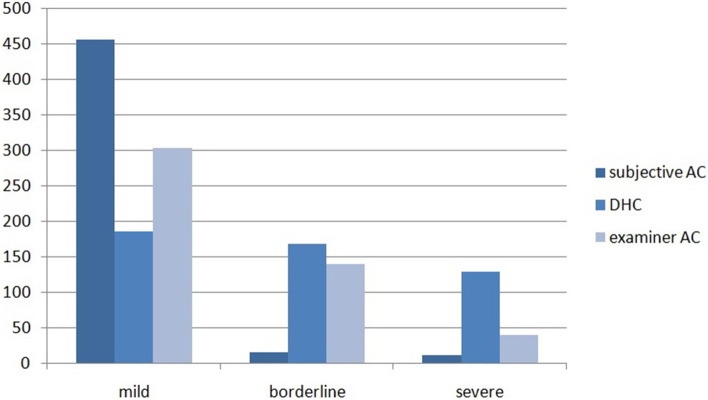
Background: Malocclusion has significant social, psychological and physical impacts on the quality of life. This study aimed to study psychosocial impact of dental aesthetics among students, and how it was modified by personality traits. Methods: Chinese version of Eysenck Personality Questionnaire Short Scale of (EPQ-RSC) and Chinese version of Psychosocial Impact of Dental Aesthetics Questionnaire (PIDAQ) were used to investigate 555 undergraduate students, aged 18 to 24 years. The participants and investigators self-rated their own dental aesthetics using the Aesthetic Component (AC) of the Index of Orthodontic Treatment Need (IOTN). The malocclusion was assessed by two independent investigators using the Dental Health Component (DHC) of IOTN. Results: No statistically significant difference was found for gender (p = 0.829) nor for majors (p = 0.598) in the psychosocial impact of dental aesthetics. Total and subscale PIDAQ scores differed significantly among the 3 IOTN grades. PIDAQ scores strongly correlated with Eysenck personality. The dimensions of extraversion and neuroticism, and dental health component grades had significant impact on participants' psychosocial well-being of dental aesthetics. Conclusions: Neurotic people with high self-concerns perceived greater psychosocial impact. Outgoing people appear to be less affected psychosocially by dental aesthetics.
Overview
The claims and statistics of this paper haven’t been checked yet.
Free: it reads the open-access text and checks the first 5 claims that cite a source we can check. Create a free account to check every claim.
Integrity signals
Registry
Cites
Statistics
Figures
Verification
Claims the paper makes
The claims and statistics of this paper haven’t been checked yet.
Free: it reads the open-access text and checks the first 5 claims that cite a source we can check. Create a free account to check every claim.
Claims other papers make about this one
Each is checked against this paper’s own text: does it say what the citing paper says it does?
The check wasn’t confident either way, so it gives no verdict — never disputed.
In the citing paper
“Research suggests that sleep deprivation may distort appearance perception, making individuals more likely to focus on perceived “flaws,” thereby reinforcing a harmful cycle [12].”
From Correlation between latent categories of body image and sleep quality in adolescent orthodontic patients. (2025) · cites this paper as [12]
Experimental — accuracy not yet measured
Self-check
Percentages, sums and reported differences re-computed from the paper’s own numbers.
The self-check needs the paper’s full text.
Citations
Cites
(1995) · Social Science & Medicine · doi:10.1016/0277-9536(95)00112-k · Cited by 7,643
Gender Similarities and Differences
Hyde, J. S. (2014) · Annual Review of Psychology · doi:10.1146/annurev-psych-010213-115057 · Cited by 1,262 · cited 1×
“The importance of culture in shaping these gender differences could be further investigated [21].”
BackgroundKlages, U., Claus, N., Wehrbein, H., & Zentner, A. (2006) · European Journal of Orthodontics · doi:10.1093/ejo/cji083 · Cited by 327 · cited 3×
“The four sub-domains of PIDAQ include items referring to latent unpleasant social issues, inferiority complexes, dislike of dental appearance and impacts on personal pride respectively [8].”
BackgroundInfluentialKragt, L., Dhamo, B., Wolvius, E. B., & Ongkosuwito, E. M. (2016) · Clinical Oral Investigations · doi:10.1007/s00784-015-1681-3 · Cited by 224 · cited 1×
“Oral Health-related Quality of life (OHrQol), a multidimensional construct to evaluate dental treatment needs and outcomes, is therefore introduced to meet the criteria of health [7].”
BackgroundOral health-related quality of life and orthodontic treatment seeking
Feu, D., de Oliveira, B. H., de Oliveira Almeida, M. A., Kiyak, H. A., & Miguel, J. A. M. (2010) · American Journal of Orthodontics and Dentofacial Orthopedics · doi:10.1016/j.ajodo.2008.09.033 · Cited by 214 · cited 1×
“However, clinical experience and other studies indicated that some patients were under critical psychosocial impacts even due to mild malocclusion [24].”
McManus, I. C., & Furnham, A. (2006) · British Journal of Psychology · doi:10.1348/000712606x101088 · Cited by 199 · cited 2×
“This may be a result of individual personalities affecting their aesthetic attitudes [9].”
BackgroundDental and social effects of malocclusion and effectiveness of orthodontic treatment: a review
Shaw, W. C., Addy, M., & Ray, C. (1980) · Community Dentistry and Oral Epidemiology · doi:10.1111/j.1600-0528.1980.tb01252.x · Cited by 195 · cited 2×
“Although malocclusion is neither conventionally accepted as a disease nor treated by professional as a lifethreatening condition, it has significant social, psychological and physical impacts on the quality of life, which is thought to worsen with the increased severity of misalignment [1, 2].”
BackgroundBadran, S. (2010) · European Journal of Orthodontics · doi:10.1093/ejo/cjq014 · Cited by 173 · cited 2×
“Although malocclusion is neither conventionally accepted as a disease nor treated by professional as a lifethreatening condition, it has significant social, psychological and physical impacts on the quality of life, which is thought to worsen with the increased severity of misalignment [1, 2].”
BackgroundAssociation of orthodontic treatment needs and oral health-related quality of life in young adults
Hassan, A. H., & Amin, H. E. (2009) · American Journal of Orthodontics and Dentofacial Orthopedics · doi:10.1016/j.ajodo.2008.02.024 · Cited by 160 · cited 1×
“This study targets at young adults (university students)because it is likely more accurate to analyze their self-perceived psychosocial impact, as they have already possessed a certain emotional stability and a more realistic view of dental-facial aesthetics [18].”
BackgroundAfroz, S., Rathi, S., Rajput, G., & Rahman, S. A. (2013) · The Journal of Indian Prosthodontic Society · doi:10.1007/s13191-012-0247-1 · Cited by 156 · cited 1×
“While others found higher needs for females or even the opposite result [20].”
BackgroundPerceptions of dentofacial morphology by laypersons, general dentists, and orthodontists
Prahl‐Andersen, B., Boersma, H., der Linden, F. P. G. M. V., & Moore, A. W. (1979) · The Journal of the American Dental Association · doi:10.14219/jada.archive.1979.0456 · Cited by 148 · cited 1×
“As reported, both negative and positive personality traits could be attributed to dental appearance [11].”
BackgroundKerosuo, H., Enezi, S. A., Kerosuo, E., & Abdulkarim, E. (2004) · American Journal of Orthodontics and Dentofacial Orthopedics · doi:10.1016/j.ajodo.2003.04.009 · Cited by 135 · cited 2×
“Several studies have reported frequency distribution skewed to the attractive (low) end in both examiner and subject AC scores [15].”
BackgroundAL-Omiri, M. K., & Karasneh, J. A. (2010) · Journal of Prosthodontics · doi:10.1111/j.1532-849x.2009.00518.x · Cited by 95 · cited 1×
“Moreover, the present result is consistent within prosthodontic restorations [30], where there is a great demand of dental aesthetics too.”
ResultCardoso, C. F., Drummond, A. F., Lages, E. M. B., Pretti, H., Ferreira, E. F. E., & de Abreu, M. H. N. G. (2011) · International Journal of Environmental Research and Public Health · doi:10.3390/ijerph8083277 · Cited by 80 · cited 1×
“Among them, IOTN provides much more accurate measurement with rapid implementation [5], because IOTN measures both requirements on the Dental Health Component(DHC) as well as the Aesthetic Component(AC).”
BackgroundPsychosocial impact of dental esthetics regulates motivation to seek orthodontic treatment
Lin, F., Ren, M., Yao, L., He, Y., Guo, J., & Ye, Q. (2016) · American Journal of Orthodontics and Dentofacial Orthopedics · doi:10.1016/j.ajodo.2016.02.024 · Cited by 79 · cited 1×
“These may provide a new direction for orthodontic and dental-aesthetic field [25].”
BackgroundSelf-citationKlages, U., Erbe, C., Sandru, S. D., Brüllman, D., & Wehrbein, H. (2014) · Quality of Life Research · doi:10.1007/s11136-014-0767-8 · Cited by 75 · cited 2×
“Some researchers have demonstrated the same result of slight or no gender difference as we did [19].”
BackgroundResultLin, H., Quan, C., Guo, C., Zhou, C., Wang, Y., & Bao, B. (2011) · European Journal of Orthodontics · doi:10.1093/ejo/cjr136 · Cited by 62 · cited 1×
“The Chinese version of PIDAQ has been tested for its validity, reliability, and factorial stability [16].”
BackgroundAL-Omiri, M. K., Quran, F. A. A., Hamad, K. Q. A., & Karasneh, J. A. (2009) · The Journal of Contemporary Dental Practice · doi:10.5005/jcdp-10-6-49 · Cited by 61 · cited 1×
“However, it has been reported that psychological factors might influence dental perceptions, which play a significant role in forming satisfaction with dental appearance, and serve to predict their effect on daily living [29].”
BackgroundKumar, P., Londhe, S. M., Kotwal, A., & Mitra, R. (2012) · Medical Journal Armed Forces India · doi:10.1016/j.mjafi.2012.02.003 · Cited by 44 · cited 1×
“Meanwhile, need for orthodontic treatment shows a continuous increase in dental care services [1, 4].”
BackgroundThe impact of dental appearance and anxiety on self‐esteem in adult orthodontic patients
Romero‐Maroto, M., Santos-Puerta, N., González‐Olmo, M. J., & Peñacoba‐Puente, C. (2015) · Orthodontics and Craniofacial Research · doi:10.1111/ocr.12091 · Cited by 36 · cited 1×
“For example, negative inclinations are always associated with passive self-assessment of dental appearance [2, 12].”
BackgroundDa-hong, X., Xiangrong, C., Liu, Y., Yusong, L., Ying, G., & Yan, S. (2012) · The Angle Orthodontist · doi:10.2319/062012-508.1 · Cited by 31 · cited 1×
“Moreover, all PIDAQ domains were scored variously in each type of malocclusion [23].”
BackgroundBrouns, V. E. H. W., de Waal, A.-L. M. L., Bronkhorst, E. M., Kuijpers‐Jagtman, A. M., & Ongkosuwito, E. M. (2022) · Clinical Oral Investigations · doi:10.1007/s00784-021-04288-7 · Cited by 29
Špalj, S., Novšak, A., Bilobrk, P., Katić, V., Zrinski, M. T., & Pavlić, A. (2015) · The Angle Orthodontist · doi:10.2319/032315-187.1 · Cited by 25 · cited 1×
“found psychosocial outcomes could be well predicted by agreeableness and conscientiousness, while neuroticism, extraversion or openness did not correlate closely [28].”
BackgroundEysenck personality and psychosocial status of adult patients with malocclusion
Zhang, L., Liu, X., Gen-jian, Z., Zhou, L., Lin, D.-Y., Wang, X.-D., & He, H. (2012) · Asian Pacific Journal of Tropical Medicine · doi:10.1016/s1995-7645(12)60015-7 · Cited by 20 · cited 17×
“Methods Chinese version of Eysenck Personality Questionnaire Short Scale of (EPQ-RSC) and Chinese version of Psychosocial Impact of Dental Aesthetics Questionnaire (PIDAQ) were used to investigate 555 undergraduate students, aged 18 to 24 years.”
BackgroundInfluentialPERFECTIONISM AND COSMETIC SURGERY
Hewitt, P. L., Sherry, S., Flett, G. L., & Shick, R. (2003) · Plastic & Reconstructive Surgery · doi:10.1097/01.prs.0000067100.50738.73 · Cited by 19 · cited 1×
“Furthermore, researchers in both cosmetic and orthognathic specialties found better accepted treatment outcomes when psychological characteristics of the patients were taken into account during treatment planning [10].”
BackgroundSolomon, D., Katz, R. V., Bush, A. C., Farley, V. K., McGerr, T. J., Min, H., Carbonella, A. M., & Kayne, J. D. (2016) · PubMed · Cited by 8
Research works printed but not linked: 4
- Jiang Q Primary exploration of comprehensive assessing of psychosocial stress Chin J Behav Med Sci 1998 03 20 22
- Qian M Wu G Zhu R Zhang X Development of the revised eysenck personality questionnaire short scale for Chinese (EPQ-RSC) Acta Psychol Sin 2000 03 317 323
- Eysenck HJ Eysenck SBG Manual of the Eysenck Personality Questionnaire 1975 London Hodder and Stoughton
- Xing S Yu G A review on research of social comparison Adv Psychol Sci 2005 01 78 84
Cited by
Zhao, H., Daraqel, B., Jiang, M., Zhang, T., Li, X., Sun, J., & Zheng, L. (2024) · American Journal of Orthodontics and Dentofacial Orthopedics · doi:10.1016/j.ajodo.2024.09.012 · Cited by 7
Wang, B. L., & Yang, M. L. (2024) · Medicine · doi:10.1097/md.0000000000039435 · Cited by 7
“[12] During treatment, it is important to help patients set realistic expectations by explaining the surgical procedures, maintaining effective communication, sharing postoperative photos.”
BackgroundXu, C., Zhang, Y., Xiong, B., Wang, H., & Liang, M. (2025) · BMC Oral Health · doi:10.1186/s12903-025-06571-5 · Cited by 3
“Numerous studies indicate that adolescents commonly experience issues such as insufficient sleep, poor sleep quality, insomnia, and disrupted sleep patterns [12].”
Alhajri, D., Alhammad, D., Alabdulqader, L., Alasbly, R. R., Alhareky, M., Algahtani, M., Al-Ansari, A., & Nazir, M. (2025) · BMC Oral Health · doi:10.1186/s12903-025-05503-7 · Cited by 2
“Additionally, students with high extraversion are significantly less affected by psychological impact, social impact, and aesthetic concerns of dental aesthetic [40].”
Anagnostou, C., Zogakis, I. P., Pagkozidis, I., Matiakis, A., Tirodimos, I., Dardavesis, T. I., & Tsimtsiou, Z. (2026) · Dentistry Journal · doi:10.3390/dj14010014 · Cited by 2
“In line with earlier research, gender was not identified as a significant determinant of satisfaction with dental appearance [23–26], suggesting that perceptions of oral aesthetics are largely independent of it.”
Metadata
- Authors
- Xu, Q., Du, W., & Lin, F.
- Affiliations
- Wenzhou Medical University (CN)
- Corresponding author
- Lin, Feiou
- ORCID
- Venue
- Head & Face Medicine
- Published
- 2023-03-15
- Volume
- 19
- Issue
- 1
- Pages
- 11-11
- ISSN
- 1746-160X (ISSN-L)
- PMC
- PMC10015677
- OpenAlex
- W4324360414
- Cited by
- 12
- References
- 28
- Citations by year
- 2026: 5 · 2025: 4 · 2024: 3
- FWCI
- 3.12
- Type
- journal article
- Language
- en
- Open access
- gold
- doi.org
- Licence
- cc-by
- creativecommons.org/licenses/by/4.0 (tdm)
- creativecommons.org/licenses/by/4.0 (vor)
- Locations
- Head & Face Medicine (publishedVersion, cc-by)
- PubMed Central (publishedVersion, cc-by)
- PubMed (publishedVersion)
- DOAJ (DOAJ: Directory of Open Access Journals) (submittedVersion, cc-by-sa)
- Topics
- Health Sciences › Dentistry › Orthodontics › Orthodontics and Dentofacial Orthopedics
- Social Sciences › Psychology › Clinical Psychology › Body Image and Dysmorphia Studies
- Social Sciences › Psychology › Clinical Psychology › Personality Traits and Psychology
- Keywords
- dental aesthetics, malocclusion, personality traits, extraversion, neuroticism, psychosocial impact, self-perception, Index of Orthodontic Treatment Need, undergraduate students, self-concern, quality of life
- MeSH terms
- Esthetics, Dental, Humans, Malocclusion, Personality, Quality of Life, Surveys and Questionnaires, Self Concept
About these checks
Registry, retraction, Cites and statistics results are computed, not judged, with one exception: a printed reference that no index lists is read once by a model before it counts as a citation error. Claims are extracted by a model and kept only when their quote appears verbatim in the text; each cited source is then checked, with a model’s help, for whether it says what the claim relies on. Those verdicts can be wrong — read the claim’s quote and the cited source before relying on one.
Statistics and arithmetic are recomputed, not judged.
Confidence bands are shown only for fields calibrated on our annotated test set. None is calibrated yet, so no band is shown.
What counts as a claim ›How we measure confidence ›How we check this ›
Are you an author, or do you see a problem with this page? Request a review
Data sources
Bibliographic data: Semantic Scholar, OpenAlex, Crossref.
Contains information from the Semantic Scholar Academic Graph Datasets, made available under the ODC Attribution License (ODC-BY 1.0).
Semantic Scholar’s data is described in: Kinney, R., et al. (2023). The Semantic Scholar Open Data Platform. arXiv:2301.10140.
