

Historical-qualitative analysis of breastfeeding trends in three OECD countries
Open accessThe DOI matches its Crossref record; 27 of the 28 references it cites were found in a registry or an index, and 1 are not checked yet.
Abstract
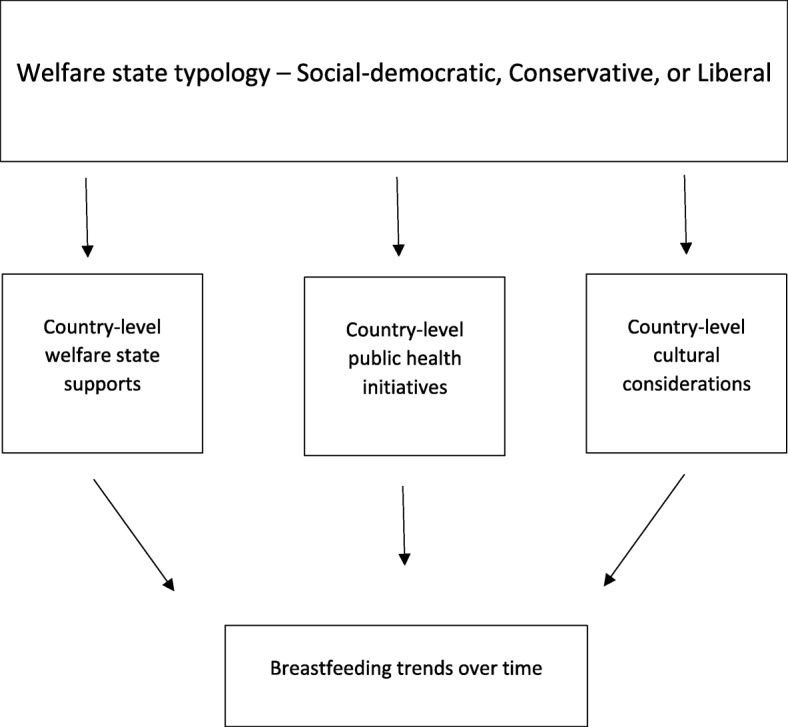
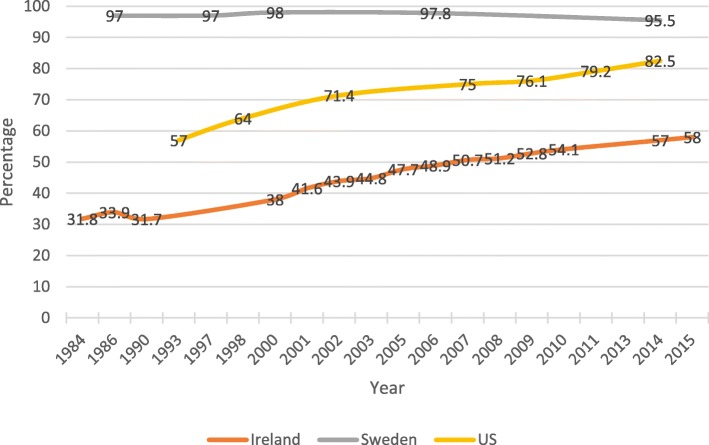
Background: Breastfeeding rates among high income, western countries vary considerably. This research examines three countries, Sweden, Ireland, and the United States, with respect to both public health initiatives and policy initiatives. Methods: This article uses a historical qualitative analysis of breastfeeding rates over time. It uses the welfare state structure as a framework for understanding the variation in breastfeeding outcomes among these three countries. Results: With its strong family policies and early adherence to international public health recommendations, Sweden was able to build high rates of breastfeeding initiation and duration. However, Sweden's breastfeeding rates have been declining, which may be a result of increasing encouragement for fathers to take equal leave, and because Sweden is no longer prioritizing breastfeeding in its public health goals. Ireland has experienced rapid growth of both breastfeeding initiation and participation in the Baby-Friendly Hospital Initiative, though its rates still lag behind much of the Western world. The United States has seen increases in participation with the Baby-Friendly Hospital Initiative, but lacks state support in public health and labor policies. Conclusion: This analysis suggests that in a country with a strong welfare state and early adoption of internationally recommended public policy, breastfeeding is able to flourish. It also suggests that the Baby-Friendly hospital Initiative is a predictor of breastfeeding success.
Overview
The claims and statistics of this paper haven’t been checked yet.
Free: it reads the open-access text and checks the first 5 claims that cite a source we can check. Create a free account to check every claim.
Integrity signals
Registry
Cites
Statistics
Figures
Verification
Claims the paper makes
The claims and statistics of this paper haven’t been checked yet.
Free: it reads the open-access text and checks the first 5 claims that cite a source we can check. Create a free account to check every claim.
Claims other papers make about this one
Each is checked against this paper’s own text: does it say what the citing paper says it does?
The cited source says what the claim attributes to it.
In the citing paper
“Another qualitative study suggests that the decline depends on the increasing encouragement for fathers to share the parent leave equally with the mother [42].”
From Fulfilment of expectations on birth and the postpartum period – A Swedish cohort study (2022) · cites this paper as [42]
Self-check
Percentages, sums and reported differences re-computed from the paper’s own numbers.
The self-check needs the paper’s full text.
Citations
Cites
The three worlds of welfare capitalism
(1990) · Choice Reviews Online · doi:10.5860/choice.28-1046 · Cited by 16,528
International Labour Organization
(2022) · Permanent Missions to the United Nations · doi:10.18356/9789210018289c229 · Cited by 4,331
Why invest, and what it will take to improve breastfeeding practices?
Rollins, N. C., Bhandari, N., Hajeebhoy, N., Horton, S., Lutter, C. K., Martines, J. C., Piwoz, E. G., Richter, L. M., & Victora, C. G. (2016) · The Lancet · doi:10.1016/s0140-6736(15)01044-2 · Cited by 2,944
Parental Leave and Child Health
Ruhm, C. J. (1998) · Journal of Health Economics · doi:10.1016/s0167-6296(00)00047-3 · Cited by 592
Culture and Welfare State Policies: Reflections on a Complex Interrelation
PFAU-EFFINGER, B. (2005) · Journal of Social Policy · doi:10.1017/s0047279404008232 · Cited by 566
Parental leave and child health
Ruhm, C. J. (2000) · Cited by 493
Who cares? assessing generosity and gender equality in parental leave policy designs in 21 countries
Ray, R., Gornick, J. C., & Schmitt, J. (2010) · Journal of European Social Policy · doi:10.1177/0958928710364434 · Cited by 416
Gendering the Comparative Analysis of Welfare States: An Unfinished Agenda
Orloff, A. S. (2009) · Sociological Theory · doi:10.1111/j.1467-9558.2009.01350.x · Cited by 336
Boeckmann, I., Misra, J., & Budig, M. J. (2015) · Social Forces · doi:10.1093/sf/sou119 · Cited by 299
Maternity and paternity at work: Law and practice across the world
Addati, L., Cassirer, N., & Gilchrist, K. (2014) · Cited by 298
The CDC guide to breastfeeding interventions.
Shealy, K. R., Li, R., Benton-Davis, S., & Grummer-Strawn, L. M. (2005) · Cited by 177
Low Breastfeeding Rates and Public Health in the United States
Wolf, J. H. (2003) · American Journal of Public Health · doi:10.2105/ajph.93.12.2000 · Cited by 169
Protection, promotion and support of breast-feeding in Europe: current situation
Cattaneo, A., Yngve, A., Koletzko, B. V., & Guzmán, L. R. (2005) · Public Health Nutrition · doi:10.1079/phn2004660 · Cited by 163
Gender Cultures and the Division of Labour in Contemporary Europe: A Cross-National Perspective
Aboim, S. (2010) · The Sociological Review · doi:10.1111/j.1467-954x.2010.01899.x · Cited by 155
Protection, promotion and support of breast-feeding in Europe: current situation
Cattaneo, A., Yngve, A., Koletzko, B., & Guzman, L. R. (2005) · Public Health Nutrition · doi:10.1079/phn2005660 · Cited by 135
Marketing breast milk substitutes: problems and perils throughout the world
Brady, J. P. (2012) · Archives of Disease in Childhood · doi:10.1136/archdischild-2011-301299 · Cited by 131
The impact on breastfeeding of labour market policy and practice in Ireland, Sweden, and the USA
Galtry, J. (2003) · Social Science & Medicine · doi:10.1016/s0277-9536(02)00372-6 · Cited by 125
Milk, money, and madness: the culture and politics of breastfeeding
(1996) · Choice Reviews Online · doi:10.5860/choice.33-5127 · Cited by 106
Global Baby-Friendly Hospital Initiative Monitoring Data: Update and Discussion
Labbok, M. H. (2012) · Breastfeeding Medicine · doi:10.1089/bfm.2012.0066 · Cited by 106
Tarrant, R. C., Younger, K. M., Sheridan-Pereira, M., White, M. J., & Kearney, J. M. (2010) · Public Health Nutrition · doi:10.1017/s1368980009991522 · Cited by 102
Hofvander, Y. (2005) · Acta Paediatrica · doi:10.1080/08035250510032781 · Cited by 74
Session 1: Public health nutrition Breast-feeding practices in Ireland
Tarrant, R. C., & Kearney, J. M. (2008) · Proceedings of The Nutrition Society · doi:10.1017/s0029665108008665 · Cited by 46
Esterik, P. V. (2006) · Medical Entomology and Zoology · Cited by 34
Historique de la diversification alimentaire
Turck, D. (2010) · Archives de Pédiatrie · doi:10.1016/s0929-693x(10)70925-8 · Cited by 30
Breastfeeding Practices in Ireland: a Review
Tarrant, R. C., & Kearney, J. M. (2008) · Arrow@dit (Dublin Institute of Technology) · Cited by 24
Breastfeeding in Ireland: a five-year strategic action plan
Gabhainn, S. N., & Batt, V. (2010) · Cited by 18
Milk, Money and Madness: The Culture and Politics of Breastfeeding
Bar-Yam, N. B. (1996) · Journal of Human Lactation · doi:10.1177/089033449601200334 · Cited by 7
International Perspectives on the Baby-Friendly Initiative
Grgurić, J., Wen, R.-A., Kylberg, E., Ashmore, S., & MacEnroe, T. (2012) · Journal of Human Lactation · doi:10.1177/0890334412447929 · Cited by 7
Research works printed but not linked: 9
- European Commission EU project on promotion of breastfeeding in Europe. Protection, promotion and support of breastfeeding in Europe: a blueprint for action (revised) 2008 Luxembourg Directorate Public Health and Risk Assessment
- European Commission Health Programme 2008–2013: Together for health 2012 Luxembourg Office for Official Publications of the European Communities
- Centers for Disease Control and Prevention Breastfeeding among U.S. children born 2002–2014, CDC national immunization survey 2017 Atlanta U.S. Department of Health and Human Services
- Purdy J McAvoy H Cotter N Breastfeeding on the island of Ireland 2017 Dublin Institute of Public Health in Ireland
- World Health Organization. Country experiences with the baby-friendly hospital initiative: compendium of case studies around the world, vol. 2017. Geneva.
- Ray R A detailed look at parental leave policies in 21 OECD countries 2008 Washington, DC Center for Economic and Policy Research
- National Center for Health Statistics. Healthy people 2010 final review. Hyattsville, MD; 2012.
- NHMRC Clinical Trials Centre An international comparison study into the implementation of the WHO code and other breastfeeding initiatives 2011 Australia Department of Health
- Baby Friendly Health Initiative in Ireland Participants in BFHI projects 2017
Cited by
Qualitative Methods in Health Care Research
Renjith, V., Yesodharan, R., Noronha, J. A., Ladd, E., & George, A. (2021) · International Journal of Preventive Medicine · doi:10.4103/ijpvm.ijpvm_321_19 · Cited by 542
“[27] Example: Williams et al. conducted a grounded theory research to explore the nature of relationship between the sense of self and the eating disorders.”
BackgroundMethodInfluentialStordal, B. (2022) · Cancer Medicine · doi:10.1002/cam4.5288 · Cited by 181
Díaz, L., Yee, L. M., & Feinglass, J. M. (2023) · Frontiers in Public Health · doi:10.3389/fpubh.2023.1256432 · Cited by 59
“Although rates of breastfeeding in the United States have improved significantly in the last 50 years (6, 7), only one in four infants are exclusively breastfed for 6 months (1).”
BackgroundChleilat, F., Klančič, T., Ma, K., Schick, A., Nettleton, J. E., & Reimer, R. A. (2020) · Nutrients · doi:10.3390/nu12051532 · Cited by 50
Breastfeeding challenges and support in a high initiation population
Zimmerman, D. R., Kaplan, M., Shoob, H., Freisthler, M. S., Toledano, M., & Stein‐Zamir, C. (2022) · Israel Journal of Health Policy Research · doi:10.1186/s13584-022-00538-5 · Cited by 36
“Other countries (e.g., the United Kingdom, the Republic of Ireland, the United States, and France) report even lower rates of breastfeeding at the 3–4 month time period, but this is usually coupled with lower initiation rates [13].”
BackgroundInfluential
Metadata
- Authors
- Lubold, A. M.
- Affiliations
- Indiana State University (US)
- Corresponding author
- Lubold, Amanda Marie
- ORCID
- Lubold, Amanda Marie
- Venue
- International Breastfeeding Journal
- Published
- 2019-08-06
- Volume
- 14
- Issue
- 1
- Pages
- 36-36
- ISSN
- 1746-4358 (ISSN-L)
- PMC
- PMC6685244
- OpenAlex
- W2965958118
- Cited by
- 36
- References
- 27
- Citations by year
- 2026: 4 · 2025: 3 · 2024: 3 · 2023: 10 · 2022: 9 · 2021: 5 · 2020: 2
- FWCI
- 3.04
- Type
- journal article
- Language
- en
- Open access
- gold
- doi.org
- Licence
- cc-by
- creativecommons.org/licenses/by/4.0/ (tdm)
- creativecommons.org/licenses/by/4.0/ (vor)
- Locations
- International Breastfeeding Journal (publishedVersion, cc-by)
- Europe PMC (PubMed Central) (publishedVersion, cc-by)
- PubMed Central (publishedVersion, cc-by)
- PubMed (publishedVersion)
- DOAJ (DOAJ: Directory of Open Access Journals) (submittedVersion, cc-by-sa)
- Funders
- UNICEF
- Topics
- Health Sciences › Medicine › Epidemiology › Breastfeeding Practices and Influences
- Health Sciences › Nursing › Nutrition and Dietetics › Infant Nutrition and Health
- Health Sciences › Medicine › Obstetrics and Gynecology › Maternal and Perinatal Health Interventions
- Keywords
- breastfeeding rates, breastfeeding initiation, breastfeeding duration, Baby-Friendly Hospital Initiative, welfare state, family policy, public health policy, labor policy, Sweden, Ireland, United States, OECD countries
- MeSH terms
- Breast Feeding, Female, Health Promotion, Humans, Infant, Newborn, Ireland, Pregnancy, Public Policy, Socioeconomic Factors, Sweden, United States, Organisation for Economic Co-Operation and Development
About these checks
Registry, retraction, Cites and statistics results are computed, not judged, with one exception: a printed reference that no index lists is read once by a model before it counts as a citation error. Claims are extracted by a model and kept only when their quote appears verbatim in the text; each cited source is then checked, with a model’s help, for whether it says what the claim relies on. Those verdicts can be wrong — read the claim’s quote and the cited source before relying on one.
Statistics and arithmetic are recomputed, not judged.
Confidence bands are shown only for fields calibrated on our annotated test set. None is calibrated yet, so no band is shown.
What counts as a claim ›How we measure confidence ›How we check this ›
Are you an author, or do you see a problem with this page? Request a review
Data sources
Bibliographic data: Semantic Scholar, OpenAlex, Crossref.
Contains information from the Semantic Scholar Academic Graph Datasets, made available under the ODC Attribution License (ODC-BY 1.0).
Semantic Scholar’s data is described in: Kinney, R., et al. (2023). The Semantic Scholar Open Data Platform. arXiv:2301.10140.
