

The DOI matches its Crossref record; 140 of the 143 references it cites were found in a registry or an index.
Protocol: Adaptive Implementation of Effective Programs Trial (ADEPT): cluster randomized SMART trial comparing a standard versus enhanced implementation strategy to improve outcomes of a mood disorders program
Open accessAbstract
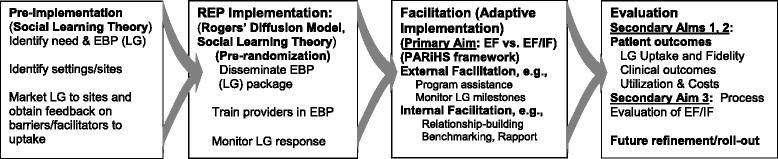
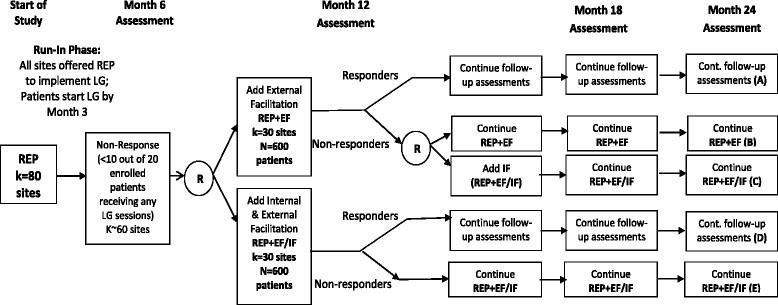
BACKGROUND: Despite the availability of psychosocial evidence-based practices (EBPs), treatment and outcomes for persons with mental disorders remain suboptimal. Replicating Effective Programs (REP), an effective implementation strategy, still resulted in less than half of sites using an EBP. The primary aim of this cluster randomized trial is to determine, among sites not initially responding to REP, the effect of adaptive implementation strategies that begin with an External Facilitator (EF) or with an External Facilitator plus an Internal Facilitator (IF) on improved EBP use and patient outcomes in 12 months. METHODS/DESIGN: This study employs a sequential multiple assignment randomized trial (SMART) design to build an adaptive implementation strategy. The EBP to be implemented is life goals (LG) for patients with mood disorders across 80 community-based outpatient clinics (N = 1,600 patients) from different U.S. regions. Sites not initially responding to REP (defined as < 50% patients receiving ≥ 3 EBP sessions) will be randomized to receive additional support from an EF or both EF/IF. Additionally, sites randomized to EF and still not responsive will be randomized to continue with EF alone or to receive EF/IF. The EF provides technical expertise in adapting LG in routine practice, whereas the on-site IF has direct reporting relationships to site leadership to support LG use in routine practice. The primary outcome is mental health-related quality of life; secondary outcomes include receipt of LG sessions, mood symptoms, implementation costs, and organizational change. DISCUSSION: This study design will determine whether an off-site EF alone versus the addition of an on-site IF improves EBP uptake and patient outcomes among sites that do not respond initially to REP. It will also examine the value of delaying the provision of EF/IF for sites that continue to not respond despite EF. TRIAL REGISTRATION: ClinicalTrials.gov identifier: NCT02151331.
Overview
The claims and statistics of this paper haven’t been checked yet.
Run the check — free, no account needed. It reads the open-access text and checks the sources it cites.
Integrity signals
Registry
Cites
Statistics
Figures
Verification
Claims the paper makes
The claims and statistics of this paper haven’t been checked yet.
Run the check — free, no account needed. It reads the open-access text and checks the sources it cites.
Claims other papers make about this one
Each is checked against this paper’s own text: does it say what the citing paper says it does?
In the citing paper
“In a subsequent study, Kilbourne et al. (2014) are using SMART to examine an adaptive version of REP (64).”
From An Overview of Research and Evaluation Designs for Dissemination and Implementation (2017) · cites this paper as [64]
Self-check
Percentages, sums and reported differences re-computed from the paper’s own numbers.
The self-check needs the paper’s full text.
Citations
Cites
The PHQ-9: Validity of a brief depression severity measure
Kroenke, K., Spitzer, R. L., & Williams, J. B. W. (2001) · Journal of General Internal Medicine · doi:10.1046/j.1525-1497.2001.016009606.x · Cited by 44,910
Self-efficacy: Toward a unifying theory of behavioral change
Bandura, A. (1977) · Psychological Review · doi:10.1037/0033-295x.84.2.191 · Cited by 43,925
Rogers, E. M., Singhal, A., & Quinlan, M. M. (2019) · Routledge eBooks · doi:10.4324/9780203710753-35 · Cited by 37,670
A Brief Measure for Assessing Generalized Anxiety Disorder: The GAD-7
Spitzer, R. L., Kroenke, K., Williams, J. B. W., & Löwe, B. (2006) · Archives of Internal Medicine · doi:10.1001/archinte.166.10.1092 · Cited by 31,765
Kytle, J., & Bandura, A. (1978) · Contemporary Sociology · doi:10.2307/2065952 · Cited by 25,422
Valente, T. W. (2003) · Genetics in Medicine · doi:10.1097/01.gim.0000061743.67794.c4 · Cited by 20,559
(1985) · Medical Entomology and Zoology · Cited by 19,180
WARE, J. E., KOSINSKI, M., & KELLER, S. D. (1996) · Medical Care · doi:10.1097/00005650-199603000-00003 · Cited by 17,392
Damschroder, L. J., Aron, D. C., Keith, R. E., Kirsh, S. R., Alexander, J. A., & Lowery, J. C. (2009) · Implementation Science · doi:10.1186/1748-5908-4-50 · Cited by 14,496
Health Behavior and Health Education: Theory, Research, and Practice
(1992) · Annals of Internal Medicine · doi:10.7326/0003-4819-116-4-350_1 · Cited by 13,232
Research works printed but not linked: 1
- Chyba MM, Washington LR: Questionnaires from the National Health Interview Survey, 1985-89. Vital Health Stat Ser. 1993, 1: 1-412.
Cited by
Sorted by citations
An introduction to implementation science for the non-specialist
Bauer, M. S., Damschroder, L. J., Hagedorn, H., Smith, J. L., & Kilbourne, A. M. (2015) · BMC Psychology · doi:10.1186/s40359-015-0089-9 · Cited by 2,168
Self-citationEnhancing the Impact of Implementation Strategies in Healthcare: A Research Agenda
Powell, B. J., Fernandez, M. E., Williams, N. J., Aarons, G. A., Beidas, R. S., Lewis, C. C., McHugh, S. M., & Weiner, B. J. (2019) · Frontiers in Public Health · doi:10.3389/fpubh.2019.00003 · Cited by 775
Implementation science should give higher priority to health equity
Brownson, R. C., Kumanyika, S., Kreuter, M. W., & Haire-Joshu, D. L. (2021) · Implementation Science · doi:10.1186/s13012-021-01097-0 · Cited by 585
An Overview of Research and Evaluation Designs for Dissemination and Implementation
Brown, C. H., Curran, G., Palinkas, L. A., Aarons, G. A., Wells, K. B., Jones, L., Collins, L. M., Duan, N., Mittman, B. S., Wallace, A., et al. (2017) · Annual Review of Public Health · doi:10.1146/annurev-publhealth-031816-044215 · Cited by 509
World Health Organization disability assessment schedule 2.0: An international systematic review
Federici, S., Bracalenti, M., Meloni, F., & Luciano, J. V. (2016) · Disability and Rehabilitation · doi:10.1080/09638288.2016.1223177 · Cited by 542
Metadata
- Authors
- Kilbourne, A. M., Almirall, D., Eisenberg, D., Waxmonsky, J., Goodrich, D. E., Fortney, J. C., Kirchner, J. E., Solberg, L. I., Main, D., Bauer, M. S., Kyle, J., Murphy, S. A., Nord, K. M., & Thomas, M. R.
- Affiliations
- VA Ann Arbor Healthcare System (US)
- University of Michigan (US)
- University of Colorado Anschutz (US)
- Health Services Research & Development (US)
- Quality Enhancement Research Initiative (US)
- HealthPartners (US)
- University of Colorado Denver (US)
- VA Boston Healthcare System (US)
- Corresponding author
- Kilbourne, Amy M
- ORCID
- Venue
- Implementation Science
- Published
- 2014-09-30
- Volume
- 9
- Issue
- 1
- Pages
- 132-132
- ISSN
- 1748-5908 (ISSN-L)
- PMC
- PMC4189548
- OpenAlex
- W1972388887
- Cited by
- 130
- References
- 143
- Citations by year
- 2026: 3 · 2025: 8 · 2024: 20 · 2023: 14 · 2022: 25 · 2021: 12 · 2020: 14 · 2019: 10 · 2018: 8 · 2017: 8 · 2016: 5 · 2015: 3
- FWCI
- 9.63
- Type
- journal article
- Language
- en
- Open access
- gold
- doi.org
- Locations
- Implementation Science (publishedVersion, cc-by)
- Europe PMC (PubMed Central) (publishedVersion, cc-by)
- PubMed Central (publishedVersion, cc-by)
- PubMed (publishedVersion)
- Deep Blue (University of Michigan) (submittedVersion)
- Digital Access to Scholarship at Harvard (DASH) (Harvard University) (submittedVersion, cc-by)
- Funders
- U.S. Public Health Service (R01 099898)
- National Institute of Mental Health (R01MH099898)
- National Institute on Drug Abuse (P50DA010075)
- Topics
- Health Sciences › Health Professions › General Health Professions › Health Policy Implementation Science
- Social Sciences › Psychology › Clinical Psychology › Psychiatric care and mental health services
- Social Sciences › Psychology › Clinical Psychology › Psychotherapy Techniques and Applications
- Keywords
- evidence-based practice uptake, mood disorders, external facilitators, community-based outpatient clinics, mental health-related quality of life, implementation costs, organizational change, sequential multiple assignment randomized trial, ADEPT
- MeSH terms
- Community Mental Health Services, Humans, Program Development, Evidence-Based Medicine, Mood Disorders, Quality Improvement, Patient Outcome Assessment
About these checks
Registry, retraction, Cites and statistics results are computed, not judged, with one exception: a printed reference that no index lists is read once by a model before it counts as a citation error. Claims are extracted by a model and kept only when their quote appears verbatim in the text; each cited source is then checked, with a model’s help, for whether it says what the claim relies on. Those verdicts can be wrong — read the claim’s quote and the cited source before relying on one.
Statistics and arithmetic are recomputed, not judged.
Confidence bands are shown only for fields calibrated on our annotated test set. None is calibrated yet, so no band is shown.
What counts as a claim ›How we measure confidence ›How we check this ›
Are you an author, or do you see a problem with this page? Request a review
