

The DOI matches its Crossref record; 42 of the 43 references it cites were found in a registry or an index.
Are multifaceted interventions more effective than single-component interventions in changing health-care professionals' behaviours? An overview of systematic reviews
Open accessAbstract
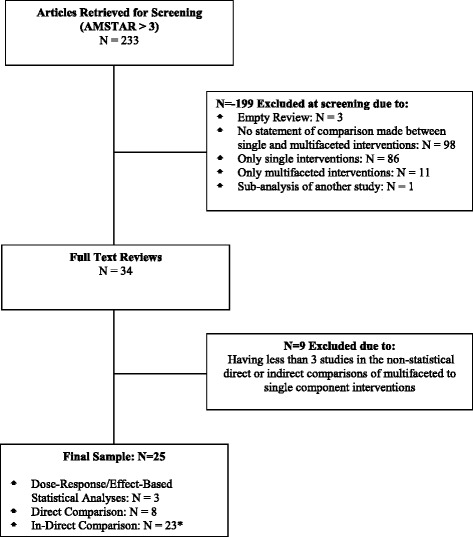
BACKGROUND: One of the greatest challenges in healthcare is how to best translate research evidence into clinical practice, which includes how to change health-care professionals' behaviours. A commonly held view is that multifaceted interventions are more effective than single-component interventions. The purpose of this study was to conduct an overview of systematic reviews to evaluate the effectiveness of multifaceted interventions in comparison to single-component interventions in changing health-care professionals' behaviour in clinical settings. METHODS: The Rx for Change database, which consists of quality-appraised systematic reviews of interventions to change health-care professional behaviour, was used to identify systematic reviews for the overview. Dual, independent screening and data extraction was conducted. Included reviews used three different approaches (of varying methodological robustness) to evaluate the effectiveness of multifaceted interventions: (1) effect size/dose-response statistical analyses, (2) direct (non-statistical) comparisons of multifaceted to single interventions and (3) indirect comparisons of multifaceted to single interventions. RESULTS: Twenty-five reviews were included in the overview. Three reviews provided effect size/dose-response statistical analyses of the effectiveness of multifaceted interventions; no statistical evidence of a relationship between the number of intervention components and the effect size was found. Eight reviews reported direct (non-statistical) comparisons of multifaceted to single-component interventions; four of these reviews found multifaceted interventions to be generally effective compared to single interventions, while the remaining four reviews found that multifaceted interventions had either mixed effects or were generally ineffective compared to single interventions. Twenty-three reviews indirectly compared the effectiveness of multifaceted to single interventions; nine of which also reported either a statistical (dose-response) analysis (N = 2) or a non-statistical direct comparison (N = 7). The majority (N = 15) of reviews reporting indirect comparisons of multifaceted to single interventions showed similar effectiveness for multifaceted and single interventions when compared to controls. Of the remaining eight reviews, six found single interventions to be generally effective while multifaceted had mixed effectiveness. CONCLUSION: This overview of systematic reviews offers no compelling evidence that multifaceted interventions are more effective than single-component interventions.
Overview
The claims and statistics of this paper haven’t been checked yet.
Run the check — free, no account needed. It reads the open-access text and checks the sources it cites.
Integrity signals
Registry
Cites
Statistics
Figures
Verification
Claims the paper makes
The claims and statistics of this paper haven’t been checked yet.
Run the check — free, no account needed. It reads the open-access text and checks the sources it cites.
Claims other papers make about this one
Each is checked against this paper’s own text: does it say what the citing paper says it does?
The cited source says what the claim attributes to it.
In the citing paper
“The current study provides foundational support for developing a multifaceted implementation strategy (e.g., combining a number of discrete implementation strategies) specifically for ASD-CBOs (Proctor et al., 2013; Squires et al., 2014).”
From Implementation-as-Usual in Community-Based Organizations Providing Specialized Services to Individuals with Autism Spectrum Disorder: A Mixed Methods Study (2021) · cites this paper as Squires et al., 2014
In the citing paper
“While the use of multifaceted and tailored implementation strategies is intuitive and has considerable face validity (29), the evidence regarding their superiority to single-component strategies has been mixed (37, 39, 40).”
From Enhancing the Impact of Implementation Strategies in Healthcare: A Research Agenda (2019) · cites this paper as [39]
In the citing paper
“A review of 25 systematic reviews (39) found “no compelling evidence that multifaceted interventions are more effective than single-component interventions” (p. 20).”
From Enhancing the Impact of Implementation Strategies in Healthcare: A Research Agenda (2019) · cites this paper as [39]
Self-check
Percentages, sums and reported differences re-computed from the paper’s own numbers.
The self-check needs the paper’s full text.
Citations
Cites
1 retracted
Interventions to implement prevention in primary care
Hulscher, M., Wensing, M., van der Weijden, T., & Grol, R. P. T. M. (1997) · doi:10.1002/14651858.cd000362 · Cited by 199
RetractedAudit and feedback: effects on professional practice and healthcare outcomes
Ivers, N., Jamtvedt, G., Flottorp, S., Young, J. M., Odgaard-Jensen, J., French, S. D., O'Brien, M. A., Johansen, M., Grimshaw, J., & Oxman, A. D. (2012) · Cochrane Database of Systematic Reviews · doi:10.1002/14651858.cd000259.pub3 · Cited by 5,485 · cited 5×
“9/23 reviews reported findings consistent with both single-component and multifaceted interventions being generally effective compared to controls [7,8,18,20,22,24,28-30]”
BackgroundResultInfluentialSelf-citationClinical Practice Guidelines We Can Trust
Board on Health Care Services (2011) · National Academies Press eBooks · doi:10.17226/13058 · Cited by 3,146
Effectiveness and efficiency of guideline dissemination and implementation strategies
Grimshaw, J., Thomas, R., MacLennan, G., Fraser, C., Ramsay, C., Vale, L., Whitty, P., Eccles, M., Matowe, L., Shirran, L., et al. (2004) · Health Technology Assessment · doi:10.3310/hta8060 · Cited by 3,044
Self-citationKnowledge translation of research findings
Grimshaw, J. M., Eccles, M. P., Lavis, J. N., Hill, S. J., & Squires, J. E. (2012) · Implementation Science · doi:10.1186/1748-5908-7-50 · Cited by 2,407
Self-citationInterventions to improve antibiotic prescribing practices for hospital inpatients
Davey, P. G., Brown, E. M., Charani, E., Fenelon, L. E., Gould, I. M., Holmes, A. H., Ramsay, C. R., Wiffen, P. J., & Wilcox, M. A. (2013) · Cochrane Database of Systematic Reviews · doi:10.1002/14651858.cd003543.pub3 · Cited by 1,893
Forsetlund, L., Bjørndal, A., Rashidian, A., Jamtvedt, G., O'Brien, M. A., Wolf, F. M., Davis, D., Odgaard-Jensen, J., & Oxman, A. D. (2009) · Cochrane Database of Systematic Reviews · doi:10.1002/14651858.cd003030.pub2 · Cited by 1,849
Davis, D. A. (1995) · JAMA · doi:10.1001/jama.1995.03530090032018 · Cited by 1,763
Systematic review finds overlapping reviews were not mentioned in every other overview
Pieper, D., Antoine, S.-L., Mathes, T., Neugebauer, E. A. M., & Eikermann, M. (2014) · Journal of Clinical Epidemiology · doi:10.1016/j.jclinepi.2013.11.007 · Cited by 1,318
Educational outreach visits: effects on professional practice and health care outcomes
O'Brien, M. A., Rogers, S., Jamtvedt, G., Oxman, A. D., Odgaard-Jensen, J., Kristoffersen, D. T., Forsetlund, L., Bainbridge, D., Freemantle, N., Davis, D., et al. (2007) · Cochrane Database of Systematic Reviews · doi:10.1002/14651858.cd000409.pub2 · Cited by 1,279
Research works printed but not linked: 1
- Davies H, Powell A, Rushmer R: Healthcare Professionals' Views on Clinician Engagement in Quality Improvement: a Literature Review. 2007, The Health Foundation, London
Cited by
Sorted by citations
Enhancing the Impact of Implementation Strategies in Healthcare: A Research Agenda
Powell, B. J., Fernandez, M. E., Williams, N. J., Aarons, G. A., Beidas, R. S., Lewis, C. C., McHugh, S. M., & Weiner, B. J. (2019) · Frontiers in Public Health · doi:10.3389/fpubh.2019.00003 · Cited by 775
Rowe, A. K., Rowe, S. Y., Peters, D. H., Holloway, K. A., Chalker, J., & Ross-Degnan, D. (2018) · The Lancet Global Health · doi:10.1016/s2214-109x(18)30398-x · Cited by 482
Levers for addressing medical underuse and overuse: achieving high-value health care
Elshaug, A. G., Rosenthal, M. B., Lavis, J. N., Brownlee, S., Schmidt, H., Nagpal, S., Littlejohns, P., Srivastava, D., Tunis, S., & Saini, V. (2017) · The Lancet · doi:10.1016/s0140-6736(16)32586-7 · Cited by 440
Lau, R., Stevenson, F., Ong, B. N., Dziedzic, K., Treweek, S., Eldridge, S., Everitt, H., Kennedy, A., Qureshi, N., Rogers, A., et al. (2015) · BMJ Open · doi:10.1136/bmjopen-2015-009993 · Cited by 254
Forsetlund, L., O’Brien, M. A., Forsén, L., Mwai, L., Reinar, L. M., Okwen, P., Horsley, T., & Rose, C. J. (2021) · Cochrane Database of Systematic Reviews · doi:10.1002/14651858.cd003030.pub3 · Cited by 325
Metadata
- Authors
- Squires, J. E., Sullivan, K., Eccles, M. P., Worswick, J., & Grimshaw, J. M.
- Affiliations
- University of Ottawa (CA)
- Ottawa Hospital Research Institute (CA)
- Newcastle University (GB)
- Cochrane Canada (CA)
- Corresponding author
- Squires, Janet E
- Venue
- Implementation Science
- Published
- 2014-10-06
- Volume
- 9
- Issue
- 1
- Pages
- 152-152
- ISSN
- 1748-5908 (ISSN-L)
- PMC
- PMC4194373
- OpenAlex
- W2140663693
- Cited by
- 368
- References
- 43
- Citations by year
- 2026: 21 · 2025: 24 · 2024: 50 · 2023: 30 · 2022: 33 · 2021: 39 · 2020: 36 · 2019: 26 · 2018: 19 · 2017: 31 · 2016: 20 · 2015: 37 · 2014: 2
- FWCI
- 5.11
- Type
- journal article
- Language
- en
- Open access
- gold
- doi.org
- Locations
- Implementation Science (publishedVersion, cc-by)
- Europe PMC (PubMed Central) (publishedVersion, cc-by)
- PubMed Central (publishedVersion, cc-by)
- PubMed (publishedVersion)
- uO Research (University of Ottawa) (submittedVersion, public-domain)
- Newcastle University ePrints (Newcastle Univesity) (cc-by)
- Funders
- Canadian Institutes of Health Research
- Topics
- Health Sciences › Health Professions › General Health Professions › Health Policy Implementation Science
- Health Sciences › Health Professions › General Health Professions › Health Sciences Research and Education
- Health Sciences › Medicine › Public Health, Environmental and Occupational Health › Clinical practice guidelines implementation
- Keywords
- multicomponent intervention, clinical practice change, evidence-to-practice translation, intervention effectiveness, dose-response relationship, indirect comparison
- MeSH terms
- Humans, Practice Patterns, Physicians', Research Design, Translational Research, Biomedical
About these checks
Registry, retraction, Cites and statistics results are computed, not judged, with one exception: a printed reference that no index lists is read once by a model before it counts as a citation error. Claims are extracted by a model and kept only when their quote appears verbatim in the text; each cited source is then checked, with a model’s help, for whether it says what the claim relies on. Those verdicts can be wrong — read the claim’s quote and the cited source before relying on one.
Statistics and arithmetic are recomputed, not judged.
Confidence bands are shown only for fields calibrated on our annotated test set. None is calibrated yet, so no band is shown.
What counts as a claim ›How we measure confidence ›How we check this ›
Are you an author, or do you see a problem with this page? Request a review
