

The DOI matches its Crossref record; 78 of the 79 references it cites were found in a registry or an index.
Toward the sustainability of health interventions implemented in sub-Saharan Africa: a systematic review and conceptual framework
Open accessAbstract
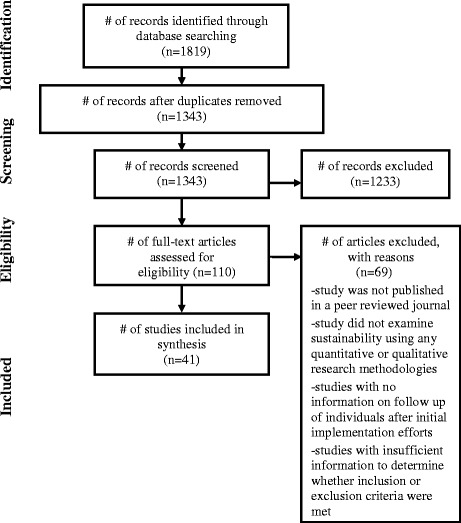
BACKGROUND: Sub-Saharan Africa (SSA) is facing a double burden of disease with a rising prevalence of non-communicable diseases (NCDs) while the burden of communicable diseases (CDs) remains high. Despite these challenges, there remains a significant need to understand how or under what conditions health interventions implemented in sub-Saharan Africa are sustained. The purpose of this study was to conduct a systematic review of empirical literature to explore how health interventions implemented in SSA are sustained. METHODS: We searched MEDLINE, Biological Abstracts, CINAHL, Embase, PsycInfo, SCIELO, Web of Science, and Google Scholar for available research investigating the sustainability of health interventions implemented in sub-Saharan Africa. We also used narrative synthesis to examine factors whether positive or negative that may influence the sustainability of health interventions in the region. RESULTS: The search identified 1819 citations, and following removal of duplicates and our inclusion/exclusion criteria, only 41 papers were eligible for inclusion in the review. Twenty-six countries were represented in this review, with Kenya and Nigeria having the most representation of available studies examining sustainability. Study dates ranged from 1996 to 2015. Of note, majority of these studies (30 %) were published in 2014. The most common framework utilized was the sustainability framework, which was discussed in four of the studies. Nineteen out of 41 studies (46 %) reported sustainability outcomes focused on communicable diseases, with HIV and AIDS represented in majority of the studies, followed by malaria. Only 21 out of 41 studies had clear definitions of sustainability. Community ownership and mobilization were recognized by many of the reviewed studies as crucial facilitators for intervention sustainability, both early on and after intervention implementation, while social and ecological conditions as well as societal upheavals were barriers that influenced the sustainment of interventions in sub-Saharan Africa. CONCLUSION: The sustainability of health interventions implemented in sub-Saharan Africa is inevitable given the double burden of diseases, health care worker shortage, weak health systems, and limited resources. We propose a conceptual framework that draws attention to sustainability as a core component of the overall life cycle of interventions implemented in the region.
Overview
The claims and statistics of this paper haven’t been checked yet.
Run the check — free, no account needed. It reads the open-access text and checks the sources it cites.
Integrity signals
Registry
Cites
Statistics
Figures
Verification
Claims the paper makes
The claims and statistics of this paper haven’t been checked yet.
Run the check — free, no account needed. It reads the open-access text and checks the sources it cites.
Claims other papers make about this one
Each is checked against this paper’s own text: does it say what the citing paper says it does?
In the citing paper
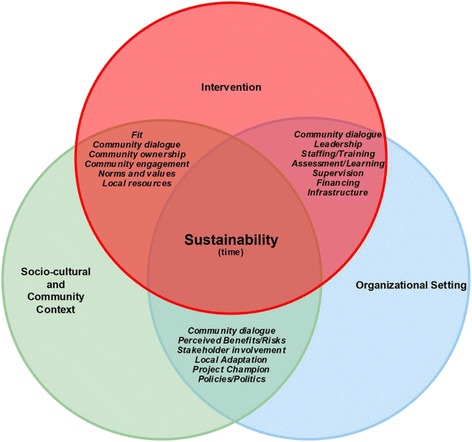
“A recent review of 41 studies across 26 countries in sub-Saharan Africa suggests that community engagement, community resources, and mobilization may be unique influences on sustainability in such contexts (63).”
From The Sustainability of Evidence-Based Interventions and Practices in Public Health and Health Care (2018) · cites this paper as [63]
Self-check
Percentages, sums and reported differences re-computed from the paper’s own numbers.
The self-check needs the paper’s full text.
Citations
Cites
Murray, C. J. L., Vos, T., Lozano, R., Naghavi, M., Flaxman, A. D., Michaud, C., Ezzati, M., Shibuya, K., Salomon, J. A., Abdalla, S., et al. (2012) · The Lancet · doi:10.1016/s0140-6736(12)61689-4 · Cited by 8,888
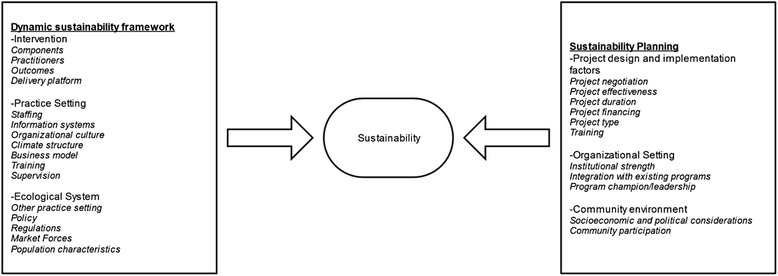
The dynamic sustainability framework: addressing the paradox of sustainment amid ongoing change
Chambers, D. A., Glasgow, R. E., & Stange, K. C. (2013) · Implementation Science · doi:10.1186/1748-5908-8-117 · Cited by 1,724
Wiltsey Stirman, S., Kimberly, J., Cook, N., Calloway, A., Castro, F., & Charns, M. (2012) · Implementation Science · doi:10.1186/1748-5908-7-17 · Cited by 1,355
Organization, W. H. (2025) · TIB Data Manager · doi:10.57702/o4rdcuwn · Cited by 1,154
Shediac-Rizkallah, M. C., & Bone, L. R. (1998) · Health Education Research · doi:10.1093/her/13.1.87 · Cited by 1,129
An Agenda for Research on the Sustainability of Public Health Programs
Scheirer, M. A., & Dearing, J. W. (2011) · American Journal of Public Health · doi:10.2105/ajph.2011.300193 · Cited by 775
Is Sustainability Possible? A Review and Commentary on Empirical Studies of Program Sustainability
Scheirer, M. A. (2005) · American Journal of Evaluation · doi:10.1177/1098214005278752 · Cited by 710
Non-communicable diseases in sub-Saharan Africa: what we know now
Dalal, S., Beunza, J. J., Volmink, J. A., Adebamowo, C., Bajunirwe, F., Njelekela, M. A., Mozaffarian, D., Fawzi, W. W., Willett, W. C., Adami, H., et al. (2011) · International Journal of Epidemiology · doi:10.1093/ije/dyr050 · Cited by 647
Complex interventions or complex systems? Implications for health economic evaluation
Shiell, A., Hawe, P., & Gold, L. H. (2008) · BMJ · doi:10.1136/bmj.39569.510521.ad · Cited by 630
Andrews, K. G., Fergus, C. A., Aregawi, M. W., Cibulskis, R. E., & Zamani, G. (2014) · Cited by 552
Research works printed but not linked: 2
- HIV/AIDS, J.U.N.P.O. Global report: UNAIDS report on the global AIDS epidemic 2013. Geneva, Switzerland: UNAIDS; 2013. p. 2014.
- Akogun O. Sustainable development and malaria illness experience among Nigerian nomads. In: Amoeda R, Lira S, Pinheiro C, editors. Heritage 2010: Heritage and Sustainable Development, Vols 1 and 2. 2001. p. 1257–61.
Cited by
Sorted by citations
Items 201–216 of 216
Asante, K. P., Iwelunmor, J., Apusiga, K., Gyamfi, J., Nyame, S., Adjei, K. G. A., Aifah, A. A., Adjei, K., Onakomaiya, D. O., Chaplin, W. F., et al. (2020) · Figshare · doi:10.6084/m9.figshare.13047327
Self-citationTiendrébeogo, J., Arnold, B., Ouédraogo, Y., Haws, R. A., Garane, L. P., Ouedraogo, V., Gouem, M., Coulibaly, A., & Bougma, M. (2024) · Figshare · doi:10.6084/m9.figshare.26722935
Chhun, N., Mangale, D. I., Agot, K. E., Masyuko, S. J., Kibugi, J., Jiang, W., Hicks, S., Badia, J., Owade, W. A., Ounda, N., et al. (2026) · Implementation Science Communications · doi:10.1186/s43058-026-00888-0
Perceptions of Obesity and Weight-Related Behaviors Among Adults With Type 2 Diabetes in Benin
Alaofè, H., Okechukwu, A., Magrath, P. A., Girard, C., Hounkpatin, W. A., & Ehiri, J. E. (2026) · Journal of Nutrition Education and Behavior · doi:10.1016/j.jneb.2025.12.005
Lujintanon, S., Eshun‐Wilson, I., Tourneau, N. L., Beres, L. K., Schwartz, S., Baral, S., Thompson, R. R., Underwood, A., Fox, B., Geng, E. H., et al. (2026) · Implementation Science Communications · doi:10.1186/s43058-026-00896-0
Abdullahi, U., Shehu, A., Garba, S., Mohammed, B. A., Sada, K. B., Akogwu, H. S., Mande, K. M., Muhammad, J., Ahmad, S., Umar, L., et al. (2026) · BMC Cardiovascular Disorders · doi:10.1186/s12872-026-05726-8
Zakari, M. (2026) · International Journal of HIV/AIDS Prevention Education and Behavioural Science · doi:10.11648/j.ijhpebs.20261201.11
Osório, D., Osório, M., Nacarapa, E., Cossa, Z., Machava, P., Nhamuanzo, M., Sanduane, L., Jesus, H., Nhangave, A. V., Mucache, E., et al. (2026) · BMC Public Health · doi:10.1186/s12889-026-28474-y
Zimu, P. M., Mabaso, Z., Mathe, A., & Grace, J. M. (2026) · BMJ Public Health · doi:10.1136/bmjph-2025-003735
Vasif, M., Haleem, A., Javaid, M., & Jahangir (2026) · Networking · doi:10.2738/net.2026.0002
Iwelunmor, J., Gbaja-Biamila, T. A., Akinsolu, F. T., Abodunrin, O. R., Arinze, C., Okwuzu, J. O., Ojo, T., Olusanya, O. A., Kalulu, P., Bradon, A., et al. (2026) · Frontiers in Public Health · doi:10.3389/fpubh.2026.1853507
Self-citationSupport for Male Survivors of Domestic Violence: Community and Social Work-Based Strategies
Rowlands, E. (2026) · Palgrave studies in victims and victimology · doi:10.1007/978-3-032-26973-7_7
Schwab, J. A., Wachinger, J., Nabiryo, M., Cazier, J., Wanyana, J., Mayombwe, K., Okou, E., Oloka, D., Ntambara, J. B., Munana, R., et al. (2026) · Global Health Science and Practice · doi:10.9745/ghsp-d-24-00061
Adewuya, A. O., Abímbọ́lá, Ṣ., Ola, B., Abdulmalik, J. O., & Oladipo, O. E. (2026) · Journal of Health Services Research & Policy · doi:10.1177/13558196261490908
Elugbadebo, O. O., Akintade, F. M., Beach, L. B., Oladeji, B. D., & Kuhns, L. M. (2026) · AIDS Research and Treatment · doi:10.1155/arat/9573277
Ngangue, P., Barro, A., Kiki, G. M., & Yé, M. (2026) · Vaccines · doi:10.3390/vaccines14100886
Metadata
- Authors
- Iwelunmor, J., Blackstone, S., Veira, D., Nwaozuru, U., Airhihenbuwa, C., Munodawafa, D., Kalipeni, E., Jutal, A., Shelley, D., & Ogedegbe, G.
- Affiliations
- University of Illinois Urbana-Champaign (US)
- New York University (US)
- Saint Louis University (US)
- World Health Organization Regional Office for Africa (CG)
- West Virginia University (US)
- Corresponding author
- Iwelunmor, Juliet
- ORCID
- Venue
- Implementation Science
- Published
- 2015-12
- Volume
- 11
- Issue
- 1
- Pages
- 43-43
- ISSN
- 1748-5908 (ISSN-L)
- PMC
- PMC4804528
- OpenAlex
- W2305876132
- Cited by
- 219
- References
- 79
- Citations by year
- 2026: 19 · 2025: 17 · 2024: 25 · 2023: 28 · 2022: 23 · 2021: 30 · 2020: 27 · 2019: 23 · 2018: 13 · 2017: 8 · 2016: 4 · 2015: 1
- FWCI
- 1.56
- Type
- journal article
- Language
- en
- Update notices
- correction (2016-04-18)
- Open access
- gold
- doi.org
- Licence
- Locations
- Implementation Science (publishedVersion, cc-by)
- PubMed Central (publishedVersion, cc-by)
- PubMed (publishedVersion)
- Funders
- Fogarty International Center (R03TW010081)
- Topics
- Health Sciences › Health Professions › General Health Professions › Health Policy Implementation Science
- Health Sciences › Medicine › Public Health, Environmental and Occupational Health › Global Health and Surgery
- Health Sciences › Medicine › Public Health, Environmental and Occupational Health › Healthcare Systems and Practices
- Keywords
- sub-Saharan Africa, community ownership, community mobilization, HIV/AIDS, malaria, double burden of disease, non-communicable diseases, health care system, conceptual framework, barriers to sustainability
- MeSH terms
- Chronic Disease, Delivery of Health Care, Health Resources, Humans, Cost of Illness, Africa South of the Sahara
About these checks
Registry, retraction, Cites and statistics results are computed, not judged, with one exception: a printed reference that no index lists is read once by a model before it counts as a citation error. Claims are extracted by a model and kept only when their quote appears verbatim in the text; each cited source is then checked, with a model’s help, for whether it says what the claim relies on. Those verdicts can be wrong — read the claim’s quote and the cited source before relying on one.
Statistics and arithmetic are recomputed, not judged.
Confidence bands are shown only for fields calibrated on our annotated test set. None is calibrated yet, so no band is shown.
What counts as a claim ›How we measure confidence ›How we check this ›
Are you an author, or do you see a problem with this page? Request a review
