

The DOI matches its Crossref record; 229 of the 234 references it cites were found in a registry or an index, and 1 are not checked yet.
Psychometric properties of implementation measures for public health and community settings and mapping of constructs against the Consolidated Framework for Implementation Research: a systematic review
Open accessAbstract
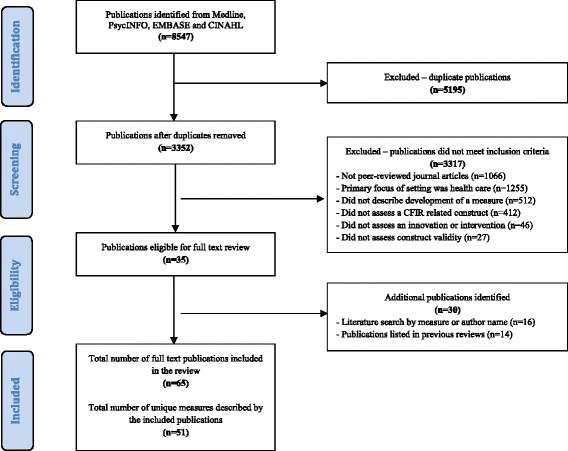
BACKGROUND: Recent reviews have synthesised the psychometric properties of measures developed to examine implementation science constructs in healthcare and mental health settings. However, no reviews have focussed primarily on the properties of measures developed to assess innovations in public health and community settings. This review identified quantitative measures developed in public health and community settings, examined their psychometric properties, and described how the domains of each measure align with the five domains and 37 constructs of the Consolidated Framework for Implementation Research (CFIR). METHODS: MEDLINE, PsycINFO, EMBASE, and CINAHL were searched to identify publications describing the development of measures to assess implementation science constructs in public health and community settings. The psychometric properties of each measure were assessed against recommended criteria for validity (face/content, construct, criterion), reliability (internal consistency, test-retest), responsiveness, acceptability, feasibility, and revalidation and cross-cultural adaptation. Relevant domains were mapped against implementation constructs defined by the CFIR. RESULTS: Fifty-one measures met the inclusion criteria. The majority of these were developed in schools, universities, or colleges and other workplaces or organisations. Overall, most measures did not adequately assess or report psychometric properties. Forty-six percent of measures using exploratory factor analysis reported >50 % of variance was explained by the final model; none of the measures assessed using confirmatory factor analysis reported root mean square error of approximation (<0.06) or comparative fit index (>0.95). Fifty percent of measures reported Cronbach's alpha of <0.70 for at least one domain; 6 % adequately assessed test-retest reliability; 16 % of measures adequately assessed criterion validity (i.e. known-groups); 2 % adequately assessed convergent validity (r > 0.40). Twenty-five percent of measures reported revalidation or cross-cultural validation. The CFIR constructs most frequently assessed by the included measures were relative advantage, available resources, knowledge and beliefs, complexity, implementation climate, and other personal resources (assessed by more than ten measures). Five CFIR constructs were not addressed by any measure. CONCLUSIONS: This review highlights gaps in the range of implementation constructs that are assessed by existing measures developed for use in public health and community settings. Moreover, measures with robust psychometric properties are lacking. Without rigorous tools, the factors associated with the successful implementation of innovations in these settings will remain unknown.
Overview
The claims and statistics of this paper haven’t been checked yet.
Run the check — free, no account needed. It reads the open-access text and checks the sources it cites.
Integrity signals
Registry
Cites
Statistics
Figures
Verification
Claims the paper makes
The claims and statistics of this paper haven’t been checked yet.
Run the check — free, no account needed. It reads the open-access text and checks the sources it cites.
Claims other papers make about this one
Each is checked against this paper’s own text: does it say what the citing paper says it does?
The cited source says what the claim attributes to it.
In the citing paper
“and systematic reviews have been undertaken describing the psychometric properties of many of these measures [64, 66].”
From Guidance for conducting feasibility and pilot studies for implementation trials (2020) · cites this paper as [66]
Self-check
Percentages, sums and reported differences re-computed from the paper’s own numbers.
The self-check needs the paper’s full text.
Citations
Cites
Hu, L., & Bentler, P. M. (1999) · Structural Equation Modeling A Multidisciplinary Journal · doi:10.1080/10705519909540118 · Cited by 108,788
Statistical Power Analysis for the Behavioral Sciences
Muller, K. E., & Cohen, J. (1989) · Technometrics · doi:10.2307/1270020 · Cited by 99,603
Tabachnick, B. G., & Fidell, L. S. (1983) · Cited by 79,882
Perceived usefulness, perceived ease of use, and user acceptance of information technology
Davis, F. D. (1989) · MIS Quarterly · doi:10.2307/249008 · Cited by 68,483
Statistical power analysis for the behavioral sciences
Cohen, J. (1990) · Computers Environment and Urban Systems · doi:10.1016/0198-9715(90)90050-4 · Cited by 65,417
User Acceptance of Information Technology: Toward A Unified View1
Venkatesh, V., Morris, M. G., Davis, G. B., & Davis, F. D. (2003) · MIS Quarterly · doi:10.2307/30036540 · Cited by 45,035
(1975) · PhilPapers (PhilPapers Foundation) · Cited by 36,737
Development and validation of brief measures of positive and negative affect: The PANAS scales.
Watson, D., Clark, L. A., & Tellegen, A. (1988) · Journal of Personality and Social Psychology · doi:10.1037/0022-3514.54.6.1063 · Cited by 32,433
User Acceptance of Computer Technology: A Comparison of Two Theoretical Models
Davis, F. D., Bagozzi, R. P., & Warshaw, P. R. (1989) · Management Science · doi:10.1287/mnsc.35.8.982 · Cited by 25,709
Kytle, J., & Bandura, A. (1978) · Contemporary Sociology · doi:10.2307/2065952 · Cited by 25,422
Research works printed but not linked: 14
- The SIRC Instrument Review Project (IRP): A systematic review and synthesis of implementation science instruments [ http://www.societyforimplementationresearchcollaboration.org/sirc-projects/sirc-instrument-project ]
- Hall GE, George A, Rutherford W. Measuring stages of concern about the innovation: a manual for use of the SoC questionnaire. Austin: Research and Development Center for Teacher Education, The University of Texas; 1979.
- Rogers EM. Diffusion of innovations. 3rd ed. New York: Free Press; 1983.
- Taylor J, Bowers D. Survey of organizations: a machine scored standardized questionnaire. Ann Arbor: Institute for Social Research, University of Michigan; 1972.
- Moos RH. The social climate scales: an overview. Palo Alto: Consulting Psychologists Press; 1974.
- Orthner DK, Cook PC, Sabah Y, Rosenfeld J. Measuring organizational learning in human services. Development and validation of the organizational learning capacity assessment. Miami: Workforce Issues in Social Work; 2005.
- Martino S, Ball SA, Gallon SL, Hall D, Garcia M, Ceperich S, Farentinos C, Hamilton J, Hausotter W. Motivational interviewing assessment: supervisory tools for enhancing proficiency. Salem: Northwest Frontier Addiction Technology Transfer Center, Oregon Health and Science University; 2006.
- Saksvik P, Nytro K, Tvedt SD. Healthy organizational change. In: Houdmont J, Leka S, editors. Occupational health psychology: European perspectives on research, education and practice, vol. 2. Nottingham: ISMAI Publishers; 2007. p. 81–90.
- Zaltman G. Metaphorically speaking: new technique uses multidisciplinary ideas to improve qualitative research. Mark Res. 1996;8:13.
- Newlove BW, Hall GE. A manual for assessing open-ended statements of concern. Austin: Research and Development Center for Teacher Education, The University of Texas; 1976.
- Venkatesh V, Davis FD. Extrinsic and intrinsic motivation to use computers in the work place. J Appl Psychol. 2000;22:1111–32.
- Anderson N, West MA. Team climate inventory: manual and user’s guide. Windsor: ASE; 1994.
- Hawe P, King L, Noort M, Jordens C, Lloyd B. Indicators to help with capacity building in health promotion. Sydney: NSW Health Department; 2000.
- Hackman JR, Oldham GR. Work redesign. Reading: Addison-Wesley; 1980.
Cited by
Sorted by citations
Guidance for conducting feasibility and pilot studies for implementation trials
Pearson, N., Naylor, P.-J., Ashe, M. C., Fernandez, M., Yoong, S. L., & Wolfenden, L. (2020) · Pilot and Feasibility Studies · doi:10.1186/s40814-020-00634-w · Cited by 475
Self-citationFinch, T. L., Girling, M., May, C. R., Mair, F. S., Murray, E., Treweek, S., McColl, E., Steen, I. N., Cook, C., Vernazza, C. R., et al. (2018) · BMC Medical Research Methodology · doi:10.1186/s12874-018-0591-x · Cited by 337
Stover, A. M., Haverman, L., van Oers, H. A., Greenhalgh, J., Potter, C., Ahmed, S., Greenhalgh, J., Gibbons, E. J., Haverman, L., Manalili, K., et al. (2020) · Quality of Life Research · doi:10.1007/s11136-020-02564-9 · Cited by 313
Nathan, N., Elton, B., Babic, M., McCarthy, N., Sutherland, R., Presseau, J., Seward, K., Hodder, R. K., Booth, D., Yoong, S. L., et al. (2017) · Preventive Medicine · doi:10.1016/j.ypmed.2017.11.012 · Cited by 293
Self-citationDesigning and undertaking randomised implementation trials: guide for researchers
Wolfenden, L., Foy, R., Presseau, J., Grimshaw, J., Ivers, N. M., Powell, B. J., Taljaard, M., Wiggers, J., Sutherland, R., Nathan, N., et al. (2021) · BMJ · doi:10.1136/bmj.m3721 · Cited by 287
Self-citation
Metadata
- Authors
- Clinton-McHarg, T., Yoong, S. L., Tzelepis, F., Regan, T., Fielding, A., Skelton, E., Kingsland, M., Ooi, J. Y., & Wolfenden, L.
- Affiliations
- Hunter Medical Research Institute (AU)
- University of Newcastle Australia (AU)
- Hunter New England Local Health District (AU)
- Corresponding author
- Wolfenden, Luke
- ORCID
- Venue
- Implementation Science
- Published
- 2016-11-08
- Volume
- 11
- Issue
- 1
- Pages
- 148-148
- ISSN
- 1748-5908 (ISSN-L)
- PMC
- PMC5100177
- OpenAlex
- W2553855586
- Cited by
- 116
- References
- 234
- Citations by year
- 2026: 6 · 2025: 9 · 2024: 11 · 2023: 16 · 2022: 12 · 2021: 15 · 2020: 14 · 2019: 15 · 2018: 11 · 2017: 6 · 2016: 1
- FWCI
- 2.10
- Type
- journal article
- Language
- en
- Open access
- gold
- doi.org
- Licence
- Locations
- Implementation Science (publishedVersion, cc-by)
- PubMed Central (publishedVersion, cc-by)
- PubMed (publishedVersion)
- DOAJ (DOAJ: Directory of Open Access Journals) (submittedVersion)
- Figshare (submittedVersion, cc-by)
- Swinburne figshare (Swinburne University of Technology) (submittedVersion)
- NOVA (University of Newcastle Australia) (submittedVersion, cc-by)
- Funders
- Hunter Medical Research Institute
- Topics
- Health Sciences › Health Professions › General Health Professions › Health Policy Implementation Science
- Health Sciences › Nursing › Research and Theory › Health Education and Validation
- Social Sciences › Decision Sciences › Management Science and Operations Research › Psychometric Methodologies and Testing
- Keywords
- psychometric properties, Consolidated Framework for Implementation Research, public health settings, community settings, measurement validity, reliability statistics, construct validity, cross-cultural adaptation, implementation climate, implementation barriers and facilitators
- MeSH terms
- Community Health Services, Diffusion of Innovation, Feasibility Studies, Humans, Psychometrics, Public Health, Surveys and Questionnaires, Reproducibility of Results, Translational Research, Biomedical, Clinical Coding
About these checks
Registry, retraction, Cites and statistics results are computed, not judged, with one exception: a printed reference that no index lists is read once by a model before it counts as a citation error. Claims are extracted by a model and kept only when their quote appears verbatim in the text; each cited source is then checked, with a model’s help, for whether it says what the claim relies on. Those verdicts can be wrong — read the claim’s quote and the cited source before relying on one.
Statistics and arithmetic are recomputed, not judged.
Confidence bands are shown only for fields calibrated on our annotated test set. None is calibrated yet, so no band is shown.
What counts as a claim ›How we measure confidence ›How we check this ›
Are you an author, or do you see a problem with this page? Request a review
