

Community-based participatory research and integrated knowledge translation: advancing the co-creation of knowledge
Open accessThe DOI matches its Crossref record; 59 of the 60 references it cites were found in a registry or an index.
Abstract
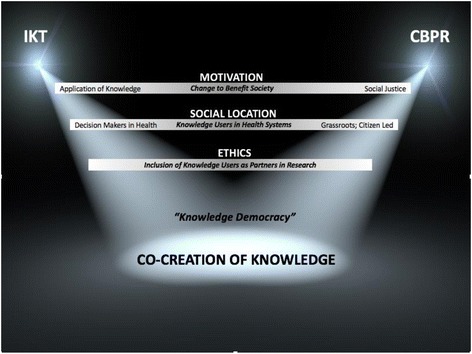
BACKGROUND: Better use of research evidence (one form of "knowledge") in health systems requires partnerships between researchers and those who contend with the real-world needs and constraints of health systems. Community-based participatory research (CBPR) and integrated knowledge translation (IKT) are research approaches that emphasize the importance of creating partnerships between researchers and the people for whom the research is ultimately meant to be of use ("knowledge users"). There exist poor understandings of the ways in which these approaches converge and diverge. Better understanding of the similarities and differences between CBPR and IKT will enable researchers to use these approaches appropriately and to leverage best practices and knowledge from each. The co-creation of knowledge conveys promise of significant social impacts, and further understandings of how to engage and involve knowledge users in research are needed. MAIN TEXT: We examine the histories and traditions of CBPR and IKT, as well as their points of convergence and divergence. We critically evaluate the ways in which both have the potential to contribute to the development and integration of knowledge in health systems. As distinct research traditions, the underlying drivers and rationale for CBPR and IKT have similarities and differences across the areas of motivation, social location, and ethics; nevertheless, the practices of CBPR and IKT converge upon a common aim: the co-creation of knowledge that is the result of knowledge user and researcher expertise. We argue that while CBPR and IKT both have the potential to contribute evidence to implementation science and practices for collaborative research, clarity for the purpose of the research-social change or application-is a critical feature in the selection of an appropriate collaborative approach to build knowledge. CONCLUSION: CBPR and IKT bring distinct strengths to a common aim: to foster democratic processes in the co-creation of knowledge. As research approaches, they create opportunities to challenge assumptions about for whom, how, and what is defined as knowledge, and to develop and integrate research findings into health systems. When used appropriately, CBPR and IKT both have the potential to contribute to and advance implementation science about the conduct of collaborative health systems research.
Overview
The claims and statistics of this paper haven’t been checked yet.
Free: it reads the open-access text and checks the first 5 claims that cite a source we can check. Create a free account to check every claim.
Integrity signals
Registry
Cites
Statistics
Figures
Verification
Claims the paper makes
The claims and statistics of this paper haven’t been checked yet.
Free: it reads the open-access text and checks the first 5 claims that cite a source we can check. Create a free account to check every claim.
Self-check
Percentages, sums and reported differences re-computed from the paper’s own numbers.
The self-check needs the paper’s full text.
Citations
Cites
Action Research and Minority Problems
Lewin, K. (1946) · Journal of Social Issues · doi:10.1111/j.1540-4560.1946.tb02295.x · Cited by 6,554 · cited 1×
“Lewin [24] is credited with the term “action research”; he defined this approach as a research methodology in which members of communities are involved in every stage of the research process, including identifying the issue to be addressed, forming a plan, taking action, and then evaluating the outcomes.”
BackgroundREVIEW OF COMMUNITY-BASED RESEARCH: Assessing Partnership Approaches to Improve Public Health
Israel, B. A., Schulz, A. J., Parker, E. A., & Becker, A. B. (1998) · Annual Review of Public Health · doi:10.1146/annurev.publhealth.19.1.173 · Cited by 5,893 · cited 1×
“While CBPR and IKT research studies differ in their attention to power relations, they both describe knowledge user engagement practices [40, 61] and expand the recognition Fig.”
BackgroundLost in knowledge translation: Time for a map?
Graham, I. D., Logan, J., Harrison, M. B., Straus, S. E., Tetroe, J., Caswell, W., & Robinson, N. (2006) · Journal of Continuing Education in the Health Professions · doi:10.1002/chp.47 · Cited by 4,705
Self-citationCrossing the Quality Chasm: A New Health System for the 21st Century
Bloom, B. S. (2002) · JAMA: The Journal of the American Medical Association · doi:10.1001/jama.287.5.646-a · Cited by 3,726
Wallerstein, N., & Duran, B. (2010) · American Journal of Public Health · doi:10.2105/ajph.2009.184036 · Cited by 2,318
Welcome to Implementation Science
Eccles, M. P., & Mittman, B. S. (2006) · Implementation Science · doi:10.1186/1748-5908-1-1 · Cited by 2,254 · cited 1×
“for implementation science [7] as the delayed implementation of effective practices (and discontinuation of”
BackgroundThe Interview: From Neutral Stance to Political Involvement.
Fontana, A., & Frey, J. H. (2005) · Cited by 1,734
Knowledge for Theory and Practice
Van De Ven, A. H., & Johnson, P. E. (2006) · Academy of Management Review · doi:10.5465/amr.2006.22527385 · Cited by 1,663
Canadian Institutes of Health Research
(2019) · The Grants Register 2020 · doi:10.1057/978-1-349-95943-3_219 · Cited by 1,466
GREENHALGH, T., JACKSON, C., SHAW, S., & JANAMIAN, T. (2016) · The Milbank Quarterly · doi:10.1111/1468-0009.12197 · Cited by 1,288 · cited 1×
“There is growing interest in collaborative approaches to knowledge generation between knowledge users and researchers and that lead to “co-created” knowledge [13].”
BackgroundJAGOSH, J., MACAULAY, A. C., PLUYE, P., SALSBERG, J., BUSH, P. L., HENDERSON, J., SIRETT, E., WONG, G., CARGO, M., HERBERT, C. P., et al. (2012) · The Milbank Quarterly · doi:10.1111/j.1468-0009.2012.00665.x · Cited by 1,268
Concept Mapping for Planning and Evaluation
Kane, M., & Trochim, W. (2007) · Sage eBooks · doi:10.4135/9781412983730 · Cited by 1,179
Community-based participatory research: assessing the evidence.
Viswanathan, M., Ammerman, A., Eng, E. M., Garlehner, G., Lohr, K. N., Griffith, D. M., Rhodes, S. D., Samuel‐Hodge, C. D., Maty, S. C., Lux, L. J., et al. (2004) · PubMed Central · Cited by 1,062
Knowledge Transfer and Exchange: Review and Synthesis of the Literature
MITTON, C., ADAIR, C. E., MCKENZIE, E., PATTEN, S. B., & PERRY, B. W. (2007) · The Milbank Quarterly · doi:10.1111/j.1468-0009.2007.00506.x · Cited by 1,050
Israel, B. A., Schulz, A. J., Parker, E. A., & Becker, A. B. (2001) · Education for Health: Change in Learning & Practice · doi:10.1080/13576280110051055 · Cited by 936
Photography in Anthropology: A Report on Two Experiments
COLLIER, J. (1957) · American Anthropologist · doi:10.1525/aa.1957.59.5.02a00100 · Cited by 631
Integrated knowledge translation (IKT) in health care: a scoping review
Gagliardi, A. R., Berta, W., Kothari, A., Boyko, J., & Urquhart, R. (2015) · Implementation Science · doi:10.1186/s13012-016-0399-1 · Cited by 628
Israel, B. A., Parker, E. A., Rowe, Z., Salvatore, A., Minkler, M., López, J., Butz, A., Mosley, A., Coates, L., Lambert, G., et al. (2005) · Environmental Health Perspectives · doi:10.1289/ehp.7675 · Cited by 601
The application of systems thinking in health: why use systems thinking?
Peters, D. H. (2014) · Health Research Policy and Systems · doi:10.1186/1478-4505-12-51 · Cited by 577
Community-Based Participatory Research From the Margin to the Mainstream: Are Researchers Prepared?
Horowitz, C. R., Robinson, M., & Seifer, S. (2009) · Circulation · doi:10.1161/circulationaha.107.729863 · Cited by 549
Community-Based Participatory Research: Implications for Public Health Funding
Minkler, M., Blackwell, A. G., Thompson, M., & Tamir, H. (2003) · American Journal of Public Health · doi:10.2105/ajph.93.8.1210 · Cited by 547
Focus Groups: Strategic Articulations of Pedagogy, Politics, and Inquiry.
Kamberelis, G., & Dimitriadis, G. (2005) · Cited by 501
Nast, H. J. (1994) · The Professional Geographer · doi:10.1111/j.0033-0124.1994.00054.x · Cited by 488 · cited 1×
“side and outside of the home as both political and worthy of study [26].”
BackgroundDRAHOTA, A., MEZA, R. D., BRIKHO, B., NAAF, M., ESTABILLO, J. A., GOMEZ, E. D., VEJNOSKA, S. F., DUFEK, S., STAHMER, A. C., & AARONS, G. A. (2016) · The Milbank Quarterly · doi:10.1111/1468-0009.12184 · Cited by 439 · cited 2×
“The existence of partnerships between knowledge users and researchers serves as a catalyst for increasing both the use and the relevance of the research [17].”
BackgroundCareTrack: assessing the appropriateness of health care delivery in Australia
Runciman, W. B., Hunt, T. D., Hannaford, N. A., Hibbert, P. D., Westbrook, J. I., Coiera, E. W., Day, R. O., Hindmarsh, D. M., McGlynn, E. A., & Braithwaite, J. (2012) · Medical Journal of Australia · doi:10.5694/mja12.10510 · Cited by 436
The co-production of what? Knowledge, values, and social relations in health care
Filipe, A., Renedo, A., & Marston, C. (2017) · PLOS Biology · doi:10.1371/journal.pbio.2001403 · Cited by 372
Some Theoretical Underpinnings of Knowledge Translation
Graham, I. D., Tetroe, J., & KT Theories Research Group (2007) · Academic Emergency Medicine · doi:10.1111/j.1553-2712.2007.tb02369.x · Cited by 323
Self-citationA critical second look at integrated knowledge translation
Kothari, A., & Wathen, C. N. (2013) · Health Policy · doi:10.1016/j.healthpol.2012.11.004 · Cited by 301
Digital storytelling: An emergent method for health promotion research and practice
Gubrium, A. (2009) · Health Promotion Practice · doi:10.1177/1524839909332600 · Cited by 290
Camden, C., Shikako-Thomas, K., Nguyen, T., Graham, E., Thomas, A., Sprung, J., Morris, C., & Russell, D. J. (2015) · Disability and Rehabilitation · doi:10.3109/09638288.2014.963705 · Cited by 231
The importance of values in evidence-based medicine
Kelly, M. P., Heath, I., Howick, J., & Greenhalgh, T. (2015) · BMC Medical Ethics · doi:10.1186/s12910-015-0063-3 · Cited by 209
Burgess‐Proctor, A. (2014) · Women s Studies International Forum · doi:10.1016/j.wsif.2014.10.014 · Cited by 199
Engaging citizens: Lessons from building Brazil's national health system
Cornwall, A., & Shankland, A. (2008) · Social Science & Medicine · doi:10.1016/j.socscimed.2008.01.038 · Cited by 190
Is Community-based Participatory Research (CBPR) Useful? A Systematic Review on Papers in a Decade.
Salimi, Y., Shahandeh, K., Malekafzali, H., Loori, N., Kheiltash, A., Jamshidi, E., Forouzan, A. S., & Majdzadeh, R. (2012) · Europe PMC (PubMed Central) · Cited by 182
Convergent evolution: The academic and policy roots of collaborative research
(2003) · Journal of Health Services Research & Policy · doi:10.1258/135581903322405108 · Cited by 182
Integrated knowledge translation
Bowen, S., & Graham, I. D. (2013) · Knowledge Translation in Health Care · doi:10.1002/9781118413555.ch02 · Cited by 170
Self-citationGagliardi, A. R., Kothari, A., & Graham, I. D. (2017) · Journal of Epidemiology and Community Health · doi:10.1136/jech-2016-207743 · Cited by 146
Self-citationIs Community-Based Participatory Research Possible?
Blumenthal, D. S. (2011) · American Journal of Preventive Medicine · doi:10.1016/j.amepre.2010.11.011 · Cited by 142
Callard, F., Rose, D., & Wykes, T. (2012) · Health Expectations · doi:10.1111/j.1369-7625.2011.00681.x · Cited by 132
A PRACTICAL GUIDE TO PHOTOVOICE: SHARING PICTURES, TELLING STORIES AND CHANGING COMMUNITIES
Palibroda, B., Krieg, B., Murdock, L., & Havelock, J. (2009) · Cited by 129
Cultural adaptation of a shared decision making tool with Aboriginal women: a qualitative study
Jull, J., Giles, A. R., Boyer, Y., & Stacey, D. (2015) · BMC Medical Informatics and Decision Making · doi:10.1186/s12911-015-0129-7 · Cited by 128
Self-citationWilson, M. G., Lavis, J. N., Travers, R., & Rourke, S. B. (2010) · Implementation Science · doi:10.1186/1748-5908-5-33 · Cited by 119
Pazoki, R., Nabipour, I., Seyednezami, N., & Imami, S. R. (2007) · BMC Public Health · doi:10.1186/1471-2458-7-216 · Cited by 98
Darroch, F., & Giles, A. (2015) · The Canadian Journal of Action Research · doi:10.33524/cjar.v15i3.155 · Cited by 76
Self-citationGaps between best evidence and practice: causes for concern
Buchan, H. (2004) · Medical Journal of Australia · doi:10.5694/j.1326-5377.2004.tb05944.x · Cited by 74
Kothari, A. R., Sibbald, S. L., & Wathen, C. N. (2014) · Health Research Policy and Systems · doi:10.1186/1478-4505-12-25 · Cited by 72
Integrated knowledge translation in mental health: family help as an example.
McGrath, P. J., Lingley‐Pottie, P., Emberly, D. J., Thurston, C., & McLean, C. B. (2009) · PubMed Central · Cited by 71
Ninomiya, M. E. M., Atkinson, D., Brascoupé, S., Firestone, M., Robinson, N., Reading, J., Ziegler, C. P., Maddox, R., & Smylie, J. K. (2017) · Systematic Reviews · doi:10.1186/s13643-017-0430-x · Cited by 67
Wilkinson, H. A., Gallagher, M., & Smith, M. (2012) · Evidence & Policy · doi:10.1332/174426412x654040 · Cited by 56
Salway, S., Chowbey, P., Such, E., & Ferguson, B. (2015) · Research Involvement and Engagement · doi:10.1186/s40900-015-0009-4 · Cited by 55
Jenkins, E., Kothari, A. R., Bungay, V., Johnson, J. L., & Oliffe, J. L. (2016) · Health Research Policy and Systems · doi:10.1186/s12961-016-0138-8 · Cited by 38
de Sayu, R. P., & Chanmugam, A. (2015) · Qualitative Health Research · doi:10.1177/1049732315577606 · Cited by 34
Powell, K., Kitson, A. A., Hoon, E. A., Newbury, J., Wilson, A., & Beilby, J. (2013) · Implementation Science · doi:10.1186/1748-5908-8-98 · Cited by 33
Rodriguez, E. M., Bowie, J. V., Frattaroli, S., & GIELEN, A. C. (2009) · Health Education Research · doi:10.1093/her/cyp010 · Cited by 26
van Bekkum, J. E., Fergie, G., & Hilton, S. (2016) · Health Research Policy and Systems · doi:10.1186/s12961-016-0093-4 · Cited by 23
Jull, J., Giles, A. R., Boyer, Y., Stacey, D., & Lodge, M. (2016) · ACME · doi:10.14288/acme.v17i3.1317 · Cited by 23
Self-citationShared decision-making and health for First Nations, Métis and Inuit women: a study protocol
Jull, J., Stacey, D., Giles, A. R., & Boyer, Y. (2012) · BMC Medical Informatics and Decision Making · doi:10.1186/1472-6947-12-146 · Cited by 18
Self-citationDixon, J., Elliott, S. J., & Clarke, A. E. (2016) · Research Involvement and Engagement · doi:10.1186/s40900-016-0043-x · Cited by 18
Syed, M., Moorhouse, A., McDonald, L., & Hitzig, S. L. (2017) · Journal of Evidence-Informed Social Work · doi:10.1080/23761407.2017.1323065 · Cited by 6
Research works printed but not linked: 7
- Wallerstein N, Duran B. The theoretical, historical and practice of CBPR. In: Minkler M, Wallerstein N., editors. Community-based participatory research for health: from process to outcomes (2nd Edition). John-Wiley & Sons; 2011. p.25-47. http://ca.wiley.com/WileyCDA/WileyTitle/productCd-0470260432.html.
- Fletcher C Community-based participatory research relationships with aboriginal communities in Canada: an overview of context and process Pimatisiwin 2002 1 1 29 61
- Salsberg J Louttit S McComber AM Fiddler R Naqshbandi M Receveur O Knowledge, capacity, readiness: translating successful experiences in community-based participatory research for health promotion Pimatisiwin 2007 5 2 125 150
- Andersson E Tritter J Wilson R Anderson E Tritter J Wilson R Introduction Health democracy: the future of involvement in health and social care 2007 London INFORM and NHS Centre for Involvement 1 6
- Panel on Research Ethics. TCPS 2 – Chapter 9. Research involving the First Nations, Inuit and Métis Peoples of Canada. 2015. http://www.pre.ethics.gc.ca/eng/policy-politique/initiatives/tcps2-eptc2/chapter9-chapitre9/. Accessed 4 May 2017.
- Canadian Oxford Dictionary, Oxford University Press, 2017 https://en.oxforddictionaries.com/definition/knowledge. Accessed 2 May 2017.
- Canadian Oxford Dictionary, Oxford University Press, 2017 https://en.oxforddictionaries.com/definition/democracy. Accessed 2 May 2017.
Cited by
Participation of people living with disabilities in physical activity: a global perspective
Martin Ginis, K. A., van der Ploeg, H. P., Foster, C., Lai, B., McBride, C. B., Ng, K., Pratt, M., Shirazipour, C. H., Smith, B., Vásquez, P. M., et al. (2021) · The Lancet · doi:10.1016/s0140-6736(21)01164-8 · Cited by 552
The FRAME-IS: a framework for documenting modifications to implementation strategies in healthcare
Miller, C. J., Barnett, M. L., Baumann, A. A., Gutner, C. A., & Wiltsey-Stirman, S. (2021) · Implementation Science · doi:10.1186/s13012-021-01105-3 · Cited by 490
Panel, S. G. P. C., Hoekstra, F., Mrklas, K. J., Khan, M., McKay, R. C., Vis-Dunbar, M., Sibley, K. M., Nguyen, T., Graham, I. D., & Gainforth, H. L. (2020) · Health Research Policy and Systems · doi:10.1186/s12961-020-0544-9 · Cited by 343
Self-citationKoorts, H., Eakin, E., Estabrooks, P., Timperio, A., Salmon, J., & Bauman, A. (2018) · International Journal of Behavioral Nutrition and Physical Activity · doi:10.1186/s12966-018-0678-0 · Cited by 335
Co-production: A resource to guide co-producing research in the sport, exercise, and health sciences
Smith, B., Williams, O., Bone, L., & Collective, T. M. S. W. C.-P. (2023) · Qualitative Research in Sport, Exercise and Health · doi:10.1080/2159676x.2022.2052946 · Cited by 297
Metadata
- Authors
- Jull, J., Giles, A., & Graham, I. D.
- Affiliations
- University of Ottawa (CA)
- Corresponding author
- Jull, Janet
- Venue
- Implementation Science
- Published
- 2017-12
- Volume
- 12
- Issue
- 1
- Pages
- 150-150
- ISSN
- 1748-5908 (ISSN-L)
- PMC
- PMC5735911
- OpenAlex
- W2778461957
- Cited by
- 651
- References
- 60
- Citations by year
- 2026: 65 · 2025: 89 · 2024: 124 · 2023: 86 · 2022: 118 · 2021: 91 · 2020: 40 · 2019: 24 · 2018: 13
- FWCI
- 33.80
- Type
- journal article
- Language
- en
- Open access
- gold
- doi.org
- Licence
- cc-by
- Locations
- Implementation Science (publishedVersion, cc-by)
- Europe PMC (PubMed Central) (publishedVersion, cc-by)
- PubMed Central (publishedVersion, cc-by)
- PubMed (publishedVersion)
- uO Research (University of Ottawa) (submittedVersion, public-domain)
- DOAJ (DOAJ: Directory of Open Access Journals) (submittedVersion, cc-by-sa)
- Funders
- Canadian Institutes of Health Research (FDN# 143237, 143237)
- Topics
- Health Sciences › Medicine › Public Health, Environmental and Occupational Health › Community Health and Development
- Health Sciences › Health Professions › General Health Professions › Health Policy Implementation Science
- Health Sciences › Health Professions › General Health Professions › Mental Health and Patient Involvement
- Keywords
- community-based participatory research, integrated knowledge translation, knowledge co-production, knowledge users, health systems research, research ethics, social change
- MeSH terms
- Community Participation, Cooperative Behavior, Decision Making, Delivery of Health Care, Humans, Motivation, Knowledge, Vulnerable Populations, Community-Based Participatory Research, Translational Research, Biomedical
About these checks
Registry, retraction, Cites and statistics results are computed, not judged, with one exception: a printed reference that no index lists is read once by a model before it counts as a citation error. Claims are extracted by a model and kept only when their quote appears verbatim in the text; each cited source is then checked, with a model’s help, for whether it says what the claim relies on. Those verdicts can be wrong — read the claim’s quote and the cited source before relying on one.
Statistics and arithmetic are recomputed, not judged.
Confidence bands are shown only for fields calibrated on our annotated test set. None is calibrated yet, so no band is shown.
What counts as a claim ›How we measure confidence ›How we check this ›
Are you an author, or do you see a problem with this page? Request a review
Data sources
Bibliographic data: Semantic Scholar, OpenAlex, Crossref.
Contains information from the Semantic Scholar Academic Graph Datasets, made available under the ODC Attribution License (ODC-BY 1.0).
Semantic Scholar’s data is described in: Kinney, R., et al. (2023). The Semantic Scholar Open Data Platform. arXiv:2301.10140.
