

The DOI matches its Crossref record; 65 of the 66 references it cites were found in a registry or an index.
Evidence-based intervention sustainability strategies: a systematic review
Open accessAbstract
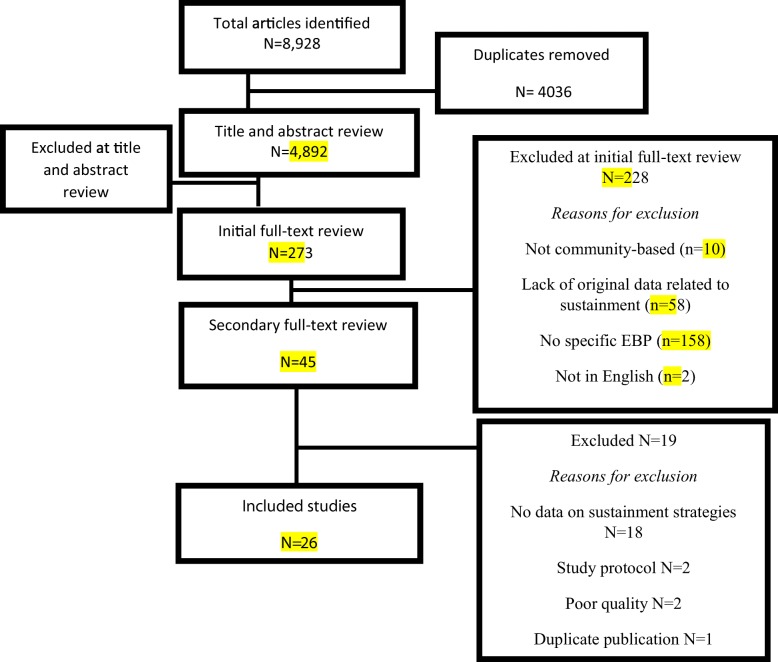
BACKGROUND: Sustainability of evidence-based interventions (EBI) remains a challenge for public health community-based institutions. The conceptual definition of sustainment is not universally agreed upon by researchers and practitioners, and strategies utilized to facilitate sustainment of EBI are not consistently reported in published literature. Given these limitations in the field, a systematic review was conducted to summarize the existing evidence supporting discrete sustainment strategies for public health EBIs and facilitating and hindering factors of sustainment. METHODS: We searched PsychINFO, Embase, ProQuest, PubMed, and Google Scholar. The initial search was run in March 2017 and an update was done in March 2019. Study eligibility criteria included (a) public health evidence-based interventions, (b) conducted in the community or community-based settings, and (c) reported outcomes related to EBI sustainment. Details characterizing the study setting, design, target population, and type of EBI sustained were extracted. RESULTS: A total of 26 articles published from 2004 to 2019 were eligible for data extraction. Overall, the importance of sustainability was acknowledged across all of the studies. However, only seven studies presented a conceptual definition of sustainment explicitly within the text. Six of the included studies reported specific sustainment strategies that were used to facilitate the sustainment of EBI. Only three of the studies reported their activities related to sustainment by referencing a sustainment framework. Multiple facilitators (i.e., adaptation/alignment, funding) and barriers (i.e., limited funding, limited resources) were identified as influencing EBI sustainment. The majority (n = 20) of the studies were conducted in high-income countries. Studies from low-income countries were mostly naturalistic. All of the studies from low-income countries reported lack of funding as a hindrance to sustainment. IMPLICATION FOR DISSEMINATION AND IMPLEMENTATION RESEARCH: Literature focused on sustainment of public health EBIs should present an explicit definition of the concept. Better reporting of the framework utilized, steps followed, and adaptations made to sustain the intervention might contribute to standardizing and developing the concept. Moreover, encouraging longitudinal dissemination and implementation (D&I) research especially in low-income countries might help strengthen D&I research capacity in public health settings.
Overview
The claims and statistics of this paper haven’t been checked yet.
Run the check — free, no account needed. It reads the open-access text and checks the sources it cites.
Integrity signals
Registry
Cites
Statistics
Figures
Verification
Claims the paper makes
The claims and statistics of this paper haven’t been checked yet.
Run the check — free, no account needed. It reads the open-access text and checks the sources it cites.
Claims other papers make about this one
Each is checked against this paper’s own text: does it say what the citing paper says it does?
The source backs part of the claim, not all of it — or backs it for a different population, condition or comparison.
In the citing paper
“However, the health benefits of the intervention may not last over an extended period after the intervention is terminated, raising concerns about sustainability [63].”
From Effectiveness of an Internet-Based Acceptance and Commitment Therapy Intervention for Reducing Psychological Distress in Health Care Professionals: Randomized Controlled Trial (2024) · cites this paper as [63]
Experimental — accuracy not yet measuredThe source backs part of the claim, not all of it — or backs it for a different population, condition or comparison.
In the citing paper
“Extensive implementation research suggests that even when the challenges of implementing EBPs with fidelity have been surmounted, it is difficult to maintain consistent use, as well as intended effects, over longer periods of time (56).”
From The Renfrew Unified Treatment for Eating Disorders and Comorbidity: Long-Term Effects of an Evidence-Based Practice Implementation in Residential Treatment (2021) · cites this paper as [56]
Experimental — accuracy not yet measuredIn the citing paper
“Reported influences on sustainability include characteristics of the innovation and the individuals involved, leadership, capacity, processes, and context [2, 9, 13, 14].”
From Factors influencing sustainability and scale-up of rural primary healthcare memory clinics: perspectives of clinic team members (2022) · cites this paper as [9]
Self-check
Percentages, sums and reported differences re-computed from the paper’s own numbers.
The self-check needs the paper’s full text.
Citations
Cites
Liberati, A., Altman, D. G., Tetzlaff, J., Mulrow, C., Gøtzsche, P. C., Ioannidis, J. P. A., Clarke, M., Devereaux, P. J., Kleijnen, J., & Moher, D. (2009) · PLoS Medicine · doi:10.1371/journal.pmed.1000100 · Cited by 28,164
von Elm, E., Altman, D. G., Egger, M., Pocock, S. J., Gøtzsche, P. C., Vandenbroucke, J. P., & Initiative, F. T. S. (2007) · PLoS Medicine · doi:10.1371/journal.pmed.0040296 · Cited by 23,020
Damschroder, L. J., Aron, D. C., Keith, R. E., Kirsh, S. R., Alexander, J. A., & Lowery, J. C. (2009) · Implementation Science · doi:10.1186/1748-5908-4-50 · Cited by 14,496
CONSORT 2010 Statement: updated guidelines for reporting parallel group randomised trials
the CONSORT Group, Schulz, K. F., Altman, D. G., & Moher, D. (2010) · BMC Medicine · doi:10.1186/1741-7015-8-18 · Cited by 13,371
Evaluating the public health impact of health promotion interventions: the RE-AIM framework.
Glasgow, R. E., Vogt, T. M., & Boles, S. M. (1999) · American Journal of Public Health · doi:10.2105/ajph.89.9.1322 · Cited by 7,217
Durlak, J. A., & DuPre, E. P. (2008) · American Journal of Community Psychology · doi:10.1007/s10464-008-9165-0 · Cited by 5,304
(2005) · Cited by 3,748
Advancing a Conceptual Model of Evidence-Based Practice Implementation in Public Service Sectors
Aarons, G. A., Hurlburt, M., & Horwitz, S. M. (2011) · Administration and Policy in Mental Health and Mental Health Services Research · doi:10.1007/s10488-010-0327-7 · Cited by 3,240
Knowledge translation of research findings
Grimshaw, J. M., Eccles, M. P., Lavis, J. N., Hill, S. J., & Squires, J. E. (2012) · Implementation Science · doi:10.1186/1748-5908-7-50 · Cited by 2,407
Glasgow, R. E., Lichtenstein, E., & Marcus, A. C. (2003) · American Journal of Public Health · doi:10.2105/ajph.93.8.1261 · Cited by 1,836
Research works printed but not linked: 2
- Qualtrics L. Qualtrics: online survey software & insight platform; 2014.
- Inc S. SPSS Base 14.0 user’s guide: Prentice Hall; 2005.
Cited by
Sorted by citations
The updated consolidated framework for implementation research based on user feedback
Damschroder, L. J., Reardon, C. M., Widerquist, M. A. O., & Lowery, J. (2022) · Implementation Science · doi:10.1186/s13012-022-01245-0 · Cited by 4,452
Application of bibliometrics in medicine: a historical bibliometrics analysis
Kokol, P., Vošner, H. B., & Završnik, J. (2020) · Health Information & Libraries Journal · doi:10.1111/hir.12295 · Cited by 538
Klaic, M., Kapp, S., Hudson, P., Chapman, W. W., Denehy, L., Story, D., & Francis, J. (2022) · Implementation Science · doi:10.1186/s13012-021-01171-7 · Cited by 443
Cassar, S., Salmon, J., Timperio, A. F., Naylor, P., van Nassau, F., Ayala, A. M. C., & Koorts, H. (2019) · International Journal of Behavioral Nutrition and Physical Activity · doi:10.1186/s12966-019-0876-4 · Cited by 313
Shoesmith, A., Hall, A. E., Wolfenden, L., Shelton, R. C., Powell, B. J., Brown, H., McCrabb, S., Sutherland, R., Yoong, S. L., Lane, C., et al. (2021) · Implementation Science · doi:10.1186/s13012-021-01134-y · Cited by 218
Metadata
- Authors
- Hailemariam, M., Bustos, T., Montgomery, B., Barajas, R., Evans, L. B., & Drahota, A.
- Affiliations
- Michigan State University (US)
- Corresponding author
- Hailemariam, Maji
- Venue
- Implementation Science
- Published
- 2019-06-06
- Volume
- 14
- Issue
- 1
- Pages
- 57-57
- ISSN
- 1748-5908 (ISSN-L)
- PMC
- PMC6554955
- OpenAlex
- W2948464760
- Cited by
- 398
- References
- 66
- Citations by year
- 2026: 43 · 2025: 70 · 2024: 72 · 2023: 73 · 2022: 59 · 2021: 47 · 2020: 25 · 2019: 5
- FWCI
- 6.25
- Type
- journal article
- Language
- en
- Open access
- gold
- doi.org
- Locations
- Implementation Science (publishedVersion, cc-by)
- PubMed Central (publishedVersion, cc-by)
- PubMed (publishedVersion)
- DOAJ (DOAJ: Directory of Open Access Journals) (submittedVersion, cc-by-sa)
- Funders
- National Institute on Minority Health and Health Disparities (U54MD011227)
- Topics
- Health Sciences › Health Professions › General Health Professions › Health Policy Implementation Science
- Health Sciences › Medicine › Public Health, Environmental and Occupational Health › Public Health Policies and Education
- Health Sciences › Medicine › Public Health, Environmental and Occupational Health › Community Health and Development
- Keywords
- evidence-based interventions, intervention sustainability, public health interventions, community-based intervention, barriers and facilitators, financial constraints, low-income countries, dissemination and implementation research
- MeSH terms
- Health Plan Implementation, Humans, Public Health, Evidence-Based Medicine
About these checks
Registry, retraction, Cites and statistics results are computed, not judged, with one exception: a printed reference that no index lists is read once by a model before it counts as a citation error. Claims are extracted by a model and kept only when their quote appears verbatim in the text; each cited source is then checked, with a model’s help, for whether it says what the claim relies on. Those verdicts can be wrong — read the claim’s quote and the cited source before relying on one.
Statistics and arithmetic are recomputed, not judged.
Confidence bands are shown only for fields calibrated on our annotated test set. None is calibrated yet, so no band is shown.
What counts as a claim ›How we measure confidence ›How we check this ›
Are you an author, or do you see a problem with this page? Request a review
