

A protocol for evaluating a multi-level implementation theory to scale-up obstetric triage in referral hospitals in Ghana
Open accessPublished version of a preprint
The DOI matches its Crossref record; 32 of the 32 references it cites were found in a registry or an index.
Abstract
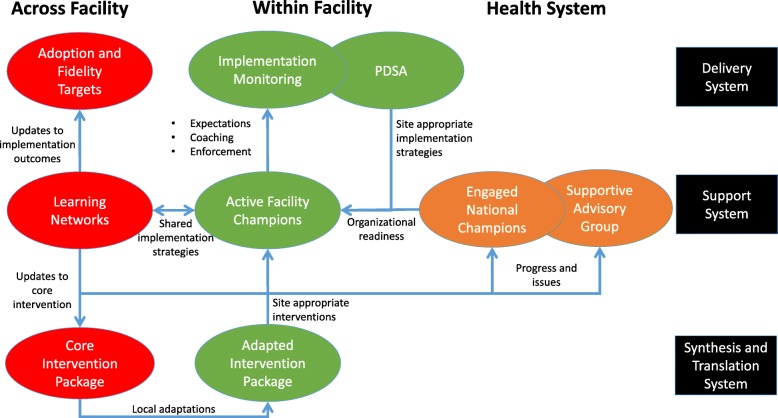
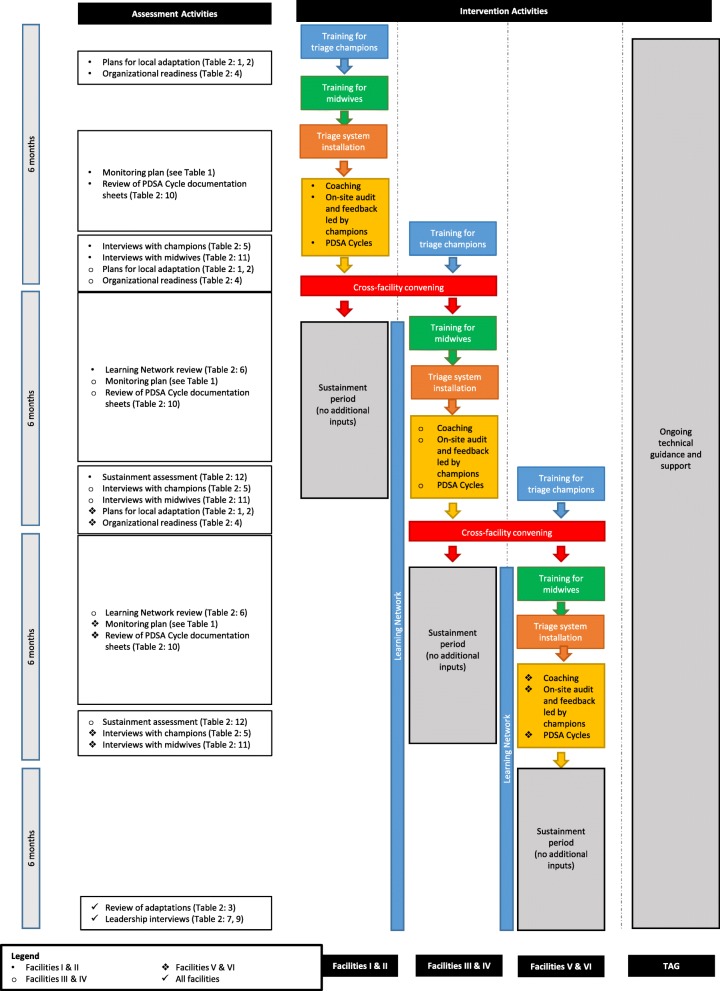
Background: Ghana significantly reduced maternal and newborn mortality between 1990 and 2015, largely through efforts focused on improving access to care. Yet achieving further progress requires improving the quality and timeliness of care. Beginning in 2013, Ghana Health Service and Kybele, a US-based non-governmental organization, developed an innovative obstetric triage system to help midwives assess, diagnosis, and determine appropriate care plans more quickly and accurately. In 2019, efforts began to scale this successful intervention into six additional hospitals. This protocol describes the theory-based implementation approach guiding scale-up and presents the proposed mixed-methods evaluation plan. Methods: An implementation theory was developed to describe how complementary implementation strategies would be bundled into a multi-level implementation approach. Drawing on the Interactive Systems Framework and Evidenced Based System for Implementation Support, the proposed implementation approach is designed to help individual facilities develop implementation capacity and also build a learning network across facilities to support the implementation of evidence-based interventions. A convergent design mixed methods approach will be used to evaluate implementation with relevant data drawn from tailored assessments, routinely collected process and quality monitoring data, textual analysis of relevant documents and WhatsApp group messages, and key informant interviews. Implementation outcomes of interest are acceptability, adoption, and sustainability. Discussion: The past decade has seen a rapid growth in the development of frameworks, models, and theories of implementation, yet there remains little guidance on how to use these to operationalize implementation practice. This study proposes one method for using implementation theory, paired with other kinds of mid-level and program theory, to guide the replication and evaluation of a clinical intervention in a complex, real-world setting. The results of this study should help to provide evidence of how implementation theory can be used to help close the “know-do” gap. Plain language summary: Every woman and every newborn deserves a safe and positive birth experience. Yet in many parts of the world, this goal is often more aspiration than reality. In 2006, Kybele, a US-based non-governmental organization, began working with the Ghanaian government to improve the quality of obstetric and newborn care in a large hospital in Greater Accra. One successful program was the development of a triage system that would help midwives rapidly assess pregnant women to determine who needed what kind of care and develop risk-based care plans. The program was then replicated in another large hospital in the Greater Accra region, where a systematic theory to inform triage implementation was developed. This paper describes the extension of this approach to scale-up the triage program implementation in six additional hospitals. The scale-up is guided by a multi-level theory that extends the facility level theory to include cross-facility learning networks and oversight by the health system. We explain the process of theory development to implement interventions and demonstrate how these require the combination of local contextual knowledge with evidence from the implementation science literature. We also describe our approach for evaluating the theory to assess its effectiveness in achieving key implementation outcomes. This paper provides an example of how to use implementation theories to guide the development and evaluation of complex programs in real-world settings.
Overview
The claims and statistics of this paper haven’t been checked yet.
Free: it reads the open-access text and checks the first 5 claims that cite a source we can check. Create a free account to check every claim.
Integrity signals
Registry
Cites
Statistics
Figures

Verification
Claims the paper makes
The claims and statistics of this paper haven’t been checked yet.
Free: it reads the open-access text and checks the first 5 claims that cite a source we can check. Create a free account to check every claim.
Claims other papers make about this one
Each is checked against this paper’s own text: does it say what the citing paper says it does?
The cited source says what the claim attributes to it.
In the citing paper
“For example, there has been widespread attention to scale-up [44–49].”
From Ten years of implementation outcomes research: a scoping review (2023) · cites this paper as [49]
Self-check
Percentages, sums and reported differences re-computed from the paper’s own numbers.
The self-check needs the paper’s full text.
Citations
Cites
Diffusion of Innovations in Service Organizations: Systematic Review and Recommendations
GREENHALGH, T., ROBERT, G., MACFARLANE, F., BATE, P., & KYRIAKIDOU, O. (2004) · The Milbank Quarterly · doi:10.1111/j.0887-378x.2004.00325.x · Cited by 7,448
(2006) · Cited by 7,081
Making sense of implementation theories, models and frameworks
Nilsen, P. (2015) · Implementation Science · doi:10.1186/s13012-015-0242-0 · Cited by 4,447 · cited 1×
“The focus on theory in implementation science has grown rapidly over the past decade but has primarily remained in the domain of research [16].”
BackgroundCurran, G. M., Bauer, M., Mittman, B., Pyne, J. M., & Stetler, C. (2012) · Medical Care · doi:10.1097/mlr.0b013e3182408812 · Cited by 4,058 · cited 1×
“6 Methods Design The OTIP evaluation uses a Type II hybrid effectiveness-implementation pre-post design (15) focusing on both clinical and implementation outcomes.”
MethodToo far to walk: Maternal mortality in context
Thaddeus, S., & Maine, D. (1994) · Social Science & Medicine · doi:10.1016/0277-9536(94)90226-7 · Cited by 3,240 · cited 1×
“Reducing the “third delay”—the delay in receiving adequate and appropriate treatment once care is sought [9]—is of particular priority.”
BackgroundImplementing, Embedding, and Integrating Practices: An Outline of Normalization Process Theory
May, C., & Finch, T. (2009) · Sociology · doi:10.1177/0038038509103208 · Cited by 2,115 · cited 1×
“Sustainability will be assessed using Normalization Process Theory (NPT), which seeks to explain how new technologies and practices become embedded into health provider routines (28,29), as well as by the post-implementation measurements of waiting time, compliance, and accuracy.”
MethodTaylor, M. J., McNicholas, C., Nicolay, C., Darzi, A., Bell, D., & Reed, J. E. (2014) · BMJ Quality & Safety · doi:10.1136/bmjqs-2013-001862 · Cited by 1,871 · cited 1×
“Training is also provided during day two on the use of Plan-Do-Study-Act (PDSA) cycles [24] to hypothesize causes for gaps in intervention quality, and to develop and test locally appropriate strategies to address them.”
BackgroundMurray, E., Treweek, S., Pope, C., MacFarlane, A., Ballini, L., Dowrick, C., Finch, T., Kennedy, A., Mair, F., O'Donnell, C., et al. (2010) · BMC Medicine · doi:10.1186/1741-7015-8-63 · Cited by 1,478
Development of a theory of implementation and integration: Normalization Process Theory
May, C. R., Mair, F., Finch, T., MacFarlane, A., Dowrick, C., Treweek, S., Rapley, T., Ballini, L., Ong, B. N., Rogers, A., et al. (2009) · Implementation Science · doi:10.1186/1748-5908-4-29 · Cited by 1,409 · cited 1×
“Sustainability will be assessed using Normalization Process Theory (NPT), which seeks to explain how new technologies and practices become embedded into health provider routines [28, 29], as well as by the post-implementation measurements of waiting time, compliance, and accuracy.”
MethodWiltsey Stirman, S., Baumann, A. A., & Miller, C. J. (2019) · Implementation Science · doi:10.1186/s13012-019-0898-y · Cited by 1,329
Research works printed but not linked: 1
- Weiss C. Nothing as practical as good theory: exploring theory-based evaluation for comprehensive community initiatives for children and families. In: Connell J, Kubisch A, Schorr L, Weiss C, editors. New approaches to evaluating community initiatives. Washington, DC: Aspen Institute; 1995.
Cited by
Ten years of implementation outcomes research: a scoping review
Proctor, E. K., Bunger, A. C., Lengnick-Hall, R., Gerke, D. R., Martin, J. K., Phillips, R. J., & Swanson, J. C. (2023) · Implementation Science · doi:10.1186/s13012-023-01286-z · Cited by 424
Diversifying Implementation Science: A Global Perspective
Bartels, S. M., Haider, S., Williams, C. R., Mazumder, Y., Ibisomi, L., Alonge, O., Theobald, S., Bärnighausen, T., Escallon, J. V., Vahedi, M., et al. (2022) · Global Health Science and Practice · doi:10.9745/ghsp-d-21-00757 · Cited by 67
“Following the intervention development and an implementation pilot, an externally funded project expanded the program to 8 additional facilities using a systematic, theory-driven implementation science approach.(40,41) A technical advisory group consisting of policy makers from the Ghana Health”
MethodSelf-citationCommunity coalition readiness for implementing something new: Using a Delphi methodology
Domlyn, A. M., & Wandersman, A. (2019) · Journal of Community Psychology · doi:10.1002/jcop.22161 · Cited by 47
Ramaswamy, R., Bogdewic, S., Williams, C. R., Deganus, S., Bonzi, G. A., Boakye, J., Koranteng, E., Mensah, R., Amanor, A., Bryce, F., et al. (2023) · Implementation Science Communications · doi:10.1186/s43058-023-00527-y · Cited by 12
“This theory, published elsewhere [25], is based on the Evidence-Based System for Implementation Support (EBSIS) [9] that specifies the need for training to be reinforced by technical assistance and quality improvement and on the leadership literature authored by Aarons et al. identifying the…”
MethodSelf-citationBogdewic, S., Ramaswamy, R., Goodman, D. M., Srofenyoh, E., Ucer, S., & Owen, M. D. (2020) · PLoS ONE · doi:10.1371/journal.pone.0242170 · Cited by 9
Self-citation
Metadata
- Authors
- Williams, C. R., Bogdewic, S., Owen, M. D., Srofenyoh, E. K., & Ramaswamy, R.
- Affiliations
- University of North Carolina at Chapel Hill (US)
- North Carolina Geological Survey (US)
- Ghana Health Service (GH)
- Corresponding author
- Ramaswamy, Rohit
- Venue
- Implementation Science
- Published
- 2020-05-12
- Volume
- 15
- Issue
- 1
- Pages
- 31-31
- ISSN
- 1748-5908 (ISSN-L)
- PMC
- PMC7218616
- OpenAlex
- W3027935244
- Semantic Scholar
- 817dab0a6852f97d2d4bf953921d15d49496f034
- Cited by
- 10
- References
- 32
- Citations by year
- 2026: 1 · 2025: 3 · 2024: 1 · 2023: 2 · 2022: 1 · 2020: 1
- FWCI
- 1.04
- Type
- journal article
- Language
- en
- Open access
- gold
- doi.org
- Licence
- cc-by
- creativecommons.org/licenses/by/4.0 (tdm)
- creativecommons.org/licenses/by/4.0 (vor)
- Locations
- Implementation Science (publishedVersion, cc-by)
- Research Square (acceptedVersion, cc-by)
- PubMed Central (publishedVersion, cc-by)
- PubMed (publishedVersion)
- Carolina Digital Repository (University of North Carolina at Chapel Hill) (submittedVersion, cc-by)
- DOAJ (DOAJ: Directory of Open Access Journals) (submittedVersion, cc-by-sa)
- UNC Libraries
- Funders
- United States Agency for International Development
- Bill and Melinda Gates Foundation
- Department for International Development
- Korea International Cooperation Agency
- Grand Challenges Canada
- Direktoratet for Utviklingssamarbeid
- Topics
- Health Sciences › Health Professions › General Health Professions › Health Policy Implementation Science
- Health Sciences › Health Professions › General Health Professions › Health Sciences Research and Education
- Health Sciences › Medicine › Public Health, Environmental and Occupational Health › Clinical practice guidelines implementation
- Keywords
- obstetric triage, scale-up, implementation theory, Interactive Systems Framework, midwives, maternal health care quality, neonatal care, implementation capacity, learning networks, knowledge-practice gap, referral hospitals, Ghana, program theory, implementation outcomes, WhatsApp communication
- MeSH terms
- Maternal-Child Health Services, Implementation Science, Learning Health System, Ghana, Humans, Midwifery, Obstetrics, Time Factors, Triage, Risk Assessment, Evidence-Based Practice, Quality Improvement
About these checks
Registry, retraction, Cites and statistics results are computed, not judged, with one exception: a printed reference that no index lists is read once by a model before it counts as a citation error. Claims are extracted by a model and kept only when their quote appears verbatim in the text; each cited source is then checked, with a model’s help, for whether it says what the claim relies on. Those verdicts can be wrong — read the claim’s quote and the cited source before relying on one.
Statistics and arithmetic are recomputed, not judged.
Confidence bands are shown only for fields calibrated on our annotated test set. None is calibrated yet, so no band is shown.
What counts as a claim ›How we measure confidence ›How we check this ›
Are you an author, or do you see a problem with this page? Request a review
How to cite
Cite CoChat for the checks on this page, and the paper for its own findings.
- This page
- CoChat. (2026). Citation check: A protocol for evaluating a multi-level implementation theory to scale-up obstetric triage in referral hospitals in Ghana. https://app.cochat.ai/papers/10.1186/s13012-020-00992-2
- The paper
- Williams, C. R., Bogdewic, S., Owen, M. D., Srofenyoh, E. K., & Ramaswamy, R. (2020). A protocol for evaluating a multi-level implementation theory to scale-up obstetric triage in referral hospitals in Ghana. Implementation Science. https://doi.org/10.1186/s13012-020-00992-2
Data sources
Bibliographic data: Semantic Scholar, OpenAlex, Crossref.
Contains information from the Semantic Scholar Academic Graph Datasets, made available under the ODC Attribution License (ODC-BY 1.0).
Semantic Scholar’s data is described in: Kinney, R., et al. (2023). The Semantic Scholar Open Data Platform. arXiv:2301.10140.
