

The DOI matches its Crossref record; 56 of the 56 references it cites were found in a registry or an index; 41 of the 69 sources its claims cite were checked for support.
The FRAME: an expanded framework for reporting adaptations and modifications to evidence-based interventions
Open accessAbstract
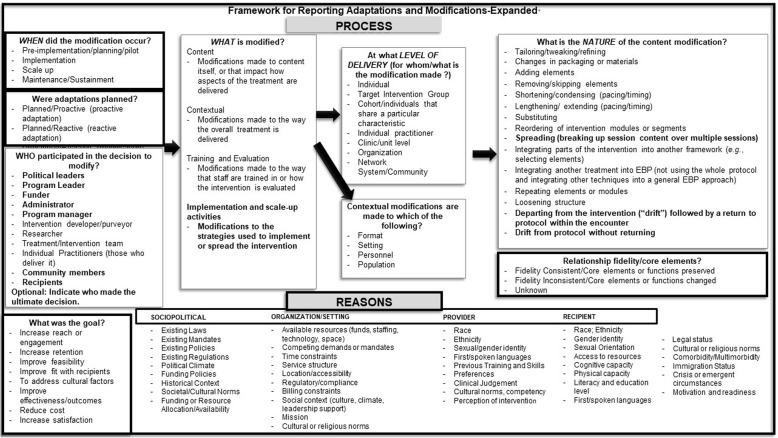
BACKGROUND: This paper describes the process and results of a refinement of a framework to characterize modifications to interventions. The original version did not fully capture several aspects of modification and adaptation that may be important to document and report. Additionally, the earlier framework did not include a way to differentiate cultural adaptation from adaptations made for other reasons. Reporting additional elements will allow for a more precise understanding of modifications, the process of modifying or adapting, and the relationship between different forms of modification and subsequent health and implementation outcomes. DISCUSSION: We employed a multifaceted approach to develop the updated FRAME involving coding documents identified through a literature review, rapid coding of qualitative interviews, and a refinement process informed by multiple stakeholders. The updated FRAME expands upon Stirman et al.'s original framework by adding components of modification to report: (1) when and how in the implementation process the modification was made, (2) whether the modification was planned/proactive (i.e., an adaptation) or unplanned/reactive, (3) who determined that the modification should be made, (4) what is modified, (5) at what level of delivery the modification is made, (6) type or nature of context or content-level modifications, (7) the extent to which the modification is fidelity-consistent, and (8) the reasons for the modification, including (a) the intent or goal of the modification (e.g., to reduce costs) and (b) contextual factors that influenced the decision. Methods of using the framework to assess modifications are outlined, along with their strengths and weaknesses, and considerations for research to validate these measurement strategies. CONCLUSION: The updated FRAME includes consideration of when and how modifications occurred, whether it was planned or unplanned, relationship to fidelity, and reasons and goals for modification. This tool that can be used to support research on the timing, nature, goals and reasons for, and impact of modifications to evidence-based interventions.
Overview
CoChat Summary
TL;DR
This paper refines the FRAME (Framework for Reporting Adaptations and Modifications-Enhanced) to better document how, when, why, and by whom evidence-based interventions are modified. It expands the original framework to capture planned vs. unplanned changes, timing across implementation phases, fidelity consistency, and cultural and contextual reasons for modification.
Key findings
- The updated FRAME adds 8 reporting aspects: timing in the implementation process, planned/proactive vs. unplanned/reactive, who decided, what was modified, level of delivery, type/nature of modifications, fidelity consistency, and reasons/goals for modification.
- The authors’ refinement process used multiple data sources: coding literature identified through a review, rapid coding of qualitative interviews with 55 mental health providers and administrators, and stakeholder feedback.
- The literature review process examined a total of 170 individual articles describing adaptations to interventions, with a “stop rule” that halted article review after no new aspects were found in 10 original sources from each additional systematic review.
- The paper explicitly adds cultural adaptation as a distinct reason for modification and specifies goals such as improving feasibility, acceptability, reach/engagement, fit, reducing costs, improving clinical outcomes, or aligning with cultural values, norms, or priorities.
Methods
- Pragmatic, multifaceted framework refinement combining literature review, qualitative interview data, and stakeholder consultation.
- Literature review and snowballing of published frameworks, reviews, and articles on adaptations/modifications; qualitative rapid coding of interview responses from 55 providers/administrators.
- Data from both sources were consolidated, collapsed into subcategories by consensus among the three authors, and then presented to stakeholder groups for further refinement.
Limitations
- The paper states it did not use a systematic review or traditional thematic analysis; it says these approaches did not align with the project goals.
- The authors note that comprehensively cataloging modifications may be difficult in some contexts, especially when an intervention has not been exhaustively described and tested; this is a limitation of applying FRAME in practice, not of the paper’s own analysis.
- The paper also says the feasibility of using a comprehensive framework will vary across research and applied settings, and that further evaluation of different ways to use FRAME is needed.
Model-written summary. Check it against the paper before relying on it.
Integrity signals
Registry
Cites
Statistics
Figures
Verification
Claims the paper makes
20 Valid · 4 Not valid · 4 Not checked · 42 Own results and interpretations
Some cited sources support this claim and some don’t — read each source’s verdict below.
In the paper
“Further, we recognized that other aspects of reporting that may be important for improving understanding of modification and its impact, such as when in the implementation process the modification was made, were also not included [28–31].”
§ The FRAME: an expanded framework for reporting adaptations and modifications to evidence-based interventions > Background
What the sources say
- Disputedcites [28] Rabin B, McCreight M, Glasgow R, editors. Systematic multi-method documentation of adaptations in five health system interventions. Implementation Sci 2018;13. sourceExperimental — accuracy not yet measured
The Methods > Adaptation Framework section says the original Stirman framework was expanded to include when adaptations were made. But the framework presented in this cited paper itself includes a WHEN category for the stage of the project at which an adaptation occurred. Thus, this source does not support the claim that this aspect was absent from the prior frameworks cited; it documents one that included it. (LLM, conf=0.87)
Checked by a reasoning model — may be wrong.
- Partly supportedcites [29] Escoffery C, Lebow-Skelley E, Udelson H, Böing EA, Wood R, Fernandez ME, et al. A scoping study of frameworks for adapting public health evidence-based interventions. Transl Behav Med. 2018;9(1):1–10. sourceExperimental — accuracy not yet measured
The Discussion (Implications for future research; page unavailable) says adaptations should be documented to better understand their impact and calls for reporting guidelines. But the paper does not establish that the reviewed frameworks omitted reporting when, during implementation, a modification was made; its Introduction notes that a taxonomy of adaptation timing had been developed. (LLM, conf=0.80)
- Could not verifycites [30] Brown CH, Curran G, Palinkas LA, Aarons GA, Wells KB, Jones L, et al. An overview of research and evaluation designs for dissemination and implementation. Annu Rev Public Health. 2017;38:1–22. sourceExperimental — accuracy not yet measured
The Introduction (page unavailable) describes adaptations during preparation and implementation, and the Between-Site Designs section describes changing an implementation strategy if it fails. Neither passage addresses whether prior frameworks included reporting when a modification was made. Searches for modification timing and reporting found no passage that settles that claim. (LLM, conf=0.69)
- Could not verifycites [31] Ramsay JE, Janevic MR, Hogan CK, Edwards DL, Connell CM. Using the replicating effective programs framework to adapt a heart health intervention. Health Promot Pract. 2018. sourceExperimental — accuracy not yet measured
The Background says adaptation processes are often poorly documented, and the Discussion (REP Framework: Limitations) says REP lacks explicit options for making certain modifications. Neither passage says prior frameworks omitted reporting when in implementation a modification was made; searches for that timing and reporting point found no such statement. (LLM, conf=0.72)
hedged- Asserted: passes — The authors put it forward as true.
- Checkable: passes — It can be checked against evidence.
- Load-bearing: passes — The paper’s conclusions depend on it.
- Based: passes — The paper gives a reason why it holds.
- Disputed
Every source the paper cites for this claim was checked and supports it.
In the paper
“Stirman and colleagues previously developed a Framework for Modification and Adaptations [16].”
§ The FRAME: an expanded framework for reporting adaptations and modifications to evidence-based interventions > Background
What the sources say
- Supportedcites [16] Stirman SW, Miller CJ, Toder K, Calloway A. Development of a framework and coding system for modifications and adaptations of evidence-based interventions. Implementation Sci. 2013;8:65. source
The paper’s Abstract (Methods) says the authors developed a system for classifying modifications to interventions, and the Background describes the intended framework. This supports identifying the work as the framework developed by Stirman and colleagues. (LLM, conf=0.94)
plain- Asserted: passes — The authors put it forward as true.
- Checkable: passes — It can be checked against evidence.
- Load-bearing: passes — The paper’s conclusions depend on it.
- Based: passes — The paper gives a reason why it holds.
- Supported
The cited sources support only part of this claim — read each source’s verdict below.
In the paper
“Without understanding forms of modification that occur, the systematic evaluation of processes and strategies that lead to more and less successful implementation may be hindered [2, 17–19].”
§ The FRAME: an expanded framework for reporting adaptations and modifications to evidence-based interventions > Background
What the sources say
- Supportedcites [2] Stirman SW, Gutner C, Edmunds J, Evans AC, Beidas R. Relationships between clinician-level attributes and fidelity-consistent and fidelity-inconsistent modifications to an evidence-based psychotherapy. Implementation Sci. 2015;10(1):115. source
The Discussion says it is important to differentiate types of modifications and that measuring them and monitoring outcomes are necessary to understand their impact. The paper also links identifying factors associated with modifications to understanding how to improve evidence-based treatment delivery. This supports the citing sentence’s hedged point about evaluating implementation strategies. (LLM, conf=0.88)
- Supportedcites [17] Baumann AA, Powell BJ, Kohl PL, Tabak RG, Penalba V, Proctor EK, et al. Cultural adaptation and implementation of evidence-based parent-training: a systematic review and critique of guiding evidence. Child Youth Serv Rev. 2015;53:113–20. source
The Discussion (page unavailable) calls for documenting what was adapted and how, and says that identifying the diversity of adaptations helps researchers examine intervention impact. The Implementation section (page unavailable) says frameworks enable systematic evaluation and that evaluating outcomes helps identify which implementation strategies work best. Together, these passages support the claim's hedged point that failing to understand modifications may hinder such evaluation. (LLM, conf=0.86)
- Not checked — no full text of the sourcecites [18] Glasziou P, Altman DG, Bossuyt P, Boutron I, Clarke M, Julious S, et al. Reducing waste from incomplete or unusable reports of biomedical research. Lancet. 2014;383(9913):267–76. source
- Partly supportedcites [19] Baumann AA, Domenech Rodríguez MM, Amador NG, Forgatch MS, Parra-Cardona JR. Parent management training-Oregon model (PMTO™) in Mexico City: integrating cultural adaptation activities in an implementation model. Clin Psychol: Sci and Pract. 2014;21(1):32–47. sourceExperimental — accuracy not yet measured
In “Implementation and Cultural Adaptation” (page unavailable), the paper says most implementation frameworks do not make adaptation explicit and calls for adaptation to be planned and evaluated throughout implementation. The Discussion (page unavailable) also stresses documenting adaptations so researchers can evaluate them. It does not explicitly say that failing to understand forms of modification hinders systematic comparison of strategies leading to more versus less successful implementation. (LLM, conf=0.78)
hedgedstates a possible cause- Asserted: passes — The authors put it forward as true.
- Checkable: passes — It can be checked against evidence.
- Load-bearing: passes — The paper’s conclusions depend on it.
- Based: passes — The paper gives a reason why it holds.
- Supported
The cited sources support only part of this claim — read each source’s verdict below.
In the paper
“The process, nature, and outcomes of modifications to evidence-based programs/practices (EBPs) have often not been well documented, despite considerable recent interest in the field of implementation science [5, 6].”
§ The FRAME: an expanded framework for reporting adaptations and modifications to evidence-based interventions > Background
What the sources say
- Partly supportedcites [5] von Thiele Schwarz U, Förberg U, Sundell K, Hasson H. Colliding ideals–an interview study of how intervention researchers address adherence and adaptations in replication studies. BMC Med Res Methodol. 2018;18(1):36. sourceExperimental — accuracy not yet measured
The Background (page unavailable) says interventions are seldom described well enough to determine adaptations, and the Discussion says many adaptations are left out of journal reports. This supports the claim about poor documentation of modifications, but the paper does not establish that their outcomes are often poorly documented or explicitly characterize the degree of recent interest across implementation science. (LLM, conf=0.83)
- Not checked — no full text of the sourcecites [6] Sundell K, Beelmann A, Hasson H, von Thiele Schwarz U. Novel programs, international adoptions, or contextual adaptations? Meta-analytical results from German and Swedish intervention research. J Clin Child Adolesc Psychol. 2016;45(6):784–96. source
plain- Asserted: passes — The authors put it forward as true.
- Checkable: passes — It can be checked against evidence.
- Load-bearing: passes — The paper’s conclusions depend on it.
- Based: passes — The paper gives a reason why it holds.
- Partly supported
The cited sources support only part of this claim — read each source’s verdict below.
In the paper
“In fact, modifications that focus on increasing the fit of the EBPs with the target population can lead to improved engagement, acceptability, and clinical outcomes, particularly when working with minority populations [8–10].”
§ The FRAME: an expanded framework for reporting adaptations and modifications to evidence-based interventions > Background
What the sources say
- Not checked — no full text of the sourcecites [8] Steinka-Fry KT, Tanner-Smith EE, Dakof GA, Henderson C. Culturally sensitive substance use treatment for racial/ethnic minority youth: a meta-analytic review. J Subst Abus Treat. 2017;75:22–37. source
- Partly supportedcites [9] Rathod S, Gega L, Degnan A, Pikard J, Khan T, Husain N, et al. The current status of culturally adapted mental health interventions: a practice-focused review of meta-analyses. Neuropsychiatr Dis Treat. 2018;14:165–78. sourceExperimental — accuracy not yet measured
The Results (Cultural factors as moderators of effect of adapted interventions; page unavailable) report that some culturally adapted interventions had greater clinical effects, including when adaptations addressed patients’ cultural values and beliefs. The Introduction links a lack of cultural adaptation to poor uptake among minority populations. The paper does not establish improved acceptability or directly show improved engagement from these modifications, and its Conclusion says the effective components and populations remain uncertain. (LLM, conf=0.84)
- Not checked — no full text of the sourcecites [10] Bernal GE, Domenech Rodríguez MM. Cultural adaptations: tools for evidence-based practice with diverse populations: American Psychological Association; 2012. source
plainstates a cause- Asserted: passes — The authors put it forward as true.
- Checkable: passes — It can be checked against evidence.
- Load-bearing: unclear — It is unclear whether the paper’s conclusions depend on it.
- Based: passes — The paper gives a reason why it holds.
11 more claims · 6 with their cited sources checked
Create a free account to see all 70 claims and every source verdict.
- It may state two separate claims as one. 26
- Probably not a substantial claim. 45
Claims other papers make about this one
Each is checked against this paper’s own text: does it say what the citing paper says it does?
The cited source says what the claim attributes to it.
In the citing paper
“Published guidance highlights the importance of Adapting the innovation [76], and the updated CFIR notes the importance of adapting the setting as well [77].”
From The updated consolidated framework for implementation research based on user feedback (2022) · cites this paper as [76]
The cited source says what the claim attributes to it.
In the citing paper
“Retrospective in nature, this study provides guidance in evaluating the implementation of a newborn care package but is limited in providing more in-depth instruction on systematic detail on modifications and adaptations to tailor interventions for this setting (79–81).”
The cited source says what the claim attributes to it.
In the citing paper
“Interviews will capture any adaptations to the ICU-PAUSE tool based on the FRAME method, such as the timing, participants, and nature of each modification [20].”
From Improving Communication in Intensive Care Unit to Ward Transitions: Protocol for Multisite National Implementation of the ICU-PAUSE Handoff Tool (2023) · cites this paper as [20]
The cited source says what the claim attributes to it.
In the citing paper
“Adaptations will be noted and codified using the Framework for Reporting Adaptations and Modifications-Expanded (FRAME) method of tracking adaptations in our postimplementation interviews [20].”
From Improving Communication in Intensive Care Unit to Ward Transitions: Protocol for Multisite National Implementation of the ICU-PAUSE Handoff Tool (2023) · cites this paper as [20]
Citations
Cites
Damschroder, L. J., Aron, D. C., Keith, R. E., Kirsh, S. R., Alexander, J. A., & Lowery, J. C. (2009) · Implementation Science · doi:10.1186/1748-5908-4-50 · Cited by 14,496
The social determinants of health: It’s time to consider the causes of the causes
Braveman, P., & Gottlieb, L. (2014) · Public Health Reports® · doi:10.1177/00333549141291s206 · Cited by 3,861
Advancing a Conceptual Model of Evidence-Based Practice Implementation in Public Service Sectors
Aarons, G. A., Hurlburt, M., & Horwitz, S. M. (2011) · Administration and Policy in Mental Health and Mental Health Services Research · doi:10.1007/s10488-010-0327-7 · Cited by 3,240
Implementation strategies: recommendations for specifying and reporting
Proctor, E. K., Powell, B. J., & McMillen, J. C. (2013) · Implementation Science · doi:10.1186/1748-5908-8-139 · Cited by 2,585
The dynamic sustainability framework: addressing the paradox of sustainment amid ongoing change
Chambers, D. A., Glasgow, R. E., & Stange, K. C. (2013) · Implementation Science · doi:10.1186/1748-5908-8-117 · Cited by 1,724
Wiltsey Stirman, S., Kimberly, J., Cook, N., Calloway, A., Castro, F., & Charns, M. (2012) · Implementation Science · doi:10.1186/1748-5908-7-17 · Cited by 1,355
Reducing waste from incomplete or unusable reports of biomedical research
Glasziou, P., Altman, D. G., Bossuyt, P., Boutron, I., Clarke, M., Julious, S., Michie, S., Moher, D., & Wager, E. (2014) · The Lancet · doi:10.1016/s0140-6736(13)62228-x · Cited by 1,319
The Cultural Adaptation of Prevention Interventions: Resolving Tensions Between Fidelity and Fit
Castro, F. G., Barrera, M., & Martinez, C. R. (2004) · Prevention Science · doi:10.1023/b:prev.0000013980.12412.cd · Cited by 1,228
Bernal, G., Bonilla, J., & Bellido, C. (1995) · Journal of Abnormal Child Psychology · doi:10.1007/bf01447045 · Cited by 1,120
The Sustainability of Evidence-Based Interventions and Practices in Public Health and Health Care
Shelton, R. C., Cooper, B. R., & Stirman, S. W. (2018) · Annual Review of Public Health · doi:10.1146/annurev-publhealth-040617-014731 · Cited by 806
Self-citation
Research works printed but not linked: 2
- Rabin BA, McCreight M, Battaglia C, Ayele R, Burke RE, Hess PL, et al. Systematic, multimethod assessment of adaptations across four diverse health systems interventions. Front Health Policy Res. 2018;6:102.
- Rogers EM. Diffusion of innovations: New York The Free Press, A Division of Simon & Schuster, Inc; 2010.
Cited by
The updated consolidated framework for implementation research based on user feedback
Damschroder, L. J., Reardon, C. M., Widerquist, M. A. O., & Lowery, J. (2022) · Implementation Science · doi:10.1186/s13012-022-01245-0 · Cited by 4,452
“Published guidance highlights the importance of Adapting the innovation [76], and the updated CFIR notes the importance of adapting the setting as well [77].”
BackgroundDamschroder, L. J., Reardon, C. M., Opra Widerquist, M. A., & Lowery, J. (2022) · Implementation Science · doi:10.1186/s13012-021-01181-5 · Cited by 784
“In a critique by Ilot et al. they recognized that when EBIs are not sustained, the result is a “waste of time, financial resources and leadership effort at a time of economic austerity” [18].”
BackgroundInfluentialThe FRAME-IS: a framework for documenting modifications to implementation strategies in healthcare
Miller, C. J., Barnett, M. L., Baumann, A. A., Gutner, C. A., & Wiltsey-Stirman, S. (2021) · Implementation Science · doi:10.1186/s13012-021-01105-3 · Cited by 490
“The FRAME-IS is based on the FRAME, the development of which is described in detail elsewhere [10, 26] Briefly, the FRAME is a framework for tracking modifications to EBPs focused on what to adapt, alongside a related adaptation framework blending the content and processes of adaptation [27, 28].”
BackgroundMethodInfluentialSelf-citationAdapting interventions to new contexts—The ADAPT guidance
Moore, G., Campbell, M., Copeland, L., Craig, P., Movsisyan, A., Hoddinott, P., Littlecott, H., O’Cathain, A., Pfadenhauer, L., Rehfuess, E., et al. (2021) · BMJ · doi:10.1136/bmj.n1679 · Cited by 511
Shelton, R. C., Chambers, D. A., & Glasgow, R. E. (2020) · Frontiers in Public Health · doi:10.3389/fpubh.2020.00134 · Cited by 448
“Investigators also increasingly recognize the need for a dynamic conceptualization of sustainability, in light of complex “real-world” contexts in which EBIs are delivered that require responsiveness, capacity building, and adaptation of EBIs (10, 11, 16).”
Background
Metadata
- Authors
- Wiltsey Stirman, S., Baumann, A. A., & Miller, C. J.
- Affiliations
- Washington University in St. Louis (US)
- Harvard University (US)
- Venue
- Implementation Science
- Published
- 2019-06-06
- Volume
- 14
- Issue
- 1
- Pages
- 58-58
- ISSN
- 1748-5908 (ISSN-L)
- PMC
- PMC6554895
- OpenAlex
- W2948736612
- Semantic Scholar
- 56ebee1f12bc4d774af4af45ec6d2283838708f6
- Cited by
- 1,329
- References
- 56
- Citations by year
- 2026: 207 · 2025: 206 · 2024: 230 · 2023: 245 · 2022: 188 · 2021: 163 · 2020: 79 · 2019: 8
- FWCI
- 149.04
- Type
- journal article
- Language
- en
- Open access
- gold
- doi.org
- Licence
- cc-by
- creativecommons.org/licenses/by/4.0/ (tdm)
- creativecommons.org/licenses/by/4.0/ (vor)
- Locations
- Implementation Science (publishedVersion, cc-by)
- PubMed Central (publishedVersion, cc-by)
- PubMed (publishedVersion)
- DOAJ (DOAJ: Directory of Open Access Journals) (submittedVersion, cc-by-sa)
- Funders
- National Institute of Mental Health (R01 MH 106506, U01HL133994-03S, UL1TR00234, R01HG009351, U24HL136790-02, 5R25MH08091607)
- Quality Enhancement Research Initiative (QUE 15-289)
- Topics
- Health Sciences › Health Professions › General Health Professions › Health Policy Implementation Science
- Social Sciences › Public Administration › Evaluation and Performance Assessment
- Health Sciences › Medicine › Public Health, Environmental and Occupational Health › Clinical practice guidelines implementation
- Keywords
- FRAME framework, intervention adaptation, cultural adaptation, reporting framework, implementation fidelity, implementation outcomes, evidence-based interventions
- MeSH terms
- Clinical Competence, Delivery of Health Care, Humans, Psychotherapy, Organizational Culture, Evidence-Based Medicine, Clinical Coding
About these checks
Registry, retraction, Cites and statistics results are computed, not judged, with one exception: a printed reference that no index lists is read once by a model before it counts as a citation error. Claims are extracted by a model and kept only when their quote appears verbatim in the text; each cited source is then checked, with a model’s help, for whether it says what the claim relies on. Those verdicts can be wrong — read the claim’s quote and the cited source before relying on one.
The claim verdicts this report counts are experimental: their accuracy is not yet measured.
A language model drew the claims from the paper on 2026-10-10, under version 3 of the claim definition (model deepseek-v4.1-flash, prompt extract-v3).
A second model labelled each claim on 2026-10-10 (model jev-1.13-20260917, definition revision gold-guideline-v0.2).
Cited sources are checked with a language model’s help (gpt-6-sol).
Statistics and arithmetic are recomputed, not judged.
Confidence bands are shown only for fields calibrated on our annotated test set. None is calibrated yet, so no band is shown.
What counts as a claim ›How we measure confidence ›How we check this ›
Are you an author, or do you see a problem with this page? Request a review
How to cite
Cite CoChat for the checks on this page, and the paper for its own findings.
- This page
- CoChat. (2026). Citation check: The FRAME: an expanded framework for reporting adaptations and modifications to evidence-based interventions. https://app.cochat.ai/papers/10.1186/s13012-019-0898-y
- The paper
- Wiltsey Stirman, S., Baumann, A. A., & Miller, C. J. (2019). The FRAME: an expanded framework for reporting adaptations and modifications to evidence-based interventions. Implementation Science. https://doi.org/10.1186/s13012-019-0898-y
Data sources
Bibliographic data: Semantic Scholar, OpenAlex, Crossref.
Contains information from the Semantic Scholar Academic Graph Datasets, made available under the ODC Attribution License (ODC-BY 1.0).
Semantic Scholar’s data is described in: Kinney, R., et al. (2023). The Semantic Scholar Open Data Platform. arXiv:2301.10140.
