

Effectiveness of training methods for delivery of evidence-based psychotherapies: a systematic review
Open accessThe DOI matches its Crossref record; 58 of the 58 references it cites were found in a registry or an index.
Abstract
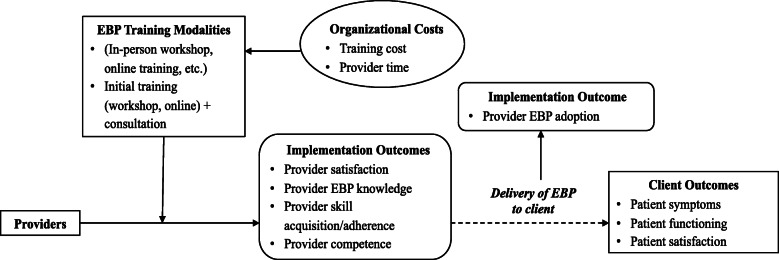
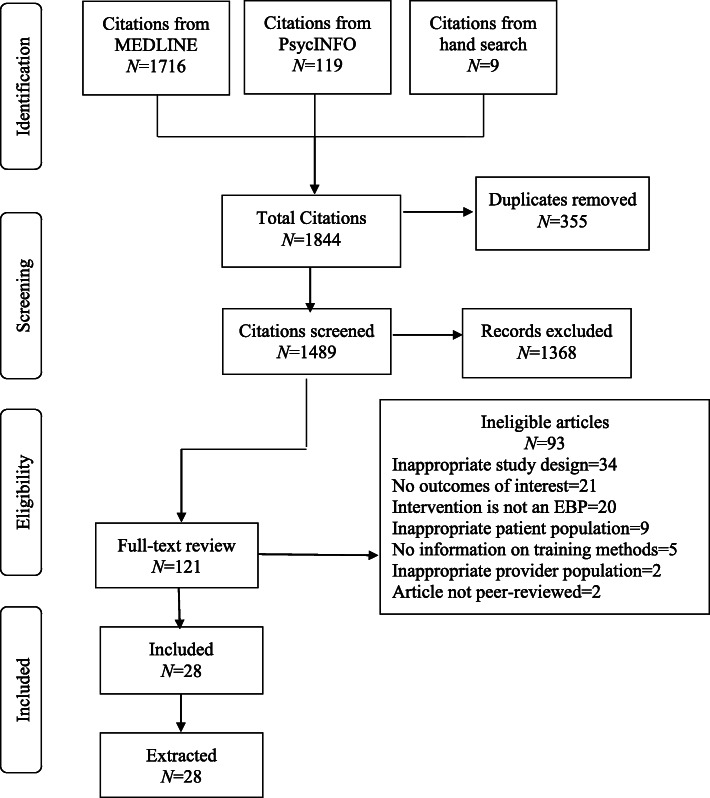
Background: Extensive efforts have been made to train mental health providers in evidence-based psychotherapies (EBPs); there is increasing attention focused on the methods through which providers are trained to deliver EBPs. Evaluating EBP training methods is an important step in determining which methods are most effective in increasing provider skill and improving client outcomes. Methods: We searched MEDLINE (Ovid) and PsycINFO for randomized controlled trials published from 1990 through June 2019 that evaluated EBP training methods to determine the effectiveness of EBP training modalities on implementation (provider and cost) and client outcomes. Eligible studies ( N = 28) were evaluated for risk of bias, and the overall strength of evidence was assessed for each outcome. Data was extracted by a single investigator and confirmed by a second; risk of bias and strength of evidence were independently rated by two investigators and determined by consensus. Results: Overall, EBP training improved short-term provider satisfaction, EBP knowledge, and adherence compared to no training or self-study of training materials (low to moderate strength of evidence). Training in an EBP did not increase treatment adoption compared to no training or self-study. No specific active EBP training modality was found to consistently increase provider EBP knowledge, skill acquisition/adherence, competence, adoption, or satisfaction compared to another active training modality. Findings were mixed regarding the additive benefit of post-training consultation on these outcomes. No studies evaluated changes in provider outcomes with regards to training costs and few studies reported on client outcomes. Limitations: The majority of included studies had a moderate risk of bias and strength of evidence for the outcomes of interest was generally low or insufficient. Few studies reported effect sizes. The ability to identify the most effective EBP training methods was limited by low strength of evidence for the outcomes of interest and substantial heterogeneity among studies. Conclusions: EBP training may have increased short-term provider satisfaction, EBP knowledge, and adherence though not adoption. Evidence was insufficient on training costs and client outcomes. Future research is needed on EBP training methods, implementation, sustainability, client outcomes, and costs to ensure efforts to train providers in EBPs are effective, efficient, and durable. Trial registration: The protocol for this review is registered in PROSPERO ( CRD42018093381 ).
Overview
The claims and statistics of this paper haven’t been checked yet.
Free: it reads the open-access text and checks the first 5 claims that cite a source we can check. Create a free account to check every claim.
Integrity signals
Registry
Cites
Statistics
Figures
Verification
Claims the paper makes
The claims and statistics of this paper haven’t been checked yet.
Free: it reads the open-access text and checks the first 5 claims that cite a source we can check. Create a free account to check every claim.
Claims other papers make about this one
Each is checked against this paper’s own text: does it say what the citing paper says it does?
The cited source says what the claim attributes to it.
In the citing paper
“Nonetheless, these evidence-based psychotherapies (EBPs) remain underutilized and underaccessed in clinical settings.10–12”
Self-check
Percentages, sums and reported differences re-computed from the paper’s own numbers.
The self-check needs the paper’s full text.
Citations
Cites
Preferred Reporting Items for Systematic Reviews and Meta-Analyses: the PRISMA statement
Moher, D., Liberati, A., Tetzlaff, J., Altman, D. G., & for the PRISMA Group (2009) · BMJ · doi:10.1136/bmj.b2535 · Cited by 83,823
Preferred reporting items for systematic reviews and meta-analyses: the PRISMA Statement.
(2009) · PubMed Central · Cited by 44,859
Preferred reporting items for systematic reviews and meta-analyses: The PRISMA statement
Moher, D., Liberati, A., Tetzlaff, J., Altman, D. G., & the PRISMA Group* (2009) · Annals of Internal Medicine · doi:10.7326/0003-4819-151-4-200908180-00135 · Cited by 37,554
The Cochrane Collaboration's tool for assessing risk of bias in randomised trials
Higgins, J. P. T., Altman, D. G., Gotzsche, P. C., Juni, P., Moher, D., Oxman, A. D., Savovic, J., Schulz, K. F., Weeks, L., Sterne, J. A. C., et al. (2011) · BMJ · doi:10.1136/bmj.d5928 · Cited by 33,817
Proctor, E., Silmere, H., Raghavan, R., Hovmand, P., Aarons, G., Bunger, A., Griffey, R., & Hensley, M. (2011) · Administration and Policy in Mental Health and Mental Health Services Research · doi:10.1007/s10488-010-0319-7 · Cited by 8,721
Powell, B. J., Waltz, T. J., Chinman, M. J., Damschroder, L. J., Smith, J. L., Matthieu, M. M., Proctor, E. K., & Kirchner, J. E. (2015) · Implementation Science · doi:10.1186/s13012-015-0209-1 · Cited by 4,963
Empirically supported psychological interventions: Controversies and evidence
Chambless, D. L., & Ollendick, T. H. (2001) · Annual Review of Psychology · doi:10.1146/annurev.psych.52.1.685 · Cited by 2,097
Forsetlund, L., Bjørndal, A., Rashidian, A., Jamtvedt, G., O'Brien, M. A., Wolf, F. M., Davis, D., Odgaard-Jensen, J., & Oxman, A. D. (2009) · Cochrane Database of Systematic Reviews · doi:10.1002/14651858.cd003030.pub2 · Cited by 1,849
Beidas, R. S., & Kendall, P. C. (2010) · Clinical Psychology: Science and Practice · doi:10.1111/j.1468-2850.2009.01187.x · Cited by 1,085 · cited 3×
“In contrast to the general conclusions of previous reviews [15, 16], the additional benefit of consultation beyond initial EBP training was inconclusive.”
BackgroundResultInfluentialA Randomized Trial of Methods to Help Clinicians Learn Motivational Interviewing.
Miller, W. R., Yahne, C. E., Moyers, T. B., Martinez, J., & Pirritano, M. (2004) · Journal of Consulting and Clinical Psychology · doi:10.1037/0022-006x.72.6.1050 · Cited by 1,075 · cited 1×
“However, two studies found that consultation did not result in additional benefit regarding provider competence beyond the initial in-person training [43, 45], although in Miller (2004), only the conditions with consultation had average competency scores at the clinical proficiency standard.”
Background
Research works printed but not linked: 1
- Whitlock EP, Green CA, Polen MR, Berg A, Klein J, Siu A, et al. Behavioral counseling interventions in primary care to reduce risky/harmful alcohol use [Internet]. Rockville (MD): agency for healthcare research and quality (US); 2004 [cited 2019 Feb 3]. (U.S. Preventive Services Task Force Evidence Syntheses, formerly Systematic Evidence Reviews). Available from: http://www.ncbi.nlm.nih.gov/books/NBK42863/. 20722127
Cited by
Pragmatic Precision Psychiatry—A New Direction for Optimizing Treatment Selection
Kessler, R. C., & Luedtke, A. (2021) · JAMA Psychiatry · doi:10.1001/jamapsychiatry.2021.2500 · Cited by 72
Henrich, D., Glombiewski, J. A., & Scholten, S. (2023) · Clinical Psychology Review · doi:10.1016/j.cpr.2023.102266 · Cited by 80
Lyon, A. R., Connors, E. H., Lawson, G. M., Nadeem, E., & Owens, J. S. (2024) · School Mental Health · doi:10.1007/s12310-024-09731-0 · Cited by 60
“Onetime training continues to be associated with increased knowledge and attitudes but, not necessarily practice change in schools (Anderson et al., 2019) or other settings (Valenstein-Mah et al., 2020).”
Learning Collaboratives: a Strategy for Quality Improvement and Implementation in Behavioral Health
Gotham, H. J., Paris, M., & Hoge, M. A. (2022) · The Journal of Behavioral Health Services & Research · doi:10.1007/s11414-022-09826-z · Cited by 49
Barnett, M. L., Puffer, E. S., Ng, L. C., & Jaguga, F. (2023) · Cambridge Prisms Global Mental Health · doi:10.1017/gmh.2023.19 · Cited by 39
“Active learning strategies are seen as the most effective ways to train providers, including professionals, in psychological interventions in general (Valenstein-Mah et al. 2020), and likely is even more critical with non-specialists with less familiarity with these skills.”
BackgroundGoldsmith, E. S., Koffel, E., Ackland, P. E., Hill, J., Landsteiner, A., Miller, W., Stroebel, B., Ullman, K., Wilt, T. J., & Duan-Porter, W. (2023) · Journal of General Internal Medicine · doi:10.1007/s11606-023-08140-4 · Cited by 38
Self-citationGoldsmith, E. S., Miller, W., Koffel, E., Ullman, K. E., Landsteiner, A. M. K., STROEBEL, B. M., Hill, J., Ackland, P. E., Wilt, T. J., & Duan‐Porter, W. (2023) · Journal of Pain · doi:10.1016/j.jpain.2023.02.026 · Cited by 38
Self-citationPinto, T. M., Veiga, V. M. N., & de Macedo, E. C. (2024) · Journal of Behavioral and Cognitive Therapy · doi:10.1016/j.jbct.2024.100495 · Cited by 36
Development and Preliminary Evaluation of an Implementation Facilitation Training Program
Kirchner, J. E., Dollar, K. M., Smith, J. L., Pitcock, J. A., Curtis, N. D., Morris, K. K., Fletcher, T. L., & Topor, D. R. (2022) · Implementation Research and Practice · doi:10.1177/26334895221087475 · Cited by 33
“Assessment of core knowledge, skill acquisition, and sustainment over time is a central component of the program evaluation (Valenstein-Mah et al., 2020).”
BackgroundConnors, E. H., Lyon, A. R., Garcia, K. A., Sichel, C. E., Hoover, S., Weist, M. D., & Tebes, J. K. (2022) · Implementation Science Communications · doi:10.1186/s43058-022-00319-w · Cited by 31
Lyon, A. R., Liu, F. F., Connors, E. H., King, K. M., Coifman, J. I., Cook, H., McRee, E., Ludwig, K., Law, A., Dorsey, S., et al. (2022) · Implementation Science Communications · doi:10.1186/s43058-022-00325-y · Cited by 28
“Training is the starting point for many professional behavior change efforts and is associated with initial, post-training improvements in provider attitudes, knowledge, and skill acquisition [5].”
BackgroundInfluentialRagnarsson, E. H., Reinebo, G., Ingvarsson, S., Lindgren, A., Beckman, M., Alfonsson, S., Hedman‐Lagerlöf, M., Rahm, C., Sahlin, H., Stenfors, T., et al. (2024) · Clinical Psychology & Psychotherapy · doi:10.1002/cpp.3003 · Cited by 30
Weisz, J. R., Thomassin, K., Hersh, J., Santucci, L. C., MacPherson, H. A., Rodriguez, G. M., Bearman, S. K., Lang, J. M., Vanderploeg, J. J., Marshall, T. M., et al. (2020) · Journal of Consulting and Clinical Psychology · doi:10.1037/ccp0000536 · Cited by 26
“Experts have noted the striking absence of cost assessments in implementation research (e.g., Eisman, Kilbourne, Dopp, Saldana, & Eisenberg, 2020; Valenstein-Mah et al., 2020) and the potency such assessments would have in making the business case with providers and administrators who must watch…”
BackgroundInfluentialSingla, D. R., Niño, A. P., Zibaman, M., Andrejek, N., Hossain, S., Cohen, M., Dalfen, A., Dennis, C., Kim, J. J., Porte, L. M. L., et al. (2023) · General Hospital Psychiatry · doi:10.1016/j.genhosppsych.2023.04.002 · Cited by 26
Sayer, N. A., Stirman, S. W., Rosen, C. S., Bernardy, N. C., Spoont, M. R., Kehle‐Forbes, S., Eftekhari, A., Chard, K. M., & Nelson, D. B. (2021) · Journal of Traumatic Stress · doi:10.1002/jts.22679 · Cited by 23
Self-citationGotham, H. J., Cummings, J. R., Dolce, J. N., Druss, B. G., Gill, K. J., Kopelovich, S. L., Molfenter, T. D., Olson, J. R., Benson, F., & Chwastiak, L. (2022) · General Hospital Psychiatry · doi:10.1016/j.genhosppsych.2022.01.004 · Cited by 22
Nutrition Education in Primary Care Adult and Family Nurse Practitioner Programs
Chao, A. M., Zhou, Y., Wei, X., Wisdom-Goulbourne, T., Dowd, M., & Compher, C. W. (2021) · Nurse Educator · doi:10.1097/nne.0000000000001050 · Cited by 21
“Implementation science frameworks often highlight education and training as an important component to delivery of evidence-based treatments in practice.(18,19) A lack of training in nutritionmay be contributing to treatment gaps.”
Psychotherapies in opioid use disorder: toward a step-care model
Durpoix, A., Rolling, J., Coutelle, R., & Lalanne, L. (2023) · Journal of Neural Transmission · doi:10.1007/s00702-023-02720-8 · Cited by 23
“…practical supervision, the cost is $1485 per participant for an in-person workshop and supervision or $785 for a distance workshop and supervision, and it can even decrease to $440 for online training or $145 for training via a manual along with an orientation session (Valenstein-Mah et al. 2020).”
BackgroundGiusto, A. M., Johnson, S. L., Lovero, K. L., Wainberg, M. L., Rono, W., Ayuku, D., & Puffer, E. S. (2021) · International Journal of Drug Policy · doi:10.1016/j.drugpo.2021.103291 · Cited by 21
Ackland, P. E., Koffel, E., Goldsmith, E. S., Ullman, K. E., Miller, W. A., Landsteiner, A. M. K., STROEBEL, B. M., Hill, J., Wilt, T. J., & Duan‐Porter, W. (2023) · Administration and Policy in Mental Health and Mental Health Services Research · doi:10.1007/s10488-023-01279-6 · Cited by 19
Self-citationMotamedi, M., Lau, A. S., Lind, T., Lui, J. H., Rodriguez, A., Smith, A., & Brookman-Frazee, L. (2021) · Implementation Research and Practice · doi:10.1177/2633489520982903 · Cited by 17
“Training, supervision, and consultation are key education and training strategies as they provide continued support after initial training, which by itself is generally insufficient to promote EBP use (Nadeem et al., 2013; Valenstein-Mah et al., 2020; Waltz et al., 2015).”
BackgroundTherapyTrainer: Using AI to Train Therapists in Written Exposure Therapy
Stade, E. C., Eichstaedt, J. C., Kaysen, D. L., Salecha, A., Greenberger, A., Singhvi, S., & Stirman, S. W. (2025) · Cognitive and Behavioral Practice · doi:10.1016/j.cbpra.2025.06.005 · Cited by 17
Hogue, A., Porter, N., Bobek, M., MacLean, A., Bruynesteyn, L., Jensen‐Doss, A., Dauber, S. E., & Henderson, C. E. (2021) · Administration and Policy in Mental Health and Mental Health Services Research · doi:10.1007/s10488-021-01152-4 · Cited by 17
Rob, M. A. A., Nor, M. N. M., & Salleh, Z. (2024) · The Electronic Journal of Business Research Methods · doi:10.34190/ejbrm.22.2.3752 · Cited by 16
“These findings are similar with finding of some of previous studies, such as Valenstein-Mah et al. (2020) programs should be designed to address the different learning styles and ensure that auditors are comfortable and confident in using BDA tools.”
Kopelovich, S. L., Slevin, R., Brian, R., Shepard, V., Baldwin, S. A., Ben‐Zeev, D., Tanana, M., & Imel, Z. E. (2025) · Psychotherapy · doi:10.1037/pst0000550 · Cited by 17
Facilitating Counselor Reflective Learning with a Real-time Annotation tool
Chen, T., Liu, M. X., Ding, E. Y., O'Neil, E., Agarwal, M., Kraut, R. E., & Dabbish, L. (2023) · CHI Conference on Human Factors in Computing Systems · doi:10.1145/3544548.3581551 · Cited by 15
“Such resource-intensity has brought about the need for developing more efficient, scalable, lower cost training methods [78].”
BackgroundComparing In-Person and Synchronous Online Training for an Evidence-Based Treatment
Baumann, B., McGuier, E. A., Rounds, J. L., Rumbarger, K., & Kolko, D. J. (2023) · Administration and Policy in Mental Health and Mental Health Services Research · doi:10.1007/s10488-023-01294-7 · Cited by 14
Shafran, R., Bond, L., Carlbring, P., Cohen, Z. D., Creed, T. A., Davey, E., Egan, S. J., Freeman, D. H., Hollon, S. D., Jacobson, N. C., et al. (2025) · Behaviour Research and Therapy · doi:10.1016/j.brat.2025.104945 · Cited by 13
Woodard, G. S., Triplett, N. S., Frank, H. E., Harrison, J. P., Robinson, S., & Dorsey, S. (2021) · Implementation Research and Practice · doi:10.1177/26334895211057883 · Cited by 14
“In line with best practices for training (Foa et al., 2020; Frank et al., 2020; Valenstein-Mah et al., 2020), clinicians applied CBT+ techniques and received expert consultation via telephone or video-based group calls twice-monthly for 6 months (12 calls total).”
MethodNisar, A., Yin, J., Nan, Y., Luo, H., Han, D., Yang, L., Li, J., Wang, D., Rahman, A., & Li, X. (2022) · International Journal of Environmental Research and Public Health · doi:10.3390/ijerph19074094 · Cited by 13
“Our previous work in Pakistan [19] conducted using a similar methodology to the current study showed very similar results, and the findings of both studies are in line with the research from high income countries [26].”
BackgroundResultLarson, M. F., Cook, C. R., Sullivan, M. M., Lyon, A. R., & Lewis, C. C. (2022) · School Mental Health · doi:10.1007/s12310-022-09499-1 · Cited by 13
“, active learning strategies) yield significant gains in trainee acquisition of knowledge and skills (Markey & Schattner, 2001; Valenstein-Mah et al., 2020) which are important precursors for actual behavior initiation and building skill fluency.”
BackgroundHogue, A., MacLean, A., Bobek, M., Porter, N., Bruynesteyn, L., Jensen‐Doss, A., & Henderson, C. E. (2022) · Journal of Clinical Child & Adolescent Psychology · doi:10.1080/15374416.2022.2051529 · Cited by 13
“To minimize agency burden, the CTC condition prescribed monthly one-hour consultation meetings, well below the intensity featured in most EBI training programs (see Beidas & Kendall, 2010; Valenstein-Mah et al., 2020).”
BackgroundMethodObservational and Accelerometer Analysis of Head Movement Patterns in Psychotherapeutic Dialogue
Inoue, M., Irino, T., Furuyama, N., & Hanada, R. (2021) · Sensors · doi:10.3390/s21093162 · Cited by 10
“Various forms of therapist training have been attempted [50].”
BackgroundAtzor, M.-C., Andersson, G., von Lersner, U., & Weise, C. (2024) · Journal of Cross-Cultural Psychology · doi:10.1177/00220221231221095 · Cited by 11
“Valenstein-Mah et al. (2020) found that incorporating online consultation significantly enhances the acceptability of training.”
Ouellette, R. R., Strambler, M. J., Genovese, M. A., Selino, S., Joyner, L., Sevin, S., Granzow, E., & Connors, E. H. (2024) · School Mental Health · doi:10.1007/s12310-024-09639-9 · Cited by 11
“…et al., 2016), post-training consultation and coaching to extend knowledge transfer into practice (Bei-das et al., 2012; Herschell et al., 2010; Valenstein-Mah et al., 2020), and internal coaches (“champions”) in partnership with external consultants to build internal capacity for sustained…”
Woodard, G. S., Casline, E. P., Ehrenreich, J. T., Ginsburg, G. S., & Jensen‐Doss, A. (2023) · Administration and Policy in Mental Health and Mental Health Services Research · doi:10.1007/s10488-023-01321-7 · Cited by 9
“Another recent systematic review found that training alone did not increase adoption of an EBP but was unable to draw conclusions about the effect of consultation due to variability of consultation across included studies (Valenstein-Mah et al., 2020).”
Woodfield, M. J., Merry, S., & Hetrick, S. E. (2022) · Implementation Research and Practice · doi:10.1177/26334895221082330 · Cited by 9
“Training serves an important role – it may increase clinician knowledge and satisfaction with an approach (Valenstein-Mah et al., 2020).”
BackgroundGumpert, M., Rautio, D., Birovecz, A., Jolstedt, M., Lundgren, T., de la Cruz, L. F., Mataix‐Cols, D., & Jansson‐Fröjmark, M. (2025) · Cognitive Behaviour Therapy · doi:10.1080/16506073.2025.2515526 · Cited by 8
“…the difficulty to develop training approaches that can consistently increase therapist competence and implementation of evidence-based treatments (Frank et al., 2020; Henrich et al., 2023; Jackson et al., 2018; Ragnarsson et al., 2024; Singh & Reyes-Portillo, 2020; Valenstein-Mah et al., 2020).”
Marriott, B. R., Walker, M. R., Howard, J., Puspitasari, A. J., Scott, K., ALBRIGHT, K. J., & Lewis, C. C. (2022) · Administration and Policy in Mental Health and Mental Health Services Research · doi:10.1007/s10488-022-01244-9 · Cited by 8
“, 2013), though the dosage and intensity of consultation needed to achieve improved training outcomes remains unclear (Valenstein-Mah et al., 2020).”
BackgroundKoenig, E., Hoffmann, U., Fegert, J. M., Keller, F., Sicorello, M., Spohrs, J., Kraus, L., Nickel, S., Schmahl, C. G., Abler, B., et al. (2024) · Child and Adolescent Psychiatry and Mental Health · doi:10.1186/s13034-024-00789-x · Cited by 7
“Considering the evidence available about training professionals in evidence-based interventions for mental health in general, there is mounting evidence demonstrating the need for dissemination and training strategies taking an active approach beyond the provision of manuals or self-study [52, 53].”
BackgroundSherrill, A. M., Wiese, C. W., Abdullah, S., & Arriaga, R. I. (2025) · Journal of Technology in Behavioral Science · doi:10.1007/s41347-025-00484-4 · Cited by 7
“We believe teaming with AI can revolutionize the availability and effectiveness of EST training by reducing the reliance on passive didactic experiences (Beidas et al., 2012; Henrich et al., 2023; Valenstein-Mah et al., 2020) and resource-consuming individual consultation (Bash & Stirman, 2020).”
Harned, M. S., Ritschel, L. A., & Schmidt, S. C. (2020) · Journal of Traumatic Stress · doi:10.1002/jts.22622 · Cited by 7
Nagy, G. A., Cassiello-Robbins, C. F., Anand, D., Arnold, M. L., Coleman, J. N., Nwosu, J., Singh, R. S., & Woodward, E. N. (2022) · Transcultural Psychiatry · doi:10.1177/13634615221105117 · Cited by 7
“Parallel to how training alone without more support does not lead to provider change (Valenstein-Mah et al., 2020), providing information on the consultation team alone is unlikely to lead to institutions starting one.”
BackgroundMarriott, B. R., Kliethermes, M. D., McMillen, J. C., Proctor, E. K., & Hawley, K. M. (2022) · Administration and Policy in Mental Health and Mental Health Services Research · doi:10.1007/s10488-022-01246-7 · Cited by 7
Asnaani, A., Chavez, M. G., Samuel, R., Pham, A., & White, R. C. (2023) · International Perspectives in Psychology · doi:10.1027/2157-3891/a000083 · Cited by 7
Gabrielian, S. E., Cordasco, K. M., Finley, E. P., Hoffmann, L. C., Harris, T. E., Calderon, R. A., Barnard, J. M., Ganz, D. A., & Olmos‐Ochoa, T. T. (2022) · Frontiers in Psychology · doi:10.3389/fpsyg.2022.1009467 · Cited by 6
“Consistent with a systematic review (Valenstein-Mah et al., 2020) that concluded that EBP training in isolation improves short-term provider satisfaction and EBP knowledge, but does not impact provider knowledge, we found that some Aftercare providers require more intense and costly supports to achieve CTI adoption.”
BackgroundHogue, A., MacLean, A., Bobek, M., Dunnsue, S., Porter, N., Jensen‐Doss, A., & Henderson, C. E. (2023) · Journal of Clinical Child & Adolescent Psychology · doi:10.1080/15374416.2023.2222405 · Cited by 6
“…efforts to train community therapists in evidence-based interventions (EBIs) have produced modest and inconsistent effects on sustainable EBI delivery (Valenstein-Mah et al., 2020), with only highly intensive and resource-demanding training packages showing reliable impacts (Frank et al., 2020).”
An equivalence analysis of provider education in youth mental health care
McGuier, E. A., Rothenberger, S. D., Friedman, A. L., & Kolko, D. J. (2021) · Health Services Research · doi:10.1111/1475-6773.13659 · Cited by 6
Woodward, E. N., Oliver, K. A., Drummond, K. L., Bartnik, M. K., McCorkindale, A., Meit, S. S., Owen, R. R., & Kirchner, J. E. (2024) · Psychological Services · doi:10.1037/ser0000903 · Cited by 5
Testing a community developed training protocol for an evidence-based treatment
Quetsch, L. B., Herschell, A. D., Kolko, D. J., Liebsack, B. K., & Carroll, R. A. (2022) · Evaluation and Program Planning · doi:10.1016/j.evalprogplan.2022.102055 · Cited by 5
STMIK IKMI, C., Basysyar, F. M., Dwilestari, G., & STMIK IKMI, C. (2022) · International Journal of Engineering Applied Sciences and Technology · doi:10.33564/ijeast.2022.v07i05.012 · Cited by 5
Interventions to promote child development in institutionalized children: a scoping review
Martins, V., Porto, V. D. S., Solís-Cordero, K., de Oliveira, C. V. R., Vicente, J. B., Amador, D. D., Veríssimo, M. D. L. Ó. R., & Cordeiro, S. M. (2025) · Revista da Escola de Enfermagem da USP · doi:10.1590/1980-220x-reeusp-2025-0044en · Cited by 4
“However, it remains unclear whether more rigorous training methods that can improve outcomes for caregivers also improve outcomes for the population they care for (38) .”
Takamatsu, N., Zain, E., Lo, K. Y. H., Prelog, P. R., Keynejad, R. C., Andress, C., Motamed, M., Shamspour, M., Quezon‐Santos, A. S. C., Smolarczyk, J., et al. (2026) · Psychiatry and Clinical Neurosciences · doi:10.1111/pcn.70024 · Cited by 4
“60 Similarly, workshops without ongoing supervision tend to improve knowledge but have limited impact on therapist behavior.”
Holmes, S. R., Smith, T. E., Romero, M. E., Reinke, W. M., & Herman, K. C. (2024) · School Psychology Review · doi:10.1080/2372966x.2024.2318234 · Cited by 4
“These workshops are the foundation for acquiring the necessary knowledge, skills, and attitudes to adopt new strategies (Valenstein-Mah et al., 2020); however, to change teachers’ practices, ongoing structured supports that provide access to continuing education, feedback, and resources are often…”
Effectiveness of Jungian psychotherapy in supervised training settings
Rœsler, C., Schörry-Volk, E., Müller, A., Zikpi, E. D., Keller, W., & Kayacan, M. (2025) · Research in Psychotherapy Psychopathology Process and Outcome · doi:10.4081/ripppo.2025.869 · Cited by 4
“A review of 28 randomized controlled trials found that while training tends to improve therapists’ knowledge and adherence to evidence-based practices, only 11% studied how clients fared, and results were mixed (Valenstein-Mah et al. , 2020).”
Hodgson, N. A., McPhillips, M., Hirschman, K. B., Summerhayes, E., Piersol, C. V., & Gitlin, L. N. (2025) · Contemporary Clinical Trials Communications · doi:10.1016/j.conctc.2025.101478 · Cited by 4
“A 2020 systematic review by Valenstein-Mah and colleagues found that online training programs can reduce implementation costs while maintaining equivalent or superior learning outcomes [18].”
Onovbiona, H., Chavez, F. T., Quetsch, L. B., & Scudder, A. T. (2025) · Frontiers in Child and Adolescent Psychiatry · doi:10.3389/frcha.2025.1517169 · Cited by 4
McGuire, A., Rancher, C. E., Glover, J., & Smith, D. W. (2024) · Evidence-Based Practice in Child and Adolescent Mental Health · doi:10.1080/23794925.2024.2324760 · Cited by 3
McGuire, A., Glover, J., & Smith, D. W. (2024) · Cognitive and Behavioral Practice · doi:10.1016/j.cbpra.2024.04.008 · Cited by 3
Surono, S. (2024) · Devotion Journal of Research and Community Service · doi:10.59188/devotion.v5i8.781 · Cited by 3
Casline, E. P., Woodard, G. S., Lane, E., Pollowitz, S., Douglas, S. R., Ehrenreich, J. T., Ginsburg, G. S., & Jensen‐Doss, A. (2024) · Administration and Policy in Mental Health and Mental Health Services Research · doi:10.1007/s10488-024-01417-8 · Cited by 3
“…for mental health intervention, and efforts to improve training models have identified that ongoing clinical consultation is necessary to help facilitate the adoption and sustainment of implementation in community settings (Frank et al., 2020; Lyon et al., 2022; Valenstein-Mah et al., 2020).”
Chaple, M., Kunins, H. V., Nass, M., Benjamin, A. C., Viel, C. R., Bertone, P., Marker, L., Warren, P., & Hartzler, B. J. (2023) · The Journal of Behavioral Health Services & Research · doi:10.1007/s11414-023-09871-2 · Cited by 3
Julianne Keane M. Pascual, M., Loreche, A. M., Mesa, R. Y. H. D., Fabian, N. M. C., Sanchez, J. T., Panganiban, J. M. S., Rey, M. P., Tan‐Lim, C. S. C., Javelosa, M. A. U., Paterno, R. P. P., et al. (2024) · Acta Medica Philippina · doi:10.47895/amp.vi0.8869 · Cited by 3
Bond, S., Binet, É., & Pudelko, B. (2021) · Santé mentale au Québec · doi:10.7202/1081510ar · Cited by 3
Motamedi, M., Lau, A. S., Byeon, Y. V., Yu, S. H., & Brookman-Frazee, L. I. (2023) · The Journal of Behavioral Health Services & Research · doi:10.1007/s11414-023-09844-5 · Cited by 2
Nuzulia, N., & Solichah, N. (2025) · Journal of Community Service and Empowerment · doi:10.22219/jcse.v6i2.39961 · Cited by 2
Martins, V., Porto, V. D. S., Solís-Cordero, K., de Oliveira, C. V. R., Vicente, J. B., Amador, D. D., Veríssimo, M. D. L. Ó. R., & Cordeiro, S. M. (2025) · Revista da Escola de Enfermagem da USP · doi:10.1590/1980-220x-reeusp-2025-0044pt · Cited by 2
What factors impact transfer of learning in child welfare: A scoping review
Gopalan, G., DePanfilis, D., Kaye‐Tzadok, A., & Deas, K. M. (2025) · Children and Youth Services Review · doi:10.1016/j.childyouth.2025.108322 · Cited by 2
TherapyTrainer: Using AI to train therapists in written exposure therapyPreprint
Stade, E. C., Eichstaedt, J. C., Kaysen, D. L., Salecha, A., Greenberger, A., Singhvi, S., & Stirman, S. W. (2024) · OSF Preprints (OSF Preprints) · doi:10.31219/osf.io/wx93m_v1 · Cited by 2
African American Women’s Experiences Coping with Stress Through Community-Based Services
Procks, D. (2023) · ScholarWorks (Walden University) · Cited by 2
Yotsidi, V., Anastasiou, T., Doulgeris, K., Theodosiou, P., & Richardson, C. (2024) · Research in Psychotherapy Psychopathology Process and Outcome · doi:10.4081/ripppo.2024.796 · Cited by 1
Pachankis, J. E., Chiaramonte, D. M., Baldwin, H. T., Prachniak, C., Levine, D. S., Van, S., Hobbs, R. J., Ankrum, H., Wilkins, L. J., Harvey, T. D., et al. (2025) · BMC Health Services Research · doi:10.1186/s12913-025-13136-3 · Cited by 1
Predictors of skill trajectories in the implementation of cognitive behavioral therapy
Kuo, P. B., Calloway, A. L., Halvorson, M. A., & Creed, T. A. (2025) · Implementation Science Communications · doi:10.1186/s43058-025-00774-1 · Cited by 1
“Implementation efforts to disseminate EBPs in community settings have broadly focused on didactic trainings and/or intensive consultation [2, 3], with very substantial investments of financial and organizational resources dedicated to achievement of strong implementation outcomes [3].”
Jonathan, G., Miyares, P. E., Hoeppner, S. S., Velazquez, S., Jacoby, R. J., Greenberg, J. L., Sprich, S. E., & Wilhelm, S. (2026) · Internet Interventions · doi:10.1016/j.invent.2026.100925 · Cited by 1
Hodgson, N. A., Hirschman, K. B., Huang, L., Summerhayes, E., Piersol, C. V., Pokrandt, P., McElroy, C., & Gitlin, L. N. (2026) · The American Journal of Geriatric Psychiatry Open Science Education and Practice · doi:10.1016/j.osep.2026.03.004 · Cited by 1
“8,9 However, while self-paced online training demonstrates strong provider-level outcomes, evidence remains insufficient regarding its impact on actual program delivery and subsequent client outcomes.”
Atif, N., Nazir, H., Waqas, A., Nisar, A., Maryam, H., Kanwal, M., Atiq, M., Tariq, M., Koukab, A., Malik, A., et al. (2026) · Cambridge Prisms Global Mental Health · doi:10.1017/gmh.2026.10202 · Cited by 1
Naslund, J. A., Tugnawat, D. K., Anand, A., Cooper, Z., Dimidjian, S., Fairburn, C. G., Hedt‐Gauthier, B., Hollon, S. D., Joshi, U., Khan, A., et al. (2026) · Nature Mental Health · doi:10.1038/s44220-026-00693-7 · Cited by 1
Linde-Krieger, L. B., Tennant, E., Davis, A., Brady, P. R., Rivers, P. S., Carter, G. A., Coffee, Z. H., Frank, D., Mahoney, A. N., Najar, S. M., et al. (2026) · Journal of Social Work Practice in the Addictions · doi:10.1080/1533256x.2026.2703982 · Cited by 1
“Extant studies suggest that training is necessary and efficacious for developing professional competencies, acquiring field specific skills, and learning new treatment techniques or modalities (Frank et al., 2020; Valenstein-Mah et al., 2020).”
Fretta, G. C., Sousa, A. P. A. D., Gouveia, M. L. G., Filho, M. D. C., Dias, N. M., & Lopes, F. M. (2026) · Current Psychology · doi:10.1007/s12144-026-09914-9 · Cited by 1
“A further concern is that scientific findings in mental health and related fields have not yet been fully integrated into routine care (Valenstein-Mah et al., 2020).”
Social Media Marketing Training for Merchants at Ngarsopuro Night Market Solo
Sari, P. N., & Andraeny, D. (2025) · REKA ELKOMIKA Jurnal Pengabdian kepada Masyarakat · doi:10.26760/rekaelkomika.v6i2.173-185 · Cited by 1
Schriger, S. H., & Beidas, R. S. (2022) · Oxford University Press eBooks · doi:10.1093/med-psych/9780198867791.003.0020 · Cited by 1
Woodard, G. S., Cheng, A. S., Phillips, D. A., Lane, E., Toranzo, T., Adams, K., Becker‐Haimes, E. M., Pedersen, L. W., Ringle, V. A. M., & Jensen‐Doss, A. (2023) · Child Maltreatment · doi:10.1177/10775595231222645 · Cited by 1
“One common support method that fosters EBP uptake among providers is expert consultation (Frank et al., 2020; Valenstein-Mah et al., 2020).”
McCoy, K., Moreland-Johnson, A., Wade, S., Reid-Quiñones, K., Swiecicki, C. C., & Hanson, R. F. (2024) · Community Mental Health Journal · doi:10.1007/s10597-024-01256-9 · Cited by 1
Characterizing Provider Readiness for Meeting Engagement Challenges in Youth Psychotherapy
Reeder, K., Becker, K. D., Chu, W., & Chorpita, B. F. (2024) · Evidence-Based Practice in Child and Adolescent Mental Health · doi:10.1080/23794925.2024.2330398 · Cited by 1
“…Becker et al., 2018), and that EBP training has been found to promote provider EBP knowledge (Beidas & Kendall, 2010; Lim et al., 2012; Valenstein-Mah et al., 2020), we hypothesized a positive relationship would exist between the number of prior EBP trainings and knowledge of…”
Providing EBP Training in Graduate School to Strengthen the School Mental Health Workforce: A Pilot
Tugendrajch, S. K., Howard, J., Rodríguez‐Quintana, N., Hein, T. C., Jacob, C., Owen‐DeSchryver, J., Koschmann, E., & Bilek, E. L. (2024) · Evidence-Based Practice in Child and Adolescent Mental Health · doi:10.1080/23794925.2024.2358477 · Cited by 1
“Despite the demonstrated success of these efforts (Frank et al., 2020), the methods can be time and resource intensive (Okamura et al., 2018), and may still not result in full adoption or integration of the novel EBP skills (Valenstein-Mah et al., 2020).”
Connors, E. H., Lyon, A. R., Garcia, K. A., Sichel, C. E., Hoover, S., Weist, M. D., & Tebes, J. A. (2022) · Research Square · doi:10.21203/rs.3.rs-1044947/v2
Evidence-based Practice among Clinical Nurses in Bahrain: Basis for a Policy Brief
Ferrer, J. M. M., & Baliton, J. (2023) · American journal of nursing research · doi:10.12691/ajnr-11-1-3
(2023) · Cambridge Prisms Global Mental Health · doi:10.1017/gmh.2023.19.pr12
(2023) · Cambridge Prisms Global Mental Health · doi:10.1017/gmh.2023.19.pr16
(2023) · Cambridge Prisms Global Mental Health · doi:10.1017/gmh.2023.19.pr13
(2023) · Cambridge Prisms Global Mental Health · doi:10.1017/gmh.2023.19.pr15
An Examination of Training Quality and Provider Outcomes Across Two Generations of Train-the-Trainer
Callaway, C. A., Varghese, J., Agnew, E. R., Sarfan, L. D., & Harvey, A. G. (2025) · Administration and Policy in Mental Health and Mental Health Services Research · doi:10.1007/s10488-025-01463-w
“Though training alone is not sufficient for EBPT implementation (Beidas & Kendall, 2010; Her-schell et al., 2010; Valenstein-Mah et al., 2020), it is a crucial step in the early adoption and long-term sustainability of EBPTs (Stirman et al., 2012).”
InfluentialMartins, V., Porto, V. D. S., Solís-Cordero, K., de Oliveira, C. V. R., Vicente, J. B., Amador, D. D., Veríssimo, M. D. L. Ó. R., & Cordeiro, S. M. (2025) · Revista da Escola de Enfermagem da USP · doi:10.1590/1980-220x-reeusp-2025-0044es
Weiss, J. A., & Panetta, L. (2026) · Canadian Psychology/Psychologie canadienne · doi:10.1037/cap0000477
Metadata
- Authors
- Valenstein-Mah, H., Greer, N., McKenzie, L., Hansen, L., Strom, T. Q., Wiltsey Stirman, S., Wilt, T. J., & Kehle-Forbes, S. M.
- Affiliations
- University of Minnesota (US)
- Minneapolis VA Health Care System (US)
- University of St. Thomas - Minnesota (US)
- Oscar G. Johnson VA Medical Center (US)
- Corresponding author
- Valenstein-Mah, Helen
- Venue
- Implementation Science
- Published
- 2020-05-27
- Volume
- 15
- Issue
- 1
- Pages
- 40-40
- ISSN
- 1748-5908 (ISSN-L)
- PMC
- PMC7251851
- OpenAlex
- W3031786051
- Semantic Scholar
- ebc0d9d404be341647b8bfc43aa368a289d9c549
- Cited by
- 104
- References
- 58
- Citations by year
- 2026: 16 · 2025: 15 · 2024: 18 · 2023: 19 · 2022: 24 · 2021: 11 · 2020: 1
- FWCI
- 1.08
- Type
- journal article
- Language
- en
- Open access
- gold
- doi.org
- Licence
- cc-by
- creativecommons.org/licenses/by/4.0 (tdm)
- creativecommons.org/licenses/by/4.0 (vor)
- Locations
- Implementation Science (publishedVersion, cc-by)
- PubMed Central (publishedVersion, cc-by)
- PubMed (publishedVersion)
- DOAJ (DOAJ: Directory of Open Access Journals) (submittedVersion, cc-by-sa)
- Funders
- Minneapolis VA Center for Care Delivery and Outcomes Research (N/A)
- Topics
- Social Sciences › Psychology › Clinical Psychology › Psychotherapy Techniques and Applications
- Health Sciences › Health Professions › General Health Professions › Health Policy Implementation Science
- Social Sciences › Psychology › Clinical Psychology › Counseling Practices and Supervision
- Keywords
- evidence-based psychotherapy, psychotherapy training, medication adherence, treatment adoption, provider satisfaction, EBP knowledge, training costs, client outcomes, implementation
- MeSH terms
- Clinical Competence, Health Personnel, Humans, Inservice Training, Health Knowledge, Attitudes, Practice, Personal Satisfaction, Psychotherapy, Practice Guidelines as Topic, Guideline Adherence, Evidence-Based Practice
About these checks
Registry, retraction, Cites and statistics results are computed, not judged, with one exception: a printed reference that no index lists is read once by a model before it counts as a citation error. Claims are extracted by a model and kept only when their quote appears verbatim in the text; each cited source is then checked, with a model’s help, for whether it says what the claim relies on. Those verdicts can be wrong — read the claim’s quote and the cited source before relying on one.
Statistics and arithmetic are recomputed, not judged.
Confidence bands are shown only for fields calibrated on our annotated test set. None is calibrated yet, so no band is shown.
What counts as a claim ›How we measure confidence ›How we check this ›
Are you an author, or do you see a problem with this page? Request a review
Data sources
Bibliographic data: Semantic Scholar, OpenAlex, Crossref.
Contains information from the Semantic Scholar Academic Graph Datasets, made available under the ODC Attribution License (ODC-BY 1.0).
Semantic Scholar’s data is described in: Kinney, R., et al. (2023). The Semantic Scholar Open Data Platform. arXiv:2301.10140.
