

Effectiveness of training methods for delivery of evidence-based psychotherapies: a systematic review
Open accessThe DOI matches its Crossref record; 58 of the 58 references it cites were found in a registry or an index.
Abstract
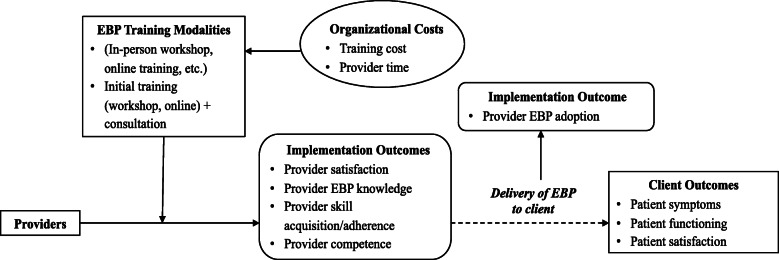
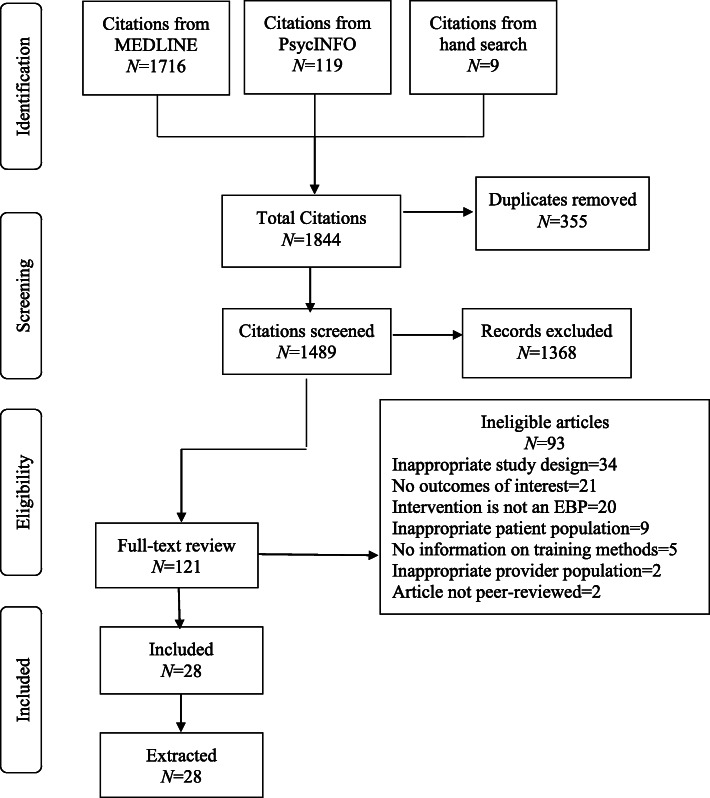
Background: Extensive efforts have been made to train mental health providers in evidence-based psychotherapies (EBPs); there is increasing attention focused on the methods through which providers are trained to deliver EBPs. Evaluating EBP training methods is an important step in determining which methods are most effective in increasing provider skill and improving client outcomes. Methods: We searched MEDLINE (Ovid) and PsycINFO for randomized controlled trials published from 1990 through June 2019 that evaluated EBP training methods to determine the effectiveness of EBP training modalities on implementation (provider and cost) and client outcomes. Eligible studies ( N = 28) were evaluated for risk of bias, and the overall strength of evidence was assessed for each outcome. Data was extracted by a single investigator and confirmed by a second; risk of bias and strength of evidence were independently rated by two investigators and determined by consensus. Results: Overall, EBP training improved short-term provider satisfaction, EBP knowledge, and adherence compared to no training or self-study of training materials (low to moderate strength of evidence). Training in an EBP did not increase treatment adoption compared to no training or self-study. No specific active EBP training modality was found to consistently increase provider EBP knowledge, skill acquisition/adherence, competence, adoption, or satisfaction compared to another active training modality. Findings were mixed regarding the additive benefit of post-training consultation on these outcomes. No studies evaluated changes in provider outcomes with regards to training costs and few studies reported on client outcomes. Limitations: The majority of included studies had a moderate risk of bias and strength of evidence for the outcomes of interest was generally low or insufficient. Few studies reported effect sizes. The ability to identify the most effective EBP training methods was limited by low strength of evidence for the outcomes of interest and substantial heterogeneity among studies. Conclusions: EBP training may have increased short-term provider satisfaction, EBP knowledge, and adherence though not adoption. Evidence was insufficient on training costs and client outcomes. Future research is needed on EBP training methods, implementation, sustainability, client outcomes, and costs to ensure efforts to train providers in EBPs are effective, efficient, and durable. Trial registration: The protocol for this review is registered in PROSPERO ( CRD42018093381 ).
Overview
The claims and statistics of this paper haven’t been checked yet.
Free: it reads the open-access text and checks the first 5 claims that cite a source we can check. Create a free account to check every claim.
Integrity signals
Registry
Cites
Statistics
Figures
Verification
Claims the paper makes
The claims and statistics of this paper haven’t been checked yet.
Free: it reads the open-access text and checks the first 5 claims that cite a source we can check. Create a free account to check every claim.
Claims other papers make about this one
Each is checked against this paper’s own text: does it say what the citing paper says it does?
The cited source says what the claim attributes to it.
In the citing paper
“Nonetheless, these evidence-based psychotherapies (EBPs) remain underutilized and underaccessed in clinical settings.10–12”
Self-check
Percentages, sums and reported differences re-computed from the paper’s own numbers.
The self-check needs the paper’s full text.
Citations
Cites
Preferred Reporting Items for Systematic Reviews and Meta-Analyses: the PRISMA statement
Moher, D., Liberati, A., Tetzlaff, J., Altman, D. G., & for the PRISMA Group (2009) · BMJ · doi:10.1136/bmj.b2535 · Cited by 83,823
Preferred reporting items for systematic reviews and meta-analyses: the PRISMA Statement.
(2009) · PubMed Central · Cited by 44,859
Preferred reporting items for systematic reviews and meta-analyses: The PRISMA statement
Moher, D., Liberati, A., Tetzlaff, J., Altman, D. G., & the PRISMA Group* (2009) · Annals of Internal Medicine · doi:10.7326/0003-4819-151-4-200908180-00135 · Cited by 37,554
The Cochrane Collaboration's tool for assessing risk of bias in randomised trials
Higgins, J. P. T., Altman, D. G., Gotzsche, P. C., Juni, P., Moher, D., Oxman, A. D., Savovic, J., Schulz, K. F., Weeks, L., Sterne, J. A. C., et al. (2011) · BMJ · doi:10.1136/bmj.d5928 · Cited by 33,817
Proctor, E., Silmere, H., Raghavan, R., Hovmand, P., Aarons, G., Bunger, A., Griffey, R., & Hensley, M. (2011) · Administration and Policy in Mental Health and Mental Health Services Research · doi:10.1007/s10488-010-0319-7 · Cited by 8,721
Powell, B. J., Waltz, T. J., Chinman, M. J., Damschroder, L. J., Smith, J. L., Matthieu, M. M., Proctor, E. K., & Kirchner, J. E. (2015) · Implementation Science · doi:10.1186/s13012-015-0209-1 · Cited by 4,963
Empirically supported psychological interventions: Controversies and evidence
Chambless, D. L., & Ollendick, T. H. (2001) · Annual Review of Psychology · doi:10.1146/annurev.psych.52.1.685 · Cited by 2,097
Forsetlund, L., Bjørndal, A., Rashidian, A., Jamtvedt, G., O'Brien, M. A., Wolf, F. M., Davis, D., Odgaard-Jensen, J., & Oxman, A. D. (2009) · Cochrane Database of Systematic Reviews · doi:10.1002/14651858.cd003030.pub2 · Cited by 1,849
Beidas, R. S., & Kendall, P. C. (2010) · Clinical Psychology: Science and Practice · doi:10.1111/j.1468-2850.2009.01187.x · Cited by 1,085 · cited 3×
“In contrast to the general conclusions of previous reviews [15, 16], the additional benefit of consultation beyond initial EBP training was inconclusive.”
BackgroundResultInfluentialA Randomized Trial of Methods to Help Clinicians Learn Motivational Interviewing.
Miller, W. R., Yahne, C. E., Moyers, T. B., Martinez, J., & Pirritano, M. (2004) · Journal of Consulting and Clinical Psychology · doi:10.1037/0022-006x.72.6.1050 · Cited by 1,075 · cited 1×
“However, two studies found that consultation did not result in additional benefit regarding provider competence beyond the initial in-person training [43, 45], although in Miller (2004), only the conditions with consultation had average competency scores at the clinical proficiency standard.”
BackgroundMcHugh, R. K., & Barlow, D. H. (2010) · American Psychologist · doi:10.1037/a0018121 · Cited by 909
Herschell, A. D., Kolko, D. J., Baumann, B. L., & Davis, A. C. (2010) · Clinical Psychology Review · doi:10.1016/j.cpr.2010.02.005 · Cited by 713
Stirman, S. W., Miller, C. J., Toder, K., & Calloway, A. (2013) · Implementation Science · doi:10.1186/1748-5908-8-65 · Cited by 691
Therapist adherence/competence and treatment outcome: A meta-analytic review.
Webb, C. A., DeRubeis, R. J., & Barber, J. P. (2010) · Journal of Consulting and Clinical Psychology · doi:10.1037/a0018912 · Cited by 657
Karlin, B. E., Ruzek, J. I., Chard, K. M., Eftekhari, A., Monson, C. M., Hembree, E. A., Resick, P. A., & Foa, E. B. (2010) · Journal of Traumatic Stress · doi:10.1002/jts.20588 · Cited by 486
Beidas, R. S., Edmunds, J. M., Marcus, S. C., & Kendall, P. C. (2012) · Psychiatric Services · doi:10.1176/appi.ps.201100401 · Cited by 370
Karlin, B. E., & Cross, G. (2014) · American Psychologist · doi:10.1037/a0033888 · Cited by 283
Grading the strength of a body of evidence when assessing health care interventions: an EPC update
Berkman, N. D., Lohr, K. N., Ansari, M. T., Balk, E. M., Kane, R., McDonagh, M., Morton, S. C., Viswanathan, M., Bass, E. B., Butler, M., et al. (2015) · Journal of Clinical Epidemiology · doi:10.1016/j.jclinepi.2014.11.023 · Cited by 279
Dimeff, L. A., Koerner, K., Woodcock, E. A., Beadnell, B., Brown, M. Z., Skutch, J. M., Paves, A. P., Bazinet, A., & Harned, M. S. (2009) · Behaviour Research and Therapy · doi:10.1016/j.brat.2009.07.011 · Cited by 214 · cited 10×
“Active training comparison Seven studies [26, 31, 33, 35, 36, 42, 46] compared provider satisfaction with different active training methods.”
BackgroundMethodInfluentialMoyers, T. B., Manuel, J. K., Wilson, P. G., Hendrickson, S. M. L., Talcott, W., & Durand, P. (2008) · Behavioural and Cognitive Psychotherapy · doi:10.1017/s1352465807004055 · Cited by 141 · cited 9×
“However, two studies found that consultation did not result in additional benefit regarding provider competence beyond the initial in-person training [43, 45], although in Miller (2004), only the conditions with consultation had average competency scores at the clinical proficiency standard.”
BackgroundMethodResultInfluentialBearman, S. K., Schneiderman, R. L., & Zoloth, E. (2017) · Administration and Policy in Mental Health and Mental Health Services Research · doi:10.1007/s10488-016-0723-8 · Cited by 132 · cited 2×
“Bearman 2017 found enhanced supervision after an in-person workshop, which utilized experiential learning (e.g., modeling and role-plays) and provided feedback on session recordings, resulted in greater increases in provider EBP fidelity compared to supervision as usual post in-person workshop [25].”
BackgroundResultMartino, S., Ball, S. A., Nich, C., Canning‐Ball, M., Rounsaville, B. J., & Carroll, K. M. (2011) · Addiction · doi:10.1111/j.1360-0443.2010.03135.x · Cited by 125 · cited 8×
“Of those eight, five found that at least one active training condition led to greater increases in provider competence than no training/self-guided study [41, 43, 45, 48, 52].”
BackgroundMethodResultInfluentialWeb-Based Training Methods for Behavioral Health Providers: A Systematic Review
Jackson, C. B., Quetsch, L. B., Brabson, L. A., & Herschell, A. D. (2018) · Administration and Policy in Mental Health and Mental Health Services Research · doi:10.1007/s10488-018-0847-0 · Cited by 112
Rakovshik, S., McManus, F. V., Vazquez-Montes, M., Muse, K., & Ougrin, D. (2016) · Journal of Consulting and Clinical Psychology · doi:10.1037/ccp0000079 · Cited by 108
Fidelity to the Cognitive Processing Therapy Protocol: Evaluation of Critical Elements
Farmer, C. C., Mitchell, K. S., Parker-Guilbert, K. S., & Galovski, T. E. (2016) · Behavior Therapy · doi:10.1016/j.beth.2016.02.009 · Cited by 101
Cohen, J. A., Mannarino, A. P., Jankowski, K., Rosenberg, S., Kodya, S., & Wolford, G. L. (2016) · Child Maltreatment · doi:10.1177/1077559515624775 · Cited by 92 · cited 6×
“Another study found that, after controlling for provider effects, clients were more likely to complete treatment (Trauma-focused Cognitive Behavioral Therapy) from providers who were randomized to complete online training and receive consultation compared to providers who were randomized to complete online training on…”
BackgroundInfluentialHarned, M. S., Dimeff, L. A., Woodcock, E. A., Kelly, T., Zavertnik, J., Contreras, I., & Danner, S. M. (2014) · Behavior Therapy · doi:10.1016/j.beth.2014.04.005 · Cited by 90
Monson, C. M., Shields, N., Suvak, M. K., Lane, J. E. M., Shnaider, P., Landy, M. S. H., Wagner, A. C., Sijercic, I., Masina, T., Wanklyn, S. G., et al. (2018) · Behaviour Research and Therapy · doi:10.1016/j.brat.2018.08.007 · Cited by 85
Therapist training: A critical review of skill training studies
Alberts, G. M., & Edelstein, B. A. (1990) · Clinical Psychology Review · doi:10.1016/0272-7358(90)90094-q · Cited by 84
Policy to implementation: evidence-based practice in community mental health – study protocol
Beidas, R. S., Aarons, G., Barg, F., Evans, A., Hadley, T., Hoagwood, K., Marcus, S., Schoenwald, S., Walsh, L., & Mandell, D. S. (2013) · Implementation Science · doi:10.1186/1748-5908-8-38 · Cited by 81 · cited 1×
“In community settings, legislators have passed policies mandating that evidence-based practices be implemented in public mental healthcare [4, 5].”
BackgroundGega, L., Norman, I. J., & Marks, I. M. (2007) · International Journal of Nursing Studies · doi:10.1016/j.ijnurstu.2006.02.009 · Cited by 76 · cited 3×
“Nine found no differences in treatment knowledge between active training conditions [26, 35–37, 42, 48, 51], including five studies that compared online and in-person training [26, 35, 42, 48, 51], two studies that compared online training to an enhanced online version [36, 37], and two studies that compared online tr…”
BackgroundZatzick, D., Donovan, D. M., Jurkovich, G., Gentilello, L., Dunn, C., Russo, J., Wang, J., Zatzick, C. D., Love, J., McFadden, C., et al. (2014) · Addiction · doi:10.1111/add.12492 · Cited by 71
Dimeff, L. A., Harned, M. S., Woodcock, E. A., Skutch, J. M., Koerner, K., & Linehan, M. M. (2015) · Behavior Therapy · doi:10.1016/j.beth.2015.01.001 · Cited by 70 · cited 1×
“Dimeff (2009, 2015) did find a difference between active training conditions: specifically, online training conditions resulted in greater increases in treatment knowledge than expert-led, in-person training [31, 33].”
BackgroundRosen, R. C., Ruzek, J. I., & Karlin, B. E. (2017) · Behaviour Research and Therapy · doi:10.1016/j.brat.2016.07.009 · Cited by 68 · cited 1×
“Evaluating EBP training and determining “evidence-based training” methods is of considerable importance [8].”
BackgroundSayer, N. A., Rosen, C. S., Bernardy, N. C., Cook, J. M., Orazem, R. J., Chard, K. M., Mohr, D. C., Kehle-Forbes, S. M., Eftekhari, A., Crowley, J., et al. (2017) · Administration and Policy in Mental Health and Mental Health Services Research · doi:10.1007/s10488-017-0809-y · Cited by 68
Self-citationSmith, J. L., Carpenter, K. M., Amrhein, P. C., Brooks, A. C., Levin, D., Schreiber, E. A., Travaglini, L. A., Hu, M.-C., & Nunes, E. V. (2012) · Journal of Consulting and Clinical Psychology · doi:10.1037/a0028176 · Cited by 67
Bennett‐levy, J., Hawkins, R., Perry, H., Cromarty, P., & Mills, J. (2012) · Australian Psychologist · doi:10.1111/j.1742-9544.2012.00089.x · Cited by 64
Technology-Based Training in Cognitive Behavioral Therapy for Substance Abuse Counselors
Weingardt, K. R., Villafranca, S. W., & Levin, C. (2006) · Substance Abuse · doi:10.1300/j465v27n03_04 · Cited by 63
Training primary care clinicians in motivational interviewing: A comparison of two models
Fu, S. S., Roth, C. S., Battaglia, C. T., Nelson, D. B., Farmer, M. M., Do, T., Goldstein, M. G., Widome, R., Hagedorn, H., & Zillich, A. J. (2014) · Patient Education and Counseling · doi:10.1016/j.pec.2014.10.007 · Cited by 61
Henggeler, S. W., Sheidow, A. J., Cunningham, P. B., Donohue, B. C., & Ford, J. D. (2008) · Journal of Clinical Child & Adolescent Psychology · doi:10.1080/15374410802148087 · Cited by 56
Dimeff, L. A., Woodcock, E. A., Harned, M. S., & Beadnell, B. A. (2011) · Behavior Therapy · doi:10.1016/j.beth.2010.06.004 · Cited by 49 · cited 1×
“Dimeff (2011) found that online training led to greater self-reported teaching and/or use of EBP skills learned compared to online placebo training at all four follow-up timepoints (2-weeks to 15-weeks post-training); however, it only led to greater teaching/use of EBP skills at one timepoint…”
BackgroundHolder, N. D., Holliday, R. P., Williams, R. C., Mullen, K. L., & Surís, A. (2017) · Cognitive Behaviour Therapy · doi:10.1080/16506073.2017.1357750 · Cited by 49 · cited 1×
“While earlier research is mixed [9], recent evidence suggests that the fidelity with which EBPs are delivered affects client outcomes, emphasizing the need for well-trained providers [10, 11].”
ResultHallgren, K. A., Dembe, A., Pace, B. T., Imel, Z. E., Lee, C. M., & Atkins, D. C. (2017) · Journal of Substance Abuse Treatment · doi:10.1016/j.jsat.2017.10.011 · Cited by 49
Harned, M. S., Dimeff, L. A., Woodcock, E. A., & Skutch, J. M. (2011) · Journal of Anxiety Disorders · doi:10.1016/j.janxdis.2010.08.015 · Cited by 48
McDonough, M., & Marks, I. M. (2002) · Medical Education · doi:10.1046/j.1365-2923.2002.01210.x · Cited by 43
Rash, C. J., DePhilippis, D., McKay, J. R., Drapkin, M., & Petry, N. M. (2013) · Journal of Substance Abuse Treatment · doi:10.1016/j.jsat.2013.03.003 · Cited by 43
Beidas, R. S., Becker-Haimes, E. M., Adams, D. R., Skriner, L., Stewart, R. E., Wolk, C. B., Buttenheim, A. M., Williams, N. J., Inacker, P., Richey, E., et al. (2017) · Implementation Science · doi:10.1186/s13012-017-0684-7 · Cited by 40
Ruzek, J. I., Rosen, R. C., Garvert, D. W., Smith, L. D., Edwards, K. S., Marceau, L. D., Harty, B. J., & Stoddard, A. M. (2014) · Journal of Traumatic Stress · doi:10.1002/jts.21977 · Cited by 34
Using the Internet to Train Therapists: Randomized Comparison of Two Scalable Methods
Cooper, Z., Bailey-Straebler, S., Morgan, K. E., O'Connor, M. E., Caddy, C., Hamadi, L., & Fairburn, C. G. (2017) · Journal of Medical Internet Research · doi:10.2196/jmir.8336 · Cited by 29
Rawson, R. A., Rataemane, S., Rataemane, L., Ntlhe, N., Fox, R. S., McCuller, W. J., & Brecht, M. (2013) · Substance Abuse · doi:10.1080/08897077.2012.691445 · Cited by 28 · cited 2×
“…experiential, active consultation led to greater increases in provider competence and EBP expertise compared to traditional consultation [25], and Rawson (2013) found that in-person consultation led to greater increases in provider competence than telephone consultation and a higher level of…”
BackgroundPuspitasari, A. J., Kanter, J. W., Busch, A. M., Leonard, R. C., DUNSIGER, S. I., Cahill, S. P., Martell, C. R., & Koerner, K. (2017) · Journal of Consulting and Clinical Psychology · doi:10.1037/ccp0000223 · Cited by 26 · cited 6×
“Active training comparison Seven studies [26, 31, 33, 35, 36, 42, 46] compared provider satisfaction with different active training methods.”
BackgroundInfluentialIntroduction to the Special Issue: Legislation Related to Children’s Evidence-Based Practice
Trupin, E. W., & Kerns, S. E. U. (2015) · Administration and Policy in Mental Health and Mental Health Services Research · doi:10.1007/s10488-015-0666-5 · Cited by 25
Disseminating Behavioural Activation for Depression via Online Training: Preliminary Steps
Hubley, S. H., Woodcock, E. A., Dimeff, L. A., & Dimidjian, S. (2014) · Behavioural and Cognitive Psychotherapy · doi:10.1017/s1352465813000842 · Cited by 20
Larson, M. J., Amodeo, M., LoCastro, J. S., Muroff, J. R., Smith, L., & Gerstenberger, E. P. (2013) · Substance Abuse · doi:10.1080/08897077.2012.746255 · Cited by 19
Implementation of a posttraumatic stress disorder mentoring program to improve treatment services.
Bernardy, N. C., Hamblen, J. L., Friedman, M. J., Ruzek, J. I., & McFall, M. (2011) · Psychological Trauma Theory Research Practice and Policy · doi:10.1037/a0024847 · Cited by 19
A Guide to Treatments That Work (DRAFT)
(2015) · Oxford University Press eBooks · doi:10.1093/med:psych/9780199342211.001.0001 · Cited by 19
Chu, B. C., Carpenter, A. L., Wyszynski, C. M., Conklin, P. H., & Comer, J. S. (2015) · Journal of Clinical Child & Adolescent Psychology · doi:10.1080/15374416.2015.1038825 · Cited by 13 · cited 6×
“One study found no difference in satisfaction between two active consultation conditions and a noconsultation control [28].”
BackgroundInfluentialSmith, T. L., Landes, S., Lester-Williams, K., Day, K., Batdorf, W. H., Brown, G. K., Trockel, M., Smith, B. N., Chard, K., Healy, E., et al. (2017) · Training and Education in Professional Psychology · doi:10.1037/tep0000156 · Cited by 13 · cited 1×
“VHA has developed a handbook with expectations and procedures for implementing EBPs at Veterans Affairs (VA) institutions [6] and has trained over 11,600 mental health staff in at least one EBP since 2007 [7].”
Method
Research works printed but not linked: 1
- Whitlock EP, Green CA, Polen MR, Berg A, Klein J, Siu A, et al. Behavioral counseling interventions in primary care to reduce risky/harmful alcohol use [Internet]. Rockville (MD): agency for healthcare research and quality (US); 2004 [cited 2019 Feb 3]. (U.S. Preventive Services Task Force Evidence Syntheses, formerly Systematic Evidence Reviews). Available from: http://www.ncbi.nlm.nih.gov/books/NBK42863/. 20722127
Cited by
Pragmatic Precision Psychiatry—A New Direction for Optimizing Treatment Selection
Kessler, R. C., & Luedtke, A. (2021) · JAMA Psychiatry · doi:10.1001/jamapsychiatry.2021.2500 · Cited by 72
Henrich, D., Glombiewski, J. A., & Scholten, S. (2023) · Clinical Psychology Review · doi:10.1016/j.cpr.2023.102266 · Cited by 80
Lyon, A. R., Connors, E. H., Lawson, G. M., Nadeem, E., & Owens, J. S. (2024) · School Mental Health · doi:10.1007/s12310-024-09731-0 · Cited by 60
“Onetime training continues to be associated with increased knowledge and attitudes but, not necessarily practice change in schools (Anderson et al., 2019) or other settings (Valenstein-Mah et al., 2020).”
Learning Collaboratives: a Strategy for Quality Improvement and Implementation in Behavioral Health
Gotham, H. J., Paris, M., & Hoge, M. A. (2022) · The Journal of Behavioral Health Services & Research · doi:10.1007/s11414-022-09826-z · Cited by 49
Barnett, M. L., Puffer, E. S., Ng, L. C., & Jaguga, F. (2023) · Cambridge Prisms Global Mental Health · doi:10.1017/gmh.2023.19 · Cited by 39
“Active learning strategies are seen as the most effective ways to train providers, including professionals, in psychological interventions in general (Valenstein-Mah et al. 2020), and likely is even more critical with non-specialists with less familiarity with these skills.”
Background
Metadata
- Authors
- Valenstein-Mah, H., Greer, N., McKenzie, L., Hansen, L., Strom, T. Q., Wiltsey Stirman, S., Wilt, T. J., & Kehle-Forbes, S. M.
- Affiliations
- University of Minnesota (US)
- Minneapolis VA Health Care System (US)
- University of St. Thomas - Minnesota (US)
- Oscar G. Johnson VA Medical Center (US)
- Corresponding author
- Valenstein-Mah, Helen
- Venue
- Implementation Science
- Published
- 2020-05-27
- Volume
- 15
- Issue
- 1
- Pages
- 40-40
- ISSN
- 1748-5908 (ISSN-L)
- PMC
- PMC7251851
- OpenAlex
- W3031786051
- Semantic Scholar
- ebc0d9d404be341647b8bfc43aa368a289d9c549
- Cited by
- 104
- References
- 58
- Citations by year
- 2026: 16 · 2025: 15 · 2024: 18 · 2023: 19 · 2022: 24 · 2021: 11 · 2020: 1
- FWCI
- 1.08
- Type
- journal article
- Language
- en
- Open access
- gold
- doi.org
- Licence
- cc-by
- creativecommons.org/licenses/by/4.0 (tdm)
- creativecommons.org/licenses/by/4.0 (vor)
- Locations
- Implementation Science (publishedVersion, cc-by)
- PubMed Central (publishedVersion, cc-by)
- PubMed (publishedVersion)
- DOAJ (DOAJ: Directory of Open Access Journals) (submittedVersion, cc-by-sa)
- Funders
- Minneapolis VA Center for Care Delivery and Outcomes Research (N/A)
- Topics
- Social Sciences › Psychology › Clinical Psychology › Psychotherapy Techniques and Applications
- Health Sciences › Health Professions › General Health Professions › Health Policy Implementation Science
- Social Sciences › Psychology › Clinical Psychology › Counseling Practices and Supervision
- Keywords
- evidence-based psychotherapy, psychotherapy training, medication adherence, treatment adoption, provider satisfaction, EBP knowledge, training costs, client outcomes, implementation
- MeSH terms
- Clinical Competence, Health Personnel, Humans, Inservice Training, Health Knowledge, Attitudes, Practice, Personal Satisfaction, Psychotherapy, Practice Guidelines as Topic, Guideline Adherence, Evidence-Based Practice
About these checks
Registry, retraction, Cites and statistics results are computed, not judged, with one exception: a printed reference that no index lists is read once by a model before it counts as a citation error. Claims are extracted by a model and kept only when their quote appears verbatim in the text; each cited source is then checked, with a model’s help, for whether it says what the claim relies on. Those verdicts can be wrong — read the claim’s quote and the cited source before relying on one.
Statistics and arithmetic are recomputed, not judged.
Confidence bands are shown only for fields calibrated on our annotated test set. None is calibrated yet, so no band is shown.
What counts as a claim ›How we measure confidence ›How we check this ›
Are you an author, or do you see a problem with this page? Request a review
Data sources
Bibliographic data: Semantic Scholar, OpenAlex, Crossref.
Contains information from the Semantic Scholar Academic Graph Datasets, made available under the ODC Attribution License (ODC-BY 1.0).
Semantic Scholar’s data is described in: Kinney, R., et al. (2023). The Semantic Scholar Open Data Platform. arXiv:2301.10140.
