

A cluster randomised controlled trial, process and economic evaluation of two large-scale quality improvement interventions embedded with a national clinical audit to improve the care for young adults with type 2 diabetes (EQUIPD2): study protocol
Open accessThe DOI matches its Crossref record; 33 of the 33 references it cites were found in a registry or an index; 4 of the 36 sources its claims cite were checked for support.
Abstract
Background: Young adults (18–39 years) with type 2 diabetes have an increased loss of life expectancy and a greater risk of complications such as retinopathy, sexual health problems and foot disease than people diagnosed with type 2 diabetes later in life. Globally, there are increasing numbers of young adults with type 2 diabetes. Evidence describes both care (for example, prescribing) and improvement practices (for example, case management) that improve outcomes for people with type 2 diabetes. The National Diabetes Audit (NDA) provides feedback describing variation in both care and outcomes in young adults. Feedback facilitation can increase the effectiveness of audit feedback. Working collaboratively between researchers, audit providers, patients, clinicians and policy-makers, we have developed two feedback facilitation interventions deliverable at scale across England. We will evaluate whether theory-informed virtual educational materials with email support (low-intensity intervention) and / or virtual workshops (medium-intensity intervention) improve outcomes for young adults with type 2 diabetes. Methods: An efficient, pragmatic cluster randomised controlled trial using routine data with a theory-informed process and economic evaluation. The interventions will be delivered alongside the NDA to primary care networks (small groups of general practices) across England. Our primary outcome will be HbA1c level at 16-months post-randomisation in young adults with type 2 diabetes and baseline HbA1c ≥ 58 mmol/mol. Secondary outcomes assess the proportion with an HbA1c below recommended thresholds, prescription consistent with recommendations and delivery of recommended care processes. We will investigate impacts on equity. We will explore implementation, engagement and fidelity through interviews, observations, documentary analysis and surveys. An economic evaluation will estimate cost-effectiveness and budget impact. Discussion: Our study embeds a further evaluation within the NDA, strengthening its role as a national diabetes learning health system. Our findings will have implications for intervention providers and funders seeking improvement in care and outcomes, and for our understanding of large-scale implementation strategies. Trial registration: ISRCTN 52205353 Registered 12 March 2025. https://www.isrctn.com/ISRCTN52205353 .
Overview
CoChat Summary
TL;DR
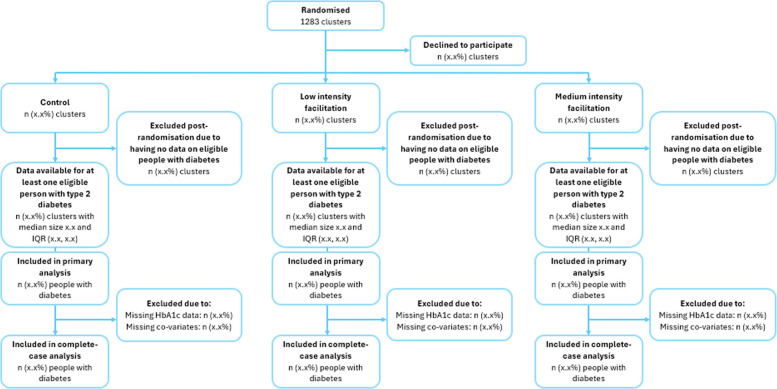
EQUIPD2 is a 3-arm cluster randomised trial protocol testing whether low- and medium-intensity feedback facilitation added to National Diabetes Audit feedback improves HbA1c in young adults with type 2 diabetes, alongside process and economic evaluations. It will randomise all 1283 primary care networks in England 1:1:1 and assess HbA1c at 16 months post-randomisation.
Key findings
- No trial outcome findings are reported; this is a study protocol. The planned primary outcome is HbA1c level at 16 months post-randomisation in young adults (18–39 years) with type 2 diabetes and baseline HbA1c ≥ 58 mmol/mol.
- Planned sample: all 1283 PCNs in England randomised 1:1:1 to medium-intensity facilitation plus NDA feedback, low-intensity facilitation plus NDA feedback, or NDA feedback alone (waitlist control). Power calculation: 1150 PCNs and 41,365 patients, ICC 0.01, coefficient of variation 1.62, SD 18.7, and 10% loss to follow-up give >99% power to detect a 2 mmol/mol HbA1c difference, using Bonferroni correction.
- Interventions: medium-intensity facilitation involves 7 virtual workshops; low-intensity facilitation involves asynchronous web-based training with email support; both are delivered by Diabetes UK alongside NDA feedback. Secondary outcomes include HbA1c < 58 mmol/mol, HbA1c < 48 mmol/mol, prescription of metformin and SGLT2 inhibitor, blood pressure ≤ 140/80 mmHg, statin prescription, and NICE-recommended care processes.
- Process evaluation will use interviews, observations, documentary analysis and surveys; economic evaluation includes within-trial cost-effectiveness and budget impact analyses, a lifetime cost-utility analysis using UKPDS-OM2, and an equity-informative cost-utility analysis.
Methods
- Design: pragmatic 3-arm cluster randomised controlled trial using routine National Diabetes Audit data, with parallel theory-informed process and economic evaluations; PCNs in England are the clusters, and all PCNs in England are eligible.
- Randomisation: 1:1:1 using a computer-generated minimisation programme within the Clinical Trials Unit, stratified by PCN-level baseline proportion of young adults with type 2 diabetes and HbA1c ≥ 58 mmol/mol (above or below median) and by NHS Integrated Care Board.
- Analysis: intention-to-treat; primary outcome compared using mixed effects linear regression with patients nested within PCNs and PCNs as a random intercept, adjusted for patient-level and PCN-level covariates; binary outcomes via mixed effects logistic regression; multiple imputation planned for missing primary outcome; subgroup analyses by ethnicity, sex, age, and deprivation.
Limitations
- Stated: allocation concealment is not feasible; no interim analyses are planned except for assessment of progression criteria; PCNs cannot give permission for the study because they are not legal entities, so permission is sought from sampled practices.
- Stated: the process evaluation is limited to up to 60 PCNs, around 20 teams per arm, and observations only in the medium-intensity arm (up to 50% of virtual workshops, approximately 28 h), so process findings may not fully represent all PCNs.
- Evident: as a protocol, no effectiveness, process, or cost-effectiveness results are yet available; the trial’s power depends on assumptions from 2021–22 NDA data and 10% loss to follow-up.
Model-written summary. Check it against the paper before relying on it.
Integrity signals
Registry
Cites
Statistics
Figures
Verification
Claims the paper makes
3 Valid · 1 Not valid · 26 Not checked · 35 Own results and interpretations
The sources with a verdict support this claim; the rest weren’t checked yet, have no full text we could read, or their verdicts aren’t rated yet.
In the paper
“They are also less likely to receive recommended diabetes care processes such as foot checks, blood pressure and cholesterol monitoring or annual clinical reviews to help reduce risk of complications [1, 4].”
§ A cluster randomised controlled trial, process and economic evaluation of two large-scale quality improvement interventions embedded with a national clinical audit to improve the care for young adults with type 2 diabetes (EQUIPD2): study protocol > Background
What the sources say
- Supportedcites [1] Misra S, Holman N, Barron E, Knighton P, Warner J, Kar P, et al. Characteristics and care of young people with type 2 diabetes included in the national diabetes audit datasets for England. Diabet Med. 2023;40(1):e14940. 36054265 PMC10087129 source
The Abstract (Interpretation and Results) states that people with type 2 diabetes aged under 40 years are 'less likely to receive the NICE recommended annual care processes or achieve target HbA1c', and the Discussion (Results, 'Care processes and treatment targets') reports that the proportion meeting all NICE age-related care processes rose significantly with age (23–34% in 19–25 and 26–39 years vs 47% and 59% in 40–59 and 60–79 years). The footnote to Table 2 defines those care processes as including HbA1c, BMI, cholesterol, blood pressure, urine microalbumin, retinal screening, foot check, smoking status and creatinine, so the exemplars named in the claim (foot checks, blood pressure and cholesterol monitoring, annual review processes) are exactly what the source measured. (LLM, conf=0.86)
- Not checked yetcites [4] National Diabetes Audit. Type 2 diabetes. NHS Digital, Leeds. 2023. Available at: https://digital.nhs.uk/.
plainstates an association- Asserted: passes — The authors put it forward as true.
- Checkable: passes — It can be checked against evidence.
- Load-bearing: passes — The paper’s conclusions depend on it.
- Based: passes — The paper gives a reason why it holds.
- Supported
The cited sources support only part of this claim — read each source’s verdict below.
In the paper
“In England, over 60,000 adults under 40 years have HbA1c levels ≥ 58 mmol/mol [3] putting them at greater risk of retinopathy, nephropathy, neuropathy, cardiovascular disease, sexual health problems and foot disease [1].”
§ A cluster randomised controlled trial, process and economic evaluation of two large-scale quality improvement interventions embedded with a national clinical audit to improve the care for young adults with type 2 diabetes (EQUIPD2): study protocol > Background
What the sources say
- Partly supportedcites [1] Misra S, Holman N, Barron E, Knighton P, Warner J, Kar P, et al. Characteristics and care of young people with type 2 diabetes included in the national diabetes audit datasets for England. Diabet Med. 2023;40(1):e14940. 36054265 PMC10087129 sourceExperimental — accuracy not yet measured
Our copy supports the setting and the threshold but not the magnitude. The Results section 'Care processes and treatment targets' (Table 2) gives, for adults aged under 40 with type 2 diabetes in England, 825 (16–18), 6,885 (19–25) and 99,895 (26–39) cases with available HbA1c data, of whom 415, 3,550 and 54,470 respectively were below 58 mmol/mol — i.e. roughly 49,000 measured at ≥58 mmol/mol, not 'over 60,000'; a figure above 60,000 only arises by subtracting target achievers from the whole 122,780/121,220 cohort, which the paper never does or states. The Abstract Results and Interpretation support only the qualitative point that those aged under 40 were 'less likely to… achieve target HbA1c' and that glycaemia was less well controlled than in older people; no passage reports a count of individuals with HbA1c ≥58 mmol/mol, and the paper's cohort is type 2 diabetes specifically. (LLM, conf=0.70)
plainstates an association- Asserted: passes — The authors put it forward as true.
- Checkable: passes — It can be checked against evidence.
- Load-bearing: passes — The paper’s conclusions depend on it.
- Based: passes — The paper gives a reason why it holds.
- Partly supported
The cited sources support only part of this claim — read each source’s verdict below.
In the paper
“Addressing modifiable factors in healthcare such as ways of working, staff skills, knowledge, attitudes and beliefs may support young adults to engage with and respond to care [5].”
§ A cluster randomised controlled trial, process and economic evaluation of two large-scale quality improvement interventions embedded with a national clinical audit to improve the care for young adults with type 2 diabetes (EQUIPD2): study protocol > Background
What the sources say
- Partly supportedcites [5] Rushforth B, McCrorie C, Glidewell L, et al. Barriers to effective management of type 2 diabetes in primary care: qualitative systematic review. Br J Gen Pract. 2016;66(643):e114–27. 26823263 PMC4723210 sourceExperimental — accuracy not yet measured
The source does support the general thrust: its Discussion (Comparison with existing literature) states 'A range of modifiable clinician perceptions that behaviour change strategies could target more effectively were identified', and the Implications for research and practice section calls for improvement strategies at both organisational and individual levels — 'clarifying primary care team roles and responsibilities, and training clinicians to support patient behaviour change' — plus equipping clinicians with behaviour-change skills, addressing nihilistic attitudes and knowledge limits (TDF domains of knowledge, skills, beliefs; Table 1, General rows, pp. e116–e118). However, the population is not young adults: our copy covers primary care clinicians and adults with type 2 diabetes generally (patient factors discussed are socioeconomic circumstances, occupation, comorbidities, older people — e115, Table 1 General), and no passage addresses young adults engaging with or responding to care. The 'young adults' specification of the claim is therefore an extension not supported by this source. (LLM, conf=0.78)
hedgedstates a possible cause- Asserted: passes — The authors put it forward as true.
- Checkable: passes — It can be checked against evidence.
- Load-bearing: passes — The paper’s conclusions depend on it.
- Based: passes — The paper gives a reason why it holds.
- Partly supported
The cited sources that could be checked couldn’t confirm or dispute this claim.
In the paper
“Totals of 1150 PCNs and 41,365 patients and an assumed intra-cluster correlation (ICC) of 0.01 and coefficient of variation of 1.62 would provide greater than 99% power to detect a 2 mmol/mol difference in HbA1c between the intervention and waitlist control arm assuming a standard deviation of 18.7 and 10% losses to follow up [17].”
§ A cluster randomised controlled trial, process and economic evaluation of two large-scale quality improvement interventions embedded with a national clinical audit to improve the care for young adults with type 2 diabetes (EQUIPD2): study protocol > Methods > Study procedure
What the sources say
- Could not verifycites [17] Grayling MJ, Wason JM. A web application for the design of multi-arm clinical trials. BMC Cancer. 2020;20:80. 10.1186/s12885-020-6525-0. 32005187 PMC6995188 sourceExperimental — accuracy not yet measured
Split into 2 atoms — 0 confirmed, 0 partially supported, 0 disputed, 0 misattributed, 2 unverifiable. Expand the claim to see per-atom verdicts.
hedgedn = 41,365- Asserted: passes — The authors put it forward as true.
- Checkable: passes — It can be checked against evidence.
- Load-bearing: passes — The paper’s conclusions depend on it.
- Based: passes — The paper gives a reason why it holds.
- Could not verify
A conclusion the paper draws from its own results — it cites no other source for it, so there is none to check. The quote shows it is in the paper.
In the paper
“We have developed two feedback facilitation interventions deliverable at scale across England.”
- Also stated in: § Background · plain
“We have developed two feedback facilitation interventions suitable for delivery at scale within the NDA to all PCNs in England: medium-intensity feedback facilitation involving virtual workshops; and low-intensity feedback facilitation delivered through virtual educational materials and email.”
§ A cluster randomised controlled trial, process and economic evaluation of two large-scale quality improvement interventions embedded with a national clinical audit to improve the care for young adults with type 2 diabetes (EQUIPD2): study protocol > Abstract > Background
plain- Asserted: passes — The authors put it forward as true.
- Checkable: passes — It can be checked against evidence.
- Load-bearing: passes — The paper’s conclusions depend on it.
- Based: passes — The paper gives a reason why it holds.
- Also stated in: § Background · plain
9 more claims
Create a free account to see all 65 claims and to verify the 32 references still open.
- It may state two separate claims as one. 23
- Probably not a substantial claim. 45
Citations
Cites
Hoffmann, T. C., Glasziou, P. P., Boutron, I., Milne, R., Perera, R., Moher, D., Altman, D. G., Barbour, V., Macdonald, H., Johnston, M., et al. (2014) · BMJ · doi:10.1136/bmj.g1687 · Cited by 10,548
Michie, S., Richardson, M., Johnston, M., Abraham, C., Francis, J., Hardeman, W., Eccles, M. P., Cane, J., & Wood, C. E. (2013) · Annals of Behavioral Medicine · doi:10.1007/s12160-013-9486-6 · Cited by 7,629
Process evaluation of complex interventions: Medical Research Council guidance
Moore, G. F., Audrey, S., Barker, M., Bond, L., Bonell, C., Hardeman, W., Moore, L., O'Cathain, A., Tinati, T., Wight, D., et al. (2015) · BMJ · doi:10.1136/bmj.h1258 · Cited by 6,204
Qualitative data analysis for applied policy research
(2002) · Analyzing Qualitative Data · doi:10.4324/9780203413081-14 · Cited by 4,964 · cited 1×
“With written, informed consent, we will audio-record and transcribe verbatim all interview data prior to using framework analysis [23] for each process evaluation objective.”
Qualitative data analysis for applied policy research
Ritchie, J., & Spencer, L. (2010) · Analyzing qualitative data · doi:10.4324/9780203413081_chapter_9 · Cited by 4,800
Bellg, A. J., Treatment Fidelity Workgroup of the NIH Behavior Change Consortium, Borrelli, B., Resnick, B., Hecht, J., Minicucci, D. S., Ory, M., Ogedegbe, G., Orwig, D., Ernst, D., et al. (2004) · Health Psychology · doi:10.1037/0278-6133.23.5.443 · Cited by 2,620
A theory of organizational readiness for change
Weiner, B. J. (2009) · Implementation Science · doi:10.1186/1748-5908-4-67 · Cited by 2,268
Implementing, Embedding, and Integrating Practices: An Outline of Normalization Process Theory
May, C., & Finch, T. (2009) · Sociology · doi:10.1177/0038038509103208 · Cited by 2,115
Self-citationQualitative Data Analysis for Applied Policy Research
Ritchie, J., & Spencer, L. (2002) · The Qualitative Researcher's Companion · doi:10.4135/9781412986274.n12 · Cited by 905
Hayes, A. J., Leal, J., Gray, A. M., Holman, R. R., & Clarke, P. M. (2013) · Diabetologia · doi:10.1007/s00125-013-2940-y · Cited by 495
Brown, B., Gude, W. T., Blakeman, T., van der Veer, S. N., Ivers, N., Francis, J. J., Lorencatto, F., Presseau, J., Peek, N., & Daker-White, G. (2019) · Implementation Science · doi:10.1186/s13012-019-0883-5 · Cited by 387
Individual patient education for people with type 2 diabetes mellitus
Duke, S.-A. S., Colagiuri, S., & Colagiuri, R. (2009) · Cochrane Database of Systematic Reviews · doi:10.1002/14651858.cd005268.pub2 · Cited by 361 · cited 1×
“Whilst such reductions in HbA1c are modest at the individual level, they can translate into significant population-level benefits and are comparable to effects by other clinical interventions [18, 19].”
Using Cost-Effectiveness Analysis to Address Health Equity Concerns
Cookson, R., Mirelman, A. J., Griffin, S., Asaria, M., Dawkins, B., Norheim, O. F., Verguet, S., & J. Culyer, A. (2017) · Value in Health · doi:10.1016/j.jval.2016.11.027 · Cited by 327
Self-citationBarriers to effective management of type 2 diabetes in primary care: qualitative systematic review
Rushforth, B., McCrorie, C., Glidewell, L., Midgley, E., & Foy, R. (2016) · British Journal of General Practice · doi:10.3399/bjgp16x683509 · Cited by 289
Self-citationCurrent insights and emerging trends in early-onset type 2 diabetes
Misra, S., Ke, C., Srinivasan, S., Goyal, A., Nyriyenda, M. J., Florez, J. C., Khunti, K., Magliano, D. J., & Luk, A. (2023) · The Lancet Diabetes & Endocrinology · doi:10.1016/s2213-8587(23)00225-5 · Cited by 222
Self-citationErnstzen, D. V., Louw, Q. A., & Hillier, S. L. (2017) · Implementation Science · doi:10.1186/s13012-016-0533-0 · Cited by 189
Distributional Cost-Effectiveness Analysis: Quantifying Health Equity Impacts and Trade-Offs
(2020) · Oxford University Press eBooks · doi:10.1093/med/9780198838197.001.0001 · Cited by 186
Revitalising audit and feedback to improve patient care
Foy, R., Skrypak, M., Alderson, S., Ivers, N. M., McInerney, B., Stoddart, J., Ingham, J., & Keenan, D. (2020) · BMJ · doi:10.1136/bmj.m213 · Cited by 162
Self-citationA general framework for classifying costing methods for economic evaluation of health care
Špacírová, Z., Epstein, D. M., García‐Mochón, L., Rovira, J., Lima, A. O. D. L., & Espín, J. (2020) · The European Journal of Health Economics · doi:10.1007/s10198-019-01157-9 · Cited by 156
Colquhoun, H. L., Carroll, K., Eva, K. W., Grimshaw, J. M., Ivers, N., Michie, S., Sales, A., & Brehaut, J. C. (2017) · Implementation Science · doi:10.1186/s13012-017-0646-0 · Cited by 123
Audit and feedback: effects on professional practice
Ivers, N., Yogasingam, S., Lacroix, M., Brown, K. A., Antony, J., Soobiah, C., Simeoni, M., Willis, T. A., Crawshaw, J., Antonopoulou, V., et al. (2025) · Cochrane Database of Systematic Reviews · doi:10.1002/14651858.cd000259.pub4 · Cited by 78
Self-citationfor the AFFINITIE programme, Lorencatto, F., Gould, N. J., McIntyre, S. A., During, C., Bird, J., Walwyn, R. E. A., Cicero, R., Glidewell, L., Hartley, S., et al. (2016) · Implementation Science · doi:10.1186/s13012-016-0528-x · Cited by 73
Self-citationThorn, J. C., Davies, C. F., Brookes, S. T., Noble, S. M., Dritsaki, M., Gray, E., Hughes, D. A., Mihaylova, B., Petrou, S., Ridyard, C., et al. (2021) · Value in Health · doi:10.1016/j.jval.2020.10.002 · Cited by 70 · cited 1×
“An analysis plan will be written following Bristol Health Economics Analysis Plan (HEAP) guidance [25] and, as far as possible, the evaluation will align with the trial statistical analysis plan and adhere to the NICE reference case.”
Aggregate Distributional Cost-Effectiveness Analysis of Health Technologies
Love-Koh, J., Cookson, R., Gutacker, N., Patton, T., & Griffin, S. C. (2019) · Value in Health · doi:10.1016/j.jval.2019.03.006 · Cited by 57
Unit Costs of Health and Social Care 2024 Manual
Jones, K. C., Weatherly, H. L. A., Birch, S., Castelli, A., Chalkley, M., Dargan, A., Findlay, D., Gao, M., Hinde, S., Markham, S., et al. (2025) · Kent Academic Repository (University of Kent) · doi:10.22024/unikent/01.02.109563 · Cited by 50
Misra, S., Holman, N., Barron, E., Knighton, P., Warner, J., Kar, P., Young, B., & Valabhji, J. (2023) · Diabetic Medicine · doi:10.1111/dme.14940 · Cited by 46
Self-citationKonnyu, K. J., Yogasingam, S., Lépine, J., Sullivan, K., Alabousi, M., Edwards, A., Hillmer, M., Karunananthan, S., Lavis, J. N., Linklater, S., et al. (2023) · Cochrane Database of Systematic Reviews · doi:10.1002/14651858.cd014513 · Cited by 37
Ivers, N. M., Tu, K., Young, J., Francis, J. J., Barnsley, J., Shah, B. R., Upshur, R. E., Moineddin, R., Grimshaw, J. M., & Zwarenstein, M. (2013) · Implementation Science · doi:10.1186/1748-5908-8-142 · Cited by 34
A web application for the design of multi-arm clinical trials
Grayling, M. J., & Wason, J. M. (2020) · BMC Cancer · doi:10.1186/s12885-020-6525-0 · Cited by 30
Exploring the content and delivery of feedback facilitation co-interventions: a systematic review
Sykes, M., Rosenberg-Yunger, Z. R. S., Quigley, M., Gupta, L., Thomas, O., Robinson, L., Caulfield, K., Ivers, N., & Alderson, S. (2024) · Implementation Science · doi:10.1186/s13012-024-01365-9 · Cited by 7
Self-citationPartha Kar: The time to tackle rising type 2 diabetes is T2DaY
Kar, P. (2023) · BMJ · doi:10.1136/bmj.p2490 · Cited by 5
Sykes, M., Copsey, B., Finch, T., Meads, D., Farrin, A., McSharry, J., Holman, N., Young, B., Berry, A., Ellis, K., et al. (2023) · Implementation Science · doi:10.1186/s13012-023-01293-0 · Cited by 4
Self-citationCookson, R., Morton, A., Schokkaert, E., Gomez, G. B., Merritt, M. W., Norheim, O. F., Griffin, S. C., & Culyer, A. J. (2020) · Oxford University Press eBooks · doi:10.1093/med/9780198838197.003.0016
Cited by
Still being checked.
Metadata
- Authors
- Sykes, M., Copsey, B., Finch, T., Martin, A., Hankin, A., Girling, M., O’Halloran, E., Medcalf-Bell, R., Dawkins, B., McSharry, J., Morrissey, E., Misra, S., Gable, D., Tan, G., Berry, A., Steele, K., Day, F., Moreau, L., Dewey, R., & Foy, R.
- Affiliations
- Northumbria University (GB)
- University of Leeds (GB)
- Ollscoil na Gaillimhe – University of Galway (IE)
- Imperial College London (GB)
- Imperial College Healthcare NHS Trust (GB)
- Diabetes UK (GB)
- Corresponding author
- Sykes, Michael
- ORCID
- Venue
- Implementation Science
- Published
- 2026-01-06
- Volume
- 21
- Issue
- 1
- Pages
- 8-8
- ISSN
- 1748-5908 (ISSN-L)
- PMC
- PMC12870161
- OpenAlex
- W7118330863
- Cited by
- 0
- References
- 31
- FWCI
- 0.00
- Type
- journal article
- Language
- en
- Open access
- gold
- doi.org
- Licence
- cc-by
- creativecommons.org/licenses/by/4.0 (tdm)
- creativecommons.org/licenses/by/4.0 (vor, 28 d)
- Locations
- Implementation Science (publishedVersion, cc-by)
- PubMed Central (publishedVersion, cc-by)
- Europe PMC (PubMed Central) (publishedVersion, cc-by)
- PubMed (publishedVersion)
- White Rose Research Online (University of Leeds, The University of Sheffield, University of York) (acceptedVersion)
- DOAJ (DOAJ: Directory of Open Access Journals) (submittedVersion, cc-by-sa)
- Funders
- Health Services Research Programme (168871)
- Topics
- Health Sciences › Health Professions › General Health Professions › Health Policy Implementation Science
- Health Sciences › Medicine › Endocrinology, Diabetes and Metabolism › Diabetes Management and Education
- Health Sciences › Medicine › Endocrinology, Diabetes and Metabolism › Diabetes Treatment and Management
- Keywords
- type 2 diabetes, young adults, National Diabetes Audit, audit and feedback, quality improvement intervention, HbA1c, glycemic control, drug prescribing, primary care, learning health systems, cost-effectiveness, budget impact, equity, implementation fidelity, email support, online workshops
- MeSH terms
- Implementation Science, Adolescent, Adult, Cost-Benefit Analysis, Diabetes Mellitus, Type 2, England, Humans, Male, Randomized Controlled Trials as Topic, Clinical Audit, Young Adult, Quality Improvement
About these checks
Registry, retraction, Cites and statistics results are computed, not judged, with one exception: a printed reference that no index lists is read once by a model before it counts as a citation error. Claims are extracted by a model and kept only when their quote appears verbatim in the text; each cited source is then checked, with a model’s help, for whether it says what the claim relies on. Those verdicts can be wrong — read the claim’s quote and the cited source before relying on one.
The claim verdicts this report counts are experimental: their accuracy is not yet measured.
A language model drew the claims from the paper on 2026-11-20, under version 3 of the claim definition (model deepseek-v4.1-flash, prompt extract-v3).
A second model labelled each claim on 2026-11-20 (model jev-1.13-20260917, definition revision gold-guideline-v0.2).
Cited sources are checked with a language model’s help (qwen3.8-omni-flash).
Statistics and arithmetic are recomputed, not judged.
Confidence bands are shown only for fields calibrated on our annotated test set. None is calibrated yet, so no band is shown.
What counts as a claim ›How we measure confidence ›How we check this ›
Are you an author, or do you see a problem with this page? Request a review
Data sources
Bibliographic data: Semantic Scholar, OpenAlex, Crossref.
Contains information from the Semantic Scholar Academic Graph Datasets, made available under the ODC Attribution License (ODC-BY 1.0).
Semantic Scholar’s data is described in: Kinney, R., et al. (2023). The Semantic Scholar Open Data Platform. arXiv:2301.10140.
