

ULK1-mediated phosphorylation of ATG14 promotes autophagy and is impaired in Huntington’s disease models
Open accessThe DOI matches its Crossref record; 41 of the 41 references it cites were found in a registry or an index.
Abstract
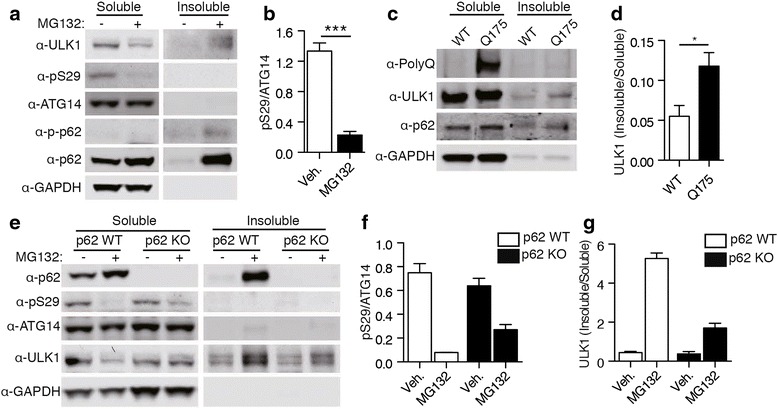
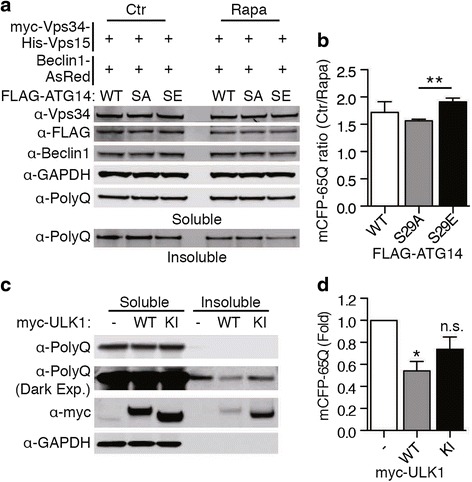
BACKGROUND: Autophagy is a bulk degradation pathway for long-lived proteins, protein aggregates, and damaged organelles. ULK1 protein kinase and Vps34 lipid kinase are two key autophagy regulators that are critical for autophagosome biogenesis. However, it isn't fully understood how ULK1 regulates Vps34, especially in the context of disease. Polyglutamine expansion in huntingtin (Htt) causes aberrant accumulation of the aggregated protein and disrupts various cellular pathways including autophagy, a lysosomal degradation pathway, underlying the pathogenesis of Huntington's disease (HD). Although autophagic clearance of Htt aggregates is under investigation as therapeutic strategy for HD, the precise mechanism of autophagy impairment remains poorly understood. Moreover, in-vivo assays of autophagy have been particularly challenging due to lack of reliable and robust molecular biomarkers. METHOD: We generated anti-phosphorylated ATG14 antibody to determine ATG14-mediated autophagy regulation; we employed Huntington's disease (HD) genetic cell models and animal models as well as autophagy reporter animal model to understand autophagy signaling and regulation in vivo. We applied biochemical analysis and molecular biology approaches to dissect the alteration of autophagy kinase activity and regulation. RESULTS: Here, we demonstrate that ULK1 phosphorylates ATG14 at serine 29 in an mTOR-dependent manner. This phosphorylation critically regulates ATG14-Vps34 lipid kinase activity to control autophagy level. We also show that ATG14-associated Vps34 activity and ULK1-mediated phosphorylation of ATG14 and Beclin 1 are compromised in the Q175 mouse model of Huntington's disease. Finally, we show that ATG14 phosphorylation is decreased during general proteotoxic stress caused by proteasomal inhibition. This reduction of the specific phosphorylation of ATG14 and Beclin 1 is mediated, in part, by p62-induced sequestration of ULK1 to an insoluble cellular fraction. We show that increased ULK1 levels and phosphor-mimetic mutant ATG14 facilitate the clearance of polyQ mutant in cells. CONCLUSION: Our study identifies a new regulatory mechanism for ATG14-Vps34 kinase activity by ULK1, which can be used as valuable molecular markers for in-vivo autophagic activity as well as potential therapeutic target for the clearance of polyglutamine disease protein.
Overview
The claims and statistics of this paper haven’t been checked yet.
Free: it reads the open-access text and checks the first 5 claims that cite a source we can check. Create a free account to check every claim.
Integrity signals
Registry
Cites
Statistics
Figures
Verification
Claims the paper makes
The claims and statistics of this paper haven’t been checked yet.
Free: it reads the open-access text and checks the first 5 claims that cite a source we can check. Create a free account to check every claim.
Claims other papers make about this one
Each is checked against this paper’s own text: does it say what the citing paper says it does?
In the citing paper
“(ii) sequesters the BECN1 interactor RASD2/RHES in the striatum (Mealer et al, 2014) and inhibits BECN1‐PIK3C3/VPS34 and ULK1 kinase activities (Lim et al, 2015; Wold et al, 2016);”
From Autophagy in major human diseases (2021) · cites this paper as Wold et al, 2016
Self-check
Percentages, sums and reported differences re-computed from the paper’s own numbers.
The self-check needs the paper’s full text.
Citations
Cites
Repertoires of Autophagy in the Pathogenesis of Ocular Diseases
Li, Y.-J., Jiang, Q., Cao, G.-F., Yao, J., & Yan, B. (2015) · Cellular Physiology and Biochemistry · doi:10.1159/000373980 · Cited by 16,304
AMPK and mTOR regulate autophagy through direct phosphorylation of Ulk1
Kim, J., Kundu, M., Viollet, B., & Guan, K.-L. (2011) · Nature Cell Biology · doi:10.1038/ncb2152 · Cited by 7,227 · cited 1×
“ULK1 is regulated in part by mTOR and AMPK, which inhibit and activate ULK1, respectively [7].”
BackgroundThe ubiquitin kinase PINK1 recruits autophagy receptors to induce mitophagy
Lazarou, M., Sliter, D. A., Kane, L. A., Sarraf, S. A., Wang, C., Burman, J. L., Sideris, D. P., Fogel, A. I., & Youle, R. J. (2015) · Nature · doi:10.1038/nature14893 · Cited by 2,774
Ravikumar, B., Vacher, C., Berger, Z., Davies, J. E., Luo, S., Oroz, L. G., Scaravilli, F., Easton, D. F., Duden, R., O'Kane, C. J., et al. (2004) · Nature Genetics · doi:10.1038/ng1362 · Cited by 2,347 · cited 1×
“However, increasing autophagy has been shown to facilitate the clearance of mutant Htt aggregates [1, 13].”
BackgroundMizushima, N., Yamamoto, A., Matsui, M., Yoshimori, T., & Ohsumi, Y. (2004) · Molecular Biology of the Cell · doi:10.1091/mbc.e03-09-0704 · Cited by 2,105 · cited 2×
“For imaging analysis, GFP-LC3 expressing mice [18] were crossed with z_Q175 mice.”
BackgroundMethodThoreen, C. C., Kang, S. A., Chang, J. W., Liu, Q., Zhang, J., Gao, Y., Reichling, L. J., Sim, T., Sabatini, D. M., & Gray, N. S. (2009) · Journal of Biological Chemistry · doi:10.1074/jbc.m900301200 · Cited by 1,803
Autophagosomes form at ER–mitochondria contact sites
Hamasaki, M., Furuta, N., Matsuda, A., Nezu, A., Yamamoto, A., Fujita, N., Oomori, H., Noda, T., Haraguchi, T., Hiraoka, Y., et al. (2013) · Nature · doi:10.1038/nature11910 · Cited by 1,683 · cited 2×
“Finally, given ATG14’s role at the ER-mitochondria contact site (MAM) and the requirement of ULK1 in ATG14 puncta formation during autophagy induction, it is possible that ULK1 activity is involved in the recruitment of one or more Vps34 complex members to the MAM [12, 35].”
BackgroundULK1 induces autophagy by phosphorylating Beclin-1 and activating VPS34 lipid kinase
Russell, R. C., Tian, Y., Yuan, H., Park, H. W., Chang, Y.-Y., Kim, J., Kim, H., Neufeld, T. P., Dillin, A., & Guan, K.-L. (2013) · Nature Cell Biology · doi:10.1038/ncb2757 · Cited by 1,529 · cited 4×
“A previous study showed that ULK1-mediated Beclin 1 phosphorylation contributes to the regulation of Vps34 activity [23].”
BackgroundInfluentialPhosphorylation of p62 Activates the Keap1-Nrf2 Pathway during Selective Autophagy
Ichimura, Y., Waguri, S., Sou, Y.-S., Kageyama, S., Hasegawa, J., Ishimura, R., Saito, T., Yang, Y., Kouno, T., Fukutomi, T., et al. (2013) · Molecular Cell · doi:10.1016/j.molcel.2013.08.003 · Cited by 1,205 · cited 4×
“Wild type and p62 KO MEF cells were provided by Dr. Masaaki Komatsu (Niigata University) [16].”
InfluentialAggregate-prone proteins with polyglutamine and polyalanine expansions are degraded by autophagy
Ravikumar, B. (2002) · Human Molecular Genetics · doi:10.1093/hmg/11.9.1107 · Cited by 1,111 · cited 1×
“Previous evidence indicated a role for Vps34 activity in HD: blocking Vps34 activity increases the levels of polyQ protein [30, 31], while addition of synthetic PI(3)P, the Vps34 product, aids in the clearance of polyQ protein [13].”
Background
Cited by
Items 101–161 of 161
Cheng, C., Chen, K.-P., Tseng, T., Hua, K., & Ju, T. (2025) · Neurotherapeutics · doi:10.1016/j.neurot.2025.e00557 · Cited by 10
Fan, P., Liu, Y., Liu, C., Yao, H., Xu, S., Jiang, Y., Wu, Y., Liu, Y., & Guo, X. L. (2025) · Proceedings of the National Academy of Sciences · doi:10.1073/pnas.2503342122 · Cited by 9
Seo, J., Park, S., Lee, D. C., Yoo, W., Yang, Y. R., Seo, H. W., Park, J. L., Joo, J., Park, K. C., & Byun, S. (2026) · Signal Transduction and Targeted Therapy · doi:10.1038/s41392-026-02688-3 · Cited by 9
Lin, L.-C., Liu, Z., Tu, B., Song, K., Sun, H., Zhou, Y., Sha, J.-M., Ye, Z., Yang, J., Zhao, J., et al. (2023) · International Journal of Biological Macromolecules · doi:10.1016/j.ijbiomac.2023.127593 · Cited by 8
Ross, B. X., Jia, L., Kong, D., Wang, T., Hager, H. M., Abcouwer, S. F., & Zacks, D. N. (2021) · Cells · doi:10.3390/cells10082010 · Cited by 8
Zhang, M., Sha, Y., Wang, J., Qi, H., Shi, P., Liu, Y., Jiang, M., Ba, L., Liu, Y., Cao, Y., et al. (2025) · European Journal of Pharmacology · doi:10.1016/j.ejphar.2025.177416 · Cited by 7
TRIM22 functions as a scaffold protein for autophagy initiation
Park, H., Heo, H., Song, Y., Lee, M. S., Cho, Y., Lee, J.-S., Chang, J., & Lee, S. (2025) · Animal Cells and Systems · doi:10.1080/19768354.2025.2498926 · Cited by 7
“…partners to assemble the second initiation complex, class III phosphoinositide 3-kinase (PI3K)/VPS34 complex, which regulates various cellular signaling pathway (Di Bartolo-meo et al. 2010; Russell et al. 2013; Wold et al. 2016; Nas-cimbeni et al. 2017; Kim et al. 2018; Park et al. 2018).”
Orlova, N. A., Sinegubova, M. V., Kolesov, D., Khodak, Y. A., Tatarskiy, V. V., & Vorobiev, I. I. (2025) · Cells · doi:10.3390/cells14100692 · Cited by 7
“A comparative study, involving various cell types but all with wild-type Bak1 and Bax, shows that rapid induction of autophagy by amino acid starvation leads to upregulation of ATG14 and ULK1 [49].”
Trelford, C. B., & Guglielmo, G. M. D. (2022) · Cellular Signalling · doi:10.1016/j.cellsig.2022.110414 · Cited by 7
Fu, J., Yang, Y., Zhu, L., Chen, Y., & Liu, B. (2022) · Journal of Medicinal Chemistry · doi:10.1021/acs.jmedchem.1c02053 · Cited by 6
Martínez-Martínez, E., Atzei, P., Vionnet, C., Roubaty, C., Kaeser-Pebernard, S., Naef, R., & Dengjel, J. (2022) · International Journal of Molecular Sciences · doi:10.3390/ijms23126860 · Cited by 7
“In agreement, autophagy signaling was increased as monitored by an increase in phosphorylation of ULK1 target sites on ATG13 and ATG14 and a decrease in mTORC1 kinase activities [20,33].”
BackgroundMethodThe triad interaction of ULK1, ATG13, and FIP200 is required for ULK complex formation and autophagy
Hama, Y., Fujioka, Y., Yamamoto, H., Mizushima, N., & Noda, N. N. (2025) · eLife · doi:10.7554/elife.101531.3 · Cited by 5
Two distinct regulatory pathways govern Cct2-Atg8 binding in the process of solid aggrephagy
Chen, Y., Liu, Z., Zhang, Y., Ye, M., Chen, Y., Gao, J., Song, J., Yang, H. M., Wu, C., Yao, W., et al. (2024) · EMBO Reports · doi:10.1038/s44319-024-00275-7 · Cited by 6
“In mammals, ULK1 activates Vps34 lipid kinase by phosphorylating Beclin1 and Atg14 (Russell et al, 2013; Wold et al, 2016).”
Turco, E., Fischer, I., & Martens, S. (2020) · bioRxiv (Cold Spring Harbor Laboratory) · doi:10.1101/2020.07.07.191189 · Cited by 6
Autophagy and GLUT1 trafficking: an overview of molecular mechanisms
Petrosino, S., & Grumati, P. (2025) · American Journal of Physiology-Cell Physiology · doi:10.1152/ajpcell.00551.2025 · Cited by 5
Autophagic mechanisms in longevity intervention: role of natural active compounds
Akça, K. T., Ayan, İ. Ç., Çetinkaya, S., Salihoğlu, E. M., & Süntar, I. P. (2023) · Expert Reviews in Molecular Medicine · doi:10.1017/erm.2023.5 · Cited by 4
MAMs and Mitochondrial Quality Control: Overview and Their Role in Alzheimer’s Disease
Luo, J.-S., Zhai, W.-H., Ding, L.-L., Zhang, X.-J., Han, J., Ning, J., Chen, X.-M., Jiang, W., Yan, R., & Chen, M. (2024) · Neurochemical Research · doi:10.1007/s11064-024-04205-w · Cited by 4
“Upon activation of the autophagy signal, the ULK1 complex promotes the involvement of Atg14 and Beclin1 in assembling the PI3K complex and initiating the production of PI3P to initiate autophago-some formation [ 166 , 167 ].”
Navigating the neuronal recycling bin: Another look at huntingtin in coordinating autophagy
Krzystek, T. J., & Gunawardena, S. (2025) · Autophagy Reports · doi:10.1080/27694127.2025.2472450 · Cited by 3
“Downstream of autophagy signalling, work in HD transgenic mice suggests differential dysregulation of ULK1 kinase activity with decreased phosphorylation of Beclin–1 and ATG14 [217] but increased phosphorylation of p62 [218].”
Liu, M., Zhou, B.-G., Li, S., Wang, Y., Zheng, L.-X., Xiong, Y., Zeng, X., & Liu, D. (2025) · Journal of Ethnopharmacology · doi:10.1016/j.jep.2025.120491 · Cited by 3
Role of FK506 binding protein 51 in central nervous system diseases
Peng, H., Wei, Y., Qiu, Y., Bi, R., Zeng, L., Hu, B., & Li, Y. Q. (2026) · Frontiers in Molecular Neuroscience · doi:10.3389/fnmol.2025.1725945 · Cited by 3
Boosting Brain Clean-Up: Can Targeting UPS Genes Offer Neuroprotection?
Mannan, A., Sharma, A., & Singh, T. G. (2025) · Molecular Neurobiology · doi:10.1007/s12035-025-05263-z · Cited by 3
“In HD, mHTT protein impairs both UPS function and ULK1-dependent autophagy initiation [268], creating a detrimental feedback loop.”
Li, N., Li, X., Qiu, X., Pan, X., Wu, S., Chen, J., Liu, R., Lu, J., Yue, Z., & Zhao, Y. (2025) · Autophagy · doi:10.1080/15548627.2025.2580438 · Cited by 2
“Several studies have reported that upon starvation signal, the N-terminal region of ATG14 would become phosphorylated to promote autophagy [21,22].”
Self-citationQi, X., Fu, X., Wang, H., & Fu, L. (2026) · Biochemical Pharmacology · doi:10.1016/j.bcp.2026.117692 · Cited by 2
Autophagy and Huntington's disease
Croce, K. R., Jasutkar, H. G., & Yamamoto, A. (2024) · Elsevier eBooks · doi:10.1016/b978-0-323-95672-7.00018-2 · Cited by 2
VPS34 in Autophagy, Cancer and Cancer Therapy
Bartolini, E., Janji, B., & Gao, R. (2026) · doi:10.20944/preprints202603.0323.v1 · Cited by 1
“This complex is specifically dedicated to autophagy initiation, and its activity is mainly regulated by the Unc-51-like kinase 1 (ULK1) complex through phosphorylation of key components such as Beclin 1 and Atg14L [47].”
Liu, Q., Ye, J., Chen, C., Zhu, Y., He, G., & Wu, F. (2026) · ChemMedChem · doi:10.1002/cmdc.202501033 · Cited by 1
“ULK1 phosphorylates ATG14L at Ser29, which is important for autophagy initiation [87]. mTORC1 hyperphosphorylates UVRAG, inhibiting the activity of Beclin-1 in complex with VPS34, and thereby suppressing autophagy — a mechanism relevant to skeletal diseases [88, 89].”
A ULK1–MTFR1L feedback loop links mitochondrial fission, mitophagy and apoptosis
Babic, R., Lucya, L., Reiter, C., Kriegenburg, F., Castellanos-Martínez, R., Hollenstein, D. M., Becker, F., Hunte, C., & Kraft, C. (2026) · Journal of Cell Science · doi:10.1242/jcs.264577 · Cited by 1
“To address this, we examined ATG14, a well-characterized direct target of ULK1 and a reliable readout of its kinase activity (Park et al., 2016; Wold et al., 2016).”
Autophagy and selective autophagy receptors: Key players against Alzheimer’s disease
Bruqi, K., & Strappazzon, F. (2025) · Neural Regeneration Research · doi:10.4103/nrr.nrr-d-25-00976 · Cited by 1
“Beclin-2 interacting protein 3 (BNIP3) and its homolog BNIP3L/NIX are two mitophagy receptors implicated in hypoxia and erythrocyte differentiation, respectively et al., 2013), ATG14 (Wold et al., 2016), and VPS15 (Mercer et al., 2021).”
Zhu, T., Jiao, X., Shi, J., Wang, B., Li, C., & Lǐ, Y. (2026) · Veterinary Microbiology · doi:10.1016/j.vetmic.2026.110993 · Cited by 1
The ATG14: multi-layer autophagy control and an emerging therapeutic target in cancer
Wang, W., Yu, C., Sun, F., Wang, R., Xia, W., Song, Q., Zhang, H., Jia, Z., Zhang, M., Wang, H. Y., et al. (2026) · APOPTOSIS · doi:10.1007/s10495-026-02302-5 · Cited by 1
Role of VPS34 Complexes in Starvation-Induced Autophagy
Sinha, S. C., Li, Y., Mukhopadhyay, S., Wyatt, S., & Dasanna, S. (2019) · Springer eBooks · doi:10.1007/978-3-319-55387-0_94 · Cited by 1
Role of lysosome-associated membrane protein, Lamp1, in Drosophila melanogaster
Chaudhry, N. Y. (2023) · doi:10.31274/td-20240617-261 · Cited by 1
Stavrides, P. H., Goulbourne, C. N., Peddy, J., Huo, C., Rao, M. V., Khetarpal, V. K., Marchionini, D. M., Nixon, R. A., & Yang, D. (2025) · eLife · doi:10.7554/elife.104979.2 · Cited by 1
The triad interaction of ULK1, ATG13, and FIP200 is required for ULK complex formation and autophagyPreprint
Hama, Y., Fujioka, Y., Yamamoto, H., Mizushima, N., & Noda, N. N. (2025) · eLife · doi:10.7554/elife.101531.2 · Cited by 1
Role of VPS34 Complexes in Starvation-Induced Autophagy
Sinha, S. C., Li, Y., Mukhopadhyay, S., Wyatt, S., & Dasanna, S. (2017) · Springer eBooks · doi:10.1007/978-3-319-40007-5_94-1
“Upon amino acid depletion, mTORC1 activity is inhibited, resulting in unphosphorylated ULK1, which is active and phosphorylates ATG14 at S29, increasing VPS34 lipid kinase activity, thereby increasing autophagy (Wold et al. 2016).”
BackgroundATG14L and ZBTB16: Critical Roles in Aggrephagy in STHdhQ7/Q7 Striatal Neurons
Kissner, V. (2020) · uO Research (University of Ottawa) · doi:10.20381/ruor-25069
Al-attar, R. (2020) · Carleton University's Institutional Repository (MacOdrum Library, Carleton University) · doi:10.22215/etd/2020-14320 · Cited by 1
Role of lysosomes in oxidative stress induced regulated cell death
Nagakannan, P. (2020) · Mspace (University of Manitoba)
In Silico Study of ULK1 Gene as a Susceptible Biomarker for Neurodegeneration
Garg, P., Srivastava, N., Seth, P. K., & Srivastava, P. (2022) · Proceedings of the National Academy of Sciences India Section B Biological Sciences · doi:10.1007/s40011-022-01419-2
Biochemical reconstitution of human autophagy initiation
Nguyen, N. M. A. (2023) · eDiss (Georg-August-Universität Göttingen) · doi:10.53846/goediss-9864
Role and regulation of autophagy in ALK positive cancers
Sorrentino, D. (2020) · theses.fr (ABES) · doi:10.70675/f5f7de65z353bz40a1z9644z679255935e4c · Cited by 2
Zarei, H., Azimi, A., Ramawad, H. A., Hajisoltani, R., & Yousefifard, M. (2024) · Research Square · doi:10.21203/rs.3.rs-3948391/v1
Compromised mitophagy in aging and neurodegenerative diseases
Lagartos-Donate, M. J., Cao, S., & Fang, E. F. (2024) · Elsevier eBooks · doi:10.1016/b978-0-443-15260-3.00017-x
Stavrides, P. H., Goulbourne, C. N., Peddy, J., Huo, C., Rao, M. V., Khetarpal, V. K., Marchionini, D. M., Nixon, R. A., & Yang, D. (2025) · eLife · doi:10.7554/elife.104979.1 · Cited by 2
Regulated cell death: Discovery, features, and implications for neurodegenerative diseases
Pandey, S. K., Nanda, A., Singh, S., & Singh, R. K. (2025) · Elsevier eBooks · doi:10.1016/b978-0-443-32852-7.00001-2
Danics, L., Muralidharan, C., Varga, Á., Rezeli, M., Gil, J., Abbas, A. A., Pap, Á., Park, A. S., Cserhalmi, M., Legault, E. M., et al. (2026) · Cellular & Molecular Biology Letters · doi:10.1186/s11658-026-00948-2
“In addition, dysregulation of phosphorylation has previously been shown to play a pivotal role in the pathology of HD [9–16].”
Post-Translational Control of BNIP3 and Mitophagy by ULK1 Kinase
Poole, L. P. (2021) · Knowledge@UChicago (University of Chicago) · doi:10.6082/a7jp3-w9f81
Wang, H., Ding, Z., Gou, M., Hu, J., Wang, Y., Wang, L., Wang, Y., 邸太妹, 张新富, Hao, X., et al. (2021) · Figshare · doi:10.6084/m9.figshare.14053378
Wang, H., Ding, Z., Gou, M., Hu, J., Wang, Y., Wang, L., Wang, Y., 邸太妹, 张新富, Hao, X., et al. (2021) · Figshare · doi:10.6084/m9.figshare.14053375
Biochemical characterization of mTORC1 regulation by glutamine metabolism
Bodineau, C. (2020) · theses.fr (ABES) · doi:10.70675/9d5aaabdz81bdz4118zb3edze237bdd8dee0
Ahmed, A. B. (2024) · theses.fr (ABES) · doi:10.70675/45334a5dz0e63z46f7zbad2zde4423b66a47 · Cited by 1
Hartopp, N., Ellis, L. V., Hughes, R. M., Mossman, E., Simmonite, E., Thoma, A., Errachidi, F.-E., Bhosale, G., Pristerà, A., Allen, S. P., et al. (2026) · bioRxiv (Cold Spring Harbor Laboratory) · doi:10.64898/2026.06.08.730157
“AMPK protein levels are reported to be lower in HD mice and induced neurons from HD patients, but not in the fibroblasts from which they were reprogrammed 76,77 , whilst ULK1 activity is reportedly lower in models of HD 78 .”
Targeting autophagy-related serine/threonine kinases to combat neurodegenerative disorders
Liu, W., & Liu, B. (2026) · Elsevier eBooks · doi:10.1016/b978-0-443-44173-8.00016-4
Yu, L., Zhuang, W., Liu, X., He, H., Deng, Y., & He, H. (2026) · Molecular Biology Reports · doi:10.1007/s11033-026-12177-z
“Reduced VPS34 kinase activity has been shown to inhibit the autophagic process in studies on cancer and Huntington’s disease [ 99, 100].”
Emerging mechanisms of ATG8-independent non-canonical autophagy
Saha, S., & Ghosh, D. K. (2026) · Journal of Physiology and Biochemistry · doi:10.1007/s13105-026-01243-6
Autophagy and Rab24 in Health and Disease
Ramm, M. (2026) · UTUPub (University of Turku)
BindingDB (2020) · UC San Diego · doi:10.7270/q2dn47kx
Metadata
- Authors
- Wold, M. S., Lim, J., Lachance, V., Deng, Z., & Yue, Z.
- Affiliations
- Icahn School of Medicine at Mount Sinai (US)
- Genentech (US)
- Wuhan University (CN)
- Corresponding author
- Yue, Zhenyu
- Venue
- Molecular Neurodegeneration
- Published
- 2016-12
- Volume
- 11
- Issue
- 1
- Pages
- 76-76
- ISSN
- 1750-1326 (ISSN-L)
- PMC
- PMC5148922
- OpenAlex
- W2560079349
- Cited by
- 153
- References
- 41
- Citations by year
- 2026: 11 · 2025: 23 · 2024: 21 · 2023: 17 · 2022: 10 · 2021: 21 · 2020: 17 · 2019: 14 · 2018: 10 · 2017: 9
- FWCI
- 10.32
- Type
- journal article
- Language
- en
- Open access
- gold
- doi.org
- Licence
- cc-by
- creativecommons.org/licenses/by/4.0/ (tdm)
- creativecommons.org/licenses/by/4.0/ (vor, 8 d)
- Locations
- Molecular Neurodegeneration (publishedVersion, cc-by)
- PubMed Central (publishedVersion, cc-by)
- PubMed (publishedVersion)
- Funders
- National Institutes of Health
- CHDI Foundation
- Topics
- Life Sciences › Biochemistry, Genetics and Molecular Biology › Cell Biology › Autophagy in Disease and Therapy
- Life Sciences › Neuroscience › Cellular and Molecular Neuroscience › Genetic Neurodegenerative Diseases
- Life Sciences › Biochemistry, Genetics and Molecular Biology › Biochemistry › Glycogen Storage Diseases and Myoclonus
- Keywords
- ULK1, ATG14, autophagy, Huntington's disease, Beclin-1, polyglutamine, protein aggregation, mTOR signaling, autophagosome formation, p62, proteasome inhibition, autophagy biomarkers
- MeSH terms
- Autophagy-Related Proteins, Autophagy-Related Protein-1 Homolog, Animals, Autophagy, Cell Line, Disease Models, Animal, Humans, Huntington Disease, Microscopy, Fluorescence, Phosphorylation, Immunoblotting, Adaptor Proteins, Vesicular Transport, Immunoprecipitation, Mice
About these checks
Registry, retraction, Cites and statistics results are computed, not judged, with one exception: a printed reference that no index lists is read once by a model before it counts as a citation error. Claims are extracted by a model and kept only when their quote appears verbatim in the text; each cited source is then checked, with a model’s help, for whether it says what the claim relies on. Those verdicts can be wrong — read the claim’s quote and the cited source before relying on one.
Statistics and arithmetic are recomputed, not judged.
Confidence bands are shown only for fields calibrated on our annotated test set. None is calibrated yet, so no band is shown.
What counts as a claim ›How we measure confidence ›How we check this ›
Are you an author, or do you see a problem with this page? Request a review
Data sources
Bibliographic data: Semantic Scholar, OpenAlex, Crossref.
Contains information from the Semantic Scholar Academic Graph Datasets, made available under the ODC Attribution License (ODC-BY 1.0).
Semantic Scholar’s data is described in: Kinney, R., et al. (2023). The Semantic Scholar Open Data Platform. arXiv:2301.10140.
