

Microbial involvement in Alzheimer disease development and progression
Open accessThe DOI matches its Crossref record; 128 of the 129 references it cites were found in a registry or an index.
Abstract
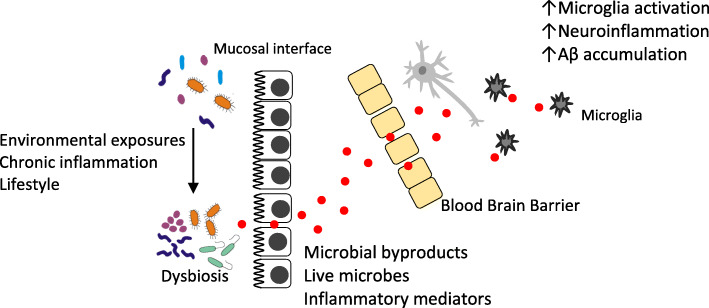
Alzheimer disease (AD) is the most prominent form of dementia and the 5th leading cause of death in individuals over 65. AD is a complex disease stemming from genetic, environmental, and lifestyle factors. It is known that AD patients have increased levels of senile plaques, neurofibrillary tangles, and neuroinflammation; however, the mechanism(s) by which the plaques, tangles, and neuroinflammation manifest remain elusive. A recent hypothesis has emerged that resident bacterial populations contribute to the development and progression of AD by contributing to neuroinflammation, senile plaque formation, and potentially neurofibrillary tangle accumulation (Fig. 1). This review will highlight recent studies involved in elucidating microbial involvement in AD development and progression.
Overview
The claims and statistics of this paper haven’t been checked yet.
Free: it reads the open-access text and checks the first 5 claims that cite a source we can check. Create a free account to check every claim.
Integrity signals
Registry
Cites
Statistics
Figures
Verification
Claims the paper makes
The claims and statistics of this paper haven’t been checked yet.
Free: it reads the open-access text and checks the first 5 claims that cite a source we can check. Create a free account to check every claim.
Claims other papers make about this one
Each is checked against this paper’s own text: does it say what the citing paper says it does?
The cited source says what the claim attributes to it.
In the citing paper
“Alterations in the host’s diet, use of antibiotics, exposure to psychosocial stress, or irregularities in the immune system may shift the relative proportions of bacterial species, resulting in a disruption of the microbiota’s composition and functionality as dysbiosis.214”
From Recent advances in Alzheimer's disease: Mechanisms, clinical trials and new drug development strategies. (2024) · cites this paper as [214]
Experimental — accuracy not yet measured
Self-check
Percentages, sums and reported differences re-computed from the paper’s own numbers.
The self-check needs the paper’s full text.
Citations
Cites
The Amyloid Hypothesis of Alzheimer’s Disease: Progress and Problems on the Road to Therapeutics
Hardy, J., & Selkoe, D. J. (2002) · Science · doi:10.1126/science.1072994 · Cited by 13,864
A human gut microbial gene catalogue established by metagenomic sequencing
MetaHIT Consortium, Qin, J., Li, R., Raes, J., Arumugam, M., Burgdorf, K. S., Manichanh, C., Nielsen, T., Pons, N., Levenez, F., et al. (2010) · Nature · doi:10.1038/nature08821 · Cited by 11,624
Amyloid oligomers exacerbate tau pathology in a mouse model of tauopathy
Selenica, M.-L. B., Brownlow, M., Jimenez, J. P., Lee, D. C., Pena, G., Dickey, C. A., Gordon, M. N., & Morgan, D. (2013) · Neurodegenerative Diseases · doi:10.1159/000337230 · Cited by 10,359
Changes of Intestinal Functions in Liver Cirrhosis
Fukui, H., & Wiest, R. (2016) · Inflammatory Intestinal Diseases · doi:10.1159/000444436 · Cited by 6,808
Revised Estimates for the Number of Human and Bacteria Cells in the Body
Sender, R., Fuchs, S., & Milo, R. (2016) · PLOS Biology · doi:10.1371/journal.pbio.1002533 · Cited by 5,425
Gut microbiota in health and disease
Sekirov, I., Russell, S. L., Antunes, L. C. M., & Finlay, B. B. (2010) · Physiological Reviews · doi:10.1152/physrev.00045.2009 · Cited by 4,182
Hearing loss and cognitive decline in older adults
Lin, F. R., Yaffe, K., Xia, J., Xue, Q.-L., Harris, T. B., Purchase-Helzner, E., Satterfield, S., Ayonayon, H. N., Ferrucci, L., Simonsick, E. M., et al. (2013) · JAMA Internal Medicine · doi:10.1001/jamainternmed.2013.1868 · Cited by 4,017
The gut microbiota--masters of host development and physiology
Sommer, F., & Bäckhed, F. (2013) · Nature Reviews Microbiology · doi:10.1038/nrmicro2974 · Cited by 3,681
Pihlstrom, B. L., Michalowicz, B. S., & Johnson, N. W. (2005) · The Lancet · doi:10.1016/s0140-6736(05)67728-8 · Cited by 3,522
Sudo, N., Chida, Y., Aiba, Y., Sonoda, J., Oyama, N., Yu, X., Kubo, C., & Koga, Y. (2004) · The Journal of Physiology · doi:10.1113/jphysiol.2004.063388 · Cited by 2,735
Cited by
Items 101–126 of 126
Bowler, B., Nasir, A. R., Szewczyk, A., Ocañas, S. R., Unnikrishnan, A., & Nouh, C. D. (2026) · Pathophysiology · doi:10.3390/pathophysiology33040074
李, 雪. (2025) · Journal of Clinical Personalized Medicine · doi:10.12677/jcpm.2025.42140
Oral microbiome: Physiological and pathological impact on oral and systemic health
Jovanović-Medojević, M., & Ninkovic, N. (2025) · Medicinski podmladak · doi:10.5937/mp76-61232
Liu, P., Xu, Y., Che, P., Wang, Y., Zhang, Y., Ji, D., Wang, C. M., Ma, X. Y., Sun, M. Y., & Zhang, N. (2026) · Translational Psychiatry · doi:10.1038/s41398-026-04048-9
In silico dysbiosis-associated neuroprotective metabolite insufficiency in Alzheimer’s disease
Shaer, N. A., & Al-Abbas, N. S. (2026) · Open Medicine · doi:10.1515/med-2026-1484
Nandi, A., Kaur, A., Ghai, S., Singh, G., & Tiwari, A. (2023) · doi:10.14293/pr2199.000546.v1
Singh, P., Kaushik, M., Gupta, S. K., & Chaudhary, A. (2024) · Journal of Applied Biology & Biotechnology · doi:10.7324/jabb.2024.176869
Human microbiomes in neurodegenerative diseases: an overview of their potential involvement
Borrego-Ruiz, A., & Borrego, J. J. (2026) · Exploration of Neuroprotective Therapy · doi:10.37349/ent.2026.1004153
Quiroga, I. Y., Cruikshank, A. E., Bond, M. L., Reed, K. S. M., Evangelista, B., Tseng, J., Ragusa, J. V., Meeker, R. B., Won, H., Cohen, S., et al. (2022) · Figshare · doi:10.6084/m9.figshare.19641880
Munawara, U., Catanzaro, M., Xu, W., Tan, C., Hirokawa, K., Bosco, N., Dumoulin, D., Khalil, A., Larbi, A., Lévesque, S., et al. (2021) · Figshare · doi:10.6084/m9.figshare.14821091
Munawara, U., Catanzaro, M., Xu, W., Tan, C., Hirokawa, K., Bosco, N., Dumoulin, D., Khalil, A., Larbi, A., Lévesque, S., et al. (2021) · Figshare · doi:10.6084/m9.figshare.14821085
Munawara, U., Catanzaro, M., Xu, W., Tan, C., Hirokawa, K., Bosco, N., Dumoulin, D., Khalil, A., Larbi, A., Lévesque, S., et al. (2021) · Figshare · doi:10.6084/m9.figshare.14821079
Munawara, U., Catanzaro, M., Xu, W., Tan, C., Hirokawa, K., Bosco, N., Dumoulin, D., Khalil, A., Larbi, A., Lévesque, S., et al. (2021) · Figshare · doi:10.6084/m9.figshare.14821082
Microbial Influence on Alzheimer's Disease
Hamby, A. (2021) · The Cardinal Edge · doi:10.18297/tce/vol1/iss1/22
Bacterial Endotoxins and Neurological Disorders: From Exposure to Therapeutic Interventions
Khan, Y. H., Liaqat, A., Mallhi, T. H., Abid, A., Alotaibi, N. H., & Khan, A. (2021) · Emerging contaminants and associated treatment technologies · doi:10.1007/978-3-030-66376-6_3
The role of diet and nutrition in Alzheimer's disease: Exploring the gut-cognitive health connection
Bhattacharya, P., Athwani, V., Vijay, T., & Aathi, M. (2026) · Elsevier eBooks · doi:10.1016/b978-0-443-33655-3.00007-9
Periodontitis and Alzheimer's disease: Porphyromonas gingivalis, gingipains and neuroinflammation
Rodríguez‐Hernández, A. G. (2025) · SAP Dentistry · doi:10.62486/dent2025156
Oral Diseases and Prevention in Pregnant Women, Infants and Preschool Children
(2026) · Frontiers research topics · doi:10.3389/978-2-8325-7395-2
Silva, D. F. S. M. (2021) · Portuguese National Funding Agency for Science, Research and Technology (RCAAP Project by FCT)
Deng, D., Su, H., Song, Y., Chen, T., Sun, Q., Jiang, H., & Zhao, M. (2021) · doi:10.3389/fcimb.2021.783917.s001
He, L., Chen, R., Zhang, B., Zhang, S., Khan, B. A., Zhu, D., Wu, Z., Xiao, C., Chen, B., Chen, F., et al. (2022) · doi:10.3389/fimmu.2022.930872.s002
Silva, M. E. F. C., Garcia, M. A., Marcelino, G. D. L., & Scriboni, A. B. (2026) · International Journal of Nutrology · doi:10.54448/ijn26219
THE EFFICACY OF PROBIOTIC SUPPLEMENTS IN ADDRESSING MALNUTRITION: A SYSTEMATIC REVIEW
(2025) · International Journal of Biology Pharmacy and Allied Sciences · doi:10.31032/ijbpas/2025/14.11.9488
Cordeiro, C. I. C. (2021) · Portuguese National Funding Agency for Science, Research and Technology (RCAAP Project by FCT)
Supporting information 1 of Salivary signatures of oral-brain communication in sleep bruxers
Deng, Y., Zhu, C., Jiang, R., Yu, C., Zhao, J., Jiang, X., & Wen, J. (2023) · doi:10.3389/fcimb.2023.1321855.s001
Metadata
- Authors
- Bulgart, H. R., Neczypor, E. W., Wold, L. E., & Mackos, A. R.
- Affiliations
- The Ohio State University (US)
- The Ohio State University Wexner Medical Center (US)
- Corresponding author
- Mackos, Amy R.
- Venue
- Molecular Neurodegeneration
- Published
- 2020-07-24
- Volume
- 15
- Issue
- 1
- Pages
- 42-42
- ISSN
- 1750-1326 (ISSN-L)
- PMC
- PMC7382139
- OpenAlex
- W3045169544
- Cited by
- 116
- References
- 129
- Citations by year
- 2026: 10 · 2025: 15 · 2024: 28 · 2023: 18 · 2022: 25 · 2021: 17 · 2020: 3
- FWCI
- 2.01
- Type
- journal article
- Language
- en
- Open access
- gold
- doi.org
- Licence
- cc-by
- creativecommons.org/licenses/by/4.0 (tdm)
- creativecommons.org/licenses/by/4.0 (vor)
- Locations
- Molecular Neurodegeneration (publishedVersion, cc-by)
- PubMed Central (publishedVersion, cc-by)
- PubMed (publishedVersion)
- DOAJ (DOAJ: Directory of Open Access Journals) (submittedVersion, cc-by-sa)
- Funders
- National Institute on Aging (AG057046)
- National Heart, Lung, and Blood Institute (HL139348)
- National Institute of Environmental Health Sciences (ES019923)
- Topics
- Life Sciences › Neuroscience › Cellular and Molecular Neuroscience › Alzheimer's disease research and treatments
- Life Sciences › Neuroscience › Neurology › Neuroinflammation and Neurodegeneration Mechanisms
- Life Sciences › Biochemistry, Genetics and Molecular Biology › Molecular Biology › Gut microbiota and health
- Keywords
- Alzheimer's disease, gut microbiota, neuroinflammation, amyloid plaques, neurofibrillary tangles, dementia, disease progression
- MeSH terms
- Alzheimer Disease, Amyloid, Brain, Humans, Neurofibrillary Tangles, Disease Progression, Plaque, Amyloid
About these checks
Registry, retraction, Cites and statistics results are computed, not judged, with one exception: a printed reference that no index lists is read once by a model before it counts as a citation error. Claims are extracted by a model and kept only when their quote appears verbatim in the text; each cited source is then checked, with a model’s help, for whether it says what the claim relies on. Those verdicts can be wrong — read the claim’s quote and the cited source before relying on one.
Statistics and arithmetic are recomputed, not judged.
Confidence bands are shown only for fields calibrated on our annotated test set. None is calibrated yet, so no band is shown.
What counts as a claim ›How we measure confidence ›How we check this ›
Are you an author, or do you see a problem with this page? Request a review
Data sources
Bibliographic data: Semantic Scholar, OpenAlex, Crossref.
Contains information from the Semantic Scholar Academic Graph Datasets, made available under the ODC Attribution License (ODC-BY 1.0).
Semantic Scholar’s data is described in: Kinney, R., et al. (2023). The Semantic Scholar Open Data Platform. arXiv:2301.10140.
