

The DOI matches its Crossref record; 205 of the 205 references it cites were found in a registry or an index.
TREM2 in the pathogenesis of AD: a lipid metabolism regulator and potential metabolic therapeutic target
Open accessAbstract
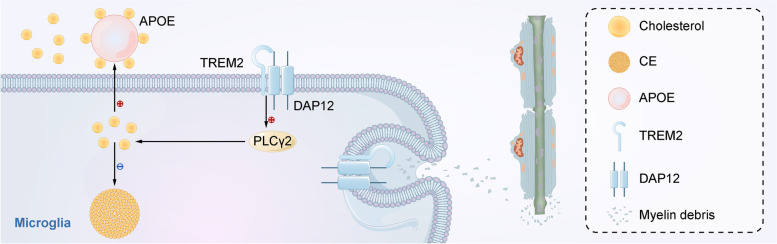
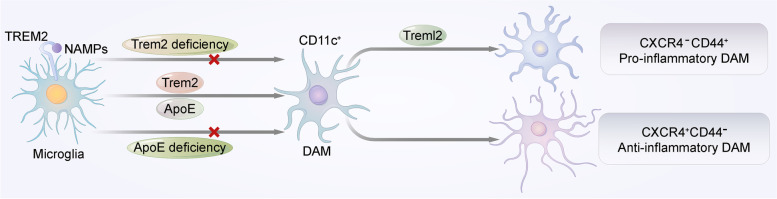
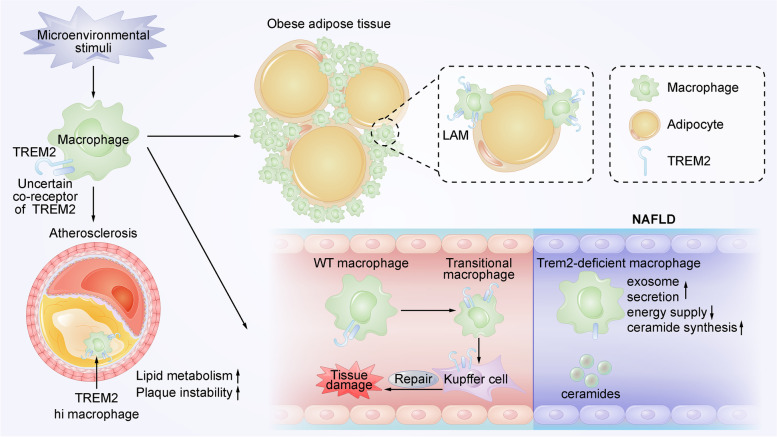
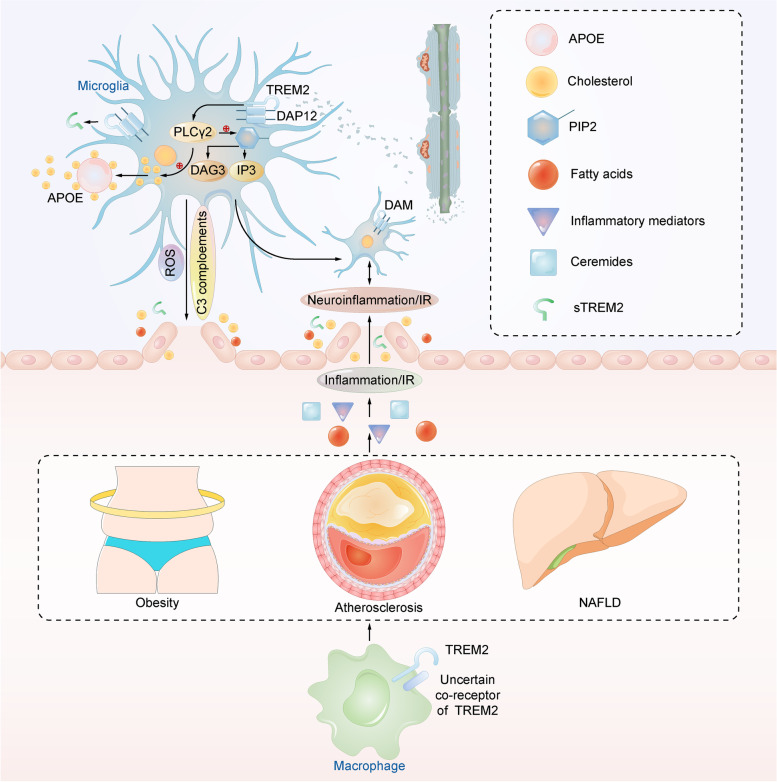
Triggering receptor expressed on myeloid cells 2 (TREM2) is a single-pass transmembrane immune receptor that is mainly expressed on microglia in the brain and macrophages in the periphery. Recent studies have identified TREM2 as a risk factor for Alzheimer’s disease (AD). Increasing evidence has shown that TREM2 can affect lipid metabolism both in the central nervous system (CNS) and in the periphery. In the CNS, TREM2 affects the metabolism of cholesterol, myelin, and phospholipids and promotes the transition of microglia into a disease-associated phenotype. In the periphery, TREM2 influences lipid metabolism by regulating the onset and progression of obesity and its complications, such as hypercholesterolemia, atherosclerosis, and nonalcoholic fatty liver disease. All these altered lipid metabolism processes could influence the pathogenesis of AD through several means, including affecting inflammation, insulin resistance, and AD pathologies. Herein, we will discuss a potential pathway that TREM2 mediates lipid metabolism to influence the pathogenesis of AD in both the CNS and periphery. Moreover, we discuss the possibility that TREM2 may be a key factor that links central and peripheral lipid metabolism under disease conditions, including AD. This link may be due to impacts on the integrity of the blood–brain barrier, and we introduce potential pathways by which TREM2 affects the blood–brain barrier. Moreover, we discuss the role of lipids in TREM2-associated treatments for AD. We propose some potential therapies targeting TREM2 and discuss the prospect and limitations of these therapies.
Overview
The claims and statistics of this paper haven’t been checked yet.
Run the check — free, no account needed. It reads the open-access text and checks the sources it cites.
Integrity signals
Registry
Cites
Statistics
Figures
Verification
Claims the paper makes
The claims and statistics of this paper haven’t been checked yet.
Run the check — free, no account needed. It reads the open-access text and checks the sources it cites.
Claims other papers make about this one
Each is checked against this paper’s own text: does it say what the citing paper says it does?
The cited source says what the claim attributes to it.
In the citing paper
“TREM2 binds to various lipid ligands, such as APOE particles (main cholesterol carriers in the brain) and myelin debris, to mediate lipid sensing and uptake (36).”
From Reducing microglial lipid load enhances β amyloid phagocytosis in an Alzheimer’s disease mouse model (2025) · cites this paper as [36]
Self-check
Percentages, sums and reported differences re-computed from the paper’s own numbers.
The self-check needs the paper’s full text.
Citations
Cites
2 retracted
RETRACTED: An update on the role of miR-124 in the pathogenesis of human disorders
Ghafouri‐Fard, S., Shoorei, H., Bahroudi, Z., Abak, A., Majidpoor, J., & Taheri, M. N. (2021) · Biomedicine & Pharmacotherapy · doi:10.1016/j.biopha.2020.111198 · Cited by 79
RetractedSharma, S., Prasanthi, J. R. P., Schommer, E., Feist, G., & Ghribi, O. (2008) · Neurobiology of Disease · doi:10.1016/j.nbd.2008.08.002 · Cited by 68
RetractedObesity is associated with macrophage accumulation in adipose tissue
Weisberg, S. P., McCann, D., Desai, M., Rosenbaum, M., Leibel, R. L., & Ferrante, A. W. (2003) · Journal of Clinical Investigation · doi:10.1172/jci200319246 · Cited by 10,041
Neuroinflammation in Alzheimer's disease
Heneka, M. T., Carson, M. J., Khoury, J. E., Landreth, G. E., Brosseron, F., Feinstein, D. L., Jacobs, A. H., Wyss-Coray, T., Vitorica, J., Ransohoff, R. M., et al. (2015) · The Lancet Neurology · doi:10.1016/s1474-4422(15)70016-5 · Cited by 6,226
A Unique Microglia Type Associated with Restricting Development of Alzheimer’s Disease
Keren-Shaul, H., Spinrad, A., Weiner, A., Matcovitch-Natan, O., Dvir-Szternfeld, R., Ulland, T. K., David, E., Baruch, K., Lara-Astaiso, D., Toth, B., et al. (2017) · Cell · doi:10.1016/j.cell.2017.05.018 · Cited by 5,493
TLR4 links innate immunity and fatty acid-induced insulin resistance
Shi, H., Kokoeva, M. V., Inouye, K., Tzameli, I., Yin, H., & Flier, J. S. (2006) · Journal of Clinical Investigation · doi:10.1172/jci28898 · Cited by 3,690
Regulation of inflammatory responses by gut microbiota and chemoattractant receptor GPR43
Maslowski, K. M., Vieira, A. T., Ng, A., Kranich, J., Sierro, F., Yu, D., Schilter, H. C., Rolph, M. S., Mackay, F., Artis, D., et al. (2009) · Nature · doi:10.1038/nature08530 · Cited by 3,241
Kim, H. J., Park, S. Y., Choi, Y. J., Han, S. J., Lee, K. W., & Kim, D. J. (2013) · Hormone Research in Paediatrics · doi:10.1159/000348848 · Cited by 3,061
TREM2 Variants in Alzheimer's Disease
Guerreiro, R., Wojtas, A., Bras, J., Carrasquillo, M., Rogaeva, E., Majounie, E., Cruchaga, C., Sassi, C., Kauwe, J. S. K., Younkin, S., et al. (2013) · New England Journal of Medicine · doi:10.1056/nejmoa1211851 · Cited by 3,020
Krasemann, S., Madore, C., Cialic, R., Baufeld, C., Calcagno, N., El Fatimy, R., Beckers, L., O’Loughlin, E., Xu, Y., Fanek, Z., et al. (2017) · Immunity · doi:10.1016/j.immuni.2017.08.008 · Cited by 2,979
Cited by
Sorted by citations
Items 201–204 of 204
TDP-43 and ALS - what's wrong with my membranes?
Dahlhaus, R., Yalcin, I., Tischer, J., & Braun, R. J. (2026) · Neurobiology of Disease · doi:10.1016/j.nbd.2026.107630
Li, M., Zhang, Y., Lü, P., Li, J., Zhang, Y., Wang, S., Bai, Y., & Wang, Y. (2026) · Frontiers in Human Neuroscience · doi:10.3389/fnhum.2026.1957032
Self-citationMatei, C., Palade, N. A., Dobri, A.-M., Dumitriu, D. O., Mutu, C., Popescu, A., Pintea, A. L., & Atasie, D. (2026) · Life · doi:10.3390/life16101749
Tumor-derived amyloid-β drives TREM2+ macrophages immunosuppression in cholangiocarcinoma
Li, X., Qian, R., Li, Y., Xu, X., Luo, Z., Lin, H., Zhu, G., Wang, G., Gao, Y., Liu, C., et al. (2026) · International Immunopharmacology · doi:10.1016/j.intimp.2026.117548
Metadata
- Authors
- Li, R.-Y., Qin, Q., Yang, H.-C., Wang, Y.-Y., Mi, Y.-X., Yin, Y.-S., Wang, M., Yu, C.-J., & Tang, Y.
- Affiliations
- Capital Medical University (CN)
- Corresponding author
- Tang, Yi
- Venue
- Molecular Neurodegeneration
- Published
- 2022-06-03
- Volume
- 17
- Issue
- 1
- Pages
- 40-40
- ISSN
- 1750-1326 (ISSN-L)
- PMC
- PMC9166437
- OpenAlex
- W4281650031
- Cited by
- 204
- References
- 205
- Citations by year
- 2026: 48 · 2025: 78 · 2024: 46 · 2023: 31 · 2022: 1
- FWCI
- 4.02
- Type
- journal article
- Language
- en
- Open access
- gold
- doi.org
- Locations
- Molecular Neurodegeneration (publishedVersion, cc-by)
- PubMed Central (publishedVersion, cc-by)
- PubMed (publishedVersion)
- DOAJ (DOAJ: Directory of Open Access Journals) (submittedVersion)
- Funders
- Natural Science Foundation of Beijing Municipality (JQ19024)
- National Natural Science Foundation of China (81970996)
- Capital’s Funds for Health Improvement and Research (CFH202041033)
- National Key R&D Program of China (2017YFC1310102, 2019YFC0118200)
- Topics
- Life Sciences › Neuroscience › Neurology › Neuroinflammation and Neurodegeneration Mechanisms
- Life Sciences › Neuroscience › Cellular and Molecular Neuroscience › Alzheimer's disease research and treatments
- Health Sciences › Medicine › Psychiatry and Mental health › Dementia and Cognitive Impairment Research
- Keywords
- TREM2, Alzheimer's disease, lipid metabolism, microglia, disease-associated microglia, cholesterol metabolism, myelin, phospholipids, obesity, hypercholesterolemia, atherosclerosis, non-alcoholic fatty liver disease, blood-brain barrier, insulin resistance, inflammation
- MeSH terms
- Alzheimer Disease, Brain, Central Nervous System, Humans, Membrane Glycoproteins, Receptors, Immunologic, Microglia, Lipid Metabolism
About these checks
Registry, retraction, Cites and statistics results are computed, not judged, with one exception: a printed reference that no index lists is read once by a model before it counts as a citation error. Claims are extracted by a model and kept only when their quote appears verbatim in the text; each cited source is then checked, with a model’s help, for whether it says what the claim relies on. Those verdicts can be wrong — read the claim’s quote and the cited source before relying on one.
Statistics and arithmetic are recomputed, not judged.
Confidence bands are shown only for fields calibrated on our annotated test set. None is calibrated yet, so no band is shown.
What counts as a claim ›How we measure confidence ›How we check this ›
Are you an author, or do you see a problem with this page? Request a review
