

The DOI matches its Crossref record; 20 of the 20 references it cites were found in a registry or an index.
‘Opening up the mind’: problem-solving therapy delivered by female lay health workers to improve access to evidence-based care for depression and other common mental disorders through the Friendship Bench Project in Zimbabwe
Open accessAbstract
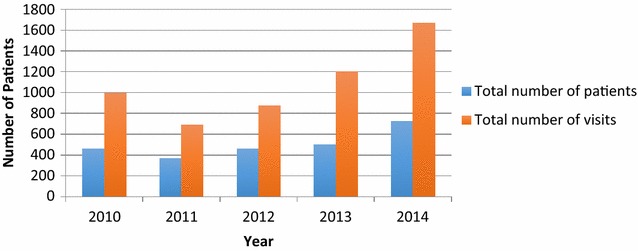
BACKGROUND: There are few accounts of evidence-based interventions for depression and other common mental disorders (CMDs) in primary care in low-income countries. The Friendship Bench Project is a collaborative care mental health intervention in primary care in Harare for CMDs which began as a pilot in 2006. CASE PRESENTATION: We employed a mixture of quantitative and qualitative approaches to investigate the project's acceptability and implementation, 4-8 years after the initial pilot study. We carried out basic descriptive analyses of routine data on attendance collected between 2010 and 2014. We also conducted five focus group discussions (FGDs) with LHWs in 2013 and 12 in-depth interviews, six with staff and six with patients, to explore experiences of the intervention, which we analysed using grounded theory. Results show that the intervention appears highly acceptable as evidenced by a consistent number of visits between 2010 and 2014 (mean 505 per year, SD 132); by the finding that the same team of female community LHWs employed as government health promoters continue to deliver assessment and problem-solving therapy, and the perceived positive benefits expressed by those interviewed. Clients described feeling 'relieved and relaxed' after therapy, and having their 'mind opened', and LHWs describing satisfaction from being agents of change. Characteristics of the LHWs (status in the community, maturity, trustworthiness), and of the intervention (use of locally validated symptom screen, perceived relevance of problem-solving therapy) and continuity of the LHW team appeared crucial. Challenges to implementation included the LHWs ongoing need for weekly supervision despite years of experience; the supervisors need for supervision for herself; training needs in managing suicidal and hostile clients; poor documentation; lack of follow-up of depressed clients; and poor access to antidepressants. CONCLUSIONS: This case study shows that a collaborative care intervention for CMDs is positively received by patients, rewarding for LHWs to deliver, and can be sustained over time at low cost. Next steps include evaluation of the impact of the intervention through a randomised trial, and testing of a technological platform for supporting supervision and monitoring clients' attendance.
Overview
The claims and statistics of this paper haven’t been checked yet.
Run the check — free, no account needed. It reads the open-access text and checks the sources it cites.
Integrity signals
Registry
Cites
Statistics
Figures
Verification
Claims the paper makes
The claims and statistics of this paper haven’t been checked yet.
Run the check — free, no account needed. It reads the open-access text and checks the sources it cites.
Claims other papers make about this one
Each is checked against this paper’s own text: does it say what the citing paper says it does?
The cited source says what the claim attributes to it.
In the citing paper
“One example of this culturally responsive practice is the use of familial terms between clients and task-sharing providers, which helped establish older adult task-sharing providers as trusted confidants with whom community members could discuss their mental health concerns [57].”
Self-check
Percentages, sums and reported differences re-computed from the paper’s own numbers.
The self-check needs the paper’s full text.
Citations
Cites
Content Analysis: An Introduction to its Methodology.
Shelley, M., & Krippendorff, K. (1984) · Journal of the American Statistical Association · doi:10.2307/2288384 · Cited by 24,351
Graneheim, U. H., & Lundman, B. (2004) · Nurse Education Today · doi:10.1016/j.nedt.2003.10.001 · Cited by 20,772
van Ginneken, N., Tharyan, P., Lewin, S., Rao, G. N., Meera, S., Pian, J., Chandrashekar, S., & Patel, V. (2013) · Cochrane Database of Systematic Reviews · doi:10.1002/14651858.cd009149.pub2 · Cited by 575
Controlled trial of psychotherapy for Congolese survivors of sexual violence
Bass, J. K., Annan, J., McIvor Murray, S., Kaysen, D., Griffiths, S., Cetinoglu, T., Wachter, K., Murray, L. K., & Bolton, P. A. (2013) · New England Journal of Medicine · doi:10.1056/nejmoa1211853 · Cited by 423 · cited 1×
“maternal depression, HIV care settings) [2] and/or in partnership with NGOs outside government public health systems [3] and it is unknown if they have been translated into delivery by existing staff in general primary care settings.”
BackgroundChibanda, D., Mesu, P., Kajawu, L., Cowan, F., Araya, R., & Abas, M. A. (2011) · BMC Public Health · doi:10.1186/1471-2458-11-828 · Cited by 319
Self-citationProblem solving and behavior therapy revisited
Nezu, A. M. (2004) · Behavior Therapy · doi:10.1016/s0005-7894(04)80002-9 · Cited by 286
Patel, V., Simunyu, E., Gwanzura, F., Lewis, G., & Mann, A. (1997) · Acta Psychiatrica Scandinavica · doi:10.1111/j.1600-0447.1997.tb10134.x · Cited by 255
Grand challenges in global mental health: integration in research, policy, and practice
Collins, P. Y., Insel, T. R., Chockalingam, A., Daar, A., & Maddox, Y. T. (2013) · PLoS Medicine · doi:10.1371/journal.pmed.1001434 · Cited by 220
Grand Challenges: Integrating Mental Health Care into the Non-Communicable Disease Agenda
Ngo, V. K., Rubinstein, A., Ganju, V. K., Kanellis, P., Loza, N., Rabadan‐Diehl, C., & Daar, A. S. (2013) · PLoS Medicine · doi:10.1371/journal.pmed.1001443 · Cited by 204
Honikman, S., van Heyningen, T., Field, S., Garman, E. C., & Tomlinson, M. (2012) · PLoS Medicine · doi:10.1371/journal.pmed.1001222 · Cited by 191
Depression and anxiety among women in an urban setting in Zimbabwe
Abas, M., & Broadhead, J. (1997) · Psychological Medicine · doi:10.1017/s0033291796004163 · Cited by 186
Self-citationChibanda, D., Bowers, T., Verhey, R., Rusakaniko, S., Abas, M., Weiss, H. A., & Araya, R. (2015) · International Journal of Mental Health Systems · doi:10.1186/s13033-015-0013-y · Cited by 179
Self-citationDepression in people living with HIV in sub‐Saharan Africa: time to act
Abas, M., Ali, G., Nakimuli‐Mpungu, E., & Chibanda, D. (2014) · Tropical Medicine & International Health · doi:10.1111/tmi.12382 · Cited by 119
Self-citationKaaya, S., Eustache, E., Lapidos‐Salaiz, I., Musisi, S., Psaros, C., & Wissow, L. S. (2013) · PLoS Medicine · doi:10.1371/journal.pmed.1001447 · Cited by 112
Nakimuli‐Mpungu, E., Wamala, K., Okello, J., Alderman, S., Odokonyero, R. F., Mojtabai, R., Mills, E. J., Kanters, S., Nachega, J. B., & Musisi, S. (2015) · The Lancet HIV · doi:10.1016/s2352-3018(15)00041-7 · Cited by 111
Problem-Solving Treatment: Evidence for Effectiveness and Feasibility in Primary Care
Mynors‐Wallis, L. (1996) · The International Journal of Psychiatry in Medicine · doi:10.2190/0hvy-cd2f-0kc7-fvtb · Cited by 95
Chibanda, D., Cowan, F. M., Healy, J. L., Abas, M., & Lund, C. (2015) · Tropical Medicine & International Health · doi:10.1111/tmi.12500 · Cited by 89
Self-citationKidia, K. K., Machando, D., Bere, T. C., Macpherson, K., Nyamayaro, P. C., Potter, L., Makadzange, T., Munjoma, R., Marufu, M., Araya, R., et al. (2015) · Tropical Medicine & International Health · doi:10.1111/tmi.12502 · Cited by 74
Self-citationChibanda, D., Cowan, F. M., Verhey, R., Machando, D., Abas, M., & Lund, C. (2016) · Community Mental Health Journal · doi:10.1007/s10597-016-0018-2 · Cited by 70
Self-citationDefeating Depression in the Developing World: A Zimbabwean Model
Abas, M., Broadhead, J., Mbape, P., & Khumalo-Sakatukwa, G. (1994) · The British Journal of Psychiatry · doi:10.1192/bjp.164.3.293 · Cited by 53
Self-citation
Research works printed but not linked: 2
- Strauss A, Corbin J. Basics of qualitative research: selective coding techniques and procedures for developing grounded theory. Sage: Newbury Park; 1998. p. 43–6.
- Zimbabwe Ministry of Health and Child Welfare. The National Health Strategy for Zimbabwe 2009–2013: equity and quality in health a people’s right. Zimbabwe: National Healthcare Trust; 2009.
Cited by
Sorted by citations
Chibanda, D., Weiss, H. A., Verhey, R., Simms, V., Munjoma, R., Rusakaniko, S., Chingono, A., Munetsi, E., Bere, T., Manda, E., et al. (2016) · JAMA · doi:10.1001/jama.2016.19102 · Cited by 502
Self-citationLe, P. D., Eschliman, E. L., Grivel, M. M., Tang, J., Cho, Y. G., Yang, X., Tay, C., Li, T., Bass, J., & Yang, L. H. (2022) · Implementation Science · doi:10.1186/s13012-021-01179-z · Cited by 233
“One example of this culturally responsive practice is the use of familial terms between clients and task-sharing providers, which helped establish older adult task-sharing providers as trusted confidants with whom community members could discuss their mental health concerns [57].”
BackgroundEsponda, G. M., Hartman, S. J., Qureshi, O., Sadler, E., Cohen, A., & Kakuma, R. (2019) · The Lancet Psychiatry · doi:10.1016/s2215-0366(19)30125-7 · Cited by 176
Javadi, D., Feldhaus, I., Mancuso, A., & Ghaffar, A. (2017) · Global Mental Health · doi:10.1017/gmh.2017.15 · Cited by 144
“Some studies mentioned demandside financing as a barrier to improved mental health delivery, citing the ability to pay for basic mental health services from the patient’s perspective (Neuner et al. 2008; Nimgaonkar & Menon, 2015; Abas et al. 2016).”
BackgroundMethodInfluentialAbas, M., Nyamayaro, P. C., Bere, T. C., Saruchera, E., Mothobi, N. Z., Simms, V. M., Mangezi, W. O., Macpherson, K., Croome, N., Magidson, J. F., et al. (2017) · AIDS and Behavior · doi:10.1007/s10461-016-1659-4 · Cited by 116
Self-citation
Metadata
- Authors
- Abas, M., Bowers, T., Manda, E., Cooper, S., Machando, D., Verhey, R., Lamech, N., Araya, R., & Chibanda, D.
- Affiliations
- King's College London (GB)
- University of Zimbabwe (ZW)
- University of Cape Town (ZA)
- Women's University in Africa (ZW)
- Schizophrenia Research Foundation (IN)
- London School of Hygiene & Tropical Medicine (GB)
- Corresponding author
- Bowers, Tarryn
- Venue
- International Journal of Mental Health Systems
- Published
- 2016-05-11
- Volume
- 10
- Issue
- 1
- Pages
- 39-39
- ISSN
- 1752-4458 (ISSN-L)
- PMC
- PMC4865009
- OpenAlex
- W2391003650
- Cited by
- 114
- References
- 20
- Citations by year
- 2026: 12 · 2025: 11 · 2024: 8 · 2023: 7 · 2022: 20 · 2021: 24 · 2020: 9 · 2019: 14 · 2018: 5 · 2017: 3 · 2016: 1
- FWCI
- 12.05
- Type
- journal article
- Language
- en
- Open access
- gold
- doi.org
- Licence
- cc-by
- Locations
- International Journal of Mental Health Systems (publishedVersion, cc-by)
- PubMed Central (publishedVersion, cc-by)
- PubMed (publishedVersion)
- LSHTM Research Online (London School of Hygiene and Tropical Medicine) (acceptedVersion)
- Research Portal (King's College London) (submittedVersion, cc-by)
- Open University of Cape Town (University of Cape Town) (submittedVersion)
- Greater South Information System
- Funders
- Grand Challenges Canada (09/31/2012 – 09/30/2015)
- Topics
- Health Sciences › Medicine › Psychiatry and Mental health › Mental Health Treatment and Access
- Health Sciences › Health Professions › General Health Professions › Health Policy Implementation Science
- Social Sciences › Psychology › Clinical Psychology › Psychiatric care and mental health services
- Keywords
- problem-solving therapy, lay health workers, community mental health workers, depression, common mental disorders, collaborative care, primary care mental health, treatment acceptability, implementation barriers, supervision, Zimbabwe
About these checks
Registry, retraction, Cites and statistics results are computed, not judged, with one exception: a printed reference that no index lists is read once by a model before it counts as a citation error. Claims are extracted by a model and kept only when their quote appears verbatim in the text; each cited source is then checked, with a model’s help, for whether it says what the claim relies on. Those verdicts can be wrong — read the claim’s quote and the cited source before relying on one.
Statistics and arithmetic are recomputed, not judged.
Confidence bands are shown only for fields calibrated on our annotated test set. None is calibrated yet, so no band is shown.
What counts as a claim ›How we measure confidence ›How we check this ›
Are you an author, or do you see a problem with this page? Request a review
