

The DOI matches its Crossref record; 81 of the 81 references it cites were found in a registry or an index.
University students’ use of mental health services: a systematic review and meta-analysis
Open accessAbstract
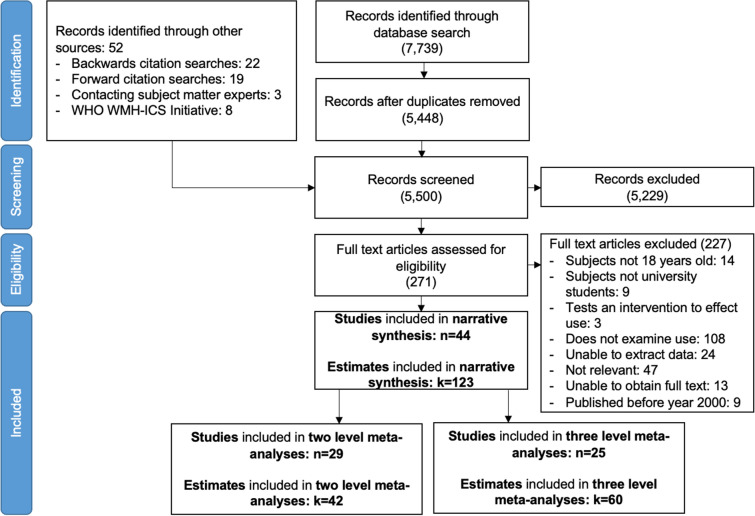
Background: International estimates suggest around a third of students arrives at university with symptoms indicative of a common mental disorder, many in late adolescence at a developmentally high-risk period for the emergence of mental disorder. Universities, as settings, represent an opportunity to contribute to the improvement of population mental health. We sought to understand what is known about the management of student mental health, and asked: (1) What proportion of students use mental health services when experiencing psychological distress? (2) Does use by students differ across health service types? Methods: A systematic review was conducted following PRISMA guidelines using a Context, Condition, Population framework (CoCoPop) with a protocol preregistered on Prospero (CRD42021238273). Electronic database searches in Medline, Embase, PsycINFO, ERIC and CINAHL Plus, key authors were contacted, citation searches were conducted, and the reference list of the WHO World Mental Health International College Student Initiative (WMH-ICS) was searched. Data extraction was performed using a pre-defined framework, and quality appraisal using the Joanna Briggs Institute tool. Data were synthesised narratively and meta-analyses at both the study and estimate level. Results: 7789 records were identified through the search strategies, with a total of 44 studies meeting inclusion criteria. The majority of included studies from the USA (n = 36), with remaining studies from Bangladesh, Brazil, Canada, China, Ethiopia and Italy. Overall, studies contained 123 estimates of mental health service use associated with a heterogeneous range of services, taking highly variable numbers of students across a variety of settings. Discussion: This is the first systematic quantitative survey of student mental health service use. The empirical literature to date is very limited in terms of a small number of international studies outside of the USA; studies of how services link together, and of student access. The significant variation we found in the proportions of students using services within and between studies across different settings and populations suggests the current services described in the literature are not meeting the needs of all students.
Overview
The claims and statistics of this paper haven’t been checked yet.
Run the check — free, no account needed. It reads the open-access text and checks the sources it cites.
Integrity signals
Registry
Cites
Statistics
Figures
Verification
Claims the paper makes
The claims and statistics of this paper haven’t been checked yet.
Run the check — free, no account needed. It reads the open-access text and checks the sources it cites.
Claims other papers make about this one
Each is checked against this paper’s own text: does it say what the citing paper says it does?
The source backs part of the claim, not all of it — or backs it for a different population, condition or comparison.
In the citing paper
“In university students, high levels of psychological distress have been linked to lower academic performance, poorer self-care, breakdowns in relationships, and increased tendency to drop out”
From A Scoping Review of Acceptance and Commitment Therapy in Higher Education (2024) · cites this paper as Osborn et al., 2022
Experimental — accuracy not yet measuredThe source backs part of the claim, not all of it — or backs it for a different population, condition or comparison.
In the citing paper
“A primary barrier was cost, where private services off-campus, or even on-campus paid services were sometimes too costly for students, and therefore not a service made use of by students (Osborn et al., 2022).”
From A Scoping Review of Acceptance and Commitment Therapy in Higher Education (2024) · cites this paper as Osborn et al., 2022
Experimental — accuracy not yet measuredThe source backs part of the claim, not all of it — or backs it for a different population, condition or comparison.
In the citing paper
“relationships are often at risk when students face high levels of stress (Osborn et al., 2022).”
From A Scoping Review of Acceptance and Commitment Therapy in Higher Education (2024) · cites this paper as Osborn et al., 2022
Experimental — accuracy not yet measuredThe cited source says what the claim attributes to it.
In the citing paper
“Factors such as 'sex and gender, ethnicity, and age' often influence help-seeking behaviour, more so than need (Osborn et al., 2022).”
From A Scoping Review of Acceptance and Commitment Therapy in Higher Education (2024) · cites this paper as Osborn et al., 2022
The cited source says what the claim attributes to it.
In the citing paper
“Students who choose not to seek treatment despite experiencing psychological distress may also fear facing stigma or have concerns of confidentiality or privacy (Osborn et al., 2022).”
From A Scoping Review of Acceptance and Commitment Therapy in Higher Education (2024) · cites this paper as Osborn et al., 2022
The cited source says what the claim attributes to it.
In the citing paper
“certain groups may choose not to seek help within their educational institutions as they feel as though the available services are not 'appropriate for their needs' (Osborn et al., 2022).”
From A Scoping Review of Acceptance and Commitment Therapy in Higher Education (2024) · cites this paper as Osborn et al., 2022
Self-check
Percentages, sums and reported differences re-computed from the paper’s own numbers.
The self-check needs the paper’s full text.
Citations
Cites
The PRISMA 2020 statement: An updated guideline for reporting systematic reviews
Page, M. J., McKenzie, J. E., Bossuyt, P. M., Boutron, I., Hoffmann, T. C., Mulrow, C. D., Shamseer, L., Tetzlaff, J. M., Akl, E. A., Brennan, S. E., et al. (2021) · BMJ · doi:10.1136/bmj.n71 · Cited by 108,283
Interrater reliability: The kappa statistic
McHugh, M. L. (2012) · Biochemia Medica · doi:10.11613/bm.2012.031 · Cited by 19,877
The Lancet Commission on global mental health and sustainable development
Patel, V., Saxena, S., Lund, C., Thornicroft, G., Baingana, F., Bolton, P., Chisholm, D., Collins, P. Y., Cooper, J. L., Eaton, J., et al. (2018) · The Lancet · doi:10.1016/s0140-6736(18)31612-x · Cited by 3,692
Levesque, J.-F., Harris, M. F., & Russell, G. (2013) · International Journal for Equity in Health · doi:10.1186/1475-9276-12-18 · Cited by 3,484
Age of onset of mental disorders: a review of recent literature
Kessler, R. C., Amminger, G. P., Aguilar-Gaxiola, S., Alonso, J., Lee, S., & ??st??n, T. B. (2007) · Current Opinion in Psychiatry · doi:10.1097/yco.0b013e32816ebc8c · Cited by 3,457 · cited 1×
“However, for those who do attend university usually do so at a developmentally high risk period for the emergence of mental heath problems [2, 3].”
BackgroundMunn, Z., Moola, S., Lisy, K., Riitano, D., & Tufanaru, C. (2015) · International Journal of Evidence-Based Healthcare · doi:10.1097/xeb.0000000000000054 · Cited by 3,131
Auerbach, R. P., Collaborators, W. W.-I., Mortier, P., Bruffaerts, R., Alonso, J., Benjet, C., Cuijpers, P., Demyttenaere, K., Ebert, D. D., Green, J. G., et al. (2018) · Journal of Abnormal Psychology · doi:10.1037/abn0000362 · Cited by 2,522 · cited 3×
“While a limited number of studies have highlighted the scale and nature of the problem outside of the USA, there is a renewed effort to understand and address barriers to treatment that stop some students reaching help in the first place [4, 16, 27].”
BackgroundDoing Meta-Analysis with R: A Hands-On Guide
Harrer, M., Cuijpers, P., Furukawa, T. A., & Ebert, D. D. (2021) · doi:10.1201/9781003107347 · Cited by 1,850
Mental disorders among college students in the World Health Organization World Mental Health Surveys
Auerbach, R. P., Alonso, J., Axinn, W. G., Cuijpers, P., Ebert, D. D., Green, J. G., Hwang, I., Kessler, R. C., Liu, H., Mortier, P., et al. (2016) · Psychological Medicine · doi:10.1017/s0033291716001665 · Cited by 1,587
Help-Seeking and Access to Mental Health Care in a University Student Population
Eisenberg, D., Golberstein, E., & Gollust, S. E. (2007) · Medical Care · doi:10.1097/mlr.0b013e31803bb4c1 · Cited by 1,131
Research works printed but not linked: 2
- Drapeau A, Marchand A, Beaulieu-Prévost D. Epidemiology of psychological distress. Ment Illn Understand Predict Control. 2012;69(2):105–6.
- Kahlenberg R, Shireman R, Quick K, et al. Policy strategies for pursuing adequate funding of community college. New York: The Century Foundation; 2018.
Cited by
Sorted by citations
Madrid‐Cagigal, A., Kealy, C., Potts, C., Mulvenna, M. D., Byrne, M., Barry, M. M., & Donohoe, G. (2025) · Early Intervention in Psychiatry · doi:10.1111/eip.70017 · Cited by 78
Zhao, R., Amanvermez, Y., Pei, J., Castro‐Ramirez, F., Rapsey, C., Garcia, C., Ebert, D. D., Haro, J. M., Fodor, L. A., David, O. A., et al. (2025) · Journal of Child Psychology and Psychiatry · doi:10.1111/jcpp.14145 · Cited by 110
Psychological Counseling among University Students Worldwide: A Systematic Review
Cerolini, S., Zagaria, A., Franchini, C., Maniaci, V. G., Fortunato, A., Petrocchi, C., Speranza, A. M., & Lombardo, C. (2023) · European Journal of Investigation in Health Psychology and Education · doi:10.3390/ejihpe13090133 · Cited by 98
Sakız, H., & Jencius, M. (2024) · Cambridge Prisms Global Mental Health · doi:10.1017/gmh.2024.1 · Cited by 50
Bantjes, J. R., Hunt, X., & Stein, D. J. (2023) · International Journal of Environmental Research and Public Health · doi:10.3390/ijerph20064859 · Cited by 55
Metadata
- Authors
- Osborn, T. G., Li, S., Saunders, R., & Fonagy, P.
- Affiliations
- University College London (GB)
- Corresponding author
- Osborn, T. G.
- Venue
- International Journal of Mental Health Systems
- Published
- 2022-12-17
- Volume
- 16
- Issue
- 1
- Pages
- 57-57
- ISSN
- 1752-4458 (ISSN-L)
- PMC
- PMC9758037
- OpenAlex
- W4312067515
- Cited by
- 167
- References
- 81
- Citations by year
- 2026: 66 · 2025: 36 · 2024: 38 · 2023: 27
- FWCI
- 3.78
- Type
- journal article
- Language
- en
- Open access
- gold
- doi.org
- Locations
- International Journal of Mental Health Systems (publishedVersion, cc-by)
- PubMed Central (publishedVersion, cc-by)
- PubMed (publishedVersion)
- DOAJ (DOAJ: Directory of Open Access Journals) (submittedVersion, cc-by-sa)
- UCL Discovery (University College London) (submittedVersion)
- Funders
- NIHR Applied Research Collaboration North Thames
- Topics
- Health Sciences › Medicine › Psychiatry and Mental health › Mental Health Treatment and Access
- Social Sciences › Psychology › Developmental and Educational Psychology › Student Stress and Coping
- Health Sciences › Health Professions › General Health Professions › Healthcare professionals’ stress and burnout
- Keywords
- student mental health, mental health service utilization, university students, psychological distress, help-seeking, common mental disorders, access to mental health care, adolescent mental health
About these checks
Registry, retraction, Cites and statistics results are computed, not judged, with one exception: a printed reference that no index lists is read once by a model before it counts as a citation error. Claims are extracted by a model and kept only when their quote appears verbatim in the text; each cited source is then checked, with a model’s help, for whether it says what the claim relies on. Those verdicts can be wrong — read the claim’s quote and the cited source before relying on one.
Statistics and arithmetic are recomputed, not judged.
Confidence bands are shown only for fields calibrated on our annotated test set. None is calibrated yet, so no band is shown.
What counts as a claim ›How we measure confidence ›How we check this ›
Are you an author, or do you see a problem with this page? Request a review
