

Mobile-based interventions for common mental disorders in youth: a systematic evaluation of pediatric health apps
Open accessThe DOI matches its Crossref record; 68 of the 68 references it cites were found in a registry or an index.
Abstract
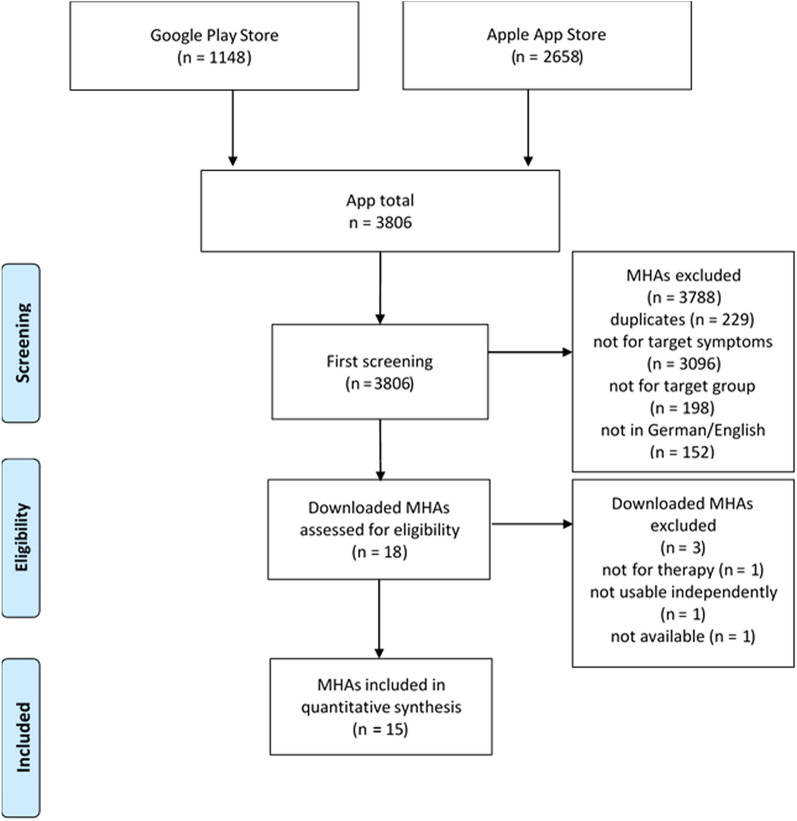
Background: The access to empirically-supported treatments for common mental disorders in children and adolescents is often limited. Mental health apps might extend service supplies, as they are deemed to be cost-efficient, scalable and appealing for youth. However, little is known about the quality of available apps. Therefore, we aimed to systematically evaluate current mobile-based interventions for pediatric anxiety, depression and posttraumatic stress disorder (PTSD). Methods: Systematic searches were conducted in Google Play Store and Apple App Store to identify relevant apps. To be eligible for inclusion, apps needed to be: (1) designed to target either anxiety, depression or PTSD in youth (0–18 years); (2) developed for children, adolescents or caregivers; (3) provided in English or German; (4) operative after download. The quality of eligible apps was assessed with two standardized rating systems (i.e.,Mobile App Rating Scale (MARS)and ENLIGHT) independently by two reviewers. Results: Overall, the searches revealed 3806 apps, with 15 mental health apps (0.39%) fulfilling our inclusion criteria. The mean overall scores suggested a moderate app quality (MARS: M = 3.59, SD = 0.50; ENLIGHT: M = 3.22, SD = 0.73). Moreover, only one app was evaluated in an RCT. The correlation of both rating scales was high (r = .936; p < .001), whereas no significant correlations were found between rating scales and user ratings (p > .05). Conclusions: Our results point to a rather poor overall app quality, and indicate an absence of scientific-driven development and lack of methodologically sound evaluation of apps. Thus, future high-quality research is required, both in terms of theoretically informed intervention development and assessment of mental health apps in RCTs. Furthermore, institutionalized best-practices that provide central information on different aspects of apps (e.g., effectiveness, safety, and data security) for patients, caregivers, stakeholders and mental health professionals are urgently needed.
Overview
The claims and statistics of this paper haven’t been checked yet.
Free: it reads the open-access text and checks the first 5 claims that cite a source we can check. Create a free account to check every claim.
Integrity signals
Registry
Cites
Statistics
Figures
Verification
Claims the paper makes
The claims and statistics of this paper haven’t been checked yet.
Free: it reads the open-access text and checks the first 5 claims that cite a source we can check. Create a free account to check every claim.
Claims other papers make about this one
Each is checked against this paper’s own text: does it say what the citing paper says it does?
The cited source says what the claim attributes to it.
In the citing paper
“Furthermore, currently available commercial apps for youth mental health lack scientific evidence [123].”
From Towards a youth mental health paradigm: a perspective and roadmap (2023) · cites this paper as [123]
Self-check
Percentages, sums and reported differences re-computed from the paper’s own numbers.
The self-check needs the paper’s full text.
Citations
Cites
A guideline of selecting and reporting intraclass correlation coefficients for reliability research
Koo, T. K., & Li, M. Y. (2016) · Journal of Chiropractic Medicine · doi:10.1016/j.jcm.2016.02.012 · Cited by 31,709
A Simple Sequentially Rejective Multiple Test Procedure
(1979) · Scandinavian Journal of Statistics · doi:10.2307/4615733 · Cited by 21,526 · cited 1×
“Holm correction for multiple testing was applied [51].”
MethodVos, T., Abajobir, A. A., Abate, K. H., Abbafati, C., Abbas, K. M., Abd-Allah, F., Abdulkader, R. S., Abdulle, A. M., Abebo, T. A., Abera, S. F., et al. (2017) · The Lancet · doi:10.1016/s0140-6736(17)32154-2 · Cited by 13,220
Vos, T., Allen, C., Arora, M., Barber, R. M., Bhutta, Z. A., Brown, A., Carter, A., Casey, D. C., Charlson, F. J., Chen, A. Z., et al. (2016) · The Lancet · doi:10.1016/s0140-6736(16)31678-6 · Cited by 7,253
Merikangas, K. R., He, J.-P., Burstein, M., Swanson, S. A., Avenevoli, S., Cui, L., Benjet, C., Georgiades, K., & Swendsen, J. (2010) · Journal of the American Academy of Child & Adolescent Psychiatry · doi:10.1016/j.jaac.2010.05.017 · Cited by 6,278
The Design and Analysis of Clinical Experiments
Fleiss, J. L. (1999) · Wiley eBooks · doi:10.1002/9781118032923 · Cited by 4,819
Polanczyk, G. V., Salum, G. A., Sugaya, L. S., Caye, A., & Rohde, L. A. (2015) · Journal of Child Psychology and Psychiatry · doi:10.1111/jcpp.12381 · Cited by 3,990
Age of onset of mental disorders: a review of recent literature
Kessler, R. C., Amminger, G. P., Aguilar-Gaxiola, S., Alonso, J., Lee, S., & ??st??n, T. B. (2007) · Current Opinion in Psychiatry · doi:10.1097/yco.0b013e32816ebc8c · Cited by 3,457 · cited 1×
“Background Mental disorders frequently originate in early periods of life [1], and are associated with significant burden and personal suffering [2].”
BackgroundGulliver, A., Griffiths, K. M., & Christensen, H. (2010) · BMC Psychiatry · doi:10.1186/1471-244x-10-113 · Cited by 3,292
Mobile app rating scale: a new tool for assessing the quality of health mobile apps
Stoyanov, S. R., Hides, L., Kavanagh, D. J., Zelenko, O., Tjondronegoro, D., & Mani, M. (2015) · JMIR mHealth and uHealth · doi:10.2196/mhealth.3422 · Cited by 2,233
Cited by
Towards a youth mental health paradigm: a perspective and roadmap
Uhlhaas, P. J., Davey, C. G., Mehta, U. M., Shah, J., Torous, J., Allen, N. B., Avenevoli, S., Bella-Awusah, T., Chanen, A., Chen, E. Y. H., et al. (2023) · Molecular Psychiatry · doi:10.1038/s41380-023-02202-z · Cited by 318
“Furthermore, currently available commercial apps for youth mental health lack scienti fi c evidence [123].”
BackgroundEcological Momentary Interventions in Public Mental Health Provision
Schulte‐Strathaus, J. C. C., Rauschenberg, C., Baumeister, H., & Reininghaus, U. (2022) · Studies in neuroscience, psychology and behavioral economics · doi:10.1007/978-3-030-98546-2_25 · Cited by 34
Self-citationTerhorst, Y., Kaiser, T., Brakemeier, E., Moshe, I., Philippi, P., Cuijpers, P. J., Baumeister, H., & Sander, L. (2024) · JAMA Network Open · doi:10.1001/jamanetworkopen.2024.23241 · Cited by 38
Self-citationGeirhos, A., Stephan, M., Wehrle, M., Mack, C., Meßner, E.-M., SCHMITT, A. J., Baumeister, H., Terhorst, Y., & Sander, L. (2022) · Scientific Reports · doi:10.1038/s41598-022-07544-2 · Cited by 33
Self-citationMeditation and mental health apps: relaxation, yoga, and meditation apps
Gál, É. (2023) · Elsevier eBooks · doi:10.1016/b978-0-323-99271-8.00013-9 · Cited by 23
Reinauer, C., Tittel, S. R., Müller-Stierlin, A., Baumeister, H., Warschburger, P., Klauser, K., Minden, K., Staab, D., Gohlke, B. C., Horlebein, B., et al. (2023) · Child and Adolescent Psychiatry and Mental Health · doi:10.1186/s13034-023-00691-y · Cited by 43
“Mental health apps targeting pediatric patients currently still lack quality and evaluation [43] but offer the potential to become a bridge to therapy or even to resolve mild cases in the future, as illustrated in a recent pilot trial on youthCOACH CD , an online depression and anxiety intervention…”
BackgroundSelf-citationLawrence‐Sidebottom, D., Huffman, L. G., Beam, A. B., Guerra, R., Parikh, A., Roots, M., & Huberty, J. (2024) · JMIR Pediatrics and Parenting · doi:10.2196/55560 · Cited by 19
“Several DMHIs exist for the treatment of pediatric PTSD [18,45]; however, a recent review found that most are of poor quality and lack evidence-and measurement-based practice in the formation and implementation of the intervention [45].”
BackgroundDevelopment and validation of the Turkish version of the Mobile App Rating Scale – MARS-TR
Mendi, O., Sarı, M. K., Stoyanov, S. R., & Mendi, B. (2022) · International Journal of Medical Informatics · doi:10.1016/j.ijmedinf.2022.104843 · Cited by 15
Lunkenheimer, F., Ebert, D. D., & Baumeister, H. (2023) · Springer eBooks · doi:10.1007/978-3-662-65816-1_19 · Cited by 15
Self-citationStress Management Interventions Among U.S. High School Adolescents: A Meta-Analysis
Ng, T. J., Ling, J., Robbins, L. B., & Kao, T. A. (2023) · Journal of the American Psychiatric Nurses Association · doi:10.1177/10783903231161608 · Cited by 17
Social-Media-Based Mental Health Interventions: Meta-Analysis of Randomized Controlled Trials
Zhang, Q., Huang, Z., Sui, Y., Lin, F.-H., Guan, H., Li, L., Wang, K., & Neitzel, A. J. (2025) · Journal of Medical Internet Research · doi:10.2196/67953 · Cited by 17
Biagianti, B., Conelea, C. A., Dabit, S., Ross, D., Beard, K. L., Harris, E., Shen, E., Jordan, J. T., & Bernstein, G. A. (2023) · Journal of Child and Adolescent Psychopharmacology · doi:10.1089/cap.2023.0001 · Cited by 9
“The researchers suggested that the most important future direction is to conduct RCTs to establish efficacy and safety of the apps (Domhardt et al., 2021).”
Psychotherapeutic interventions for childhood posttraumatic stress disorder: an update
Rossouw, J., Sharp, T. H., Halligan, S. L., & Seedat, S. (2022) · Current Opinion in Psychiatry · doi:10.1097/yco.0000000000000821 · Cited by 12
Vaitkienė, G., Kuzborska, Z., & Žukauskıenė, M. (2022) · Journal of Ageing and Longevity · doi:10.3390/jal2030016 · Cited by 11
Domhardt, M., Grund, S., Mayer, A., Büscher, R., Ebert, D. D., Sander, L., Karyotaki, E., Cuijpers, P. J., & Baumeister, H. (2022) · Frontiers in Psychiatry · doi:10.3389/fpsyt.2022.899115 · Cited by 9
Self-citationMehrotra, S., Tripathi, R., Sengupta, P., Karishiddimath, A., Francis, A., Sharma, P., Sudhir, P. M., Srikanth, T. K., Rao, G. N., & Sagar, R. (2025) · JMIR mhealth and uhealth · doi:10.2196/79238 · Cited by 9
“…low mental health literacy [6], the absence of empirically validated or empirically informed content—often due to limited involvement of mental health professionals in app development [1]—further increases challenges and risks for users, who may struggle to assess the validity of app content…”
Hollier, J. M., Strickland, T. A., Fordis, M., van Tilburg, M. A. L., Shulman, R. J., & Thompson, D. I. (2023) · JMIR Formative Research · doi:10.2196/41321 · Cited by 7
“The authors also reported that these reviewed mobile apps had poor quality and “an absence of scientific-driven development and lack of methodologically sound evaluation of apps” [33].”
BackgroundFigueroa, C. A., Pérez‐Flores, N. J., Guan, K., & Stiles‐Shields, C. (2024) · BMJ Open · doi:10.1136/bmjopen-2023-081673 · Cited by 5
“For instance, commercially available apps often lack evidence-based foundations, 14 20 grapple with privacy concerns 21 and are hampered by gender and racial biases.”
BackgroundSteubl, L., Büscher, R., Sander, L., Baumel, A., Barck, K., Sachser, C., Fegert, J. M., Brähler, E., Baumeister, H., & Domhardt, M. (2025) · Clinical Psychology in Europe · doi:10.32872/cpe.15233 · Cited by 6
“…like Sweden or Australia does not refer to all available digital health interventions and many reviews of publicly available mobile health apps show considerable limitations when it comes to data privacy and security (Domhardt, Messner, et al., 2021; Simon et al., 2023; Steubl et al., 2022).”
Self-citationSleep well, worry less: A co-design study for the development of the SMILE app
Cormier, M., Orr, M., Käser, A., MacDonald, H., Chorney, J. M. L., & Meier, S. M. (2024) · Digital Health · doi:10.1177/20552076241283242 · Cited by 8
“15 Some available mental health apps address both anxiety and sleep problems.”
Depression Self-Care Apps’ Characteristics and Applicability to Older Adults: Systematic Assessment
Yin, R., Rajappan, D., Martinengo, L., Chan, F. H. F., Smith, H. E., Griva, K., Subramaniam, M., & Car, L. T. (2025) · Journal of Medical Internet Research · doi:10.2196/56418 · Cited by 8
“Although there were mental health apps specifically targeting the youth [29], it remains unknown whether there are apps that cater for older adults’ specific needs in terms of mental health content and digital accessibility [30,31].”
Kohl, S. H., Henn, A. T., Fendel, J. C., Luttermann, A., van Noort, B. M., & Konrad, K. (2024) · Zeitschrift für Kinder- und Jugendpsychiatrie und Psychotherapie · doi:10.1024/1422-4917/a000989 · Cited by 6
Birkeland, M. S., Blestad, C., Skar, A. S., Arnberg, F. K., & Jensen, T. K. (2025) · European Journal of Psychotraumatology · doi:10.1080/20008066.2025.2481703 · Cited by 4
“Several reviews have investigated the effects of mental health apps used as standalone interventions, both in adults (Linardon et al., 2019; Sander et al., 2020; Wang et al., 2020) and adolescents (Domhardt et al., 2021).”
Digital Therapeutics in Child Psychiatry: Harnessing Technology to Treat Pediatric Mental Health
Gansner, M., Jacobson, N. C., Marsch, L. A., & Kulman, R. (2024) · Springer eBooks · doi:10.1007/978-3-031-69362-5_23 · Cited by 1
The Use of Mobile Apps in Adolescent Psychotherapy: Assessment of Psychotherapists’ Perspectives
Wüllner, S., Hermenau, K., Hecker, T., & Siniatchkin, M. (2025) · JMIR Formative Research · doi:10.2196/65788 · Cited by 1
“These ratings were comparable to those of other MHAs [21].”
Ozturk, C. S., & Demir, K. (2025) · Current Psychiatry Reports · doi:10.1007/s11920-025-01613-9 · Cited by 2
“It provides a 1 was created by the authors in alignment with existing literature [ 12, 14, 29, 39, 45, 47, 56–58] ● One Mind PsyberGuide [Internet].”
InfluentialDarko, A. P., Zhang, B., Agbodah, K., Antwi, C. O., Asamoah, K. O., Ren, K., & Ren, J. (2025) · Humanities and Social Sciences Communications · doi:10.1057/s41599-025-05625-x · Cited by 1
Why Is It Essential to Address Digital Public Health in an Interdisciplinary Way?
Maaß, L., Dassow, H.-H., Diethei, D., Freye, M., Niess, J., & Do, S. (2025) · Springer series on epidemiology and public health · doi:10.1007/978-3-031-90154-6_1 · Cited by 3
Simon, L., Steubl, L., Gossmann, M., Stach, M., Terhorst, Y., Witte, J., Reis, O., Kölch, M., Berger, C., Pryss, R., et al. (2026) · Sleep Medicine · doi:10.1016/j.sleep.2026.108814 · Cited by 2
Self-citationTraber‐Walker, N., Bühlmann, C., Gerstenberg, M., Metzler, S., Probst, F., Voets, E., Walitza, S., & Franscini, M. (2026) · Journal of Psychiatric Research · doi:10.1016/j.jpsychires.2026.03.009 · Cited by 1
Lima, R. A., Baumeister, H., Pryss, R., Küchler, A., Kraft, R., Berghoff, N., Nagel, L., Reichert, M., Idrees, A. R., Stach, M., et al. (2026) · BMJ Open · doi:10.1136/bmjopen-2025-108674 · Cited by 2
“31 Fifth, the IMPROVA programme offers tailored content for key stakeholders involved in adolescent mental health promotion, including adolescents themselves, school staff, and families.”
Self-citationWidyaningsih, B. D., & Purnacandra, A. P. (2023) · Journal of ICSAR · doi:10.17977/um005v7i12023p99 · Cited by 1
The Impact of a Mental Health Game (eQuoo) on the Resilience of Young Adults: A Case Series Study
Jefferies, P., Dixon, A., & Ungar, M. T. (2023) · Journal of Medical Psychology · doi:10.3233/jmp-220041 · Cited by 3
“This contributes to the body of evidence supporting the effectiveness of mHealth apps such as eQuoo [7, 36–39].”
Zhang, Q., Sui, Y., Lin, F.-H., Guan, H., Li, L., Wang, K., Huang, Z., & Neitzel, A. J. (2024) · doi:10.2196/preprints.67953
Rodgers' Evolutionary Concept Analysis: Mental Health Help-seeking for Adolescents
Han, K. S., Shin, J., Shin, H. J., Lee, S. Y., Song, M., & Lee, N. (2025) · Journal of Korean Academy of Psychiatric and Mental Health Nursing · doi:10.12934/jkpmhn.2025.34.2.220
Reinauer, C., Tittel, S. R., Müller-Stierlin, A., Baumeister, H., Warschburger, P., Klauser, K., Minden, K., Staab, D., Gohlke, B. C., Horlebein, B., et al. (2024) · Figshare · doi:10.6084/m9.figshare.26657398
Self-citationTechnology Use in the Treatment of Pediatric Anxiety
Kalmus, S. L., Jardine, P. H., Stevens, S., Ellington, E. E., & Smith-Schrandt, H. L. (2026) · Journal of Psychosocial Nursing and Mental Health Services · doi:10.3928/02793695-20260306-01
Steubl, L., von Altenbockum, M., Portenhauser, A. A., Simon, L., Stach, M., Terhorst, Y., Brandt-Heunemann, S., Pryss, R., Wabitsch, M., & Baumeister, H. (2026) · International Journal of Obesity · doi:10.1038/s41366-026-02097-0
“Notably, the two highest-rated MHAs in this review were those that had undergone a national certi fi cation process (i.e., the German DiGA certi fi cation), highlighting the potential value of formal quality assurance and quality management standards for MHAs.”
Self-citationTraber‐Walker, N., & Franscini, M. (2026) · Springer eBooks · doi:10.1007/978-3-032-10341-3_1
Mundakir, M., Sukadiono, S., Hakim, M. H., Fitriyani, V. R., Syarifurrahman, I., & Choliq, I. (2026) · Journal of Child and Adolescent Psychiatric Nursing · doi:10.1111/jcap.70064
Altun, A., Lim, X. Y., Ng, H., Kadwadkar, M., Alfayadh, N., D’Souza, L., & Boyle, J. (2026) · Research Square · doi:10.21203/rs.3.rs-10440902/v1
Settingspezifische Psychotherapie
Rief, W., Schramm, E., & Strauss, B. M. (2026) · Elsevier eBooks · doi:10.1016/b978-3-437-21352-6.00037-7
Tong, F., Antoniou, S., & Larsen, M. (2026) · Journal of the American Medical Informatics Association · doi:10.1093/jamia/ocag154
Metadata
- Authors
- Domhardt, M., Messner, E.-M., Eder, A.-S., Engler, S., Sander, L. B., Baumeister, H., & Terhorst, Y.
- Affiliations
- Universität Ulm (DE)
- University of Freiburg (DE)
- Corresponding author
- Terhorst, Yannik
- ORCID
- Venue
- Child and Adolescent Psychiatry and Mental Health
- Published
- 2021-09-13
- Volume
- 15
- Issue
- 1
- Pages
- 49-49
- ISSN
- 1753-2000 (ISSN-L)
- PMC
- PMC8438844
- OpenAlex
- W3199074261
- Cited by
- 43
- References
- 68
- Citations by year
- 2026: 10 · 2025: 10 · 2024: 8 · 2023: 9 · 2022: 6
- FWCI
- 5.16
- Type
- journal article
- Language
- en
- Open access
- gold
- doi.org
- Licence
- cc-by
- creativecommons.org/licenses/by/4.0 (tdm)
- creativecommons.org/licenses/by/4.0 (vor)
- Locations
- Child and Adolescent Psychiatry and Mental Health (publishedVersion, cc-by)
- Europe PMC (PubMed Central) (publishedVersion, other-oa)
- PubMed Central (publishedVersion, cc-by)
- PubMed (publishedVersion)
- DOAJ (DOAJ: Directory of Open Access Journals) (submittedVersion, cc-by-sa)
- Informationszentrum Lebenswissenschaften (ZB MED) (submittedVersion, cc-by)
- OPen Access Repositorium der Universität Ulm (OPARU) (Ulm University) (submittedVersion, other-oa)
- Universität Ulm, Kommunikations- und Informationszentrum (kiz) (cc-by)
- Funders
- Universität Ulm
- Topics
- Social Sciences › Psychology › Applied Psychology › Digital Mental Health Interventions
- Health Sciences › Health Professions › General Health Professions › Mobile Health and mHealth Applications
- Social Sciences › Sociology and Political Science › Impact of Technology on Adolescents
- Keywords
- mobile health apps, child mental health, youth anxiety, adolescent depression, post-traumatic stress disorder, app quality assessment, Mobile App Rating Scale, digital mental health interventions, app store search
About these checks
Registry, retraction, Cites and statistics results are computed, not judged, with one exception: a printed reference that no index lists is read once by a model before it counts as a citation error. Claims are extracted by a model and kept only when their quote appears verbatim in the text; each cited source is then checked, with a model’s help, for whether it says what the claim relies on. Those verdicts can be wrong — read the claim’s quote and the cited source before relying on one.
Statistics and arithmetic are recomputed, not judged.
Confidence bands are shown only for fields calibrated on our annotated test set. None is calibrated yet, so no band is shown.
What counts as a claim ›How we measure confidence ›How we check this ›
Are you an author, or do you see a problem with this page? Request a review
Data sources
Bibliographic data: Semantic Scholar, OpenAlex, Crossref.
Contains information from the Semantic Scholar Academic Graph Datasets, made available under the ODC Attribution License (ODC-BY 1.0).
Semantic Scholar’s data is described in: Kinney, R., et al. (2023). The Semantic Scholar Open Data Platform. arXiv:2301.10140.
