

The DOI matches its Crossref record; 1 of the 1 references it cites were found in a registry or an index.
Significantly enhancing recombinant alkaline amylase production in Bacillus subtilis by integration of a novel mutagenesis-screening strategy with systems-level fermentation optimization
Open accessAbstract
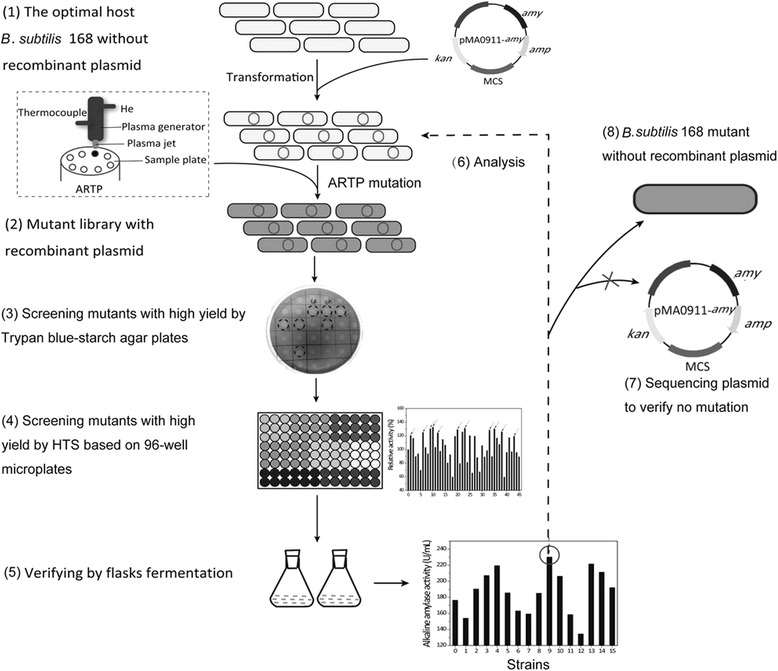
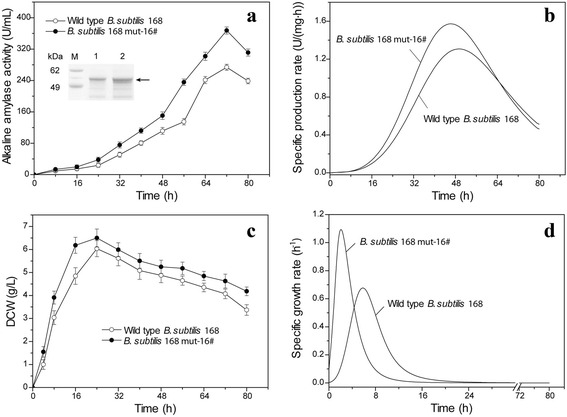
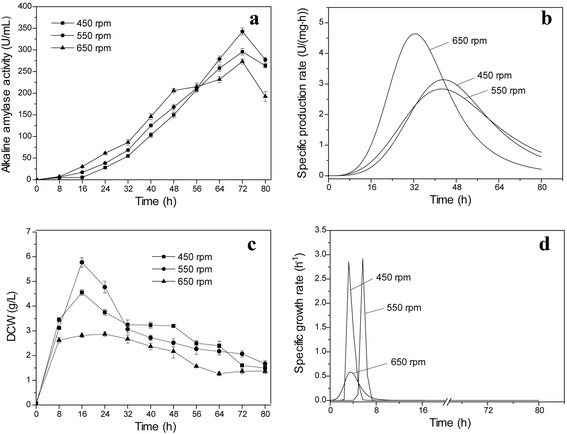
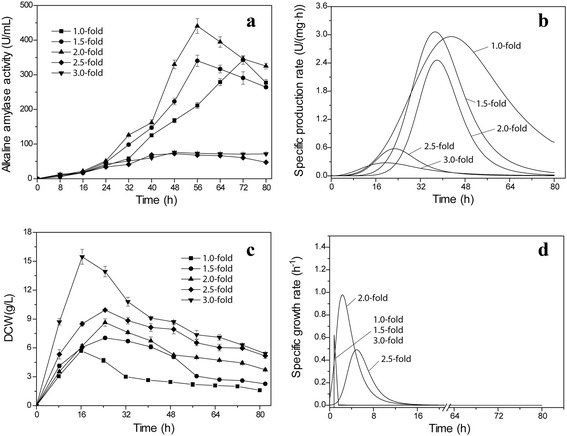
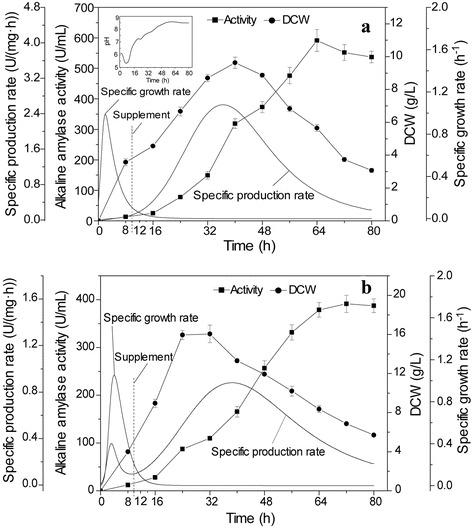
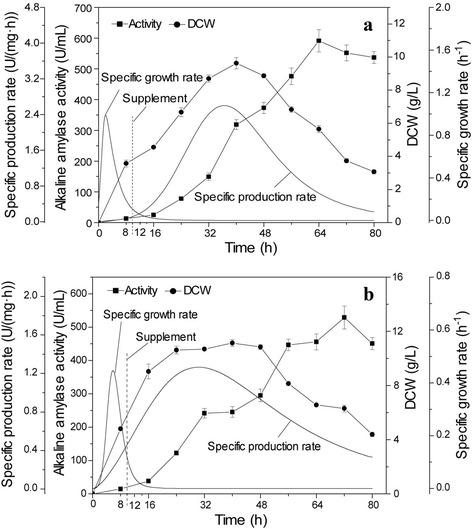
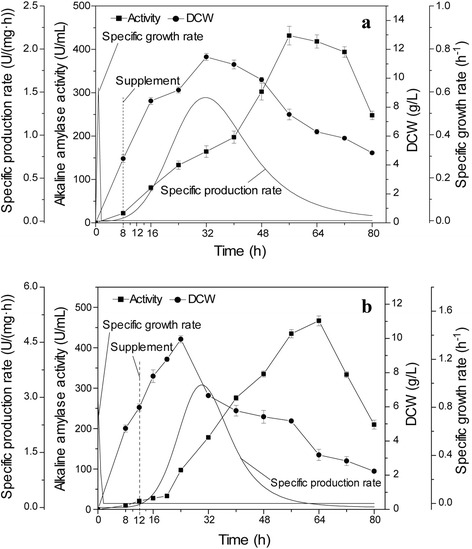
Alkaline amylase has significant potential for applications in the textile, paper and detergent industries, however, low yield of which cannot meet the requirement of industrial application. In this work, a novel ARTP mutagenesis-screening method and fermentation optimization strategies were used to significantly improve the expression level of recombinant alkaline amylase in B. subtilis 168. The activity of alkaline amylase in mutant B. subtilis 168 mut-16# strain was 1.34-fold greater than that in the wild-type, and the highest specific production rate was improved from 1.31 U/(mg·h) in the wild-type strain to 1.57 U/(mg·h) in the mutant strain. Meanwhile, the growth of B. subtilis was significantly enhanced by ARTP mutagenesis. When the agitation speed was 550 rpm, the highest activity of recombinant alkaline amylase was 1.16- and 1.25-fold of the activities at 450 and 650 rpm, respectively. When the concentration of soluble starch and soy peptone in the initial fermentation medium was doubled, alkaline amylase activity was increased 1.29-fold. Feeding hydrolyzed starch and soy peptone mixture or glucose significantly improved cell growth, but inhibited the alkaline amylase production in B. subtilis 168 mut-16#. The highest alkaline amylase activity by feeding hydrolyzed starch reached 591.4 U/mL, which was 1.51-fold the activity by feeding hydrolyzed starch and soy peptone mixture. Single pulse feeding-based batch feeding at 10 h favored the production of alkaline amylase in B. subtilis 168 mut-16#. The results indicated that this novel ARTP mutagenesis-screening method could significantly improve the yield of recombinant proteins in B. subtilis . Meanwhile, fermentation optimization strategies efficiently promoted expression of recombinant alkaline amylase in B. subtilis 168 mut-16#. These findings have great potential for facilitating the industrial-scale production of alkaline amylase and other enzymes, using B. subtilis cultures as microbial cell factories.
Overview
The claims and statistics of this paper haven’t been checked yet.
Run the check — free, no account needed. It reads the open-access text and checks the sources it cites.
Integrity signals
Registry
Cites
Statistics
Figures
Verification
Claims the paper makes
The claims and statistics of this paper haven’t been checked yet.
Run the check — free, no account needed. It reads the open-access text and checks the sources it cites.
Claims other papers make about this one
Each is checked against this paper’s own text: does it say what the citing paper says it does?
The source backs part of the claim, not all of it — or backs it for a different population, condition or comparison.
In the citing paper
“The effective use of soya peptone or soya protein hydrolysate as nitrogen sources by some strains of B. subtilis has been reported, where high cell density biomass production was a prerequisite for the synthesis of certain secondary metabolites and industrially important enzymes [21-23].”
From Optimization of Bacillus subtilis PW12 biomass production using RSM: a preliminary study towards single-cell protein production for aquaculture (2024) · cites this paper as [23]
Experimental — accuracy not yet measuredThe cited source says what the claim attributes to it.
In the citing paper
“The biomass yield obtained in this investigation was similar to that reported in the study of Ma et al. [23] in which a fed batch fermentation experiment with a mutant strain of B. subtilis 168 mut-16# was conducted. Feeding of soya peptone and hydrolyzed starch to the medium increased the dry cell weight of the bacteria, and the highest dry cell weight obtained was 14.3 g/L which”
From Optimization of Bacillus subtilis PW12 biomass production using RSM: a preliminary study towards single-cell protein production for aquaculture (2024) · cites this paper as [23]
Self-check
Percentages, sums and reported differences re-computed from the paper’s own numbers.
The self-check needs the paper’s full text.
Citations
Cites
High acetone-butanol-ethanol production in pH-stat co-feeding of acetate and glucose
Gao, M., Tashiro, Y., Wang, Q., Sakai, K., & Sonomoto, K. (2016) · Journal of Bioscience and Bioengineering · doi:10.1016/j.jbiosc.2016.01.013 · Cited by 30
Research works printed but not linked: 32
- Arikan B. Highly thermostable, thermophilic, alkaline, SDS and chelator resistant amylase from a thermophilic Bacillus sp isolate A3-15. Bioresour Technol. 2008;99:3071–6. · DOI
- Roy JK, Mukherjee AK. Applications of a high maltose forming, thermo-stable alpha-amylase from an extremely alkalophilic Bacillus licheniformis strain AS08E in food and laundry detergent industries. Biochem Eng J. 2013;77:220–30. · DOI
- Vester JK, Glaring MA, Stougaard P. An exceptionally cold-adapted alpha-amylase from a metagenomic library of a cold and alkaline environment. Appl Microbiol Biotechnol. 2015;99:717–27. · DOI
- Murakami S, Nagasaki K, Nishimoto H, Shigematu R, Umesaki J, Takenaka S, Kaulpiboon J, Prousoontorn M, Limpaseni T, Pongsawasdi P, Aoki K. Purification and characterization of five alkaline, thermotolerant, and maltotetraose-producing alpha-amylases from Bacillus halodurans MS-2-5, and production of recombinant enzymes in Escherichia coli. Enzym Microb Technol. 2008;43:321–8. · DOI
- Yang HQ, Liu L, Shin H-D, Chen RR, Li JH, Du GC, Chen J. Integrating terminal truncation and oligopeptide fusion for a novel protein engineering strategy to improve specific activity and catalytic efficiency: alkaline alpha-amylase as a case study. Appl Environ Microbiol. 2013;79:6429–38. · DOI
- Guan CR, Cui WJ, Cheng JT, Zhou L, Liu ZM, Zhou ZM. Development of an efficient autoinducible expression system by promoter engineering in Bacillus subtilis. Microb Cell Fact. 2016;15:66. · DOI
- Liu L, Yang HQ, Shin H-D, Chen RR, Li JH, Du GC, Chen J. How to achieve high-level expression of microbial enzymes Strategies and perspectives. Bioengineered. 2013;4:212–23. · DOI
- Jaouadi NZ, Jaouadi B, Aghajari N, Bejar S. The overexpression of the SAPB of Bacillus pumilus CBS and mutated sapB-L31I/T33S/N99Y alkaline proteases in Bacillus subtilis DB430: New attractive properties for the mutant enzyme. Bioresour Technol. 2012;105:142–51. · DOI
- Ma YF, Yang HQ, Chen XZ, Sun B, Du GC, Zhou ZM, Song JN, Fan Y, Shen W. Significantly improving the yield of recombinant proteins in Bacillus subtilis by a novel powerful mutagenesis tool (ARTP): Alkaline alpha-amylase as a case study. Protein Expr Purif. 2015;114:82–8. · DOI
- Thao Thi N, Thi Dinh Q, Hoang TL. Cloning and enhancing production of a detergent- and organic-solvent-resistant nattokinase from Bacillus subtilis VTCC-DVN-12-01 by using an eight-protease-gene-deficient Bacillus subtilis WB800. Microb Cell Fact. 2013;12:79. · DOI
- Ploss TN, Reilman E, Monteferrante CG, Denham EL, Piersma S, Lingner A, Vehmaanpera J, Lorenz P, van Dijl JM. Homogeneity and heterogeneity in amylase production by Bacillus subtilis under different growth conditions. Microb Cell Fact. 2016;15:57. · DOI
- Degering C, Eggert T, Puls M, Bongaerts J, Evers S, Maurer K-H, Jaeger K-E. Optimization of protease secretion in Bacillus subtilis and Bacillus licheniformis by screening of homologous and heterologous signal peptides. Appl Environ Microbiol. 2010;76:6370–6. · DOI
- Ozturk S, Calik P, Ozdamar TH. Fed-batch biomolecule production by Bacillus subtilis: A state of the art review. Trends Biotechnol. 2016;34:329–45. · DOI
- Trang Thi Phuong P, Hoang Duc N, Schumann W. Development of a strong intracellular expression system for Bacillus subtilis by optimizing promoter elements. J Biotechnol. 2012;157:167–72. · DOI
- Zhang X, Zhang C, Zhou Q-Q, Zhang X-F, Wang L-Y, Chang H-B, Li H-P, Oda Y, Xing X-H. Quantitative evaluation of DNA damage and mutation rate by atmospheric and room-temperature plasma (ARTP) and conventional mutagenesis. Appl Microbiol Biotechnol. 2015;99:5639–46. · DOI
- Park YS, Dohjima T, Okabe M. Enhanced alpha-amylase production in recombinant Bacillus brevis by fed-batch culture with amino acid control. Biotechnol Bioeng. 1996;49:36–44. · DOI
- Zhang X, Zhang XF, Li HP, Wang LY, Zhang C, Xing XH, Bao CY. Atmospheric and room temperature plasma (ARTP) as a new powerful mutagenesis tool. Appl Microbiol Biotechnol. 2014;98:5387–96. · DOI
- Fang MY, Jin LH, Zhang C, Tan YY, Jiang PX, Ge N, Li HP, Xing XH. Rapid mutation of Spirulina platensis by a new mutagenesis system of atmospheric and room temperature plasmas (ARTP) and generation of a mutant library with diverse phenotypes. PLoS One. 2013;8:e77046. · DOI
- Lu Y, Wang LY, Ma K, Li G, Zhang C, Zhao HX, Lai QH, Li H-P, Xing X-H. Characteristics of hydrogen production of an Enterobacter aerogenes mutant generated by a new atmospheric and room temperature plasma (ARTP). Biochem Eng J. 2011;55:17–22. · DOI
- Hua XF, Wang J, Wu ZJ, Zhang HX, Li HP, Xing XH, Liu Z. A salt tolerant Enterobacter cloacae mutant for bioaugmentation of petroleum-and salt-contaminated soil. Biochem Eng J. 2010;49:201–6. · DOI
- Veening JW, Igoshin OA, Eijlander RT, Nijland R, Hamoen LW, Kuipers O. Transient heterogeneity in extracellular protease production by Bacillus subtilis. Mol Sys Biol. 2008;4:184. · DOI
- Kwon E-Y, Kim KM, Kim MK, Lee IY, Kim BS. Production of nattokinase by high cell density fed-batch culture of Bacillus subtilis. Bioprocess Biosyst Eng. 2011;34:789–93. · DOI
- Wu QL, Chen T, Gan Y, Chen X, Zhao XM. Optimization of riboflavin production by recombinant Bacillus subtilis RH44 using statistical designs. Appl Microbiol Biotechnol. 2007;76:783–94. · DOI
- Huang HJ, Ridgway D, Gu TY, Moo-Young M. Enhanced amylase production by Bacillus subtilis using a dual exponential feeding strategy. Bioprocess Biosyst Eng. 2004;27:63–9. · DOI
- Yao J, Xu H, Shi NN, Cao X, Feng XH, Li S, Ouyang PK. Analysis of carbon metabolism and improvement of g-polyglutamic acid production from Bacillus subtilis NX-2. Appl Biochem Biotechnol. 2010;160:2332–41. · DOI
- Westers H, Darmon E, Zanen G, Veening JW, Kuipers OP, Bron S, Quax WJ, van Dijl JM. The Bacillus secretion stress response is an indicator for α-amylase levels. Lett Appl Microbiol. 2004;39:65–73. · DOI
- Hyyryläinen HL, Bolhuis A, Darmon E, Muukkonen L, Koski P, Vitikainen M, Sarvas M, Prágai Z, Bron S, van Dijl JM, Kontinen VP. A novel two component regulatory system in Bacillus subtilis for the survival of severe secretion stress. Mol Microbiol. 2001;41:1159–72. · DOI
- Tulin EE, Ueda S, Yamagata H, Udaka S, Yamane T. Effective extracullular production of Bacillus stearothermophilus esterase by pH-stat modal fed-batch culture of recombinant Bacillus brevis. Biotechnol Bioeng. 1992;40:844–50. · DOI
- Pohl S, Harwood CR. Heterologous protein secretion by Bacillus species from the cradle to the grave. Adv Appl Microbiol. 2010;73:1–25. · DOI
- Li KT, Liu D-H, Chu J, Wang Y-H, Zhuang Y-P, Zhang S-L. An effective and simplified pH-stat control strategy for the industrial fermentation of vitamin B(12) by Pseudomonas denitrificans. Bioprocess Biosyst Eng. 2008;31:605–10. · DOI
- Zhang M, Shi ML, Zhou Z, Yang S, Yuan ZY, Ye Q. Production of Alcaligenes faecalis penicillin G acylase in Bacillus subtilis WB600 (pMA5) fed with partially hydrolyzed starch. Enzyme Microb Technol. 2006;39:555–60. · DOI
- Cho Y-H, Song JY, Kim KM, Kim MK, Lee IY, Kim SB, Kim HS, Han NS, Lee BH, Kim BS. Production of nattokinase by batch and fed-batch culture of Bacillus subtilis. New Biotechnol. 2010;27:341–6. · DOI
Cited by
Gracious, M., & Nandakumar, S. (2024) · Journal of Applied Biology & Biotechnology · doi:10.7324/jabb.2024.177031 · Cited by 2
“The biomass yield obtained in this investigation was similar to that reported in the study of Ma et al. [23] in which a fed batch fermentation experiment with a mutant strain of B. subtilis 168 mut-16# was conducted.”
Metadata
- Authors
- Ma, Y., Shen, W., Chen, X., Liu, L., Zhou, Z., Xu, F., & Yang, H.
- Affiliations
- Jiangnan University (CN)
- Corresponding author
- Yang, Haiquan
- Venue
- Journal of Biological Engineering
- Published
- 2016-10-17
- Volume
- 10
- Issue
- 1
- Pages
- 13-13
- ISSN
- 1754-1611 (ISSN-L)
- PMC
- PMC5067897
- OpenAlex
- W2533170373
- Cited by
- 36
- References
- 1
- Citations by year
- 2025: 3 · 2024: 1 · 2023: 1 · 2022: 6 · 2021: 4 · 2020: 6 · 2019: 7 · 2018: 5 · 2017: 3
- FWCI
- 4.37
- Type
- journal article
- Language
- en
- Open access
- gold
- doi.org
- Licence
- cc-by
- Locations
- Journal of Biological Engineering (publishedVersion, cc-by)
- Europe PMC (PubMed Central) (publishedVersion, cc-by)
- PubMed Central (publishedVersion, cc-by)
- PubMed (publishedVersion)
- Funders
- 863 Program (2014AA021304)
- Natural Science Foundation of Jiangsu Province (BK20140152)
- National Natural Science Foundation of China (CN) (21406089)
- the Open Project Program of the Key Laboratory of Industrial Biotechnology, Ministry of Education, China (KLIB-KF201509)
- 111 Project (111-2-06)
- Topics
- Life Sciences › Biochemistry, Genetics and Molecular Biology › Biotechnology › Enzyme Production and Characterization
- Life Sciences › Biochemistry, Genetics and Molecular Biology › Molecular Biology › Microbial Metabolic Engineering and Bioproduction
- Life Sciences › Biochemistry, Genetics and Molecular Biology › Molecular Biology › Fungal and yeast genetics research
- Keywords
- Bacillus subtilis, recombinant protein expression, fermentation optimization, soy peptone, stirring speed, enzyme production, microbial cell factories
About these checks
Registry, retraction, Cites and statistics results are computed, not judged, with one exception: a printed reference that no index lists is read once by a model before it counts as a citation error. Claims are extracted by a model and kept only when their quote appears verbatim in the text; each cited source is then checked, with a model’s help, for whether it says what the claim relies on. Those verdicts can be wrong — read the claim’s quote and the cited source before relying on one.
Statistics and arithmetic are recomputed, not judged.
Confidence bands are shown only for fields calibrated on our annotated test set. None is calibrated yet, so no band is shown.
What counts as a claim ›How we measure confidence ›How we check this ›
Are you an author, or do you see a problem with this page? Request a review
