

Modelling cardiac fibrosis using three-dimensional cardiac microtissues derived from human embryonic stem cells
Open accessThe DOI matches its Crossref record; 82 of the 83 references it cites were found in a registry or an index.
Abstract
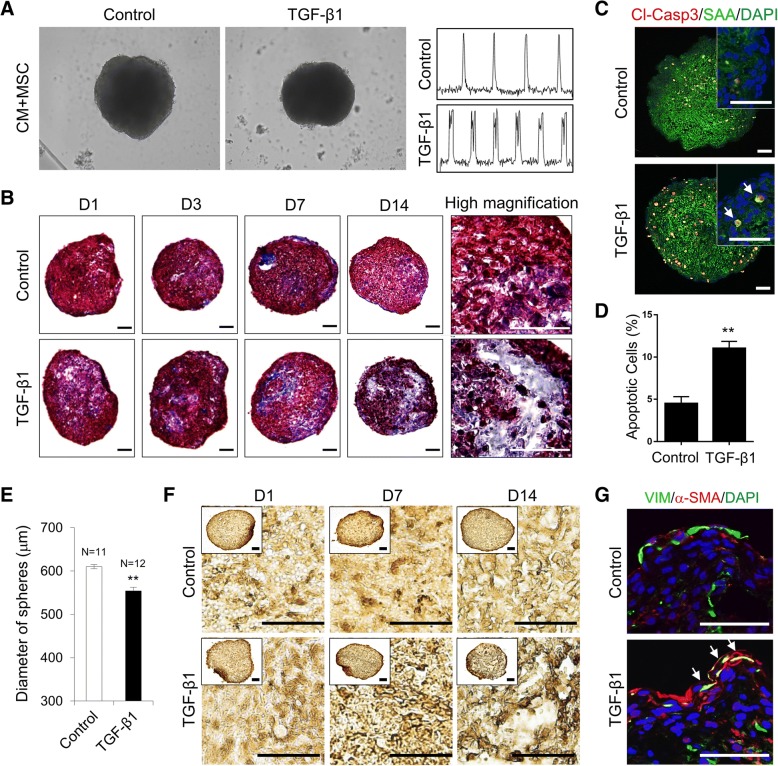
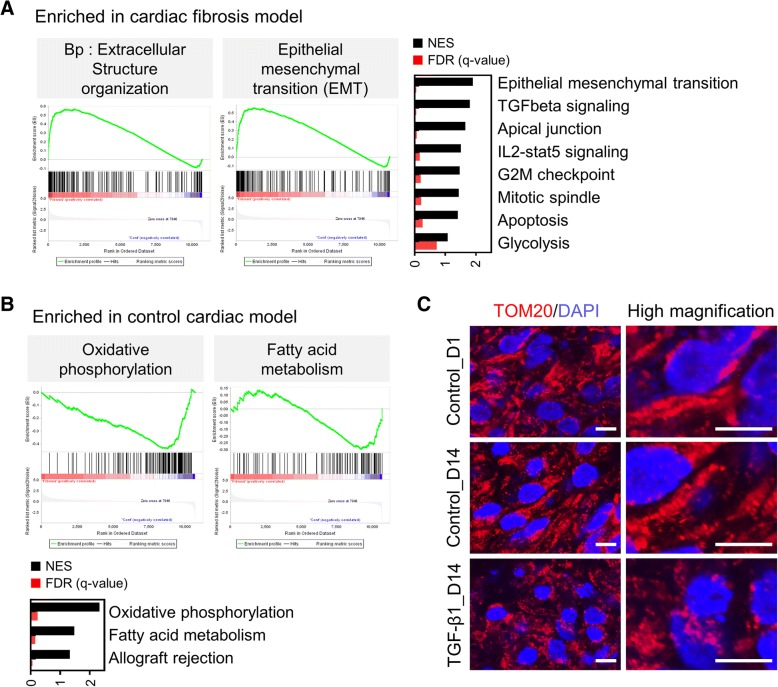
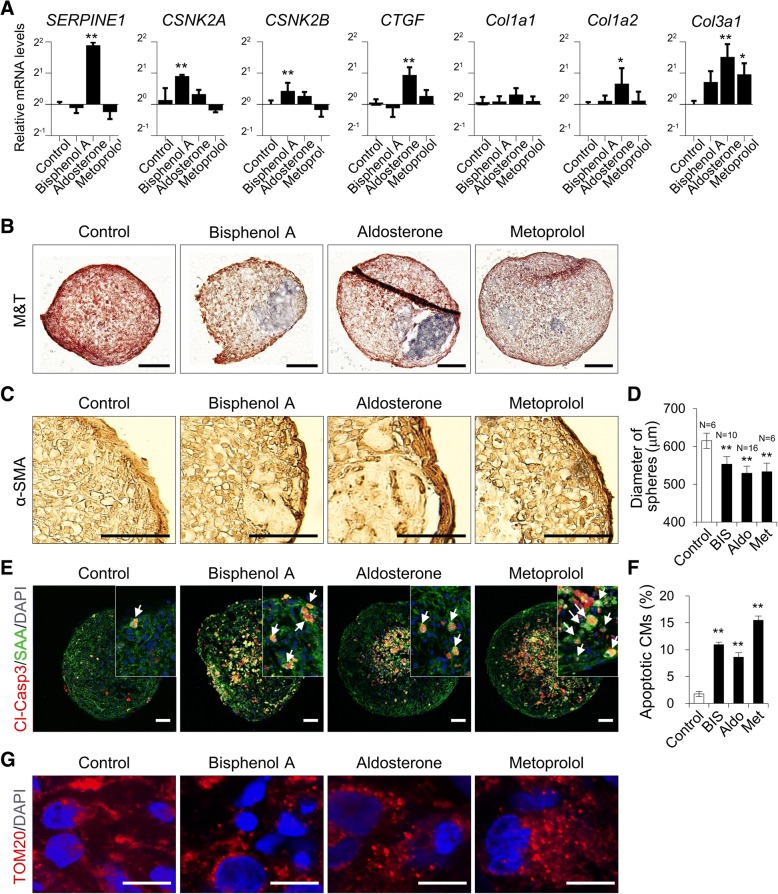
BACKGROUND: Cardiac fibrosis is the most common pathway of many cardiac diseases. To date, there has been no suitable in vitro cardiac fibrosis model that could sufficiently mimic the complex environment of the human heart. Here, a three-dimensional (3D) cardiac sphere platform of contractile cardiac microtissue, composed of human embryonic stem cell (hESC)-derived cardiomyocytes (CMs) and mesenchymal stem cells (MSCs), is presented to better recapitulate the human heart. RESULTS: We hypothesized that MSCs would develop an in vitro fibrotic reaction in response to treatment with transforming growth factor-β1 (TGF-β1), a primary inducer of cardiac fibrosis. The addition of MSCs improved sarcomeric organization, electrophysiological properties, and the expression of cardiac-specific genes, suggesting their physiological relevance in the generation of human cardiac microtissue model in vitro. MSCs could also generate fibroblasts within 3D cardiac microtissues and, subsequently, these fibroblasts were transdifferentiated into myofibroblasts by the exogenous addition of TGF-β1. Cardiac microtissues displayed fibrotic features such as the deposition of collagen, the presence of numerous apoptotic CMs and the dissolution of mitochondrial networks. Furthermore, treatment with pro-fibrotic substances demonstrated that this model could reproduce key molecular and cellular fibrotic events. CONCLUSIONS: This highlights the potential of our 3D cardiac microtissues as a valuable tool for manifesting and evaluating the pro-fibrotic effects of various agents, thereby representing an important step forward towards an in vitro system for the prediction of drug-induced cardiac fibrosis and the study of the pathological changes in human cardiac fibrosis.
Overview
The claims and statistics of this paper haven’t been checked yet.
Free: it reads the open-access text and checks the first 5 claims that cite a source we can check. Create a free account to check every claim.
Integrity signals
Registry
Cites
Statistics
Figures
Verification
Claims the paper makes
The claims and statistics of this paper haven’t been checked yet.
Free: it reads the open-access text and checks the first 5 claims that cite a source we can check. Create a free account to check every claim.
Claims other papers make about this one
Each is checked against this paper’s own text: does it say what the citing paper says it does?
The cited source says what the claim attributes to it.
In the citing paper
“For example, spheroid cultures have enabled the engineering of heart, liver, and lung fibrosis models6,15–18”
From 3D bioprinting of high cell-density heterogeneous tissue models through spheroid fusion within self-healing hydrogels (2021) · cites this paper as [17]
Self-check
Percentages, sums and reported differences re-computed from the paper’s own numbers.
The self-check needs the paper’s full text.
Citations
Cites
1 retracted
Li, J., Dai, Y., Su, Z., & Wei, G. (2016) · Bioscience Reports · doi:10.1042/bsr20160346 · Cited by 26
RetractedThe Molecular Signatures Database Hallmark Gene Set Collection
Liberzon, A., Birger, C., Thorvaldsdóttir, H., Ghandi, M., Mesirov, J. P., & Tamayo, P. (2015) · Cell Systems · doi:10.1016/j.cels.2015.12.004 · Cited by 13,807
Chemically defined generation of human cardiomyocytes
Burridge, P. W., Matsa, E., Shukla, P., Lin, Z. C., Churko, J. M., Ebert, A. D., Lan, F., Diecke, S., Huber, B., Mordwinkin, N. M., et al. (2014) · Nature Methods · doi:10.1038/nmeth.2999 · Cited by 1,606
Cardiac Fibrosis: The Fibroblast Awakens
Travers, J. G., Kamal, F. A., Robbins, J., Yutzey, K. E., & Blaxall, B. C. (2016) · Circulation Research · doi:10.1161/circresaha.115.306565 · Cited by 1,596
Fibrosis–a common pathway to organ injury and failure
Rockey, D. C., Bell, P. D., & Hill, J. A. (2015) · New England Journal of Medicine · doi:10.1056/nejmra1300575 · Cited by 1,428 · cited 1×
“These myofibroblasts have high fibrotic activity marked by the expression of α-smooth muscle actin (α-SMA), resulting in myocardial fibrosis and stiffening, which eventually impairs cardiac function [6, 7].”
BackgroundCardiac fibroblasts: At the heart of myocardial remodeling
Porter, K. E., & Turner, N. A. (2009) · Pharmacology & Therapeutics · doi:10.1016/j.pharmthera.2009.05.002 · Cited by 1,010
Cardiac Fibroblast: The Renaissance Cell
Souders, C. A., Bowers, S. L. K., & Baudino, T. A. (2009) · Circulation Research · doi:10.1161/circresaha.109.209809 · Cited by 984
Biowire: a platform for maturation of human pluripotent stem cell–derived cardiomyocytes
Nunes, S. S., Miklas, J. W., Liu, J., Aschar-Sobbi, R., Xiao, Y., Zhang, B., Jiang, J., Massé, S., Gagliardi, M., Hsieh, A., et al. (2013) · Nature Methods · doi:10.1038/nmeth.2524 · Cited by 952
Transforming growth factor (TGF)-β signaling in cardiac remodeling
Dobaczewski, M., Chen, W., & Frangogiannis, N. G. (2011) · Journal of Molecular and Cellular Cardiology · doi:10.1016/j.yjmcc.2010.10.033 · Cited by 934
Structural and functional characterisation of cardiac fibroblasts
CAMELLITI, P., BORG, T., & KOHL, P. (2005) · Cardiovascular Research · doi:10.1016/j.cardiores.2004.08.020 · Cited by 930
Cited by
Daly, A. C., Davidson, M. D., & Burdick, J. A. (2021) · Nature Communications · doi:10.1038/s41467-021-21029-2 · Cited by 470
Complex Relationship Between Cardiac Fibroblasts and Cardiomyocytes in Health and Disease
Hall, C., Gehmlich, K., Denning, C., & Pavlovic, D. (2021) · Journal of the American Heart Association · doi:10.1161/jaha.120.019338 · Cited by 205
Beauchamp, P., Jackson, C. B., Ozhathil, L. C., Agarkova, I., Galindo, C. L., Sawyer, D. B., Suter, T. M., & Zuppinger, C. (2020) · Frontiers in Molecular Biosciences · doi:10.3389/fmolb.2020.00014 · Cited by 202
“CF culture in scaffold-free, multicellular aggregates does not lead to significant proliferation of primary CF, even on the surface of the spheroid, unless stimulated by growthor other profibrotic factors [(Desroches et al., 2012; Lee et al., 2019), and own observations].”
BackgroundMastikhina, O., Moon, B.-U., Williams, K., Hatkar, R., Gustafson, D., Mourad, O., Sun, X., Koo, M., Lam, A. Y. L., Sun, Y., et al. (2020) · Biomaterials · doi:10.1016/j.biomaterials.2019.119741 · Cited by 185
“assessment capabilities such as force of contraction [16,44].”
Background3D Cardiac Cell Culture: A Critical Review of Current Technologies and Applications
Zuppinger, C. (2019) · Frontiers in Cardiovascular Medicine · doi:10.3389/fcvm.2019.00087 · Cited by 171
“Other cardiomyopathies that have been modeled in 3D cultures include cardiac fibrosis (46), hypertrophy (47), Chagas disease (48), atrial fibrillation (49), cardiotoxic cancer therapies, and other toxins (19, 20, 22, 44, 50).”
Background
Metadata
- Authors
- Lee, M.-O., Jung, K. B., Jo, S.-J., Hyun, S.-A., Moon, K.-S., Seo, J.-W., Kim, S.-H., & Son, M.-Y.
- Affiliations
- Korea Research Institute of Bioscience and Biotechnology (KR)
- Korea Institute of Toxicology (KR)
- Korea Institute of Science and Technology (KR)
- Corresponding author
- Lee, Mi-Ok
- Kim, Sang-Heon
- Son, Mi-Young
- ORCID
- Venue
- Journal of Biological Engineering
- Published
- 2019-02-13
- Volume
- 13
- Issue
- 1
- Pages
- 15-15
- ISSN
- 1754-1611 (ISSN-L)
- PMC
- PMC6375184
- OpenAlex
- W2920494793
- Cited by
- 72
- References
- 83
- Citations by year
- 2026: 4 · 2025: 5 · 2024: 10 · 2023: 9 · 2022: 8 · 2021: 15 · 2020: 11 · 2019: 10
- FWCI
- 7.95
- Type
- journal article
- Language
- en
- Open access
- gold
- doi.org
- Licence
- cc-by
- creativecommons.org/licenses/by/4.0/ (tdm)
- Locations
- Journal of Biological Engineering (publishedVersion, cc-by)
- Europe PMC (PubMed Central) (publishedVersion, other-oa)
- PubMed Central (publishedVersion, cc-by)
- PubMed (publishedVersion)
- DOAJ (DOAJ: Directory of Open Access Journals) (submittedVersion, cc-by-sa)
- KRIBB Repository (submittedVersion)
- Funders
- Ministry of Trade, Industry and Energy (10063334)
- Ministry of Science, ICT and Future Planning (2018R1C1B6008256, 2018M3A9H3023077)
- Korea Research Institute of Bioscience and Biotechnology (KRIBB initiative program)
- Topics
- Health Sciences › Medicine › Cardiology and Cardiovascular Medicine › Cardiac Fibrosis and Remodeling
- Life Sciences › Biochemistry, Genetics and Molecular Biology › Molecular Biology › Pluripotent Stem Cells Research
- Life Sciences › Biochemistry, Genetics and Molecular Biology › Cell Biology › Mesenchymal stem cell research
- Keywords
- myocardial fibrosis, human embryonic stem cell-derived cardiomyocytes, mesenchymal stem cells, TGF-β1, myofibroblast transdifferentiation, fibroblast transdifferentiation, cardiomyocyte apoptosis, collagen deposition, sarcomeric organization, in vitro fibrosis model
About these checks
Registry, retraction, Cites and statistics results are computed, not judged, with one exception: a printed reference that no index lists is read once by a model before it counts as a citation error. Claims are extracted by a model and kept only when their quote appears verbatim in the text; each cited source is then checked, with a model’s help, for whether it says what the claim relies on. Those verdicts can be wrong — read the claim’s quote and the cited source before relying on one.
Statistics and arithmetic are recomputed, not judged.
Confidence bands are shown only for fields calibrated on our annotated test set. None is calibrated yet, so no band is shown.
What counts as a claim ›How we measure confidence ›How we check this ›
Are you an author, or do you see a problem with this page? Request a review
Data sources
Bibliographic data: Semantic Scholar, OpenAlex, Crossref.
Contains information from the Semantic Scholar Academic Graph Datasets, made available under the ODC Attribution License (ODC-BY 1.0).
Semantic Scholar’s data is described in: Kinney, R., et al. (2023). The Semantic Scholar Open Data Platform. arXiv:2301.10140.
