

Long-term upregulation of cortical glutamatergic AMPA receptors in a mouse model of chronic visceral pain
Open accessThe DOI matches its Crossref record; 59 of the 59 references it cites were found in a registry or an index.
Abstract
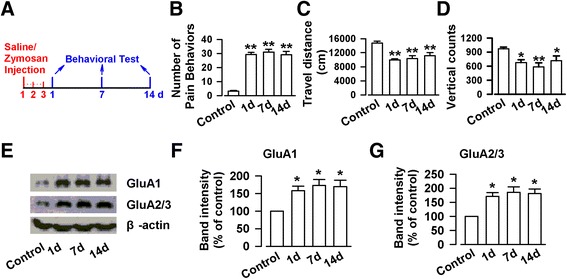
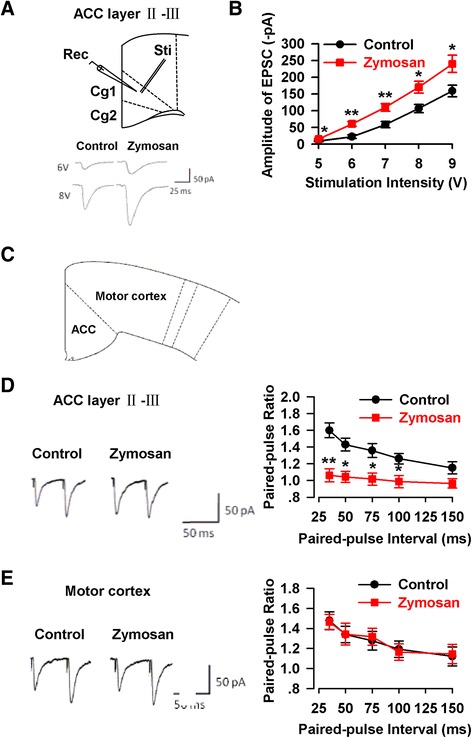
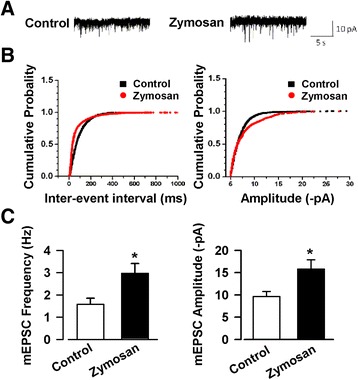
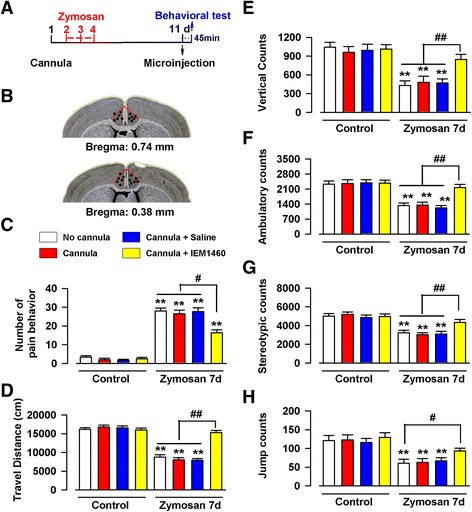
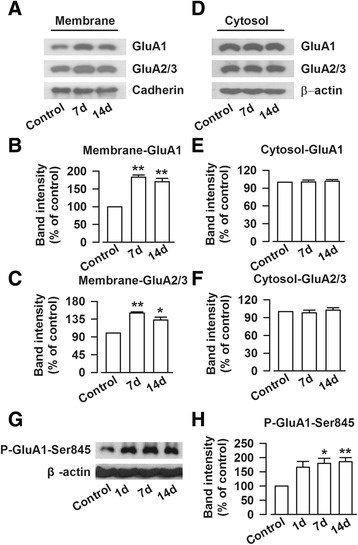
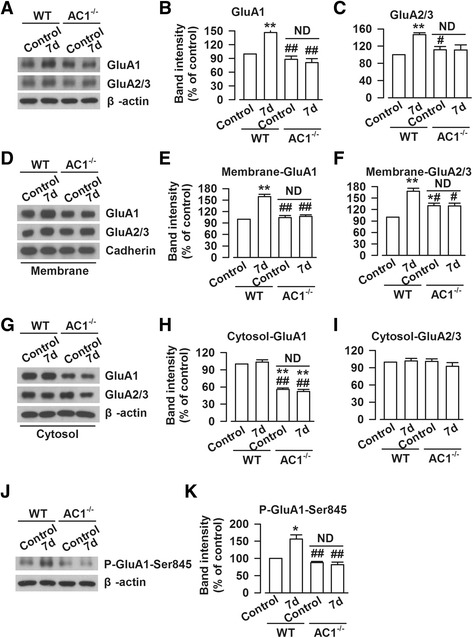
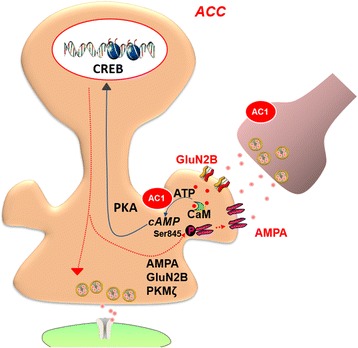
BACKGROUND: Irritable bowel syndrome (IBS) is one of the most common functional gastrointestinal disorders and it causes long-lasting visceral pain and discomfort. AMPA receptor mediated long-term potentiation (LTP) has been shown to play a critical role in animal models of neuropathic and inflammatory pain. No report is available for central changes in the ACC of mice with chronic visceral pain. RESULTS: In this study, we used integrative methods to investigate potential central plastic changes in the anterior cingulate cortex (ACC) of a visceral pain mouse model induced by intracolonic injection of zymosan. We found that visceral pain induced an increased expression of AMPA receptors (at the post synapses) in the ACC via an enhanced trafficking of the AMPA receptors to the membrane. Both GluA1 and GluA2/3 subunits were significantly increased. Supporting biochemical changes, excitatory synaptic transmission in the ACC were also significantly enhanced. Microinjection of AMPA receptor inhibitor IEM1460 into the ACC inhibited visceral and spontaneous pain behaviors. Furthermore, we found that the phosphorylation of GluA1 at the Ser845 site was increased, suggesting that GluA1 phosphorylation may contribute to AMPA receptor trafficking. Using genetically knockout mice lacking calcium-calmodulin stimulated adenylyl cyclase subtype 1 (AC1), we found that AMPA receptor phosphorylation and its membrane trafficking induced by zymosan injection were completely blocked. CONCLUSIONS: Our results provide direct evidence for cortical AMPA receptors to contribute to zymosan-induced visceral and spontaneous pain and inhibition of AC1 activity may help to reduce chronic visceral pain.
Overview
The claims and statistics of this paper haven’t been checked yet.
Free: it reads the open-access text and checks the first 5 claims that cite a source we can check. Create a free account to check every claim.
Integrity signals
Registry
Cites
Statistics
Figures
Verification
Claims the paper makes
The claims and statistics of this paper haven’t been checked yet.
Free: it reads the open-access text and checks the first 5 claims that cite a source we can check. Create a free account to check every claim.
Claims other papers make about this one
Each is checked against this paper’s own text: does it say what the citing paper says it does?
In the citing paper
“Furthermore, these alterations have been proposed to act in a positive feedback manner, as increased AC1 activity can reciprocally drive increases in the GluN2B subunit of NMDA-Rs (234) as well as increase the phosphorylation and expression of α-amino-3-hydroxy-5-methyl-4-isoxazolepropionic acid (AMPA) receptors (235, 238).”
From Physiological roles of mammalian transmembrane adenylyl cyclase isoforms (2022) · cites this paper as [235]
Self-check
Percentages, sums and reported differences re-computed from the paper’s own numbers.
The self-check needs the paper’s full text.
Citations
Cites
3 retracted
Fan, J., Wu, X., Cao, Z., Chen, S., Owyang, C., & Li, Y. (2009) · Gastroenterology · doi:10.1053/j.gastro.2009.01.069 · Cited by 63 · cited 1×
“Finally, the GluN2B-containing NMDA receptors, postsynaptic CaMKII, and extracellular signal-regulated kinase-1 and −2 (ERK1/2) in the ACC mediate visceral pain in animals [46–49].”
RetractedWu, X., Gao, J., Yan, J., Fan, J., Owyang, C., & Li, Y. (2008) · American Journal of Physiology-Gastrointestinal and Liver Physiology · doi:10.1152/ajpgi.00452.2007 · Cited by 50 · cited 1×
“Finally, the GluN2B-containing NMDA receptors, postsynaptic CaMKII, and extracellular signal-regulated kinase-1 and −2 (ERK1/2) in the ACC mediate visceral pain in animals [46–49].”
RetractedLi, Y., Zhang, X., Liu, H., Cao, Z., Chen, S., Cao, B., & Liu, J. (2012) · Journal of Neurochemistry · doi:10.1111/j.1471-4159.2012.07717.x · Cited by 25 · cited 1×
“Finally, the GluN2B-containing NMDA receptors, postsynaptic CaMKII, and extracellular signal-regulated kinase-1 and −2 (ERK1/2) in the ACC mediate visceral pain in animals [46–49].”
RetractedPKA phosphorylation of AMPA receptor subunits controls synaptic trafficking underlying plasticity
Esteban, J. A., Shi, S.-H., Wilson, C., Nuriya, M., Huganir, R. L., & Malinow, R. (2003) · Nature Neuroscience · doi:10.1038/nn997 · Cited by 894 · cited 1×
“In this regard, protein kinase A (PKA) has been shown to play roles in plasticity-related AMPA receptor trafficking [33, 34].”
The interaction between Stargazin and PSD-95 regulates AMPA receptor surface trafficking
Bats, C., Groc, L., & Choquet, D. (2007) · Neuron · doi:10.1016/j.neuron.2007.01.030 · Cited by 590 · cited 1×
“Previous studies in the hippocampus and ACC show that trafficking of AMPA receptors to the membrane play important roles in synaptic potentiation [29–31].”
Cortical excitation and chronic pain
Zhuo, M. (2008) · Trends in Neurosciences · doi:10.1016/j.tins.2008.01.003 · Cited by 535 · cited 2×
“Cumulative evidence supports the notion that forebrain neurons including those in the ACC and insular cortex play a crucial role for pain-related perception [13, 14].”
Self-citationTillisch, K., Mayer, E. A., & Labus, J. S. (2011) · Gastroenterology · doi:10.1053/j.gastro.2010.07.053 · Cited by 412 · cited 1×
“In addition, human brain imaging studies revealed that the long-term structural changes in the brain of IBS patients, suggesting the role of central brain areas in IBS related chronic visceral pain [6–9].”
Alleviating Neuropathic Pain Hypersensitivity by Inhibiting PKMζ in the Anterior Cingulate Cortex
Li, X.-Y., Ko, H.-G., Chen, T., Descalzi, G., Koga, K., Wang, H., Kim, S. S., Shang, Y., Kwak, C., Park, S.-W., et al. (2010) · Science · doi:10.1126/science.1191792 · Cited by 410 · cited 1×
“Cumulative evidence consistently suggests that neurons of the ACC are involved in pain-related perception, especially in chronic pain [21, 35–38].”
Self-citationPresynaptic and Postsynaptic Amplifications of Neuropathic Pain in the Anterior Cingulate Cortex
Xu, H., Wu, L.-J., Wang, H., Zhang, X., Vadakkan, K. I., Kim, S. S., Steenland, H. W., & Zhuo, M. (2008) · The Journal of Neuroscience · doi:10.1523/jneurosci.1812-08.2008 · Cited by 370 · cited 6×
“The percentage increase in the phosphorylation was similar on day 7 and 14, which were comparable with that in the ACC of neuropathic pain animal model [32].”
Self-citationA new model of visceral pain and referred hyperalgesia in the mouse
Laird, J. M. A., Martinez-Caro, L., Garcia-Nicas, E., & Cervero, F. (2001) · Pain · doi:10.1016/s0304-3959(01)00275-5 · Cited by 350
Cited by
Tsuda, M., Koga, K., Chen, T., & Zhuo, M. (2017) · Journal of Neurochemistry · doi:10.1111/jnc.14001 · Cited by 173
Self-citationPhysiological roles of mammalian transmembrane adenylyl cyclase isoforms
Ostrom, K. F., LaVigne, J. E., Brust, T. F., Seifert, R., Dessauer, C. W., Watts, V. J., & Ostrom, R. S. (2022) · Physiological Reviews · doi:10.1152/physrev.00013.2021 · Cited by 131
Mechanisms of Channel Block in Calcium-Permeable AMPA Receptors
Twomey, E. C., Yelshanskaya, M. V., Vassilevski, A. A., & Sobolevsky, A. I. (2018) · Neuron · doi:10.1016/j.neuron.2018.07.027 · Cited by 106
“IEM-1460 (micromolar potency) attenuates epileptic seizures (Gmiro and Serdyuk, 2008; Szczurowska and Mare s, 2015) and may reduce visceral pain (Kopach et al., 2016; Liu et al., 2015) and CP-AMPAR activity related to schizophrenia (Umino et al.”
Stress-Induced Chronic Visceral Pain of Gastrointestinal Origin
Greenwood-Van Meerveld, B., & Johnson, A. C. (2017) · Frontiers in Systems Neuroscience · doi:10.3389/fnsys.2017.00086 · Cited by 97
Descending facilitation: From basic science to the treatment of chronic pain
Zhuo, M. (2017) · Molecular Pain · doi:10.1177/1744806917699212 · Cited by 90
Self-citation
Metadata
- Authors
- Liu, S.-B., Zhang, M.-M., Cheng, L.-F., Shi, J., Lu, J.-S., & Zhuo, M.
- Affiliations
- University of Toronto (CA)
- Xi'an Jiaotong University (CN)
- Corresponding author
- Zhuo, Min
- Venue
- Molecular Brain
- Published
- 2015-11-19
- Volume
- 8
- Issue
- 1
- Pages
- 76-76
- ISSN
- 1756-6606 (ISSN-L)
- PMC
- PMC4653882
- OpenAlex
- W2176291309
- Cited by
- 55
- References
- 59
- Citations by year
- 2026: 6 · 2025: 3 · 2024: 7 · 2023: 4 · 2022: 2 · 2021: 5 · 2020: 6 · 2019: 6 · 2018: 5 · 2017: 6 · 2016: 5
- FWCI
- 3.93
- Type
- journal article
- Language
- en
- Open access
- gold
- doi.org
- Licence
- cc-by
- Locations
- Molecular Brain (publishedVersion, cc-by)
- PubMed Central (publishedVersion, cc-by)
- PubMed (publishedVersion)
- TSpace (University of Toronto) (submittedVersion)
- Funders
- CIHR (258523)
- Canadian Network for Research and Innovation in Machining Technology, Natural Sciences and Engineering Research Council of Canada (402555)
- Topics
- Health Sciences › Medicine › Physiology (medical) › Pain Mechanisms and Treatments
- Life Sciences › Neuroscience › Cellular and Molecular Neuroscience › Neuroscience and Neuropharmacology Research
- Health Sciences › Medicine › Gastroenterology › Gastrointestinal motility and disorders
- Keywords
- chronic visceral pain, AMPA receptors, anterior cingulate cortex, zymosan, irritable bowel syndrome, GluA1 phosphorylation, AMPA receptor trafficking, excitatory synaptic transmission, spontaneous pain, central sensitization
- MeSH terms
- Adamantane, Adenylyl Cyclases, Animals, Behavior, Animal, Calcium, Cell Membrane, Disease Models, Animal, Glutamates, Gyrus Cinguli, Injections, Models, Biological, Synaptic Transmission, Phosphorylation, Phosphoserine, Time Factors, Zymosan, Up-Regulation, Gene Deletion, Receptors, AMPA, Excitatory Postsynaptic Potentials, Protein Transport, Irritable Bowel Syndrome, Mice, Visceral Pain, Chronic Pain
About these checks
Registry, retraction, Cites and statistics results are computed, not judged, with one exception: a printed reference that no index lists is read once by a model before it counts as a citation error. Claims are extracted by a model and kept only when their quote appears verbatim in the text; each cited source is then checked, with a model’s help, for whether it says what the claim relies on. Those verdicts can be wrong — read the claim’s quote and the cited source before relying on one.
Statistics and arithmetic are recomputed, not judged.
Confidence bands are shown only for fields calibrated on our annotated test set. None is calibrated yet, so no band is shown.
What counts as a claim ›How we measure confidence ›How we check this ›
Are you an author, or do you see a problem with this page? Request a review
How to cite
Cite CoChat for the checks on this page, and the paper for its own findings.
- This page
- CoChat. (2026). Citation check: Long-term upregulation of cortical glutamatergic AMPA receptors in a mouse model of chronic visceral pain. https://app.cochat.ai/papers/10.1186/s13041-015-0169-z
- The paper
- Liu, S.-B., Zhang, M.-M., Cheng, L.-F., Shi, J., Lu, J.-S., & Zhuo, M. (2015). Long-term upregulation of cortical glutamatergic AMPA receptors in a mouse model of chronic visceral pain. Molecular Brain. https://doi.org/10.1186/s13041-015-0169-z
Data sources
Bibliographic data: Semantic Scholar, OpenAlex, Crossref.
Contains information from the Semantic Scholar Academic Graph Datasets, made available under the ODC Attribution License (ODC-BY 1.0).
Semantic Scholar’s data is described in: Kinney, R., et al. (2023). The Semantic Scholar Open Data Platform. arXiv:2301.10140.
