

No raw data, no science: another possible source of the reproducibility crisis
Open accessThe DOI matches its Crossref record; 14 of the 14 references it cites were found in a registry or an index; 3 of the 8 sources its claims cite were checked for support.
Abstract
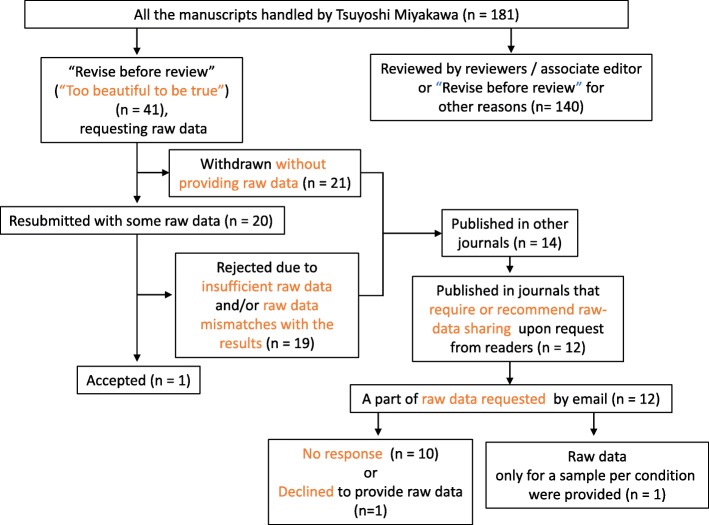
A reproducibility crisis is a situation where many scientific studies cannot be reproduced. Inappropriate practices of science, such as HARKing, p-hacking, and selective reporting of positive results, have been suggested as causes of irreproducibility. In this editorial, I propose that a lack of raw data or data fabrication is another possible cause of irreproducibility. As an Editor-in-Chief of Molecular Brain , I have handled 180 manuscripts since early 2017 and have made 41 editorial decisions categorized as “Revise before review,” requesting that the authors provide raw data. Surprisingly, among those 41 manuscripts, 21 were withdrawn without providing raw data, indicating that requiring raw data drove away more than half of the manuscripts. I rejected 19 out of the remaining 20 manuscripts because of insufficient raw data. Thus, more than 97% of the 41 manuscripts did not present the raw data supporting their results when requested by an editor, suggesting a possibility that the raw data did not exist from the beginning, at least in some portions of these cases. Considering that any scientific study should be based on raw data, and that data storage space should no longer be a challenge, journals, in principle, should try to have their authors publicize raw data in a public database or journal site upon the publication of the paper to increase reproducibility of the published results and to increase public trust in science.
Overview
CoChat Summary
TL;DR
This editorial argues that lack of raw data—and possibly data fabrication—is another likely source of the reproducibility crisis, based on the author’s experience handling manuscripts as Editor-in-Chief of *Molecular Brain*. The author reports that when asked for raw data, more than 97% of 41 flagged manuscripts did not provide appropriate raw data, and proposes that journals require raw data deposition before publication.
Key findings
- Of 180 manuscripts handled since early 2017 to September 2019, 41 received “Revise before review” decisions requesting raw data; 21 were withdrawn without providing raw data, and of the remaining 20, 19 were rejected for insufficient raw data. Only 1 was sent for review and accepted, meaning more than 97% of the 41 did not or could not provide appropriate raw data.
- Among the 20 resubmitted with some raw data, 9 presented partial or no data, 7 had raw data that did not match the results, 11 of 18 western blotting manuscripts lacked size markers and/or entire membrane images, and 2 showed evidence of image duplications and inappropriate cuts/pastes.
- Among 40 withdrawn or rejected manuscripts, 14 were later published elsewhere; 12 of those journals require or recommend raw data upon request. The author contacted authors of the 12 papers: 10 did not respond, 1 sent raw data for only one sample per condition when each condition was supposed to have 6 samples, and 1 declined.
- Informal Twitter surveys: about 53% of 227 life-science respondents suspected more than two-thirds of withdrawn/insufficient manuscripts might have fabricated data; more than 60% of 56 researchers thought careful fabricators equal or outnumber careless ones, leading the author to roughly estimate that more than a quarter of the 180 manuscripts may include some misconduct.
Methods
- Editorial/descriptive analysis by the Editor-in-Chief of *Molecular Brain*, covering 180 manuscripts handled from early 2017 to September 2019, with 41 “Revise before review” decisions requesting raw data, absolute p-values, and multiple-test corrections.
- Counts of manuscript withdrawal, rejection, raw-data sufficiency, mismatches between raw data and results, and image problems; follow-up requests to authors of 14 later-published papers; and two informal Japanese-language Twitter surveys (227 and 56 life-science respondents).
- No formal statistical modeling or systematic sampling is reported; the analysis is descriptive and based on the editor’s caseload and online speculation.
Limitations
- The paper states that it cannot know what percentage of manuscripts had fabricated data without formal investigation, that its estimates are rough and casual speculation based on non-scientific and anecdotal episodes, and that the Twitter surveys reflect speculation or “gut feelings” rather than concrete examples.
- The paper notes alternative reasons authors may withdraw after being asked for raw data, including unwillingness to gather/upload data, data-mining concerns, or choosing journals that do not require disclosure; it also notes that rejected cases could be honest and careless mistakes, and that requests included absolute p-values and multiple-test corrections, so raw data may not be the sole reason for withdrawal.
- Evident from the text: the findings come from a single editor at one journal, use a non-random convenience sample, rely on subjective triggers such as data looking “too beautiful to be true,” and include no formal verification of fabrication or misconduct.
Model-written summary. Check it against the paper before relying on it.
Integrity signals
Registry
Cites
Statistics
Figures
Verification
Claims the paper makes
3 Valid · 5 Not valid · 5 Not checked · 30 Own results and interpretations
Every source the paper cites for this claim was checked and supports it.
In the paper
“Misconduct was found to be reported more frequently by medical/pharmacological researchers than others in this systematic review [13]”
§ No raw data, no science: another possible source of the reproducibility crisis > Absence of raw data means the absence of science
What the sources say
- Supportedcites [13] Fanelli D How many scientists fabricate and falsify research? A systematic review and meta-analysis of survey data PLoS One 2009 4 5 e5738 10.1371/journal.pone.0005738 19478950 PMC2685008 source
The Abstract states that, after controlling for survey-method differences, medical/pharmacological researchers reported misconduct more frequently than others. The Discussion likewise describes higher reporting in samples exclusively from medical, clinical and pharmacological research than in other fields or mixed samples. The claim concerns reporting, not whether those researchers actually committed more misconduct. (LLM, conf=0.94)
plainstates an association- Asserted: passes — The authors put it forward as true.
- Checkable: passes — It can be checked against evidence.
- Load-bearing: unclear — It is unclear whether the paper’s conclusions depend on it.
- Based: passes — The paper gives a reason why it holds.
- Supported
A result the paper reports from its own data — it cites no other source for it, so there is none to check. The quote shows it is in the paper.
In the paper
“the authors of 34 out of the 40 manuscripts that did not provide raw data to Molecular Brain belonged to hospital or medical school in the analysis in this editorial.”
§ No raw data, no science: another possible source of the reproducibility crisis > Absence of raw data means the absence of science
plainstates an association- Asserted: passes — The authors put it forward as true.
- Checkable: passes — It can be checked against evidence.
- Load-bearing: unclear — It is unclear whether the paper’s conclusions depend on it.
- Based: passes — The paper gives a reason why it holds.
A result the paper reports from its own data — it cites no other source for it, so there is none to check. The quote shows it is in the paper.
In the paper
“Out of the remaining 20 cases where the authors resubmitted the manuscripts with some raw data, 19 had insufficient data.”
- Also stated in: § Abstract · plain
“I rejected 19 out of the remaining 20 manuscripts because of insufficient raw data.”
§ No raw data, no science: another possible source of the reproducibility crisis > Raw data rarely comes out
plainn = 20- Asserted: passes — The authors put it forward as true.
- Checkable: passes — It can be checked against evidence.
- Load-bearing: passes — The paper’s conclusions depend on it.
- Based: passes — The paper gives a reason why it holds.
- Also stated in: § Abstract · plain
A result the paper reports from its own data — it cites no other source for it, so there is none to check. The quote shows it is in the paper.
In the paper
“have made 41 editorial decisions categorized as ‘Revise before review’, with comments asking the authors to provide raw data”
- Also stated in: § Abstract · plain
“have made 41 editorial decisions categorized as “Revise before review,” requesting that the authors provide raw data”
§ No raw data, no science: another possible source of the reproducibility crisis > Raw data rarely comes out
plain- Asserted: passes — The authors put it forward as true.
- Checkable: passes — It can be checked against evidence.
- Load-bearing: passes — The paper’s conclusions depend on it.
- Based: passes — The paper gives a reason why it holds.
- Also stated in: § Abstract · plain
A result the paper reports from its own data — it cites no other source for it, so there is none to check. The quote shows it is in the paper.
In the paper
“Twelve journals out of those that published the 14 papers require or recommend that the authors provide raw data upon request from readers in their policies.”
§ No raw data, no science: another possible source of the reproducibility crisis > Raw data rarely comes out
plain- Asserted: passes — The authors put it forward as true.
- Checkable: passes — It can be checked against evidence.
- Load-bearing: passes — The paper’s conclusions depend on it.
- Based: passes — The paper gives a reason why it holds.
17 more claims
Create a free account to see all 43 claims and to verify the 5 references still open.
- It may state two separate claims as one. 5
- Probably not a substantial claim. 18
Claims other papers make about this one
Each is checked against this paper’s own text: does it say what the citing paper says it does?
The source backs part of the claim, not all of it — or backs it for a different population, condition or comparison.
In the citing paper
“At least 11 journals across 8 publishers have now recognized the threat of paper mills through journal editorials (36,62–73).”
From Protection of the human gene research literature from contract cheating organizations known as research paper mills (2022) · cites this paper as [62]
Experimental — accuracy not yet measuredThe source backs part of the claim, not all of it — or backs it for a different population, condition or comparison.
In the citing paper
“To date, manuscripts or articles that may have been produced with assistance from paper mills has been recognised by researchers analysing unexpected literature trends (38,85,86) and/or verifiable errors (38,39,56) and by journal editors and experts describing unusual manuscript or publication features (10,36,37,62–73,82).”
From Protection of the human gene research literature from contract cheating organizations known as research paper mills (2022) · cites this paper as [62]
Experimental — accuracy not yet measuredThe cited source says what the claim attributes to it.
In the citing paper
“Unless submitted with the paper, requesting such data from the authors for confirming the findings of their study has until now usually been met with an unsatisfactory response.94”
From Integrity of randomized clinical trials: Performance of integrity tests and checklists requires assessment (2023) · cites this paper as [94]
The check wasn’t confident either way, so it gives no verdict — never disputed.
In the citing paper
“Over the past year, growing numbers of journals have begun to recognise the issue of manuscripts and publications from paper mills (73, 74, 75, 76, 77, 78, 79, 80, 81, 82, 83), including articles that analyse genes and drug treatments in human cell lines (77, 79).”
From Identification of human gene research articles with wrongly identified nucleotide sequences (2022) · cites this paper as [73]
Experimental — accuracy not yet measuredIn the citing paper
“and failure to provide convincing raw data upon request (36,62) (Table 2).”
From Protection of the human gene research literature from contract cheating organizations known as research paper mills (2022) · cites this paper as [62]
1 more claim about this paper
Create a free account to see every claim other papers make about this one.
Self-check
Percentages, sums and reported differences re-computed from the paper’s own numbers.
Each contradiction between two passages listed here was confirmed by an independent check.
Rated minor: it would not touch a result — a value no result rests on, a p-value that stays on the same side of the significance level, or a conflict that is clerical, resolved elsewhere in the paper, or outside its own findings.
In the paper
§ No raw data, no science: another possible source of the reproducibility crisis > Absence of raw data means the absence of science
“According to COPE (Committee on Publication Ethics)‘s flowchart resource [10] on suspected fabricated data in a submitted manuscript”
§ No raw data, no science: another possible source of the reproducibility crisis > References
“10. Promoting research data sharing at Springer Nature: Of Schemes and Memes Blog. Available from: http://blogs.nature.com/ofschemesandmemes/2016/07/05/promoting-research-data-sharing-at-springer-nature. Cited 5 Nov 2019.”
Citations
Cites
1 retracted
Retracted Science and the Retraction Index
Fang, F. C., & Casadevall, A. (2011) · Infection and Immunity · doi:10.1128/iai.05661-11 · Cited by 405
RetractedEstimating the reproducibility of psychological science
Open Science Collaboration (2015) · Science · doi:10.1126/science.aac4716 · Cited by 8,515
1,500 scientists lift the lid on reproducibility
Baker, M. (2016) · Nature · doi:10.1038/533452a · Cited by 4,209
Raise standards for preclinical cancer research
Begley, C. G., & Ellis, L. M. (2012) · Nature · doi:10.1038/483531a · Cited by 2,979
HARKing: Hypothesizing after the results are known
Kerr, N. L. (1998) · Personality and Social Psychology Review · doi:10.1207/s15327957pspr0203_4 · Cited by 1,989
Fanelli, D. (2009) · PLoS ONE · doi:10.1371/journal.pone.0005738 · Cited by 1,911
Believe it or not: how much can we rely on published data on potential drug targets?
Prinz, F., Schlange, T., & Asadullah, K. (2011) · Nature Reviews Drug Discovery · doi:10.1038/nrd3439-c1 · Cited by 1,888
Systematic Review of the Empirical Evidence of Study Publication Bias and Outcome Reporting Bias
Dwan, K., Altman, D. G., Arnaiz, J. A., Bloom, J., Chan, A.-W., Cronin, E., Decullier, E., Easterbrook, P. J., Von Elm, E., Gamble, C., et al. (2008) · PLoS ONE · doi:10.1371/journal.pone.0003081 · Cited by 1,546
The Extent and Consequences of P-Hacking in Science
Head, M. L., Holman, L., Lanfear, R., Kahn, A. T., & Jennions, M. D. (2015) · PLOS Biology · doi:10.1371/journal.pbio.1002106 · Cited by 1,388
Reproducibility in Science: Improving the Standard for Basic and Preclinical Research
Begley, C. G., & Ioannidis, J. P. A. (2015) · Circulation Research · doi:10.1161/circresaha.114.303819 · Cited by 1,035
Research works printed but not linked: 1
- Cell Press STAR★Methods. Available from: https://www.cell.com/star-authors-guide. Cited 5 Nov 2019.
Cited by
RESCRIPt: Reproducible sequence taxonomy reference database management
(2021) · doi:10.1371/journal.pcbi.1009581 · Cited by 983
“On the one hand, increasing experimental and analytical 119 complexity pose mounting challenges to effective documentation and sharing of methodological 120 procedures and results [63–66].”
BackgroundGabelica, M., Bojčić, R., & Puljak, L. (2022) · Journal of Clinical Epidemiology · doi:10.1016/j.jclinepi.2022.05.019 · Cited by 249
Open science saves lives: lessons from the COVID-19 pandemic
Besançon, L., Peiffer-Smadja, N., Segalas, C., Jiang, H., Masuzzo, P., Smout, C., Billy, E., Deforet, M., & Leyrat, C. (2021) · BMC Medical Research Methodology · doi:10.1186/s12874-021-01304-y · Cited by 249
“Therefore, recent years have seen an increase in policies, from journals and institutions alike, asking researchers to share their raw data by default, except when data could not be shared for privacy reasons [15, 82].”
BackgroundInfluentialRESCRIPt: Reproducible sequence taxonomy reference database management for the massesPreprint
Robeson, M. S., O’Rourke, D. R., Kaehler, B. D., Ziemski, M., Dillon, M. R., Foster, J. T., & Bokulich, N. A. (2020) · bioRxiv (Cold Spring Harbor Laboratory) · doi:10.1101/2020.10.05.326504 · Cited by 178
Rosso, M., Wirz, R., Loretan, A. V., Sutter, N., da Cunha, C. T. P., Jarić, I., Würbel, H., & Voelkl, B. (2022) · Neuroscience & Biobehavioral Reviews · doi:10.1016/j.neubiorev.2022.104928 · Cited by 141
“…obtaining consistent results across studies aimed at answering the same scientific question, each of which has obtained its own data. o Relevant literature: (Baker, 2015; Begley and Ioannidis, 2015; Freedman et al., 2015; Roth and Cox, 2015; Baker, 2016; Miyakawa, 2020; Smith and Lilley, 2019) 1.”
Foundation models for materials discovery – current state and future directions
Pyzer‐Knapp, E. O., Manica, M., Staar, P., Morin, L., Ruch, P., Laino, T., Smith, J. R., & Curioni, A. (2025) · npj Computational Materials · doi:10.1038/s41524-025-01538-0 · Cited by 187
“The lack of reproducibility, in particular, can usually be traced back to experimental data and metadata that is fl awed or missing 131,132 .”
Will It Ever Be FAIR?: Making Archaeological Data Findable, Accessible, Interoperable, and Reusable
Nicholson, C., Kansa, S., Gupta, N., & Fernandez, R. (2023) · Advances in Archaeological Practice · doi:10.1017/aap.2022.40 · Cited by 77
“February 2023 | Advances in Archaeological Practice | A Journal of the Society for American Archaeology FAIR principles, which require submitting primary data to a trusted repository, similar to those required by the American Journal of Biological Anthropology (AJBA 2021; Miyakawa 2020).”
MethodHamilton, D. G., Hong, K., Fraser, H., Rowhani-Farid, A., Fidler, F., & Page, M. J. (2023) · BMJ · doi:10.1136/bmj-2023-075767 · Cited by 86
The new paradigm in animal testing – “3Rs alternatives”
Poh, W. T., & Stanslas, J. (2024) · Regulatory Toxicology and Pharmacology · doi:10.1016/j.yrtph.2024.105705 · Cited by 100
The five pillars of computational reproducibility: bioinformatics and beyond
Ziemann, M., Poulain, P., & Bora, A. (2023) · Briefings in Bioinformatics · doi:10.1093/bib/bbad375 · Cited by 124
“In terms of research rigor, inspecting raw data can uncover inadvertent errors and research integrity problems [107].”
BackgroundImaging methods are vastly underreported in biomedical research
Marqués, G., Pengo, T., & Sanders, M. A. (2020) · eLife · doi:10.7554/elife.55133 · Cited by 78
“It seems that further educational efforts are needed to ensure researchers report their methods fully, and a more proactive approach by journal editors seems to have a beneficial effect on the rigor of experimental reporting (Miyakawa, 2020).”
BackgroundVangay, P., Burgin, J., Johnston, A., Beck, K. L., Berrios, D. C., Blumberg, K., Canon, S., Chain, P., Chandonia, J.-M., Christianson, D., et al. (2021) · mSystems · doi:10.1128/msystems.01194-20 · Cited by 67
“Data access remains a challenge for reproducible science (11, 34, 36, 37).”
BackgroundArtner, R., Verliefde, T., Steegen, S., Gomes, S. L. B. T., Traets, F., Tuerlinckx, F., & Vanpaemel, W. (2021) · Psychological Methods · doi:10.1037/met0000365 · Cited by 88
“The author of the 12th article only sent some of the raw data (see Figure 1 in Miyakawa, 2020).”
BackgroundInterpretable machine learning as a tool for scientific discovery in chemistry
Dybowski, R. (2020) · New Journal of Chemistry · doi:10.1039/d0nj02592e · Cited by 67
Research Integrity: Where We Are and Where We Are Heading
Zhaksylyk, A., Zimba, O., Yessirkepov, M., & Kocyigit, B. F. (2023) · Journal of Korean Medical Science · doi:10.3346/jkms.2023.38.e405 · Cited by 64
“46,47”
How Naunyn-Schmiedeberg’s Archives of Pharmacology deals with fraudulent papers from paper mills
Seifert, R. (2021) · Naunyn-Schmiedeberg's Archives of Pharmacology · doi:10.1007/s00210-021-02056-8 · Cited by 62
“Two recent excellent papers have summarized several major (sad) features of paper mills (Byrne and Christopher 2020; Miyakawa 2020).”
BackgroundInfluentialReproducible image handling and analysis
Miura, K., & Nørrelykke, S. F. (2021) · The EMBO Journal · doi:10.15252/embj.2020105889 · Cited by 67
“On the other hand, for ensuring the reproducibility of data handling and methods, which is the core interest of this article, the scope of data publishing is focused more on sharing the method in a published article with others (Miyakawa, 2020).”
MethodOpen Science Saves Lives: Lessons from the COVID-19 PandemicPreprint
Besançon, L., Peiffer‐Smadja, N., Ségalas, C., Jiang, H., Masuzzo, P., Smout, C., Billy, É., Déforet, M., & Leyrat, C. (2020) · bioRxiv (Cold Spring Harbor Laboratory) · doi:10.1101/2020.08.13.249847 · Cited by 59
Reproducibility in research into metal-organic frameworks in nanomedicine
Forgan, R. S. (2024) · Communications Materials · doi:10.1038/s43246-024-00475-7 · Cited by 78
“Indeed, others have opined that a lack of availability of raw data hinders reproducibility of scienti fi c research in general 48 .”
Cultural Psychology, Diversity, and Representation in Open Science
Syed, M., & Kathawalla, U. (2021) · Oxford University Press eBooks · doi:10.1093/oso/9780190095949.003.0015 · Cited by 73
Statistical Significance Testing at CHI PLAY: Challenges and Opportunities for More Transparency
Vornhagen, J. B., Tyack, A., & Mekler, E. D. (2020) · Proceedings of the Annual Symposium on Computer-Human Interaction in Play · doi:10.1145/3410404.3414229 · Cited by 50
“and trust [116, 117], while freeing up space in papers to concentrate on other relevant aspects (e.”
BackgroundThe Repository Chemotion: Infrastructure for Sustainable Research in Chemistry**
Tremouilhac, P., Lin, C., Huang, P., Huang, Y., Nguyen, A., Jung, N., Bach, F., Ulrich, R., Neumair, B., Streit, A., et al. (2020) · Angewandte Chemie International Edition · doi:10.1002/anie.202007702 · Cited by 58
(Why) Are Open Research Practices the Future for the Study of Language Learning?
Marsden, E. J., & Morgan‐Short, K. (2023) · Language Learning · doi:10.1111/lang.12568 · Cited by 56
Byrne, J. A., Park, Y., Richardson, R. A. K., Pathmendra, P., Sun, M., & Stoeger, T. (2022) · Nucleic Acids Research · doi:10.1093/nar/gkac1139 · Cited by 46
“Repeatedly described features include manuscripts that do not fit stated journal criteria or special issue scope (63,66), conserved structures suggesting the use of manuscript templates (66,70,71), manipulated or duplicated images and figures (36,64–67,69,71), and failure to provide convincing raw data upon request (3…”
Palmer, D. D., Dumont, J. R., Dexter, T. D., Prado, M. A. M., Finger, E. C., Bussey, T. J., & Saksida, L. M. (2021) · Neurobiology of Learning and Memory · doi:10.1016/j.nlm.2021.107443 · Cited by 58
Colella, J. P., Stephens, R. B., Campbell, M., Kohli, B. A., Parsons, D. J., & McLean, B. S. (2020) · BioScience · doi:10.1093/biosci/biaa146 · Cited by 46
Research – A blockchain of knowledge?
Ducrée, J. (2020) · Blockchain Research and Applications · doi:10.1016/j.bcra.2020.100005 · Cited by 35
Timeliness and content of retraction notices for publications by a single research group
Grey, A., Avenell, A., & Bolland, M. (2022) · Accountability in Research · doi:10.1080/08989621.2021.1920409 · Cited by 41
“…with overarching concerns (The Editors 2019a; Ellis 2015; Rennie 2010), attention has focused on permissive manuscript submission processes (Miyakawa 2020), inconsistent, opaque and inadequate publisher and institutional assessments (Grey, Bolland, Gamble, and Avenell 2019, 2020a;…”
BackgroundIdentification of human gene research articles with wrongly identified nucleotide sequences
Park, Y., West, R. A., Pathmendra, P., Favier, B., Stoeger, T., Capes-Davis, A., Cabanac, G., Labbé, C., & Byrne, J. A. (2022) · Life Science Alliance · doi:10.26508/lsa.202101203 · Cited by 37
“Over the past year, growing numbers of journals have begun to recognise the issue of manu-scriptsandpublications from papermills (73, 74, 75, 76,77, 78, 79, 80,81, 82, 83), including articles that analyse genes and drug treatments in human cell lines (77, 79).”
Best practices for data management and sharing in experimental biomedical research
Cunha‐Oliveira, T., Ioannidis, J. P. A., & Oliveira, P. J. (2024) · Physiological Reviews · doi:10.1152/physrev.00043.2023 · Cited by 58
Multiple Driver Impacts on Rocky Intertidal Systems: The Need for an Integrated Approach
Kunze, C., Wölfelschneider, M., & Rölfer, L. (2021) · Frontiers in Marine Science · doi:10.3389/fmars.2021.667168 · Cited by 50
“One possible solution to overcome both time and resource restrictions may be improved data sharing, i.e., an open data policy, as recently emphasized by Mieszkowska (2016) and Miyakawa (2020).”
BackgroundSoeharjono, S., & Roche, D. G. (2021) · BioScience · doi:10.1093/biosci/biab024 · Cited by 46
Ducrée, J., Etzrodt, M., Bartling, S. H., Walshe, R., Harrington, T. S., Wittek, N., Posth, S., Wittek, K., Ionita, A., Prinz, W., et al. (2021) · Frontiers in Blockchain · doi:10.3389/fbloc.2021.631648 · Cited by 31
“…after the results are known ( “ HARKing ” ) (Kerr, 1998; Rubin 2017), selective analysis and reporting (Dwan et al., 2008; Page et al., 2014; Open Science, 2015), p value hacking (Smith and Ebrahim, 2002; Head et al., 2015), and missing raw data (Zuiderwijk and Spiers, 2019; Miyakawa, 2020).”
BackgroundA partial solution for the replication crisis in economics
Briggs, W. M. (2023) · Asian Journal of Economics and Banking · doi:10.1108/ajeb-03-2023-0027 · Cited by 39
Co-simulation for buildings and smart energy systems — A taxonomic review
Alfalouji, Q., Schranz, T., Falay, B., Wilfling, S., Exenberger, J., Mattausch, T., Gomes, C. Â. G., & Schweiger, G. (2023) · Simulation Modelling Practice and Theory · doi:10.1016/j.simpat.2023.102770 · Cited by 47
McGuinness, L. A., & Sheppard, A. L. (2021) · PLOS ONE · doi:10.1371/journal.pone.0250887 · Cited by 33
Cultural Psychology, Diversity, and Representation in Open SciencePreprint
Syed, M., & Kathawalla, U. (2020) · doi:10.31234/osf.io/t7hp2 · Cited by 27
Peters, G.-J., & Crutzen, R. (2024) · Meta-Psychology · doi:10.15626/mp.2022.3638 · Cited by 61
“Open Science principles include, for example, Open Data (Miyakawa, 2020; Murray-Rust, 2018) and pre-registrations (Lakens, 2019; Nosek et al., 2018).”
BackgroundMiller, A. A., Rao, A. S., Nelakanti, S. R., Kujalowicz, C., Shi, T., Rodriguez, T., Ellington, A. D., & Stovall, G. M. (2022) · Analytical Chemistry · doi:10.1021/acs.analchem.1c04407 · Cited by 36
“After the root anti-lysozyme RNA aptamer node (1) in Figure 1, the first branch point leads to four nodes.”
BackgroundKim, J., Kim, C., Kim, K. H., Lee, Y., Yu, D. H., Yun, J., Baek, H., Park, R. W., & You, S. C. (2023) · Scientific Data · doi:10.1038/s41597-023-02580-7 · Cited by 31
“The usual policy of ‘sharing data upon request’ may not be optimal as it may limit the accessibility and usability of the data 21”
Kroon, C., Breuer, L., Jones, L., An, J., Akan, A., Mohamed Ali, E. A., Busch, F., Fislage, M., Ghosh, B., Hellrigel-Holderbaum, M., et al. (2022) · PLOS Biology · doi:10.1371/journal.pbio.3001783 · Cited by 31
“All journals should routinely request full-length western blot source data prior to publication to ensure these data exist [28].”
BackgroundBehind every great research project is great data management
Kanza, S., & Knight, N. (2022) · BMC Research Notes · doi:10.1186/s13104-022-05908-5 · Cited by 27
“There are unfortunately a large number of peer reviewed scientific studies that are not reproducible [8, 9], which could be due to lack of availability of raw data, poor methodological explanations, missing data, and a number of other considerations.”
BackgroundGitHub repositories with links to academic papers: Public access, traceability, and evolution
Wattanakriengkrai, S., Chinthanet, B., Hata, H., Kula, R. G., Treude, C., Guo, J., & Matsumoto, K. (2021) · Journal of Systems and Software · doi:10.1016/j.jss.2021.111117 · Cited by 54
Sabel, B. A., & Seifert, R. (2021) · Naunyn-Schmiedeberg's Archives of Pharmacology · doi:10.1007/s00210-021-02158-3 · Cited by 27
“Other journals have suffered similar criminal science publishing gang attacks (Seifert 2021; Christopher 2021) such as the journal Molecular Brain which estimates a similar figure of 25% fake submissions (Miyakawa 2020).”
BackgroundDental Research Data Availability and Quality According to the FAIR Principles
Uribe, S. E., Sofi-Mahmudi, A., Raittio, E., Maldupa, I., & Vilne, B. (2022) · Journal of Dental Research · doi:10.1177/00220345221101321 · Cited by 27
“However, the raw data generated by research are rarely shared (Miyakawa 2020).”
BackgroundThermal processing reduces PFAS concentrations in blue food – A systematic review and meta-analysis
Vendl, C., Pottier, P., Taylor, M. D., Bräunig, J., Gibson, M. J., Hesselson, D., Neely, G. G., Lagisz, M., & Nakagawa, S. (2022) · Environmental Pollution · doi:10.1016/j.envpol.2022.119081 · Cited by 28
Nüst, D., & Eglen, S. J. (2021) · F1000Research · doi:10.12688/f1000research.51738.2 · Cited by 52
“When an editor (Tsuyoshi Miyakawa) requested raw data from n=41 authors before reviewing, 21 authors withdrew their manuscripts; 19 of the 20 remaining articles were rejected after peer review 88 .”
A community-led initiative for training in reproducible research
Auer, S., Haelterman, N. A. T., Weissgerber, T. L., Erlich, J. C., Susilaradeya, D., Julkowska, M., Gazda, M. A., Schwessinger, B., Jadavji, N. M., Reproducibility for Everyone Team, et al. (2021) · eLife · doi:10.7554/elife.64719 · Cited by 33
Wittau, J., & Seifert, R. (2024) · Naunyn-Schmiedeberg s Archives of Pharmacology · doi:10.1007/s00210-024-03272-8 · Cited by 36
Advice for improving the reproducibility of data extraction in meta‐analysis
Ivimey‐Cook, E. R., Noble, D. W. A., Nakagawa, S., Lajeunesse, M. J., & Pick, J. L. (2023) · Research Synthesis Methods · doi:10.1002/jrsm.1663 · Cited by 28
Blueprints for measuring natural behavior
Puścian, A., & Knapska, E. (2022) · iScience · doi:10.1016/j.isci.2022.104635 · Cited by 25
“…many neurons at a time in group-housed animals (Anpilov et al., 2020; Cai et al., 2022; Caras and Sanes, 2017; Inagaki et al., 2019; Li et al., 2022; Lu et al., 2018; Mayer et al., 2019; Montgomery et al., 2015; Murphy et al., 2016; Pinnell et al., 2015; Yang et al., 2021; Zong et al., 2022).”
BackgroundPeters, G.-J., & Crutzen, R. (2022) · doi:10.31234/osf.io/8tpcv · Cited by 22
Feldmann, M. J., Gage, J. L., Turner, S., & Ubbens, J. R. (2021) · The Plant Phenome Journal · doi:10.1002/ppj2.20023 · Cited by 23
“…best practices across labs with varying levels of experience, there is a need to report latent phenotyping analyses and protocols precisely and accurately in the literature, alongside relevant code repositories(Fanelli, 2018; Harris, 2018; Hutson, 2018; Miyakawa, 2020; Peng, 2015; Stoddart, 2016).”
BackgroundCorrecting the scientific record – A broken system?
Bolland, M. J., Grey, A. B., Avenell, A., & Klein, A. A. (2020) · Accountability in Research · doi:10.1080/08989621.2020.1852938 · Cited by 24
“If they do answer, many authors will not engage – often they choose not to supply original patient data or cannot because data are (allegedly) not available (Miyakawa 2020).”
BackgroundStandardizing Substrate Selection: A Strategy toward Unbiased Evaluation of Reaction Generality
Rana, D., Pflüger, P. M., Hölter, N., Tan, G., & Glorius, F. (2024) · ACS Central Science · doi:10.1021/acscentsci.3c01638 · Cited by 51
González‐Roz, A., Loredo, V. M., Aston, E. R., Metrik, J., Murphy, J. G., Balodis, I. M., Secades‐Villa, R., Belisario, K. L., & MacKillop, J. M. (2022) · Addiction · doi:10.1111/add.16075 · Cited by 25
Hewera, M., Nickel, A., Knipprath, N., Muhammad, S., Fan, X., Steiger, H., Hänggi, D., & Kahlert, U. D. (2020) · F1000Research · doi:10.12688/f1000research.24494.1 · Cited by 20
Ricolfi, L., Vendl, C., Bräunig, J., Taylor, M. D., Hesselson, D., Neely, G. G., Lagisz, M., & Nakagawa, S. (2024) · Environment International · doi:10.1016/j.envint.2024.108860 · Cited by 31
Khan, K. S., Fawzy, M., & Chien, P. F. W. (2023) · International Journal of Gynecology & Obstetrics · doi:10.1002/ijgo.14837 · Cited by 20
“94 There remains a gap between the recommendations for data sharing and actual practice.”
BackgroundAcademic application of Good Cell Culture Practice for induced pluripotent stem cells
Tigges, J. (2021) · ALTEX · doi:10.14573/altex.2101221 · Cited by 19
“de) entist’s or even their own experiments, respectively (Baker and Penny, 2016; Miyakawa, 2020).”
BackgroundInfluentialEEG Datasets for Healthcare: A Scoping Review
da Silva, C. P., Tedesco, S. A., & O’Flynn, B. (2024) · IEEE Access · doi:10.1109/access.2024.3376254 · Cited by 20
“Also, Miyakawa [30] suggests that some results are not supported by raw data – 97% of 41 manuscripts that had been marked for review and asked by the editor to provide raw data were retracted or rejected.”
BackgroundWhiston, A., Lennon, A., Brown, C., Looney, C., Larkin, E., O'Sullivan, L., Sik, N., & Semkovska, M. (2022) · Frontiers in Psychiatry · doi:10.3389/fpsyt.2022.746678 · Cited by 21
“Importantly, this problem was not unique to the current study, previous research shows 97% of authors did not present raw data upon request for journal submissions (83).”
ResultCovid‐19.bioreproducibility.org: A web resource for SARS‐CoV ‐2‐related structural models
Brzeziński, D., Kowiel, M., Cooper, D. R., Cymborowski, M., Grabowski, M., Wlodawer, A., Dauter, Z., Shabalin, I. G., Gilski, M. J., Rupp, B., et al. (2020) · Protein Science · doi:10.1002/pro.3959 · Cited by 18
Vogt, L., Strömert, P., Matentzoglu, N., Karam, N., Konrad, M., Prinz, M., & Baum, R. (2025) · Scientific Data · doi:10.1038/s41597-025-05011-x · Cited by 22
“Moreover, enhancing the machine-actionability of (meta)data could also contribute to a solution to the reproducibility crisis in science 3 by making raw data available, findable, and reusable 4 .”
Miedel, M. T., Varmazyad, M., Xia, M., Brooks, M. M., Gavlock, D. C., Reese, C. E., Behari, J., Soto–Gutiérrez, A., Gough, A., Taylor, D. L., et al. (2025) · Cell Reports Methods · doi:10.1016/j.crmeth.2025.101028 · Cited by 24
Guidelines for Research Data Integrity (GRDI)
Miller, G., & Spiegel, E. (2025) · Scientific Data · doi:10.1038/s41597-024-04312-x · Cited by 33
Registered reports and replications: An ongoing Journal of School Psychology initiative
Braden, J. P. (2024) · Journal of School Psychology · doi:10.1016/j.jsp.2024.101294 · Cited by 18
Smith, A. J., Lambert, P. C., & Rutherford, M. J. (2022) · BMC Medical Research Methodology · doi:10.1186/s12874-022-01654-1 · Cited by 20
Read, K., Ganshorn, H., Rutley, S., & Scott, D. R. M. (2021) · CMAJ Open · doi:10.9778/cmajo.20200303 · Cited by 21
Samota, E. K., & Davey, R. (2021) · Frontiers in Research Metrics and Analytics · doi:10.3389/frma.2021.678554 · Cited by 23
“Furthermore, for transparent and reproducible science, both negative (or null) and positive results should be reported for others to examine the evidence (Franco et al., 2014; Prager et al., 2019; Miyakawa, 2020).”
BackgroundFalconnier, C., Caparros-Roissard, A., Decraene, C., & Lutz, P.-É. (2023) · Molecular Psychiatry · doi:10.1038/s41380-023-02238-1 · Cited by 21
Child, A. W., Hinds, J. J., Sheneman, L., & Buerki, S. (2022) · BMC Research Notes · doi:10.1186/s13104-022-05996-3 · Cited by 16
Improving bioinformatics software quality through incorporation of software engineering practices
Noor, A. (2022) · PeerJ Computer Science · doi:10.7717/peerj-cs.839 · Cited by 26
“Problems can be faced when trying to handle the challenges of integrating data of differing qualities while incorporating sources of disseminated information (Miyakawa, 2020).”
BackgroundEnsuring Prevention Science Research is Synthesis-Ready for Immediate and Lasting Scientific Impact
Hennessy, E. A., Acabchuk, R. L., Arnold, P. A., Dunn, A. G., Foo, Y. Z., Johnson, B. T., Geange, S. R., Haddaway, N., Nakagawa, S., Mapanga, W., et al. (2021) · Prevention Science · doi:10.1007/s11121-021-01279-8 · Cited by 20
Reproducibility Starts from You Today
der Velden, Y. T.-V., Dintzner, N., & Teperek, M. (2020) · Patterns · doi:10.1016/j.patter.2020.100099 · Cited by 21
Experts fail to reliably detect AI-generated histological data
Hartung, J., Reuter, S., Kulow, V. A., Fähling, M., Spreckelsen, C., & Mrowka, R. (2024) · Scientific Reports · doi:10.1038/s41598-024-73913-8 · Cited by 22
“…data, the combination of which is much harder to fake than an image alone 15,31 , (iii) it is necessary to actually be able to meaningfully enforce the use of standards as C2PA, and (iv) the requirement to submit original data seems to act as a deterrence against fraudulent misconduct per se 34 .”
Galkin, F., Naumov, V., Pushkov, S., Sidorenko, D., Urban, A. S., Zagirova, D., Alawi, K. M., Aliper, A., Gumerov, R., Kalashnikov, A., et al. (2024) · bioRxiv (Cold Spring Harbor Laboratory) · doi:10.1101/2024.07.25.605062 · Cited by 25
BEXIS2: A FAIR-aligned data management system for biodiversity, ecology and environmental data
Chamanara, J., Gaikwad, J., Gerlach, R., Algergawy, A., Ostrowski, A., & König‐Ries, B. (2021) · Biodiversity Data Journal · doi:10.3897/bdj.9.e72901 · Cited by 17
MethodsJ2: a software tool to capture metadata and generate comprehensive microscopy methods text
Ryan, J., Pengo, T., Rigano, A., Llopis, P. D. L. M. M., Itano, M. S., Cameron, L., Marqués, G., Strambio‐De‐Castillia, C., Sanders, M. A., & Brown, C. M. (2021) · Nature Methods · doi:10.1038/s41592-021-01290-5 · Cited by 22
Realising respiratory microbiomic meta-analyses: time for a standardised framework
Broderick, D. T. J., Marsh, R. L., Waite, D. W., Pillarisetti, N., Chang, A. B., & Taylor, M. W. (2023) · Microbiome · doi:10.1186/s40168-023-01499-w · Cited by 16
A Blockchain-Based Architecture for Trust in Collaborative Scientific Experimentation
Coelho, R., Braga, R. M. M., David, J., Ströele, V., Campos, F., & Dantas, M. A. R. (2022) · Journal of Grid Computing · doi:10.1007/s10723-022-09626-x · Cited by 17
“According to [47], one of the possible causes of the reproducibility crisis is the lack of raw data used in research.”
BackgroundData format standards in analytical chemistry
Rauh, D., Blankenburg, C., Fischer, T. G., Jung, N., Kühn, S., Schatzschneider, U., Schulze, T., & Neumann, S. (2022) · Pure and Applied Chemistry · doi:10.1515/pac-2021-3101 · Cited by 18
Privacy and uniqueness of neighborhoods in social networks
Romanini, D., Lehmann, S., & Kivelä, M. (2021) · Scientific Reports · doi:10.1038/s41598-021-94283-5 · Cited by 27
“This process is the basis of the scientific method, and essential in order to avoid a crisis in reproducing scientific results which have already been reported in multiple fields [11, 12, 13].”
MethodFAIR Data and Software: Improving Efficiency and Quality of Biocatalytic Science
Pleiss, J. (2024) · ACS Catalysis · doi:10.1021/acscatal.3c06337 · Cited by 13
Reporting In Vitro Experiments Responsibly – the RIVER RecommendationsPreprint
The RIVER working group (2023) · MetArXiv (OSF Preprints) · doi:10.31222/osf.io/x6aut · Cited by 25
A Blockchain-Based Approach to Provenance and Reproducibility in Research Workflows
Wittek, K., Wittek, N., Lawton, J., Dohndorf, I., Weinert, A., & Ionita, A. (2021) · IEEE International Conference on Blockchain and Cryptocurrency (ICBC) · doi:10.1109/icbc51069.2021.9461139 · Cited by 25
“practices, which are mainly originating from a lack of raw data [4]–[6] and p-value hacking by selective data analysis and reporting [7]–[11].”
BackgroundNüst, D., & Eglen, S. J. (2021) · F1000Research · doi:10.12688/f1000research.51738.1 · Cited by 14
Improving reproducibility and reusability in the Journal of Cheminformatics
Hoyt, C. T., Zdrazil, B., Guha, R., Jeliazkova, N., Martínez‐Mayorga, K., & Nittinger, E. (2023) · Journal of Cheminformatics · doi:10.1186/s13321-023-00730-y · Cited by 14
Ancel Keys: The legacy of a giant in physiology, nutrition, and public health
Montani, J. (2021) · Obesity Reviews · doi:10.1111/obr.13196 · Cited by 18
Automatic extraction of FAIR data from publications using LLMPreprint
Patiny, L., & Godin, G. (2023) · ChemRxiv · doi:10.26434/chemrxiv-2023-05v1b-v2 · Cited by 21
Improving Science That Uses Code
Thimbleby, H. (2023) · The Computer Journal · doi:10.1093/comjnl/bxad067 · Cited by 19
Molina-Ruiz, F. J., Introna, C., Bombau, G., Galofré, M., & Canals, J. M. (2022) · Cells · doi:10.3390/cells11131984 · Cited by 15
Reflections on chemical risk assessment or how (not) to serve society with science
Hanekamp, J. C., & Calabrese, E. J. (2021) · The Science of The Total Environment · doi:10.1016/j.scitotenv.2021.148511 · Cited by 14
Bridging the Brain and Data Sciences
Horn, J. D. V. (2020) · Big Data · doi:10.1089/big.2020.0065 · Cited by 12
“…and the growing amounts of neuroscience data, 134 its analysis using modern computational methods, 135 and inclusion into dynamic and interactive forms of open-access publishing, 136 for understanding brain form, function, and connectivity is a prime example of the fourth paradigm in action.”
Göpel, T., & Burggren, W. W. (2022) · American Journal of Physiology-Regulatory, Integrative and Comparative Physiology · doi:10.1152/ajpregu.00026.2022 · Cited by 12
DeSci-Decentralized SciencePreprint
Ducrée, J., Codyre, M., Walshe, R., & Barting, S. (2022) · Preprints.org · doi:10.20944/preprints202205.0223.v1 · Cited by 10
Replicability in Empirical Legal Research
Chin, J. M., & Zeiler, K. (2021) · Annual Review of Law and Social Science · doi:10.1146/annurev-lawsocsci-121620-085055 · Cited by 21
Borycz, J., & Carroll, B. C. (2020) · Information Services & Use · doi:10.3233/isu-200083 · Cited by 17
Promoting Data Sharing: The Moral Obligations of Public Funding Agencies
Wendelborn, C., Anger, M., & Schickhardt, C. (2024) · Science and Engineering Ethics · doi:10.1007/s11948-024-00491-3 · Cited by 14
FAIR+E pathogen data for surveillance and research: lessons from COVID-19
Neves, A., Cuesta, I., Hjerde, E., Klemetsen, T., Salgado, D., van Helden, J., Rahman, N., Fatima, N., Karathanasis, N., Zmora, P., et al. (2023) · Frontiers in Public Health · doi:10.3389/fpubh.2023.1289945 · Cited by 11
Metadata
- Authors
- Miyakawa, T.
- Affiliations
- Fujita Health University (JP)
- Corresponding author
- Miyakawa, Tsuyoshi
- ORCID
- Miyakawa, Tsuyoshi
- Venue
- Molecular Brain
- Published
- 2020-02-21
- Volume
- 13
- Issue
- 1
- Pages
- 24-24
- ISSN
- 1756-6606 (ISSN-L)
- PMC
- PMC7033918
- OpenAlex
- W3012838233
- Semantic Scholar
- 9813ab60ef54171243b592136f46458814525768
- Cited by
- 268
- References
- 14
- Citations by year
- 2026: 13 · 2025: 21 · 2024: 67 · 2023: 35 · 2022: 44 · 2021: 53 · 2020: 34
- Type
- journal article
- Language
- en
- Open access
- gold
- doi.org
- Licence
- cc-by
- creativecommons.org/licenses/by/4.0/ (tdm)
- creativecommons.org/licenses/by/4.0/ (vor)
- Locations
- Molecular Brain (publishedVersion, cc-by)
- Europe PMC (PubMed Central) (publishedVersion, cc-by)
- PubMed Central (publishedVersion, cc-by)
- PubMed (publishedVersion)
- DOAJ (DOAJ: Directory of Open Access Journals) (submittedVersion, cc-by-sa)
- Topics
- Physical Sciences › Computer Science › Information Systems › Research Data Management Practices
- Social Sciences › Library and Information Sciences › Academic Publishing and Open Access
- Social Sciences › Education › Academic integrity and plagiarism
- Keywords
- replication crisis, raw data availability, data fabrication, data sharing, editorial policy, manuscript rejection, scholarly publishing, research integrity, selective reporting
- MeSH terms
- Data Analysis, Publications, Science, Reproducibility of Results
About these checks
Registry, retraction, Cites and statistics results are computed, not judged, with one exception: a printed reference that no index lists is read once by a model before it counts as a citation error. Claims are extracted by a model and kept only when their quote appears verbatim in the text; each cited source is then checked, with a model’s help, for whether it says what the claim relies on. Those verdicts can be wrong — read the claim’s quote and the cited source before relying on one.
A language model drew the claims from the paper on 2026-10-04, under version 3 of the claim definition (model deepseek-v4.1-flash, prompt extract-v3).
A second model labelled each claim on 2026-10-04 (model jev-1.13-20260917, definition revision gold-guideline-v0.2).
Cited sources are checked with a language model’s help (gpt-6-sol).
Statistics and arithmetic are recomputed, not judged.
Confidence bands are shown only for fields calibrated on our annotated test set. None is calibrated yet, so no band is shown.
What counts as a claim ›How we measure confidence ›How we check this ›
Are you an author, or do you see a problem with this page? Request a review
Data sources
Bibliographic data: Semantic Scholar, OpenAlex, Crossref.
Contains information from the Semantic Scholar Academic Graph Datasets, made available under the ODC Attribution License (ODC-BY 1.0).
Semantic Scholar’s data is described in: Kinney, R., et al. (2023). The Semantic Scholar Open Data Platform. arXiv:2301.10140.
