

Up-regulation of IGF2BP2 by multiple mechanisms in pancreatic cancer promotes cancer proliferation by activating the PI3K/Akt signaling pathway
Open accessThe DOI matches its Crossref record; 25 of the 25 references it cites were found in a registry or an index.
Abstract
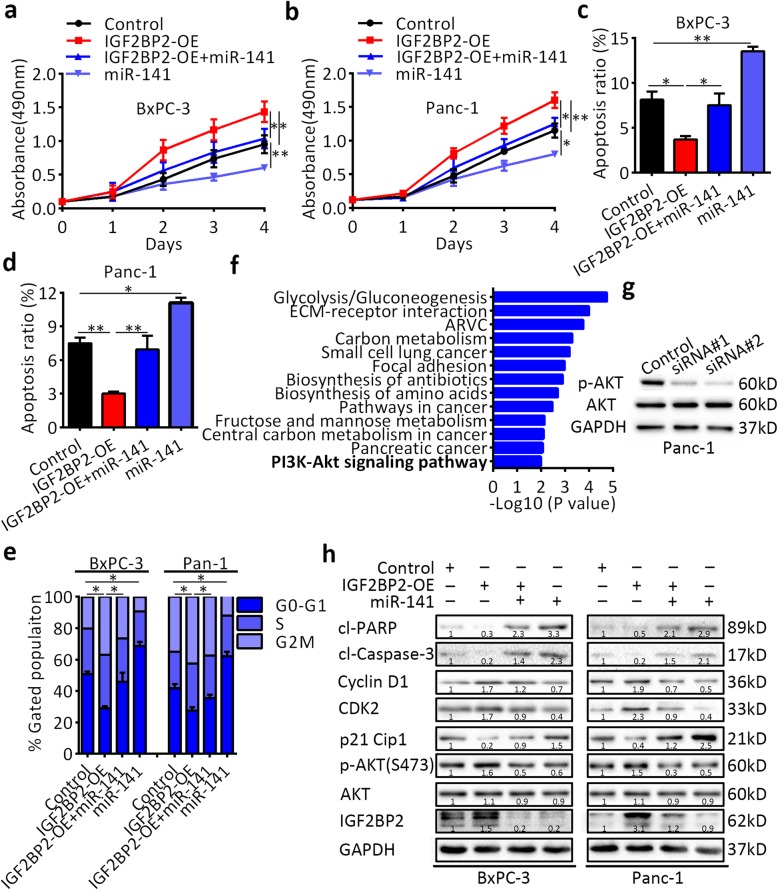
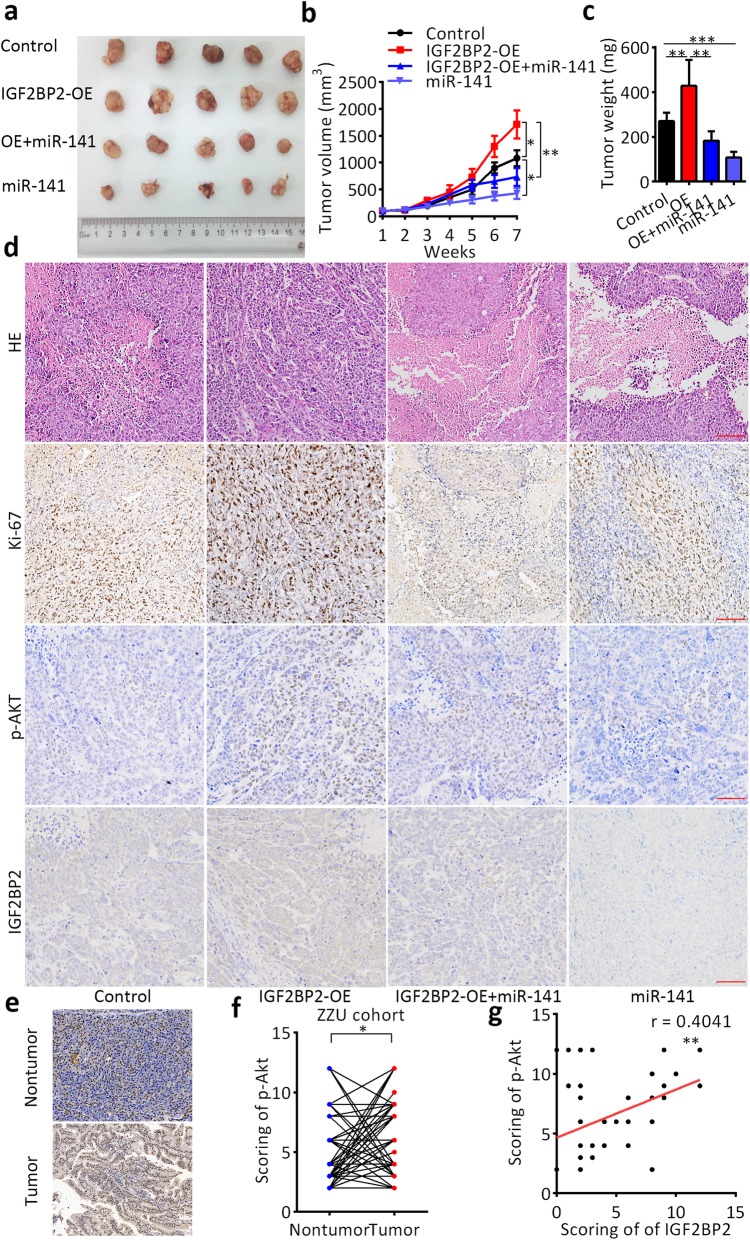
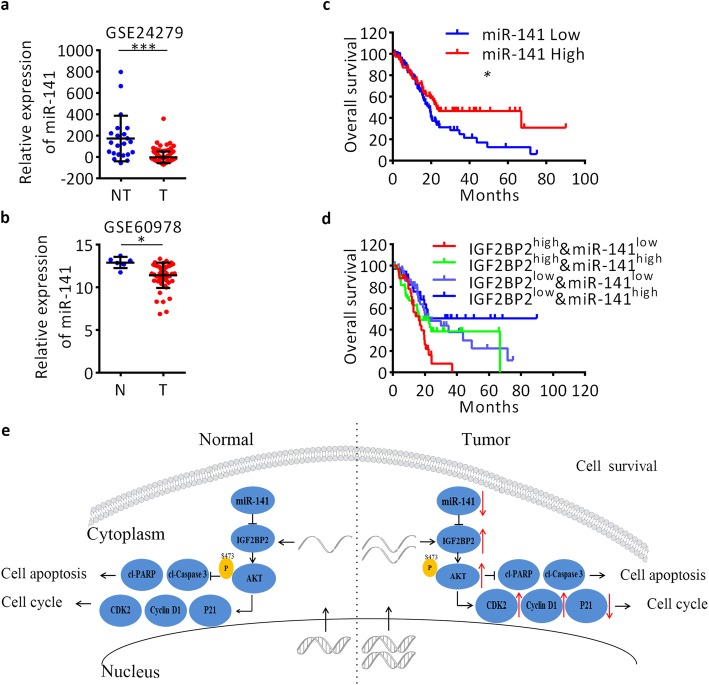
Background: The survival of pancreatic cancer patients remains poor. However, the underlying molecular mechanism and new therapeutic target of pancreatic cancer are still needed to be found. Many studies have shown that the IGF2 mRNA-binding protein 2 (IGF2BP2) plays oncogenic roles in cancers. However, the clinical significance, role and molecular mechanisms of IGF2BP2 in pancreatic cancer remain unclear. Methods: The expression of IGF2BP2 and miR-141 was detected in pancreatic cancer, and clinical significances were analyzed by statistical analysis. The function of IGF2BP2 and miR-141 was determined in vitro and in vivo, and the underlying mechanism was investigated. The gene copy number variation (CNV) of IGF2BP2 was analyzed based on The Cancer Genome Atlas (TCGA) dataset. microRNAs (miRNAs) regulating IGF2BP2 were predicted by online tools and confirmed by experiments. Results: IGF2BP2 is overexpressed in pancreatic cancer tissues compared with control tissues. Upregulation of IGF2BP2 predicts shorter overall survival (OS) in pancreatic cancer patients by statistical analysis. IGF2BP2 overexpression is partially due to genomic amplification. Bioinformatics analyses and validation experiments showed that IGF2BP2 is a direct target of miR-141. A negative correlation between IGF2BP2 mRNA expression and the expression of miR-141 was observed in pancreatic cancer tissues and more importantly, reexpression of miR-141 rescued the oncogenic role of IGF2BP2. Moreover, upregulating IGF2BP2 expression promotes pancreatic cancer cell growth by activating the PI3K/Akt signaling pathway in vitro and in vivo. Conclusions: We comprehensively reveal the oncogenic role of IGF2BP2 in pancreatic cancer carcinogenesis and confirm that genomic amplification and the silencing of miR-141 contribute to its activation. Our findings highlight that IGF2BP2 may be a promising molecular target for the treatment of pancreatic cancer.
Overview
The claims and statistics of this paper haven’t been checked yet.
Free: it reads the open-access text and checks the first 5 claims that cite a source we can check. Create a free account to check every claim.
Integrity signals
Registry
Cites
Statistics
Figures
Verification
Claims the paper makes
The claims and statistics of this paper haven’t been checked yet.
Free: it reads the open-access text and checks the first 5 claims that cite a source we can check. Create a free account to check every claim.
Claims other papers make about this one
Each is checked against this paper’s own text: does it say what the citing paper says it does?
The source backs part of the claim, not all of it — or backs it for a different population, condition or comparison.
In the citing paper
“Multiple microRNAs act as negative regulators of IMP2 across a variety of biological processes and diseases, including breast, pancreatic, and hepatocellular carcinoma, as well as keratinocyte migration, demonstrating the extensive regulatory network controlling its activity [55,56,57,58,59,60,61].”
From IMPlications of IMP2 in RNA Biology and Disease (2025) · cites this paper as [57]
Experimental — accuracy not yet measured
Self-check
Percentages, sums and reported differences re-computed from the paper’s own numbers.
The self-check needs the paper’s full text.
Citations
Cites
1 retracted
miR-141-3p is a key negative regulator of the EGFR pathway in osteosarcoma
Wang, J., Wang, G., Li, B., Qiu, C., & He, M. (2018) · OncoTargets and Therapy · doi:10.2147/ott.s171304 · Cited by 28
RetractedSiegel, R. L., Miller, K. D., & Jemal, A. (2016) · CA: A Cancer Journal for Clinicians · doi:10.3322/caac.21332 · Cited by 16,003
Bell, J. L., Wächter, K., Mühleck, B., Pazaitis, N., Köhn, M., Lederer, M., & Hüttelmaier, S. (2013) · Cellular and Molecular Life Sciences · doi:10.1007/s00018-012-1186-z · Cited by 783
Ren, J., Ding, L., Zhang, D., Shi, G., Xu, Q., Shen, S., Wang, Y., Wang, T., & Hou, Y. (2018) · Theranostics · doi:10.7150/thno.25541 · Cited by 698
IGF2 mRNA-binding protein 2: biological function and putative role in type 2 diabetes
Christiansen, J., Kolte, A. M., Hansen, T. V. O., & Nielsen, F. C. (2009) · Journal of Molecular Endocrinology · doi:10.1677/jme-09-0016 · Cited by 182
Huang, S., Wa, Q., Pan, J., Peng, X., Ren, D., Huang, Y., Chen, X., & Tang, Y. (2017) · Journal of Experimental & Clinical Cancer Research · doi:10.1186/s13046-017-0645-7 · Cited by 118
Gao, S., Sun, Y. K., Zhang, X., Hu, L., Liu, Y., Chua, C. Y. X., Phillips, L. M., Ren, H., Fleming, J. B., Wang, H., et al. (2016) · Cancer Research · doi:10.1158/0008-5472.can-16-0438 · Cited by 116 · cited 1×
“1 Jianshe east Road, Zhengzhou 450000, China Full list of author information is available at the end of the article are frequently found in pancreatic cancer and associated with the aberrant activation of tumor driver genes [6, 7].”
BackgroundRegulation of tumor angiogenesis by microRNAs: State of the art
Goradel, N. H., Mohammadi, N., Haghi‐Aminjan, H., Farhood, B., Negahdari, B., & Sahebkar, A. (2018) · Journal of Cellular Physiology · doi:10.1002/jcp.27051 · Cited by 113
Zheng, L., Xu, M., Xu, J., Wu, K., Fang, Q., Liang, Y., Zhou, S., Cen, D., Ji, L., Han, W., et al. (2018) · Cell Death & Disease · doi:10.1038/s41419-018-0399-y · Cited by 106
Dai, N., Ji, F., Wright, J., Minichiello, L., Sadreyev, R., & Avruch, J. (2017) · eLife · doi:10.7554/elife.27155 · Cited by 103
IMP2/p62 induces genomic instability and an aggressive hepatocellular carcinoma phenotype
Kessler, S. M., Laggai, S., Barghash, A., Schultheiss, C. S., Lederer, E., Artl, M., Helms, V, Haybaeck, J., & Kiemer, A. K. (2015) · Cell Death & Disease · doi:10.1038/cddis.2015.241 · Cited by 92
Imp2 regulates GBM progression by activating IGF2/PI3K/Akt pathway
Mu, Q., Wang, L., Yu, F., Gao, H., Lei, T., Li, P., Liu, P., Zheng, X., Hu, X., Chen, Y., et al. (2015) · Cancer Biology & Therapy · doi:10.1080/15384047.2015.1019185 · Cited by 89
Downregulated miR-98-5p promotes PDAC proliferation and metastasis by reversely regulating MAP4K4
Fu, Y., Liu, X., Chen, Q., Liu, T., Lu, C., Yu, J., Miao, Y., & Wei, J. (2018) · Journal of Experimental & Clinical Cancer Research · doi:10.1186/s13046-018-0807-2 · Cited by 87
Klompmaker, S., de Rooij, T., Korteweg, J. J., van Dieren, S., van Lienden, K. P., van Gulik, T. M., Busch, O. R., & Besselink, M. G. (2016) · British journal of surgery · doi:10.1002/bjs.10148 · Cited by 86
Tang, H., Zhu, J., Du, W., Liu, S., Zeng, Y., Ding, Z., Zhang, Y., Wang, X., Liu, Z., & Huang, J. (2018) · Journal of Experimental & Clinical Cancer Research · doi:10.1186/s13046-018-0811-6 · Cited by 86
SOX9 regulates ERBB signalling in pancreatic cancer development
Grimont, A., Pinho, A. V., Cowley, M. J., Augereau, C., Mawson, A., Giry-Laterrière, M., Van den Steen, G., Waddell, N., Pajic, M., Sempoux, C., et al. (2015) · Gut · doi:10.1136/gutjnl-2014-307075 · Cited by 84
Dahlem, C., Barghash, A., Puchas, P., Haybaeck, J., & Kessler, S. M. (2019) · International Journal of Molecular Sciences · doi:10.3390/ijms20133204 · Cited by 76
Inhibition of Autophagy by Deguelin Sensitizes Pancreatic Cancer Cells to Doxorubicin
Xu, X., Zhao, Y., Zhang, M., He, R., Shi, X., Guo, X., Shi, C.-J., Peng, F., Wang, M., Shen, M., et al. (2017) · International Journal of Molecular Sciences · doi:10.3390/ijms18020370 · Cited by 65
Self-citationRachagani, S., Macha, M. A., Menning, M., Dey, P., Pai, P., Smith, L. M., Mo, Y.-Y., & Batra, S. K. (2015) · Oncotarget · doi:10.18632/oncotarget.5641 · Cited by 60
Loveček, M., Skalický, P., Chudáček, J., Szkorupa, M., Švébišová, H., Lemstrová, R., Ehrmann, J., Melichar, B., Yogeswara, T., Klos, D., et al. (2017) · World Journal of Gastroenterology · doi:10.3748/wjg.v23.i35.6420 · Cited by 59
Pan, Y., Lu, F., Xiong, P., Pan, M., Zhang, Z., Lin, X., Pan, M., & Huang, H. (2018) · Journal of Experimental & Clinical Cancer Research · doi:10.1186/s13046-018-0848-6 · Cited by 40
Kessler, S. M., Lederer, E., Laggai, S., Golob-Schwarzl, N., Hosseini, K., Petzold, J., Schweiger, C., Reihs, R., Keil, M., Hoffmann, J., et al. (2017) · Oncotarget · doi:10.18632/oncotarget.21116 · Cited by 39
MicroRNA-141 inhibits proliferation of gastric cardia adenocarcinoma by targeting MACC1
Li, S., Zhu, J., Li, J., Li, S., & Li, B. (2017) · Archives of Medical Science · doi:10.5114/aoms.2017.68757 · Cited by 23
Kyriazanos, I. D., Tsoukalos, G., Papageorgiou, G., Verigos, K. E., Miliadis, L., & Stoidis, C. N. (2011) · Surgical Oncology · doi:10.1016/j.suronc.2011.04.004 · Cited by 21
VICKZ2 protein expression in ovarian serous carcinoma effusions is associated with poor survival
Davidson, B., Rosenfeld, Y. B.-Z., Holth, A., Hellesylt, E., Trope, C. G., Reich, R., & Yisraeli, J. K. (2014) · Human Pathology · doi:10.1016/j.humpath.2014.03.005 · Cited by 15
Cited by
Wang, S., Zheng, Y., Yang, F., Zhu, L., Zhu, X.-Q., Wang, Z.-F., Wu, X.-L., Zhou, C.-H., Yan, J.-Y., Hu, B.-Y., et al. (2021) · Signal Transduction and Targeted Therapy · doi:10.1038/s41392-021-00659-4 · Cited by 369
Novel insights into the interplay between m6A modification and noncoding RNAs in cancer
Yi, Y.-C., Chen, X.-Y., Zhang, J., & Zhu, J.-S. (2020) · Molecular Cancer · doi:10.1186/s12943-020-01233-2 · Cited by 252
The role of IGF2BP2, an m6A reader gene, in human metabolic diseases and cancers
Wang, J., Chen, L., & Qiang, P. (2021) · Cancer Cell International · doi:10.1186/s12935-021-01799-x · Cited by 221
“HNSCC ↑ Oncogene Scavenging and degradation, synthesis and metabolism, cell growth, death and motility / / [67] PDAC ↑ Oncogene Aerobic glycolysis, proliferation / GLUT1 [68] ↑ Oncogene Cell growth miR-141 PI3K/Akt [20] ↑ Oncogene Proliferation, stemness-like properties LncRNA DANCR [70] GBC ↑ Oncogene Tumor growth /…”
BackgroundInfluentialOverview of current targeted therapy in gallbladder cancer
Song, X., Hu, Y., Li, Y., Shao, R., Liu, F., & Liu, Y. (2020) · Signal Transduction and Targeted Therapy · doi:10.1038/s41392-020-00324-2 · Cited by 202
Liu, Y., Shi, M., He, X., Cao, Y., Liu, P., Li, F., Zou, S., Wen, C., Zhan, Q., Xu, Z., et al. (2022) · Journal of Hematology & Oncology · doi:10.1186/s13045-022-01272-w · Cited by 202
“It has been reported that IGF2BP2 could represent an independent predictor of pancreatic cancer [50].”
Background
Metadata
- Authors
- Xu, X., Yu, Y., Zong, K., Lv, P., & Gu, Y.
- Affiliations
- First Affiliated Hospital of Zhengzhou University (CN)
- Corresponding author
- Lv, Pengwei
- ORCID
- Venue
- Journal of Experimental & Clinical Cancer Research
- Published
- 2019-12
- Volume
- 38
- Issue
- 1
- Pages
- 497-497
- ISSN
- 0392-9078 (ISSN-L)
- 1756-9966
- PMC
- PMC6921559
- OpenAlex
- W2995202505
- Semantic Scholar
- 9dd058402ff10a8166b316f18d526a76c4a87743
- Cited by
- 203
- References
- 25
- Citations by year
- 2026: 9 · 2025: 17 · 2024: 27 · 2023: 28 · 2022: 68 · 2021: 42 · 2020: 12
- FWCI
- 13.27
- Type
- journal article
- Language
- en
- Open access
- gold
- doi.org
- Licence
- cc-by
- creativecommons.org/licenses/by/4.0/ (tdm)
- creativecommons.org/licenses/by/4.0/ (vor, 17 d)
- Locations
- Journal of Experimental & Clinical Cancer Research (publishedVersion, cc-by)
- PubMed Central (publishedVersion, cc-by)
- PubMed (publishedVersion)
- DOAJ (DOAJ: Directory of Open Access Journals) (submittedVersion)
- Topics
- Health Sciences › Medicine › Oncology › Pancreatic and Hepatic Oncology Research
- Life Sciences › Biochemistry, Genetics and Molecular Biology › Cancer Research › MicroRNA in disease regulation
- Life Sciences › Biochemistry, Genetics and Molecular Biology › Cancer Research › Cancer-related molecular mechanisms research
- Keywords
- IGF2BP2, pancreatic cancer, miR-141, PI3K/Akt signaling, gene amplification, oncogenes, tumor cell proliferation, overall survival, microRNA regulation, therapeutic target
- MeSH terms
- Aged, Aged, 80 and over, Animals, Cell Cycle, Cell Movement, Disease Models, Animal, Female, Gene Amplification, Humans, Middle Aged, Models, Biological, Pancreatic Neoplasms, Prognosis, Biomarkers, Tumor, Signal Transduction, Gene Expression Regulation, Neoplastic, RNA-Binding Proteins, Apoptosis, Phosphatidylinositol 3-Kinases, RNA Interference, MicroRNAs, Cell Line, Tumor, Cell Proliferation, Proto-Oncogene Proteins c-akt, Mice, Heterografts
About these checks
Registry, retraction, Cites and statistics results are computed, not judged, with one exception: a printed reference that no index lists is read once by a model before it counts as a citation error. Claims are extracted by a model and kept only when their quote appears verbatim in the text; each cited source is then checked, with a model’s help, for whether it says what the claim relies on. Those verdicts can be wrong — read the claim’s quote and the cited source before relying on one.
Statistics and arithmetic are recomputed, not judged.
Confidence bands are shown only for fields calibrated on our annotated test set. None is calibrated yet, so no band is shown.
What counts as a claim ›How we measure confidence ›How we check this ›
Are you an author, or do you see a problem with this page? Request a review
Data sources
Bibliographic data: Semantic Scholar, OpenAlex, Crossref.
Contains information from the Semantic Scholar Academic Graph Datasets, made available under the ODC Attribution License (ODC-BY 1.0).
Semantic Scholar’s data is described in: Kinney, R., et al. (2023). The Semantic Scholar Open Data Platform. arXiv:2301.10140.
