

Validation of a point-of-care capillary lactate measuring device (Lactate Pro 2)
Open accessPublished version of a preprint
The DOI matches its Crossref record; 24 of the 24 references it cites were found in a registry or an index.
Abstract
Background: The measurement of lactate in emergency medical services has the potential for earlier detection of shock and can be performed with a point-of-care handheld device. Validation of a point-of-care handheld device is required for prehospital implementation. Aim: The primary aim was to validate the accuracy of Lactate Pro 2 in healthy volunteers and in haemodynamically compromised intensive care patients. The secondary aim was to evaluate which sample site, fingertip or earlobe, is most accurate compared to arterial lactate. Methods: Arterial, venous and capillary blood samples from fingertips and earlobes were collected from intensive care patients and healthy volunteers. Arterial and venous blood lactate samples were analysed on a stationary hospital blood gas analyser (ABL800 Flex) as the reference device and compared to the Lactate Pro 2. We used the Bland-Altman method to calculate the limits of agreement and used mixed effect models to compare instruments and sample sites. A total of 49 intensive care patients with elevated lactate and 11 healthy volunteers with elevated lactate were included. Results: There was no significant difference in measured lactate between Lactate Pro 2 and the reference method using arterial blood in either the healthy volunteers or the intensive care patients. Capillary lactate measurement in the fingertip and earlobe of intensive care patients was 47% (95% CI (29 to 68%), p < 0.001) and 27% (95% CI (11 to 45%), p < 0.001) higher, respectively, than the corresponding arterial blood lactate. In the healthy volunteers, we found that capillary blood lactate in the fingertip was 14% higher than arterial blood lactate (95% CI (4 to 24%), p = 0.003) and no significant difference between capillary blood lactate in the earlobe and arterial blood lactate. Conclusion: Our results showed that the handheld Lactate Pro 2 had good agreement with the reference method using arterial blood in both intensive care patients and healthy volunteers. However, we found that the agreement was poorer using venous blood in both groups. Furthermore, the earlobe may be a better sample site than the fingertip in intensive care patients.
Overview
The claims and statistics of this paper haven’t been checked yet.
Free: it reads the open-access text and checks the first 5 claims that cite a source we can check. Create a free account to check every claim.
Integrity signals
Registry
Cites
Statistics
Figures
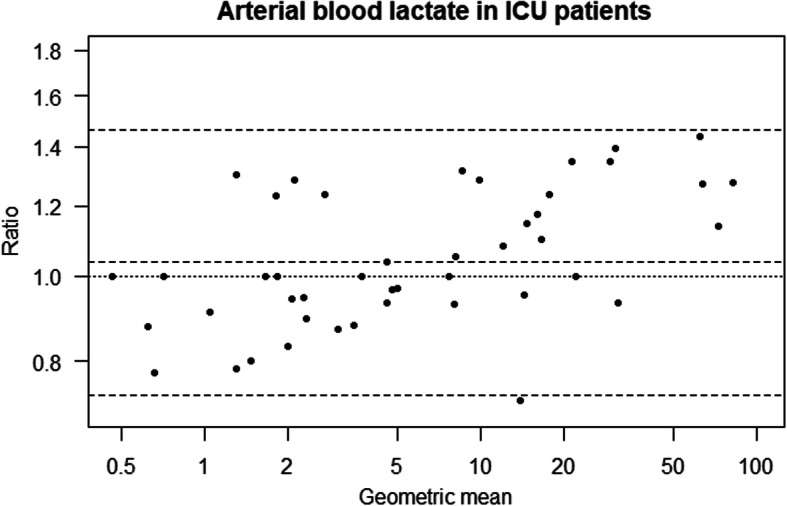
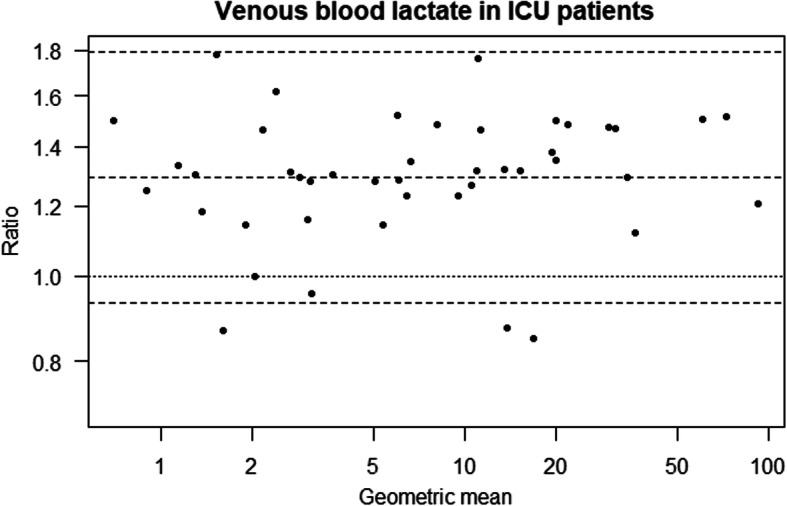
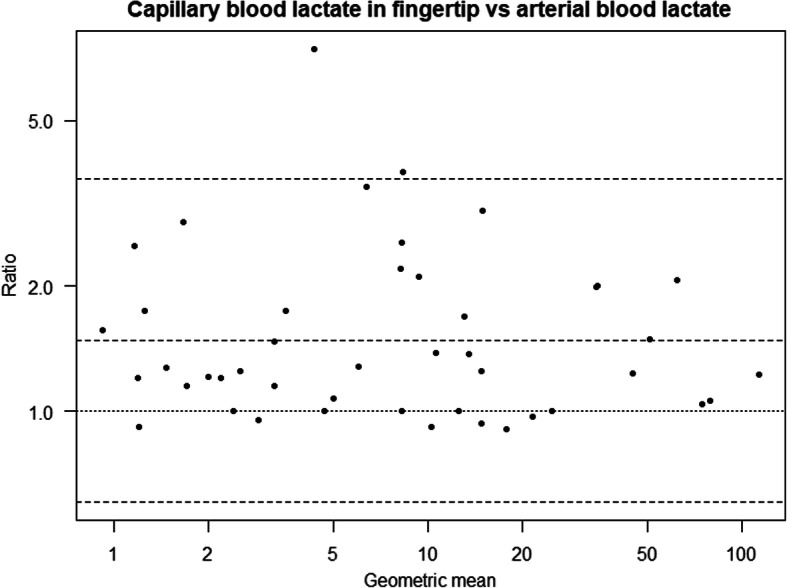
Verification
Claims the paper makes
The claims and statistics of this paper haven’t been checked yet.
Free: it reads the open-access text and checks the first 5 claims that cite a source we can check. Create a free account to check every claim.
Claims other papers make about this one
Each is checked against this paper’s own text: does it say what the citing paper says it does?
The source backs part of the claim, not all of it — or backs it for a different population, condition or comparison.
In the citing paper
“Previous studies showed that Lactate Pro 2 presented a good reliability compared with blood samples (Crotty et al., 2021; Raa et al., 2020), with higher agreement if the measurement is performed in the earlobe than in the fingertip (Raa et al., 2020), and with Bland Altman 95% limits of agreement varied from ± 0.3 mmol.L -1 to +1.4 mmol.L -1 for concentrations lower than 4.0 mmol.L -1 and higher”
From A comparative analysis of mathematical methods for detecting lactate thresholds using muscle oxygenation data during a graded cycling test (2023) · cites this paper as Raa et al., 2020
Experimental — accuracy not yet measured
Self-check
Percentages, sums and reported differences re-computed from the paper’s own numbers.
The self-check needs the paper’s full text.
Citations
Cites
R: A Language and Environment for Statistical Computing
R Core Team (2025) · doi:10.32614/r.manuals · Cited by 352,181
Measuring agreement in method comparison studies
Bland, J. M., & Altman, D. G. (1999) · Statistical Methods in Medical Research · doi:10.1177/096228029900800204 · Cited by 9,619
Etiology and Therapeutic Approach to Elevated Lactate Levels
Andersen, L. W., Mackenhauer, J., Roberts, J. C., Berg, K. M., Cocchi, M. N., & Donnino, M. W. (2013) · Mayo Clinic Proceedings · doi:10.1016/j.mayocp.2013.06.012 · Cited by 731
Casserly, B., Phillips, G. S., Schorr, C., Dellinger, R. P., Townsend, S. R., Osborn, T. M., Reinhart, K., Selvakumar, N., & Levy, M. M. (2015) · Critical Care Medicine · doi:10.1097/ccm.0000000000000742 · Cited by 465
Dunham, C. M., Siegel, J. H., Weireter, L. J., FABIAN, M., Goodarzi, S., Guadalupi, P., Gettings, L., Linberg, S. E., & Vary, T. C. (1991) · Critical Care Medicine · doi:10.1097/00003246-199102000-00020 · Cited by 326
Jansen, T. C., van Bommel, J., Mulder, P. G., Rommes, J. H., Schieveld, S. J., & Bakker, J. (2008) · Critical Care · doi:10.1186/cc7159 · Cited by 222
Reliability and accuracy of six hand-held blood lactate analysers.
Bonaventura, J. M., Sharpe, K., Knight, E., Fuller, K. L., Tanner, R. K., & Gore, C. J. (2015) · PubMed Central · Cited by 222
Rixen, D., & Siegel, J. H. (2005) · Critical Care · doi:10.1186/cc3526 · Cited by 207
ASSESSING SHOCK RESUSCITATION STRATEGIES BY OXYGEN DEBT REPAYMENT
Barbee, R. W., Reynolds, P. S., & Ward, K. R. (2010) · Shock · doi:10.1097/shk.0b013e3181b8569d · Cited by 188
Guyette, F., Suffoletto, B., Castillo, J.-L., Quintero, J., Callaway, C., & Puyana, J.-C. (2011) · Journal of Trauma: Injury, Infection & Critical Care · doi:10.1097/ta.0b013e318210f5c9 · Cited by 159 · cited 1×
“Recent prehospital studies on lactate measurement suggest that lactate may be more sensitive than SBP and HR in identifying haemorrhagic shock patients who may bene t from early blood transfusion, and suggest that lactate may be independent of conventional vital signs in identifying these patients (10-14).”
Background
Research works printed but not linked: 2
- Vincent JL De Backer D Circulatory shock N Engl J Med 2014 370 6 583 24499231
- Luong MWIM Taylor CM Stress testing: a contribution from Dr. Robert a. Bruce, father of exercise physiology B C Med J 2016 58 2 70 76
Cited by
Mentzoni, F., Skaugen, M., Eythorsdottir, I., Roterud, S., JOHANSEN, E. S., & Losnegard, T. (2024) · European Journal of Applied Physiology · doi:10.1007/s00421-024-05572-6 · Cited by 33
Determination of Second Lactate Threshold Using Near-infrared Spectroscopy in Elite Cyclists
Salas-Montoro, J.-A., Mateo-March, M., Sánchez-Muñoz, C., & Zabala, M. (2022) · International Journal of Sports Medicine · doi:10.1055/a-1738-0252 · Cited by 27
“A portable analyser was used (Lactate Pro 2, Arkray, Kyoto, Japan) to take La measurements from the right earlobe [29] at rest and at the end of each step.”
MethodEmerging trends in wearable glove-based sensors: A review
Tsong, J. L., Robert, R., & Khor, S. M. (2023) · Analytica Chimica Acta · doi:10.1016/j.aca.2023.341277 · Cited by 27
Crosby, S., Butcher, A. J., McDonald, K., BERGER, N. J. A., Bekker, P., & Best, R. (2022) · International Journal of Environmental Research and Public Health · doi:10.3390/ijerph19063527 · Cited by 22
Accuracy of a point-of-care blood lactate measurement device in a prehospital setting
Walther, L. H., Zegers, F. D., Nybo, M., Mogensen, C. B., Christensen, E. F., Lassen, A. T., & Mikkelsen, S. S. (2022) · Journal of Clinical Monitoring and Computing · doi:10.1007/s10877-022-00812-6 · Cited by 20
Metadata
- Authors
- Raa, A., Sunde, G. A., Bolann, B., Kvåle, R., Bjerkvig, C., Eliassen, H. S., Wentzel-Larsen, T., & Heltne, J.-K.
- Affiliations
- University of Bergen (NO)
- Haukeland University Hospital (NO)
- Norwegian Armed Forces (NO)
- Corresponding author
- Raa, Anette
- Venue
- Scandinavian Journal of Trauma, Resuscitation and Emergency Medicine
- Published
- 2020-08-18
- Volume
- 28
- Issue
- 1
- Pages
- 83-83
- ISSN
- 1757-7241 (ISSN-L)
- PMC
- PMC7437027
- OpenAlex
- W3079308900
- Cited by
- 36
- References
- 24
- Citations by year
- 2026: 6 · 2025: 6 · 2024: 8 · 2023: 6 · 2022: 7 · 2021: 3
- FWCI
- 2.41
- Type
- journal article
- Language
- en
- Open access
- gold
- doi.org
- Licence
- cc-by
- creativecommons.org/licenses/by/4.0 (tdm)
- creativecommons.org/licenses/by/4.0 (vor)
- Locations
- Scandinavian Journal of Trauma Resuscitation and Emergency Medicine (publishedVersion, cc-by)
- Research Square (acceptedVersion, cc-by)
- PubMed Central (publishedVersion, cc-by)
- PubMed (publishedVersion)
- NORA - Norwegian Open Research Archives (submittedVersion, cc-by)
- DOAJ (DOAJ: Directory of Open Access Journals) (submittedVersion, cc-by-sa)
- Figshare (cc-by)
- Funders
- Regionalt Akuttmedisinsk Kompetansesenter (ePhortenummer 2017/7788 /prosjektnummer 441021)
- Topics
- Health Sciences › Health Professions › Medical Laboratory Technology › Clinical Laboratory Practices and Quality Control
- Health Sciences › Medicine › Critical Care and Intensive Care Medicine › Sepsis Diagnosis and Treatment
- Health Sciences › Medicine › Endocrinology, Diabetes and Metabolism › Diabetes Management and Research
- Keywords
- point-of-care testing, device validation, arterial lactate, venous lactate, intensive care unit patients, shock detection, emergency medical services
- MeSH terms
- Aged, Arteries, Blood Gas Analysis, Capillaries, Critical Care, Emergency Medical Services, Female, Humans, Male, Middle Aged, Prospective Studies, Veins, Point-of-Care Systems, Lactic Acid
About these checks
Registry, retraction, Cites and statistics results are computed, not judged, with one exception: a printed reference that no index lists is read once by a model before it counts as a citation error. Claims are extracted by a model and kept only when their quote appears verbatim in the text; each cited source is then checked, with a model’s help, for whether it says what the claim relies on. Those verdicts can be wrong — read the claim’s quote and the cited source before relying on one.
Statistics and arithmetic are recomputed, not judged.
Confidence bands are shown only for fields calibrated on our annotated test set. None is calibrated yet, so no band is shown.
What counts as a claim ›How we measure confidence ›How we check this ›
Are you an author, or do you see a problem with this page? Request a review
Data sources
Bibliographic data: Semantic Scholar, OpenAlex, Crossref.
Contains information from the Semantic Scholar Academic Graph Datasets, made available under the ODC Attribution License (ODC-BY 1.0).
Semantic Scholar’s data is described in: Kinney, R., et al. (2023). The Semantic Scholar Open Data Platform. arXiv:2301.10140.
