

Effects of selective β1-adrenoceptor blockade on cardiovascular and renal function and circulating cytokines in ovine hyperdynamic sepsis
Open accessThe DOI matches its Crossref record; 32 of the 32 references it cites were found in a registry or an index.
Abstract
Introduction: Activation of the sympathetic nervous system has beneficial cardiovascular effects in sepsis, but there is also evidence that sympatholytics have beneficial actions in sepsis. We therefore determined the effect of selective β 1-adrenoceptor blockade on cardiac and renal function and cytokine release in ovine hyperdynamic sepsis. Methods: Hyperdynamic sepsis was induced by infusion of live E. coli for 24 hours in nine conscious sheep instrumented with flow probes on the pulmonary and left renal artery. Cardiovascular and renal function and levels of plasma cytokines were determined in a control group and during selective β1-adrenoceptor blockade with atenolol (10 mg intravenous bolus then 0.125 mg/kg/h) from 8 to 24 hours of sepsis. Results: Hyperdynamic sepsis was characterized by hypotension with increases in cardiac output (CO), heart rate (HR) and renal blood flow (RBF), and acute kidney injury. Atenolol caused sustained reductions in HR (P <0.001) and CO (P <0.001). Despite the lower CO the sepsis-induced fall in mean arterial pressure (MAP) was similar in both groups. The sepsis-induced increase in RBF, decrease in renal function and increase in arterial lactate were unaffected by atenolol. Sepsis increased plasma levels of tumour necrosis factor alpha (TNF-α), interleukin 6 (IL-6) and IL-10. Atenolol caused a further increase in IL-10, but did not affect levels of TNF-α or IL-6. Conclusions: In sepsis, selective β 1-adrenoceptor blockade reduced CO, but not MAP. During sepsis, atenolol did not alter the development of acute kidney injury or the levels of pro-inflammatory cytokines, but enhanced the release of IL-10. Atenolol appears safe in sepsis, has no deleterious cardiovascular or renal effects, and has an anti-inflammatory effect.
Overview
The claims and statistics of this paper haven’t been checked yet.
Free: it reads the open-access text and checks the first 5 claims that cite a source we can check. Create a free account to check every claim.
Integrity signals
Registry
Cites
Statistics
Figures
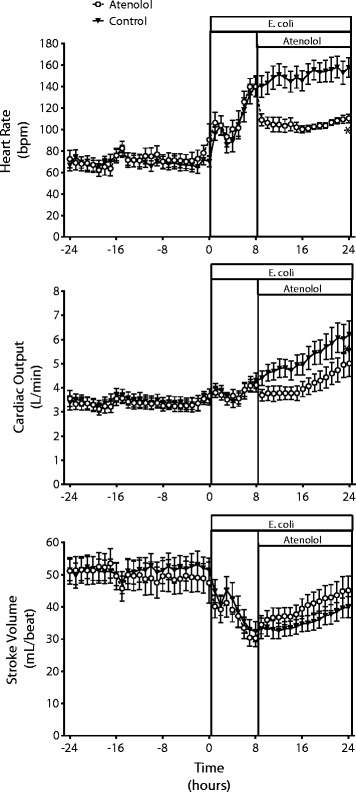
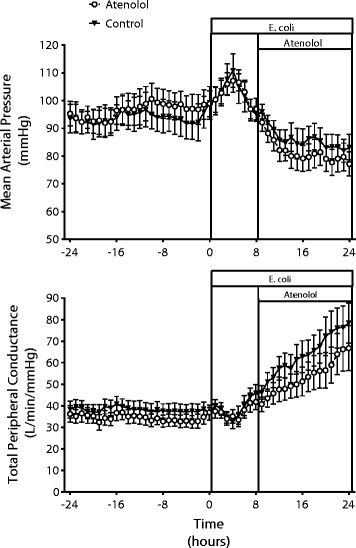
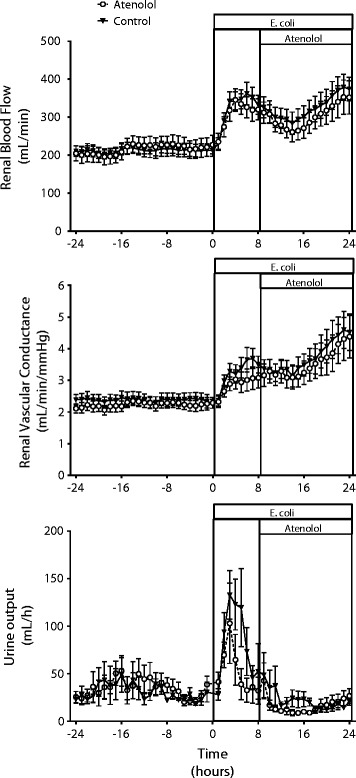
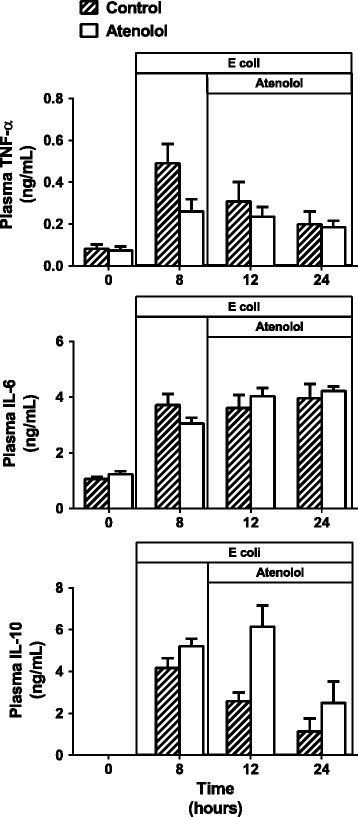
Verification
Claims the paper makes
The claims and statistics of this paper haven’t been checked yet.
Free: it reads the open-access text and checks the first 5 claims that cite a source we can check. Create a free account to check every claim.
Claims other papers make about this one
Each is checked against this paper’s own text: does it say what the citing paper says it does?
The source backs part of the claim, not all of it — or backs it for a different population, condition or comparison.
In the citing paper
“The potential clinical benefit of ARDN compared with TRDN is that intact efferent nerves may be able to maintain blood pressure and kidney function in response to hypotensive insults such as septic shock75.”
From Renal nerves in physiology, pathophysiology and interoception (2025) · cites this paper as [75]
Experimental — accuracy not yet measured
Self-check
Percentages, sums and reported differences re-computed from the paper’s own numbers.
The self-check needs the paper’s full text.
Citations
Cites
Surviving Sepsis Campaign: International Guidelines for Management of Severe Sepsis and Septic Shock
Dellinger, R. P., Levy, M. M., Rhodes, A., Annane, D., Gerlach, H., Opal, S. M., Sevransky, J. E., Sprung, C. L., Douglas, I. S., Jaeschke, R., et al. (2013) · Critical Care Medicine · doi:10.1097/ccm.0b013e31827e83af · Cited by 9,694
The Surviving Sepsis Campaign Guidelines Committee including The Pediatric Subgroup*, Dellinger, R. P., Levy, M. M., Rhodes, A., Annane, D., Gerlach, H., Opal, S. M., Sevransky, J. E., Sprung, C. L., Douglas, I. S., et al. (2013) · Intensive Care Medicine · doi:10.1007/s00134-012-2769-8 · Cited by 7,290
Genomic responses in mouse models poorly mimic human inflammatory diseases
Seok, J., Warren, H. S., Cuenca, A. G., Mindrinos, M. N., Baker, H. V., Xu, W., Richards, D. R., McDonald-Smith, G. P., Gao, H., Hennessy, L., et al. (2013) · Proceedings of the National Academy of Sciences · doi:10.1073/pnas.1222878110 · Cited by 3,005
Kellum, J. A. (2007) · Archives of Internal Medicine · doi:10.1001/archinte.167.15.1655 · Cited by 828
Morelli, A., Ertmer, C., Westphal, M., Rehberg, S., Kampmeier, T., Ligges, S., Orecchioni, A., D’Egidio, A., D’Ippoliti, F., Raffone, C., et al. (2013) · JAMA · doi:10.1001/jama.2013.278477 · Cited by 720
Mechanisms of sepsis-induced cardiac dysfunction
Rudiger, A., & Singer, M. (2007) · Critical Care Medicine · doi:10.1097/01.ccm.0000266683.64081.02 · Cited by 704
Anti-inflammatory cytokine profile and mortality in febrile patients
VANDISSEL, J., VANLANGEVELDE, P., WESTENDORP, R., KWAPPENBERG, K., & FROLICH, M. (1998) · The Lancet · doi:10.1016/s0140-6736(00)80013-6 · Cited by 482
Martin, C., Boisson, C., Haccoun, M., Thomachot, L., & Mege, J.-L. (1997) · Critical Care Medicine · doi:10.1097/00003246-199711000-00018 · Cited by 356
Inappropriate Sympathetic Activation at Onset of Septic Shock: A Spectral Analysis Approach
ANNANE, D., TRABOLD, F., SHARSHAR, T., JARRIN, I., BLANC, A. S., RAPHAEL, J. C., & GAJDOS, P. (1999) · American Journal of Respiratory and Critical Care Medicine · doi:10.1164/ajrccm.160.2.9810073 · Cited by 296
Resilience to Bacterial Infection: Difference between Species Could Be Due to Proteins in Serum
Warren, H. S., Fitting, C., Hoff, E., Adib‐Conquy, M., Beasley‐Topliffe, L., Tesini, B., Liang, X., Valentine, C., Hellman, J., Hayden, D., et al. (2010) · The Journal of Infectious Diseases · doi:10.1086/649557 · Cited by 269 · cited 1×
“These differences from the present study are probably in part species related considering the vastly different sensitivity to LPS across species, with humans and sheep having a 500 to 1,000 times greater sensitivity than rats and mice [30].”
Background
Cited by
Lankadeva, Y. R., Kosaka, J., Evans, R. G., Bailey, S. R., Bellomo, R., & May, C. N. (2016) · Kidney International · doi:10.1016/j.kint.2016.02.017 · Cited by 212
Self-citationCortical and Medullary Tissue Perfusion and Oxygenation in Experimental Septic Acute Kidney Injury
Calzavacca, P., Evans, R. G., Bailey, M., Bellomo, R., & May, C. N. (2015) · Critical Care Medicine · doi:10.1097/ccm.0000000000001198 · Cited by 143
Self-citationSepsis-induced cardiac dysfunction and β-adrenergic blockade therapy for sepsis
Suzuki, T., Suzuki, Y., Okuda, J., Kurazumi, T., Suhara, T., Ueda, T., Nagata, H., & Morisaki, H. (2017) · Journal of Intensive Care · doi:10.1186/s40560-017-0215-2 · Cited by 125
Beta-blocker use in severe sepsis and septic shock: a systematic review
Sanfilippo, F., Santonocito, C., Morelli, A., & Foëx, P. (2015) · Current Medical Research and Opinion · doi:10.1185/03007995.2015.1062357 · Cited by 94
Reversal of the Pathophysiological Responses to Gram-Negative Sepsis by Megadose Vitamin C
Lankadeva, Y. R., Peiris, R. M., Okazaki, N., Birchall, I. E., Trask-Marino, A. L., Dornom, A., Vale, T. A. M., Evans, R. G., Yanase, F., Bellomo, R., et al. (2020) · Critical Care Medicine · doi:10.1097/ccm.0000000000004770 · Cited by 73
Self-citation
Metadata
- Authors
- Calzavacca, P., Lankadeva, Y. R., Bailey, S. R., Bailey, M., Bellomo, R., & May, C. N.
- Affiliations
- The University of Melbourne (AU)
- Monash University (AU)
- Austin Hospital (AU)
- Corresponding author
- May, Clive N
- Venue
- Critical Care
- Published
- 2014-11-21
- Volume
- 18
- Issue
- 6
- Pages
- 610-610
- ISSN
- 1364-8535 (ISSN-L)
- PMC
- PMC4262191
- OpenAlex
- W2118399335
- Cited by
- 38
- References
- 32
- Citations by year
- 2026: 1 · 2025: 4 · 2024: 3 · 2023: 1 · 2022: 1 · 2021: 4 · 2020: 3 · 2019: 4 · 2018: 4 · 2017: 5 · 2016: 3 · 2015: 4 · 2014: 1
- FWCI
- 3.27
- Type
- journal article
- Language
- en
- Open access
- gold
- doi.org
- Licence
- cc-by
- creativecommons.org/licenses/by/4.0 (tdm)
- creativecommons.org/licenses/by/4.0 (vor)
- Locations
- Critical Care (publishedVersion, cc-by)
- PubMed Central (publishedVersion, cc-by)
- PubMed (publishedVersion)
- Minerva Access (University of Melbourne) (submittedVersion, cc-by)
- Funders
- University of Melbourne
- State Government of Victoria
- Medical Research Council
- National Health and Medical Research Council
- Topics
- Health Sciences › Medicine › Critical Care and Intensive Care Medicine › Sepsis Diagnosis and Treatment
- Health Sciences › Medicine › Surgery › Hemodynamic Monitoring and Therapy
- Health Sciences › Medicine › Nephrology › Acute Kidney Injury Research
- Keywords
- sepsis, beta1-adrenoceptor blockade, atenolol, sympatholytic agents, hyperdynamic sepsis, acute kidney injury, renal blood flow, cardiac output, cytokines, IL-10, TNF-α, interleukin-6, anti-inflammatory activity, sheep model, Escherichia coli sepsis
- MeSH terms
- Animals, Atenolol, Cardiac Output, Heart Rate, Kidney, Renal Circulation, Sheep, Cytokines, Treatment Outcome, Sepsis, Adrenergic beta-1 Receptor Antagonists
About these checks
Registry, retraction, Cites and statistics results are computed, not judged, with one exception: a printed reference that no index lists is read once by a model before it counts as a citation error. Claims are extracted by a model and kept only when their quote appears verbatim in the text; each cited source is then checked, with a model’s help, for whether it says what the claim relies on. Those verdicts can be wrong — read the claim’s quote and the cited source before relying on one.
Statistics and arithmetic are recomputed, not judged.
Confidence bands are shown only for fields calibrated on our annotated test set. None is calibrated yet, so no band is shown.
What counts as a claim ›How we measure confidence ›How we check this ›
Are you an author, or do you see a problem with this page? Request a review
How to cite
Cite CoChat for the checks on this page, and the paper for its own findings.
- This page
- CoChat. (2026). Citation check: Effects of selective β1-adrenoceptor blockade on cardiovascular and renal function and circulating cytokines in ovine hyperdynamic sepsis. https://app.cochat.ai/papers/10.1186/s13054-014-0610-1
- The paper
- Calzavacca, P., Lankadeva, Y. R., Bailey, S. R., Bailey, M., Bellomo, R., & May, C. N. (2014). Effects of selective β1-adrenoceptor blockade on cardiovascular and renal function and circulating cytokines in ovine hyperdynamic sepsis. Critical Care. https://doi.org/10.1186/s13054-014-0610-1
Data sources
Bibliographic data: Semantic Scholar, OpenAlex, Crossref.
Contains information from the Semantic Scholar Academic Graph Datasets, made available under the ODC Attribution License (ODC-BY 1.0).
Semantic Scholar’s data is described in: Kinney, R., et al. (2023). The Semantic Scholar Open Data Platform. arXiv:2301.10140.
