

Antipsychotic prescribing patterns during and after critical illness: A prospective cohort study.
Open accessThe DOI matches its Crossref record; 36 of the 38 references it cites were found in a registry or an index.
Abstract
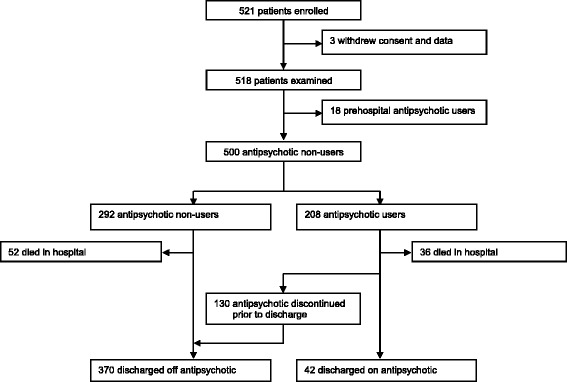
BACKGROUND: Antipsychotics are used to treat delirium in the intensive care unit (ICU) despite unproven efficacy. We hypothesized that atypical antipsychotic treatment in the ICU is a risk factor for antipsychotic prescription at discharge, a practice that might increase risk since long-term use is associated with increased mortality. METHODS: After excluding patients on antipsychotics prior to admission, we examined antipsychotic use in a prospective cohort of ICU patients with acute respiratory failure and/or shock. We collected data on medication use from medical records and assessed patients for delirium using the Confusion Assessment Method for the ICU. Using multivariable logistic regression, we analyzed whether age, delirium duration, atypical antipsychotic use, and discharge disposition (each selected a priori) were independent risk factors for discharge on an antipsychotic. We also examined admission Acute Physiology and Chronic Health Evaluation (APACHE) II score, haloperidol use, and days of benzodiazepine use in post hoc analyses. RESULTS: After excluding 18 patients due to prior antipsychotic use and three who withdrew, we included 500 patients. Among 208 (42%) treated with an antipsychotic, median (interquartile range) age was 59 (49-69) years and APACHE II score was 26 (22-32), characteristics that were similar among antipsychotic nonusers. Antipsychotic users were more likely than nonusers to have had delirium (93% vs. 61%, p < 0.001). Of the 208 antipsychotic users, 172 survived to hospital discharge, and 42 (24%) of these were prescribed an antipsychotic at discharge. Treatment with an atypical antipsychotic was the only independent risk factor for antipsychotic prescription at discharge (odds ratio 17.6, 95% confidence interval 4.9 to 63.3; p < 0.001). Neither age, delirium duration, nor discharge disposition were risk factors (p = 0.11, 0.38, and 0.12, respectively) in the primary regression model, and post hoc analyses found APACHE II (p = 0.07), haloperidol use (p = 0.16), and days of benzodiazepine use (p = 0.31) were also not risk factors for discharge on an antipsychotic. CONCLUSIONS: In this study, antipsychotics were used to treat nearly half of all antipsychotic-naïve ICU patients and were prescribed at discharge to 24% of antipsychotic-treated patients. Treatment with an atypical antipsychotic greatly increased the odds of discharge with an antipsychotic prescription, a practice that should be examined carefully during medication reconciliation since these drugs carry "black box warnings" regarding long-term use.
Overview
The claims and statistics of this paper haven’t been checked yet.
Free: it reads the open-access text and checks the first 5 claims that cite a source we can check. Create a free account to check every claim.
Integrity signals
Registry
Cites
Statistics
Figures
Verification
Claims the paper makes
The claims and statistics of this paper haven’t been checked yet.
Free: it reads the open-access text and checks the first 5 claims that cite a source we can check. Create a free account to check every claim.
Claims other papers make about this one
Each is checked against this paper’s own text: does it say what the citing paper says it does?
The source backs part of the claim, not all of it — or backs it for a different population, condition or comparison.
In the citing paper
“Hospitalization and ICU admission are high-risk periods for unintentional medication error-both continuations of medications for temporary indications and unintentional discontinuations of chronic medications (596, 599, 600, 602).”
From Surviving Sepsis Campaign: International Guidelines for Management of Sepsis and Septic Shock 2021. (2021) · cites this paper as [599]
Experimental — accuracy not yet measuredThe source backs part of the claim, not all of it — or backs it for a different population, condition or comparison.
In the citing paper
“Transfer from ICU to general floor and discharge from the hospital are both vulnerable periods for patients, with high frequency of medication errors and information loss (596-602).”
From Surviving Sepsis Campaign: International Guidelines for Management of Sepsis and Septic Shock 2021. (2021) · cites this paper as [599]
Experimental — accuracy not yet measuredThe source backs part of the claim, not all of it — or backs it for a different population, condition or comparison.
In the citing paper
“Transfer from ICU to general floor and discharge from the hospital are both vulnerable periods for patients, with high frequency of medication errors and information loss [596–602].”
From Surviving sepsis campaign: international guidelines for management of sepsis and septic shock 2021 (2021) · cites this paper as [602]
Experimental — accuracy not yet measuredThe source backs part of the claim, not all of it — or backs it for a different population, condition or comparison.
In the citing paper
“Hospitalisation and ICU admission are high-risk periods for unintentional medication error—both continuations of medications for temporary indications and unintentional discontinuations of chronic medications [596, 599, 600, 602].”
From Surviving sepsis campaign: international guidelines for management of sepsis and septic shock 2021 (2021) · cites this paper as [602]
Experimental — accuracy not yet measured
Self-check
Percentages, sums and reported differences re-computed from the paper’s own numbers.
The self-check needs the paper’s full text.
Citations
Cites
Charlson, M. E., Pompei, P., Ales, K. L., & MacKenzie, C. R. (1987) · Journal of Chronic Diseases · doi:10.1016/0021-9681(87)90171-8 · Cited by 49,742 · cited 1×
“These included patient age, gender, ethnicity, chronic disease burden as per the Charlson Comorbidity Index [14], severity of illness as per the Acute Physiology and Chronic Health Evaluation (APACHE) II score [15] and Sequential Organ Failure Assessment (SOFA) [16] score, ICU type, admission diagnosis, duration of me…”
MethodAPACHE II: A severity of disease classification system
KNAUS, W. A., DRAPER, E. A., WAGNER, D. P., & ZIMMERMAN, J. E. (1985) · Critical Care Medicine · doi:10.1097/00003246-198510000-00009 · Cited by 13,664
APACHE II-A Severity of Disease Classification System: Reply
Knaus, W. A., Draper, E. A., Wagner, D. P., & Zimmerman, J. E. (1986) · Critical Care Medicine · doi:10.1097/00003246-198608000-00028 · Cited by 13,376 · cited 1×
“These included patient age, gender, ethnicity, chronic disease burden as per the Charlson Comorbidity Index [14], severity of illness as per the Acute Physiology and Chronic Health Evaluation (APACHE) II score [15] and Sequential Organ Failure Assessment (SOFA) [16] score, ICU type, admission diagnosis, duration of me…”
MethodVincent, J. L., Moreno, R., Takala, J., Willatts, S., De Mendonça, A., Bruining, H., Reinhart, C. K., Suter, P. M., & Thijs, L. G. (1996) · Intensive Care Medicine · doi:10.1007/bf01709751 · Cited by 11,674
APACHE II: a severity of disease classification system.
Knaus, W. A., Draper, E. S., Wagner, D. P., & Zimmerman, J. E. (1985) · PubMed · Cited by 6,034
Barr, J., Fraser, G. L., Puntillo, K., Ely, E. W., Gélinas, C., Dasta, J. F., Davidson, J. E., Devlin, J. W., Kress, J. P., Joffe, A. M., et al. (2013) · Critical Care Medicine · doi:10.1097/ccm.0b013e3182783b72 · Cited by 3,765 · cited 1×
“Yet, in the updated SCCM guidelines on the management of pain, agitation, and delirium published in 2013 [5], the authors concluded that there was no evidence supporting the use of haloperidol to treat delirium in the ICU, and the use of atypical antipsychotics was supported only by low-quality evidence.”
BackgroundSelf-citationEly, E. W., Inouye, S. K., Bernard, G. R., Gordon, S., Francis, J., May, L., Truman, B., Speroff, T., Gautam, S., Margolin, R., et al. (2001) · JAMA · doi:10.1001/jama.286.21.2703 · Cited by 3,210 · cited 5×
“Ely EW, Margolin R, Francis J, May L, Truman B, Dittus R, et al. Evaluation of delirium in critically ill patients: validation of the Confusion Assessment Method for the Intensive Care Unit (CAM-ICU).”
MethodSelf-citationDelirium as a Predictor of Mortality in Mechanically Ventilated Patients in the Intensive Care Unit
Ely, E. W. (2004) · JAMA · doi:10.1001/jama.291.14.1753 · Cited by 3,073 · cited 1×
“Given that patients with delirium are at increased risk for agitationrelated adverse outcomes as well as mortality [21–23], longer hospital stays [24], and long-term cognitive impairment [13, 25], clinicians frequently treat delirium with Table 2 Characteristics according to discharge on antipsychotic”
BackgroundSelf-citationLong-term cognitive impairment after critical illness
Pandharipande, P. P., Girard, T. D., Jackson, J. C., Morandi, A., Thompson, J. L., Pun, B. T., Brummel, N. E., Hughes, C. G., Vasilevskis, E. E., Shintani, A. K., et al. (2013) · New England Journal of Medicine · doi:10.1056/nejmoa1301372 · Cited by 2,842
Self-citationEly, E. W., Margolin, R., Francis, J., May, L., Truman, B., Dittus, R., Speroff, T., Gautam, S., Bernard, G. R., & Inouye, S. K. (2001) · Critical Care Medicine · doi:10.1097/00003246-200107000-00012 · Cited by 2,422 · cited 5×
“Ely EW, Margolin R, Francis J, May L, Truman B, Dittus R, et al. Evaluation of delirium in critically ill patients: validation of the Confusion Assessment Method for the Intensive Care Unit (CAM-ICU).”
MethodSelf-citation
Cited by
Surviving sepsis campaign: international guidelines for management of sepsis and septic shock 2021
Evans, L., Rhodes, A., Alhazzani, W., Antonelli, M., Coopersmith, C. M., French, C., Machado, F. R., Mcintyre, L., Ostermann, M., Prescott, H. C., et al. (2021) · Intensive Care Medicine · doi:10.1007/s00134-021-06506-y · Cited by 5,082
Devlin, J. W., Skrobik, Y., Gélinas, C., Needham, D. M., Slooter, A. J. C., Pandharipande, P. P., Watson, P. L., Weinhouse, G. L., Nunnally, M. E., Rochwerg, B., et al. (2018) · Critical Care Medicine · doi:10.1097/ccm.0000000000003299 · Cited by 3,956
Self-citationSurviving Sepsis Campaign: International Guidelines for Management of Sepsis and Septic Shock 2021.
Evans, L., Rhodes, A., Alhazzani, W., Antonelli, M., Coopersmith, C. M., French, C., Machado, F. R., Mcintyre, L., Ostermann, M., Prescott, H. C., et al. (2021) · Critical Care Medicine · doi:10.1097/ccm.0000000000005337 · Cited by 2,935
Devlin, J. W., Skrobik, Y., Gélinas, C., Needham, D. M., Slooter, A. J. C., Pandharipande, P. P., Watson, P. L., Weinhouse, G. L., Nunnally, M. E., Rochwerg, B., et al. (2018) · Critical Care Medicine · doi:10.1097/ccm.0000000000003259 · Cited by 372
Self-citationCaring for the critically ill patients over 80: a narrative review
Guidet, B., Vallet, H., Boddaert, J., de Lange, D. W., Morandi, A., Leblanc, G., Artigas, A., & Flaatten, H. K. (2018) · Annals of Intensive Care · doi:10.1186/s13613-018-0458-7 · Cited by 181
Elderly Patients and Management in Intensive Care Units (ICU): Clinical Challenges
Brunker, L. B., Boncyk, C. S., Rengel, K. F., & Hughes, C. G. (2023) · Clinical Interventions in Aging · doi:10.2147/cia.s365968 · Cited by 170
Post-intensive care syndrome follow-up system after hospital discharge: a narrative review
Nakanishi, N., Liu, K., Hatakeyama, J., Kawauchi, A., Yoshida, M., Sumita, H., Miyamoto, K., & Nakamura, K. (2024) · Journal of Intensive Care · doi:10.1186/s40560-023-00716-w · Cited by 125
“Polypharmacy is common in critically ill patients due to the wide variety of symptoms [74].”
BackgroundImproving Long-Term Outcomes After Sepsis
Prescott, H. C., & Costa, D. K. (2017) · Critical Care Clinics · doi:10.1016/j.ccc.2017.08.013 · Cited by 93
Critical Care Pharmacists and Medication Management in an ICU Recovery Center
Stollings, J. L., Bloom, S. L., Wang, L., Ely, E. W., Jackson, J. C., & Sevin, C. M. (2018) · Annals of Pharmacotherapy · doi:10.1177/1060028018759343 · Cited by 88
“Unnecessary medications are often continued following hospital discharge.(25,35-45) Additionally, home maintenance medications are often not resumed on hospital admission and/or subsequent discharge, increasing the risk of death, emergency department visit, or hospitalization.”
BackgroundResultSelf-citationBosma, L. B. E., Hunfeld, N., Quax, R. A. M., Meuwese, E., Melief, P. H. G. J., van Bommel, J., Tan, S. S., van Kranenburg, M. J., & van den Bemt, P. M. L. A. (2018) · Annals of Intensive Care · doi:10.1186/s13613-018-0361-2 · Cited by 82
Balas, M. C., Weinhouse, G. L., Denehy, L., Chanques, G., Rochwerg, B., Misak, C. J., Skrobik, Y., Devlin, J. W., & Fraser, G. L. (2018) · Critical Care Medicine · doi:10.1097/ccm.0000000000003307 · Cited by 72
Debate article: Antipsychotic medications are clinically useful for the treatment of delirium
Meagher, D. J., Agar, M. R., & Teodorczuk, A. (2017) · International Journal of Geriatric Psychiatry · doi:10.1002/gps.4759 · Cited by 76
“In real world practice, antipsychotic treatment frequently continues for extended periods including beyond hospital discharge (Tomichek et al., 2016) emphasising the need to clarify treatment duration, including the merits of ongoing use.”
BackgroundICU Survivorship—The Relationship of Delirium, Sedation, Dementia, and Acquired Weakness
Mart, M. F., Pun, B. T., Pandharipande, P., Jackson, J. C., & Ely, E. W. (2021) · Critical Care Medicine · doi:10.1097/ccm.0000000000005125 · Cited by 67
Self-citationStollings, J. L., Devlin, J. W., Pun, B. T., Puntillo, K., Kelly, T., Hargett, K. D., Morse, A., Esbrook, C. L., Engel, H. J., Perme, C., et al. (2019) · Critical Care Nurse · doi:10.4037/ccn2019981 · Cited by 51
Self-citationDelirium Monitoring: Yes or No? That Is The Question
Marra, A., Kotfis, K., Hosie, A., MacLullich, A. M. J., Pandharipande, P. P., Ely, E. W., & Pun, B. T. (2019) · American Journal of Critical Care · doi:10.4037/ajcc2019874 · Cited by 50
Self-citationBoncyk, C. S., Farrin, E., Stollings, J. L., Rumbaugh, K. A., Wilson, J. E., Marshall, M., Feng, X., Shotwell, M. S., Pandharipande, P. P., & Hughes, C. G. (2021) · Anesthesia & Analgesia · doi:10.1213/ane.0000000000005365 · Cited by 48
Self-citationRizvi, M. S., Nei, A. M., Gajic, O., Mara, K. C., & Barreto, E. F. (2019) · Critical Care Medicine · doi:10.1097/ccm.0000000000003814 · Cited by 38
Optimizing care for critically ill older adults
Geen, O. D., Rochwerg, B. N., & Wang, X. M. (2021) · Canadian Medical Association Journal · doi:10.1503/cmaj.210652 · Cited by 37
Antipsychotics for the Prevention and Treatment of Delirium
Neufeld, K. J., Needham, D. M., Oh, E. S., Wilson, L. M., Nikooie, R., Zhang, A., Koneru, M., Balagani, A., Singu, S., Aldabain, L., et al. (2019) · doi:10.23970/ahrqepccer219 · Cited by 27
Intensive Care Society State of the Art 2018 Abstracts
Cronin, J., Chen, R., Crockett, D., Farmery, A., Hedenstierna, G., Larsson, A., Camporota, L., & Formenti, F. (2019) · Journal of the Intensive Care Society · doi:10.1177/1751143719835452 · Cited by 28
Olafson, K., Marrie, R. A., Bolton, J. M., Bernstein, C. N., Bienvenu, O. J., Kredentser, M. S., Logsetty, S., Chateau, D. G., Nie, Y., Blouw, M., et al. (2021) · Intensive Care Medicine · doi:10.1007/s00134-021-06513-z · Cited by 27
New and Persistent Sedative Prescriptions Among Older Adults Following a Critical Illness
Burry, L. D., Bell, C. M., Hill, A. D., Pinto, R. L., Scales, D. C., Bronskill, S. E., Williamson, D. R., Rose, L., Fu, L., Fowler, R., et al. (2023) · CHEST Journal · doi:10.1016/j.chest.2022.12.033 · Cited by 27
Impact of a pharmacist intervention at an intensive care rehabilitation clinic
MacTavish, P., Quasim, T., Shaw, M., Devine, H., Daniel, M., Kinsella, J., Fenelon, C., Kishore, R., Iwashyna, T. J., & McPeake, J. M. (2019) · BMJ Open Quality · doi:10.1136/bmjoq-2018-000580 · Cited by 27
Stollings, J. L., Poyant, J., Groth, C. M., Rappaport, S. H., Kruer, R. M., Miller, E., Whitten, J. A., McIntire, A. M., McDaniel, C. M., Betthauser, K. D., et al. (2023) · Journal of Intensive Care Medicine · doi:10.1177/08850666231176194 · Cited by 26
Self-citationKram, B., Schultheis, J. M., Kram, S. J., & Cox, C. E. (2018) · Journal of Pharmacy Practice · doi:10.1177/0897190018761412 · Cited by 25
A retrospective analysis of the effectiveness of antipsychotics in the treatment of ICU delirium
Weaver, C., Kane‐Gill, S. L., Gunn, S. R., Kirisci, L., & Smithburger, P. L. (2017) · Journal of Critical Care · doi:10.1016/j.jcrc.2017.05.034 · Cited by 22
“Additionally, research shows that roughly one fourth of delirious patients treatedwith antipsychotics inadvertently receive an antipsychotic prescription at discharge, placing these patients at risk of the long term adverse effects associated with this medication class [34].”
BackgroundMohammad, R. A., Betthauser, K. D., Bookstaver, R. E., Coe, A. B., Hatton, J., Fritschle, A. C., Jagow, B., Kenes, M. T., MacTavish, P., Slampak-Cindric, A. A., et al. (2020) · JACCP JOURNAL OF THE AMERICAN COLLEGE OF CLINICAL PHARMACY · doi:10.1002/jac5.1311 · Cited by 21
Self-citationLambert, J. L., Vermassen, J., Fierens, J., Peperstraete, H., Petrović, M., & Colpaert, K. E. (2020) · Journal of Critical Care · doi:10.1016/j.jcrc.2020.10.030 · Cited by 21
Melatonin and Ramelteon for the treatment of delirium: A systematic review and meta-analysis
Beaucage-Charron, J., Rinfret, J., Coveney, R., & Williamson, D. R. (2023) · Journal of Psychosomatic Research · doi:10.1016/j.jpsychores.2023.111345 · Cited by 21
Medication-related problems in critical care survivors: a systematic review
Short, A., McPeake, J. M., Andonovic, M., McFee, S., Quasim, T., Leyland, A. H., Shaw, M., Iwashyna, T. J., & MacTavish, P. (2023) · European Journal of Hospital Pharmacy · doi:10.1136/ejhpharm-2023-003715 · Cited by 19
Haloperidol and Ziprasidone for Treatment of Delirium in Critical Illness
Oldham, C. M., Neufeld, K. J., & Lee, H. B. (2019) · New England Journal of Medicine · doi:10.1056/nejmc1901272 · Cited by 18
Krotsetis, S., Nydahl, P., Dubb, R., Hermes, C., Kaltwasser, A., & von Haken, R. (2017) · Intensive Care Medicine · doi:10.1007/s00134-017-4945-3 · Cited by 16
Statin discontinuation and new antipsychotic use after an acute hospital stay vary by hospital
Coe, A. B., Vincent, B. M., & Iwashyna, T. J. (2020) · PLoS ONE · doi:10.1371/journal.pone.0232707 · Cited by 16
“[2, 3, 9, 11, 12, 33] The indications for use of both medications are unclear from the outpatient pharmacy medication fill records used in this study.”
BackgroundCoe, A. B., Bookstaver, R. E., Fritschle, A. C., Kenes, M. T., MacTavish, P., Mohammad, R. A., Simonelli, R. J., Whitten, J. A., & Stollings, J. L. (2019) · Hospital Pharmacy · doi:10.1177/0018578718823740 · Cited by 13
Self-citationAtypical Antipsychotic Safety in the CICU
Hanna, M. P., Adie, S. K., Ketcham, S. W., Deshmukh, A., Gondi, K. T., Abdul-Aziz, A. A., Prescott, H. C., Thomas, M. P., & Konerman, M. C. (2021) · The American Journal of Cardiology · doi:10.1016/j.amjcard.2021.09.052 · Cited by 13
Kovacic, N., Gagnon, D. J., Riker, R. R., Wen, S., & Fraser, G. L. (2019) · Journal of Pharmacy Practice · doi:10.1177/0897190019830518 · Cited by 13
“Multiple authors have documented high continuation rates of psychoactive agents at ICU and/or hospital discharge.(3,4,13-24) The literature is not uniform regarding risk factors for continuation of antipsychotics after hospital discharge, but most available data cite admission to a medical ICU service, longer hospital…”
BackgroundDeininger, M. M., Schnitzler, S., Benstoem, C., Simon, T.-P., Marx, G., Panagiotidis, D., Ziles, D., Schnoering, H., Karasimos, E., & Breuer, T. G. K. (2023) · Scientific Reports · doi:10.1038/s41598-023-30781-y · Cited by 11
Jaworska, N., Soo, A., Stelfox, H. T., Burry, L. D., & Fiest, K. M. (2023) · PLoS ONE · doi:10.1371/journal.pone.0287929 · Cited by 11
“Previous observational studies estimate 21 to 24% of antipsychotic naïve critically ill patients who receive an antipsychotic in the intensive care unit (ICU) are discharged from hospital with an ongoing antipsychotic prescription [7,8].”
BackgroundMethodResultInfluentialPharmacist‐driven discontinuation of antipsychotics for ICU delirium: A quasi‐experimental study
Stuart, M., Smith, Z., Payter, K., Martz, C. R., To, L., Swiderek, J. L., Coba, V. E., & Peters, M. A. (2020) · JACCP JOURNAL OF THE AMERICAN COLLEGE OF CLINICAL PHARMACY · doi:10.1002/jac5.1234 · Cited by 11
Trends in use of antipsychotics and psychoactive drugs in older patients after major surgery
Kim, D. H., Lee, H., Pawar, A. M., Lee, S. B., Park, C. M., Levin, R., Metzger, E. D., Bateman, B. T., Ely, E. W., Pandharipande, P. P., et al. (2023) · Journal of the American Geriatrics Society · doi:10.1111/jgs.18580 · Cited by 11
Self-citationBourne, R. S., Ioannides, C. P., Gillies, C., Bull, K. M., Turton, E. C. O., & Bryden, D. C. (2021) · European Journal of Hospital Pharmacy · doi:10.1136/ejhpharm-2020-002618 · Cited by 10
Levine, A. R., Lemieux, S. M., D’Aquino, D., Tenney, A., Pisani, M. A., & Ali, S. S. (2019) · Clinical Medicine Insights Psychiatry · doi:10.1177/1179557319863813 · Cited by 10
Barker, M., Dixon, A., Camporota, L., Barrett, N. A., & Wan, R. (2019) · Perfusion · doi:10.1177/0267659119858037 · Cited by 10
“BMI, kg/m2, median (interquartile range) 28 (26-33) 26 (23-31) 0.”
InfluentialChekani, F., Holmes, H. M., Johnson, M. L., Chen, H., Sherer, J. T., & Aparasu, R. R. (2020) · Drug Healthcare and Patient Safety · doi:10.2147/dhps.s226486 · Cited by 9
“1 Both motor and non-motor symptoms contribute to impaired quality of life of patients with PD. 4 Dopaminergic medications act as dopamine replacement (i.e. levodopa) or agonist for dopamine receptors.”
InfluentialMansi, E. T., Rentsch, C. T., Bourne, R. S., Guthrie, B., & Lone, N. (2024) · Journal of the Intensive Care Society · doi:10.1177/17511437231223470 · Cited by 8
“17 This is substantially higher than our finding of 1.1% of antipsychotic-naïve critical care survivors prescribed antipsychotics or mania medicines after hospital discharge and the recent published findings from Canada.”
ResultInfluentialApplying the geriatric 5Ms in critical care: the ICU-5Ms
Geen, O. D., Perrella, A., Rochwerg, B. N., & Wang, X. M. (2022) · Canadian Journal of Anesthesia/Journal canadien d anesthésie · doi:10.1007/s12630-022-02270-9 · Cited by 8
“20 Antipsychotics have not been shown to reduce the incidence or duration of delirium and should be otherwise avoided.”
Riester, M. R., Goyal, P., Jiang, L., Erqou, S. A., Rudolph, J. L., McGeary, J. E., Rogus‐Pulia, N. M., Madrigal, C. B., Quach, L., Wu, W., et al. (2022) · Journal of General Internal Medicine · doi:10.1007/s11606-021-07233-2 · Cited by 8
Jaworska, N., Moss, S. J., Krewulak, K. D., Stelfox, Z., Niven, D. J., Ismail, Z., Burry, L. D., & Fiest, K. M. (2022) · BMC Health Services Research · doi:10.1186/s12913-022-08650-7 · Cited by 8
Jaworska, N., Krewulak, K. D., Schalm, E., Niven, D. J., Ismail, Z., Burry, L. D., Leigh, J. P., & Fiest, K. M. (2023) · Journal of General Internal Medicine · doi:10.1007/s11606-023-08042-5 · Cited by 8
The Role of Quetiapine in Treating Delirium in Critical Care Settings: A Narrative Review
Menozzi, A., Gotti, M., Mantovani, E. A., Galimberti, A., Umbrello, M., Mistraletti, G., Sabbatini, G., Pezzi, A., & Formenti, P. (2025) · Journal of Clinical Medicine · doi:10.3390/jcm14082798 · Cited by 7
Characteristics, Complications, and Outcomes of Critical Illness in Patients with Parkinson Disease
Lieberman, O. J., Douglas, V. C., & LaHue, S. C. (2024) · Neurocritical Care · doi:10.1007/s12028-024-02062-7 · Cited by 7
“For example, patients with PD are at greater risk of adverse outcomes when administered antipsychotics [21, 22], which are used frequently to attain behavioral control in critically ill patients with agitation or delirium [23, 24].”
Burry, L. D., Bell, C. M., Hill, A. D., Pinto, R. L., Scales, D. C., Bronskill, S. E., Rose, L., Williamson, D. R., Fowler, R., & Wunsch, H. (2024) · American Journal of Respiratory and Critical Care Medicine · doi:10.1164/rccm.202403-0492rl · Cited by 6
Identifying and Resolving Drug-Related Problems in Geriatric Patients
Peterson, M. E., Stollings, J. L., & Ely, E. W. (2026) · Hospital Pharmacy · doi:10.1177/00185787251414339 · Cited by 7
Self-citationHershkovitz, A., & Nissan, R. (2020) · Journal of Applied Gerontology · doi:10.1177/0733464820904564 · Cited by 6
“It is also noteworthy that many hospitalized older adult patients are prescribed AP drugs long after their discharge (Tomichek et al., 2016).”
BackgroundEvaluation of medication changes following severe COVID-19 infection: a multicentre evaluation
MacTavish, P., McPeake, J. M., Breslin, A., Forrest, R., Kishore, R., MacGregor, F. B., Oprey, A., Quasim, T., & Shaw, M. (2021) · BMJ Open Respiratory Research · doi:10.1136/bmjresp-2021-001037 · Cited by 5
Moore, S. (2018) · American Journal of Therapeutics · doi:10.1097/mjt.0000000000000685 · Cited by 5
Phan, S. V., Lugin, Y., & Morgan, K. (2019) · Mental Health Clinician · doi:10.9740/mhc.2019.03.088 · Cited by 4
“In an institution that largely serves a rural population, antipsychotic prescribing at discontinuation was not worse than what has been previously reported in other regions of the United States.4,5,7,8”
BackgroundResultInfluentialJaworska, N., Makuk, K., Krewulak, K. D., Niven, D. J., Ismail, Z., Burry, L. D., Mehta, S., & Fiest, K. M. (2022) · Critical Care Explorations · doi:10.1097/cce.0000000000000806 · Cited by 4
“Approximately one in three patients newly prescribed an antipsychotic medication in the ICU will be discharged from hospital with an ongoing prescription where the clinical indication for ongoing use is not clear (1, 14, 15).”
BackgroundReply: Critical Care Pharmacists and Medication Management in an ICU Recovery Center
Stollings, J. L., Bloom, S. L., & Sevin, C. M. (2018) · Annals of Pharmacotherapy · doi:10.1177/1060028018799501 · Cited by 4
Self-citationCentral nervous system medication use around hospitalization
Pavon, J. M., Sloane, R. J., Colon-Emeric, C. S., Pieper, C. F., Schmader, K. E., Gallagher, D. M., & Hastings, S. N. (2024) · Journal of the American Geriatrics Society · doi:10.1111/jgs.18915 · Cited by 3
“21 As many as 24% of CNS medications initiated in the hospital continue post-discharge, 12,22 and one in five patients experience medication-related complications after leaving the hospital.”
BackgroundBeaudrie-Nunn, A. N., Poyant, J., Groth, C. M., Rappaport, S. H., Kruer, R. M., Miller, E., Whitten, J. A., McIntire, A. M., McDaniel, C. M., Betthauser, K. D., et al. (2024) · American Journal of Health-System Pharmacy · doi:10.1093/ajhp/zxae244 · Cited by 3
Self-citationWebb, A. J., Casal, G. L., Newman, K. A., Culshaw, J., Northam, K. A., Solomon, E. J., Beargie, S. M., Johnson, R., Lopez, N. D., Hayes, B. D., et al. (2024) · Journal of Intensive Care Medicine · doi:10.1177/08850666241270089 · Cited by 3
“24 Continuation of ICU-initiated therapies in the out-patient setting is common; this has also been described with antipsychotics 25 and acid-suppressive therapy.”
Mehl, S. C., Cunningham, M. E., Chance, M. D., Zhu, H., Fallon, S. C., Naik-Mathuria, B. J., Ettinger, N., & Vogel, A. M. (2021) · Pediatric Surgery International · doi:10.1007/s00383-021-05039-1 · Cited by 3
Intérêt de l’évaluation pré-opératoire et prise en charge post opératoire du patient âgé
Guidet, B., Bianco, C., & Vallet, H. (2022) · Bulletin de l Académie Nationale de Médecine · doi:10.1016/j.banm.2022.09.003 · Cited by 3
Personnes âgées et réanimation
Guidet, B. (2020) · Bulletin de l Académie Nationale de Médecine · doi:10.1016/j.banm.2019.11.016 · Cited by 3
Wingfield, S. A., & Flaherty, J. H. (2022) · Wiley eBooks · doi:10.1002/9781119484288.ch61 · Cited by 3
Medication-Related Problems in Surgical Patients
Jeffery, S. M., & Campbell, N. L. (2020) · Springer eBooks · doi:10.1007/978-3-319-47771-8_12 · Cited by 2
Opioid and Sedative Coprescription: Prescribing Patterns after an ICU Admission
Tozer, T., MacKenzie, M., Burgess, S. V., Loubani, O. M., & Neville, H. L. (2023) · The Canadian Journal of Hospital Pharmacy · doi:10.4212/cjhp.3245 · Cited by 2
Singer, S., Betthauser, K. D., Barber, A. E., Bookstaver, R. E., Dixit, D., Groth, C. M., Kenes, M. T., MacTavish, P., Kruer, R. M., McDaniel, C. M., et al. (2024) · Hospital Pharmacy · doi:10.1177/00185787241269113 · Cited by 2
Self-citationHalavonich, L., Robert, S., McGraw, D., Weeda, E. R., Mullinax, K., & Bass, B. (2020) · Mental Health Clinician · doi:10.9740/mhc.2020.01.025 · Cited by 2
“Days of inpatient antipsychotic therapy, median (IQR) 7 (2-13) 5 (1-12) .”
BackgroundMedication Changes and Diagnosis of New Chronic Illnesses in COVID-19 Intensive Care Unit Survivors
Mohammad, R. A., Nguyen, C. T., Costello, P. G., Poyant, J., Yeung, S. Y. A., Landolf, K. M., Kim, A. K., Artman, K. L., Taylor, D., Kenes, M. T., et al. (2022) · Annals of Pharmacotherapy · doi:10.1177/10600280211063319 · Cited by 2
Self-citationJaworska, N., Moss, S. J., Krewulak, K. D., Stelfox, Z., Niven, D. J., Ismail, Z., Burry, L. D., & Fiest, K. M. (2022) · BMJ Open · doi:10.1136/bmjopen-2021-057585 · Cited by 2
Haloperidol and delirium: what is next?
Andersen‐Ranberg, N. C., Girard, T. D., & Perner, A. (2023) · Intensive Care Medicine · doi:10.1007/s00134-023-07232-3 · Cited by 2
“For these reasons, if a clinician chooses to pharmacologically treat a delirious adult ICU patient, haloperidol is better supported by evidence than other antipsychotics, which have not been carefully studied and are frequently inappropriately continued after hospital discharge [12].”
BackgroundSelf-citationDelirium: From the Operating Room to the ICU
Tramarin, J., Accurso, G., Puglisi, M., & Gregoretti, C. (2020) · Springer eBooks · doi:10.1007/978-3-030-43873-9_11 · Cited by 2
Medication Management to Prevent and Mitigate Post-intensive Care Syndrome
Coe, A. B., MacTavish, P., & Stollings, J. L. (2021) · Springer eBooks · doi:10.1007/978-3-030-68680-2_14 · Cited by 2
Self-citationCrawford, J. D., Goldsmith, M., Wortzel, J. R., & Shaw, R. J. (2018) · Elsevier eBooks · doi:10.1016/b978-0-323-51147-6.00012-0 · Cited by 2
Republication de : Personnes âgées et réanimation
Guidet, B. (2020) · Journal Européen des Urgences et de Réanimation · doi:10.1016/j.jeurea.2020.08.006 · Cited by 1
Medication Transitions of Care in Trauma and Acute Care Surgery Patients
Shoulders, B. R., Maguigan, K. L., Strange, D. K., & Lemon, S. J. (2024) · Critical Care Nurse · doi:10.4037/ccn2024401 · Cited by 1
The Impact of Centrally Acting Drug Burden at Discharge on Long-Term Outcomes Among ICU Survivors
Boncyk, C. S., Connell, J., Stollings, J. L., Vasilevskis, E. E., Walsh, A., Rengel, K. F., Jackson, J., Orun, O. M., Raman, R., Pandharipande, P. P., et al. (2026) · Critical Care Medicine · doi:10.1097/ccm.0000000000007225 · Cited by 1
Self-citationPrevention, recognition and management of delirium in patients who are critically ill
Hyde‐Wyatt, J. (2017) · Nursing Standard · doi:10.7748/ns.2017.e10667 · Cited by 1
“Introduction of a care bundle that reduces sedation, promotes gradual reduction of ventilatory support and encourages mobility is one potential strategy to manage delirium (Trogrlíc et al 2015, Collinsworth et al 2016).”
BackgroundOptimisation des soins chez les personnes âgées gravement malades
Geen, O. D., Rochwerg, B. N., & Wang, X. M. (2021) · Canadian Medical Association Journal · doi:10.1503/cmaj.210652-f · Cited by 1
Bose, S., Groat, D., Stollings, J. L., Barney, P., Dinglas, V. D., Banner‐Goodspeed, V., Carmichael, H. L., Mir-Kasimov, M., Jackson, J. C., Needham, D. M., et al. (2024) · Australian Critical Care · doi:10.1016/j.aucc.2024.02.001 · Cited by 1
Self-citationCritical Care Canada Forum 2022 Abstracts
(2023) · Canadian Journal of Anesthesia/Journal canadien d anesthésie · doi:10.1007/s12630-023-02445-y · Cited by 1
Analgesia, Sedation, and Delirium in the ICU
Oyler, D. R., & Bernard, A. C. (2018) · Springer eBooks · doi:10.1007/978-3-319-71712-8_4
Stollings, J. L. (2018) · Springer eBooks · doi:10.1007/978-3-319-94337-4_22
Self-citationMedication-Related Problems in Surgical Patients
Jeffery, S. M., & Campbell, N. L. (2018) · Springer eBooks · doi:10.1007/978-3-319-20317-1_12-1
Preventive Strategies to Reduce Intensive Care Unit Delirium
Kalvas, L. B., Barnes‐Daly, M. A., Ely, E. W., & Balas, M. C. (2020) · Springer eBooks · doi:10.1007/978-3-030-25751-4_13
Self-citationTreatment Strategies for Delirium
Campbell, N. L., & Khan, B. A. (2020) · Springer eBooks · doi:10.1007/978-3-030-25751-4_14
Evaluating Antipsychotic Prescribing in the Intensive Care Unit and Across the Continuum of Care
Pasqualicchio, M., & Clarke, H. (2019) · Scholarly Commons - Baptist Health South Florida (Baptist Health South Florida)
Serin, E. K., & Bülbüloğlu, S. (2021) · International Journal of Health Services Research and Policy · doi:10.33457/ijhsrp.845184
DepRescribing psychoActive MedicATions in the ICu (DRAMATIC): A retrospective chart review
Eisa, M., Tabbara, N., Cheung, A., Persad, N., Williamson, D. R., Mailman, J. F., & Burry, L. D. (2019) · TSpace (University of Toronto)
Use of Opioid Analgesics in Postsurgical and Trauma Patients
Brown, D. R., & Pedersen, M. R. (2021) · Springer eBooks · doi:10.1007/978-3-030-77399-1_12
Yoshihiro, S., Tomita, T., Sakuraya, M., Onozuka, K., & Hashimoto, Y. (2021) · Journal of the Japanese Society of Intensive Care Medicine · doi:10.3918/jsicm.28_437
Taylor, A., Chen, A. Y., Reddy, A. J., Adriane, L., & Torbic, H. (2022) · American Journal of Health-System Pharmacy · doi:10.1093/ajhp/zxac042
Critical Care Canada Forum 2021 Abstracts
(2022) · Canadian Journal of Anesthesia/Journal canadien d anesthésie · doi:10.1007/s12630-022-02207-2
Prin, M., & Ginde, A. A. (2022) · Journal of the American Geriatrics Society · doi:10.1111/jgs.17922
Connell, J. M., McCann, B., Feng, X., Shotwell, M. S., Hughes, C. G., & Boncyk, C. S. (2023) · Journal of Intensive Care Medicine · doi:10.1177/08850666231198030
Patel, N., Dannemiller, R. E., Kovacevic, M. P., Dube, K. M., Lupi, K. E., Blum, R., & Crowley, K. E. (2024) · JACCP JOURNAL OF THE AMERICAN COLLEGE OF CLINICAL PHARMACY · doi:10.1002/jac5.1924
New initiation of opioids, benzodiazepines and antipsychotics following hospitalization for COVID‐19
Harrison, S., Capers, K., Chen, G., Liu, J. T., Pannu, A., Banner‐Goodspeed, V., Leibowitz, A., & Bose, S. (2024) · Journal of Hospital Medicine · doi:10.1002/jhm.13408
Menozzi, A., Gotti, M., Mantovani, E. A., Galimberti, A., Umbrello, M., Mistraletti, G., Sabbatini, G., Pezzi, A., & Formenti, P. (2024) · Preprints.org · doi:10.20944/preprints202409.2341.v1
Metadata
- Authors
- Tomichek, J. E., Stollings, J. L., Pandharipande, P. P., Chandrasekhar, R., Ely, E. W., & Girard, T. D.
- Affiliations
- Vanderbilt University Medical Center (US)
- Vanderbilt University (US)
- University of Pittsburgh (US)
- Corresponding author
- Girard, Timothy D.
- ORCID
- Venue
- Critical Care
- Published
- 2016-11-24
- Volume
- 20
- Issue
- 1
- Pages
- 378-378
- ISSN
- 1364-8535 (ISSN-L)
- PMC
- PMC5122157
- OpenAlex
- W2555449802
- Semantic Scholar
- 394794d5424e71bd3bc033030dab3e1c81c95e0b
- Cited by
- 100
- References
- 38
- Citations by year
- 2026: 6 · 2025: 3 · 2024: 12 · 2023: 13 · 2022: 11 · 2021: 15 · 2020: 13 · 2019: 11 · 2018: 11 · 2017: 5
- FWCI
- 8.17
- Type
- journal article
- Language
- en
- Open access
- gold
- doi.org
- Licence
- cc-by
- creativecommons.org/licenses/by/4.0/ (tdm)
- creativecommons.org/licenses/by/4.0/ (vor)
- Locations
- Critical Care (publishedVersion, cc-by)
- PubMed Central (publishedVersion, cc-by)
- PubMed (publishedVersion)
- Funders
- National Institute on Aging (AG027472, AG034257, AG035117)
- National Heart, Lung, and Blood Institute (HL111111)
- U.S. Department of Veterans Affairs
- Topics
- Health Sciences › Medicine › Critical Care and Intensive Care Medicine › Intensive Care Unit Cognitive Disorders
- Health Sciences › Medicine › Psychiatry and Mental health › Schizophrenia research and treatment
- Health Sciences › Medicine › Geriatrics and Gerontology › Pharmaceutical Practices and Patient Outcomes
- Keywords
- antipsychotic prescribing, atypical antipsychotics, delirium, intensive care unit, critical illness, post-discharge medication use, benzodiazepines, haloperidol, APACHE II score, acute respiratory failure, shock, Confusion Assessment Method for the ICU, hospital discharge disposition, mortality risk factors
- MeSH terms
- Aged, Critical Care, Female, Humans, Intensive Care Units, Male, Middle Aged, Patient Discharge, Drug Prescriptions, Prospective Studies, Antipsychotic Agents, Cohort Studies, Critical Illness, Medication Reconciliation
About these checks
Registry, retraction, Cites and statistics results are computed, not judged, with one exception: a printed reference that no index lists is read once by a model before it counts as a citation error. Claims are extracted by a model and kept only when their quote appears verbatim in the text; each cited source is then checked, with a model’s help, for whether it says what the claim relies on. Those verdicts can be wrong — read the claim’s quote and the cited source before relying on one.
Statistics and arithmetic are recomputed, not judged.
Confidence bands are shown only for fields calibrated on our annotated test set. None is calibrated yet, so no band is shown.
What counts as a claim ›How we measure confidence ›How we check this ›
Are you an author, or do you see a problem with this page? Request a review
Data sources
Bibliographic data: Semantic Scholar, OpenAlex, Crossref.
Contains information from the Semantic Scholar Academic Graph Datasets, made available under the ODC Attribution License (ODC-BY 1.0).
Semantic Scholar’s data is described in: Kinney, R., et al. (2023). The Semantic Scholar Open Data Platform. arXiv:2301.10140.
