

Antipsychotic prescribing patterns during and after critical illness: A prospective cohort study.
Open accessThe DOI matches its Crossref record; 36 of the 38 references it cites were found in a registry or an index.
Abstract
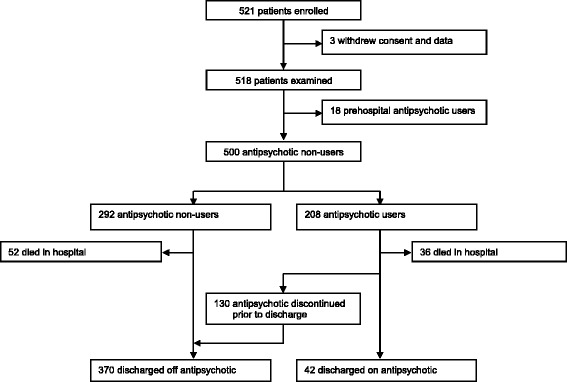
BACKGROUND: Antipsychotics are used to treat delirium in the intensive care unit (ICU) despite unproven efficacy. We hypothesized that atypical antipsychotic treatment in the ICU is a risk factor for antipsychotic prescription at discharge, a practice that might increase risk since long-term use is associated with increased mortality. METHODS: After excluding patients on antipsychotics prior to admission, we examined antipsychotic use in a prospective cohort of ICU patients with acute respiratory failure and/or shock. We collected data on medication use from medical records and assessed patients for delirium using the Confusion Assessment Method for the ICU. Using multivariable logistic regression, we analyzed whether age, delirium duration, atypical antipsychotic use, and discharge disposition (each selected a priori) were independent risk factors for discharge on an antipsychotic. We also examined admission Acute Physiology and Chronic Health Evaluation (APACHE) II score, haloperidol use, and days of benzodiazepine use in post hoc analyses. RESULTS: After excluding 18 patients due to prior antipsychotic use and three who withdrew, we included 500 patients. Among 208 (42%) treated with an antipsychotic, median (interquartile range) age was 59 (49-69) years and APACHE II score was 26 (22-32), characteristics that were similar among antipsychotic nonusers. Antipsychotic users were more likely than nonusers to have had delirium (93% vs. 61%, p < 0.001). Of the 208 antipsychotic users, 172 survived to hospital discharge, and 42 (24%) of these were prescribed an antipsychotic at discharge. Treatment with an atypical antipsychotic was the only independent risk factor for antipsychotic prescription at discharge (odds ratio 17.6, 95% confidence interval 4.9 to 63.3; p < 0.001). Neither age, delirium duration, nor discharge disposition were risk factors (p = 0.11, 0.38, and 0.12, respectively) in the primary regression model, and post hoc analyses found APACHE II (p = 0.07), haloperidol use (p = 0.16), and days of benzodiazepine use (p = 0.31) were also not risk factors for discharge on an antipsychotic. CONCLUSIONS: In this study, antipsychotics were used to treat nearly half of all antipsychotic-naïve ICU patients and were prescribed at discharge to 24% of antipsychotic-treated patients. Treatment with an atypical antipsychotic greatly increased the odds of discharge with an antipsychotic prescription, a practice that should be examined carefully during medication reconciliation since these drugs carry "black box warnings" regarding long-term use.
Overview
The claims and statistics of this paper haven’t been checked yet.
Free: it reads the open-access text and checks the first 5 claims that cite a source we can check. Create a free account to check every claim.
Integrity signals
Registry
Cites
Statistics
Figures
Verification
Claims the paper makes
The claims and statistics of this paper haven’t been checked yet.
Free: it reads the open-access text and checks the first 5 claims that cite a source we can check. Create a free account to check every claim.
Claims other papers make about this one
Each is checked against this paper’s own text: does it say what the citing paper says it does?
The source backs part of the claim, not all of it — or backs it for a different population, condition or comparison.
In the citing paper
“Hospitalization and ICU admission are high-risk periods for unintentional medication error-both continuations of medications for temporary indications and unintentional discontinuations of chronic medications (596, 599, 600, 602).”
From Surviving Sepsis Campaign: International Guidelines for Management of Sepsis and Septic Shock 2021. (2021) · cites this paper as [599]
Experimental — accuracy not yet measuredThe source backs part of the claim, not all of it — or backs it for a different population, condition or comparison.
In the citing paper
“Transfer from ICU to general floor and discharge from the hospital are both vulnerable periods for patients, with high frequency of medication errors and information loss (596-602).”
From Surviving Sepsis Campaign: International Guidelines for Management of Sepsis and Septic Shock 2021. (2021) · cites this paper as [599]
Experimental — accuracy not yet measuredThe source backs part of the claim, not all of it — or backs it for a different population, condition or comparison.
In the citing paper
“Transfer from ICU to general floor and discharge from the hospital are both vulnerable periods for patients, with high frequency of medication errors and information loss [596–602].”
From Surviving sepsis campaign: international guidelines for management of sepsis and septic shock 2021 (2021) · cites this paper as [602]
Experimental — accuracy not yet measuredThe source backs part of the claim, not all of it — or backs it for a different population, condition or comparison.
In the citing paper
“Hospitalisation and ICU admission are high-risk periods for unintentional medication error—both continuations of medications for temporary indications and unintentional discontinuations of chronic medications [596, 599, 600, 602].”
From Surviving sepsis campaign: international guidelines for management of sepsis and septic shock 2021 (2021) · cites this paper as [602]
Experimental — accuracy not yet measured
Self-check
Percentages, sums and reported differences re-computed from the paper’s own numbers.
The self-check needs the paper’s full text.
Citations
Cites
Charlson, M. E., Pompei, P., Ales, K. L., & MacKenzie, C. R. (1987) · Journal of Chronic Diseases · doi:10.1016/0021-9681(87)90171-8 · Cited by 49,742 · cited 1×
“These included patient age, gender, ethnicity, chronic disease burden as per the Charlson Comorbidity Index [14], severity of illness as per the Acute Physiology and Chronic Health Evaluation (APACHE) II score [15] and Sequential Organ Failure Assessment (SOFA) [16] score, ICU type, admission diagnosis, duration of me…”
MethodAPACHE II: A severity of disease classification system
KNAUS, W. A., DRAPER, E. A., WAGNER, D. P., & ZIMMERMAN, J. E. (1985) · Critical Care Medicine · doi:10.1097/00003246-198510000-00009 · Cited by 13,664
APACHE II-A Severity of Disease Classification System: Reply
Knaus, W. A., Draper, E. A., Wagner, D. P., & Zimmerman, J. E. (1986) · Critical Care Medicine · doi:10.1097/00003246-198608000-00028 · Cited by 13,376 · cited 1×
“These included patient age, gender, ethnicity, chronic disease burden as per the Charlson Comorbidity Index [14], severity of illness as per the Acute Physiology and Chronic Health Evaluation (APACHE) II score [15] and Sequential Organ Failure Assessment (SOFA) [16] score, ICU type, admission diagnosis, duration of me…”
MethodVincent, J. L., Moreno, R., Takala, J., Willatts, S., De Mendonça, A., Bruining, H., Reinhart, C. K., Suter, P. M., & Thijs, L. G. (1996) · Intensive Care Medicine · doi:10.1007/bf01709751 · Cited by 11,674
APACHE II: a severity of disease classification system.
Knaus, W. A., Draper, E. S., Wagner, D. P., & Zimmerman, J. E. (1985) · PubMed · Cited by 6,034
Barr, J., Fraser, G. L., Puntillo, K., Ely, E. W., Gélinas, C., Dasta, J. F., Davidson, J. E., Devlin, J. W., Kress, J. P., Joffe, A. M., et al. (2013) · Critical Care Medicine · doi:10.1097/ccm.0b013e3182783b72 · Cited by 3,765 · cited 1×
“Yet, in the updated SCCM guidelines on the management of pain, agitation, and delirium published in 2013 [5], the authors concluded that there was no evidence supporting the use of haloperidol to treat delirium in the ICU, and the use of atypical antipsychotics was supported only by low-quality evidence.”
BackgroundSelf-citationEly, E. W., Inouye, S. K., Bernard, G. R., Gordon, S., Francis, J., May, L., Truman, B., Speroff, T., Gautam, S., Margolin, R., et al. (2001) · JAMA · doi:10.1001/jama.286.21.2703 · Cited by 3,210 · cited 5×
“Ely EW, Margolin R, Francis J, May L, Truman B, Dittus R, et al. Evaluation of delirium in critically ill patients: validation of the Confusion Assessment Method for the Intensive Care Unit (CAM-ICU).”
MethodSelf-citationDelirium as a Predictor of Mortality in Mechanically Ventilated Patients in the Intensive Care Unit
Ely, E. W. (2004) · JAMA · doi:10.1001/jama.291.14.1753 · Cited by 3,073 · cited 1×
“Given that patients with delirium are at increased risk for agitationrelated adverse outcomes as well as mortality [21–23], longer hospital stays [24], and long-term cognitive impairment [13, 25], clinicians frequently treat delirium with Table 2 Characteristics according to discharge on antipsychotic”
BackgroundSelf-citationLong-term cognitive impairment after critical illness
Pandharipande, P. P., Girard, T. D., Jackson, J. C., Morandi, A., Thompson, J. L., Pun, B. T., Brummel, N. E., Hughes, C. G., Vasilevskis, E. E., Shintani, A. K., et al. (2013) · New England Journal of Medicine · doi:10.1056/nejmoa1301372 · Cited by 2,842
Self-citationEly, E. W., Margolin, R., Francis, J., May, L., Truman, B., Dittus, R., Speroff, T., Gautam, S., Bernard, G. R., & Inouye, S. K. (2001) · Critical Care Medicine · doi:10.1097/00003246-200107000-00012 · Cited by 2,422 · cited 5×
“Ely EW, Margolin R, Francis J, May L, Truman B, Dittus R, et al. Evaluation of delirium in critically ill patients: validation of the Confusion Assessment Method for the Intensive Care Unit (CAM-ICU).”
MethodSelf-citationJacobi, J., Fraser, G. L., Coursin, D. B., Riker, R. R., Fontaine, D., Wittbrodt, E. T., Chalfin, D. B., Masica, M. F., Bjerke, H. S., Coplin, W. M., et al. (2002) · Critical Care Medicine · doi:10.1097/00003246-200201000-00020 · Cited by 1,895 · cited 2×
“antipsychotics, a practice that was recommended in older clinical practice guidelines [1].”
BackgroundDelirium as a predictor of long-term cognitive impairment in survivors of critical illness
Girard, T. D., Jackson, J. C., Pandharipande, P. P., Pun, B. T., Thompson, J. L., Shintani, A. K., Gordon, S. M., Canonico, A. E., Dittus, R. S., Bernard, G. R., et al. (2010) · Critical Care Medicine · doi:10.1097/ccm.0b013e3181e47be1 · Cited by 1,213 · cited 1×
“Given that patients with delirium are at increased risk for agitationrelated adverse outcomes as well as mortality [21–23], longer hospital stays [24], and long-term cognitive impairment [13, 25], clinicians frequently treat delirium with Table 2 Characteristics according to discharge on antipsychotic”
BackgroundSelf-citationLong-Term Cognitive Impairment After Critical Illness
Pandharipande, P. P., Girard, T. D., Jackson, J. C., Morandi, A., Thompson, J. L., Pun, B. T., Brummel, N. E., Hughes, C. G., Vasilevskis, E. E., Shintani, A. K., et al. (2014) · Survey of Anesthesiology · doi:10.1097/sa.0000000000000071 · Cited by 1,114
Self-citationThe impact of delirium in the intensive care unit on hospital length of stay
Ely, E., Gautam, S., Margolin, R., Francis, J., May, L., Speroff, T., Truman, B., Dittus, R., Bernard, G., & Inouye, S. (2001) · Intensive Care Medicine · doi:10.1007/s00134-001-1132-2 · Cited by 1,038 · cited 1×
“Given that patients with delirium are at increased risk for agitationrelated adverse outcomes as well as mortality [21–23], longer hospital stays [24], and long-term cognitive impairment [13, 25], clinicians frequently treat delirium with Table 2 Characteristics according to discharge on antipsychotic”
BackgroundSelf-citationRisk of Death in Elderly Users of Conventional vs. Atypical Antipsychotic Medications
Wang, P. S., Schneeweiss, S., Avorn, J., Fischer, M. A., Mogun, H., Solomon, D. H., & Brookhart, M. A. (2005) · New England Journal of Medicine · doi:10.1056/nejmoa052827 · Cited by 959 · cited 1×
“Indeed, long-term use of antipsychotics among vulnerable populations may increase the risk of death [7, 8], and these drugs now carry “black box warnings” from the US Food and Drug Administration (FDA) regarding treatment of dementia-related psychosis in elderly patients.”
BackgroundAntipsychotic Drugs: Prolonged QTc Interval, Torsade de Pointes, and Sudden Death
Glassman, A. H., & Bigger, J. T. (2001) · American Journal of Psychiatry · doi:10.1176/appi.ajp.158.11.1774 · Cited by 822 · cited 1×
“Side effects include ventricular arrhythmias, excess sedation, akathisia, and hypotension, among others [6].”
BackgroundDays of Delirium Are Associated with 1-Year Mortality in an Older Intensive Care Unit Population
Pisani, M. A., Kong, S. Y. J., Kasl, S. V., Murphy, T. E., Araujo, K. L. B., & Van Ness, P. H. (2009) · American Journal of Respiratory and Critical Care Medicine · doi:10.1164/rccm.200904-0537oc · Cited by 798 · cited 1×
“Given that patients with delirium are at increased risk for agitationrelated adverse outcomes as well as mortality [21–23], longer hospital stays [24], and long-term cognitive impairment [13, 25], clinicians frequently treat delirium with Table 2 Characteristics according to discharge on antipsychotic”
BackgroundDelirium in the intensive care unit
Girard, T. D., Pandharipande, P. P., & Ely, E. W. (2008) · Critical Care · doi:10.1186/cc6149 · Cited by 622
Self-citationMaust, D. T., Kim, H. M., Seyfried, L. S., Chiang, C., Kavanagh, J., Schneider, L. S., & Kales, H. C. (2015) · JAMA Psychiatry · doi:10.1001/jamapsychiatry.2014.3018 · Cited by 617 · cited 1×
“Indeed, long-term use of antipsychotics among vulnerable populations may increase the risk of death [7, 8], and these drugs now carry “black box warnings” from the US Food and Drug Administration (FDA) regarding treatment of dementia-related psychosis in elderly patients.”
BackgroundDevlin, J. W., Roberts, R. J., Fong, J. J., Skrobik, Y., Riker, R. R., Hill, N. S., Robbins, T., & Garpestad, E. (2010) · Critical Care Medicine · doi:10.1097/ccm.0b013e3181b9e302 · Cited by 525 · cited 1×
“[28] compared quetiapine with placebo for the treatment of persistent delirium in 36 ICU patients who had not responded to haloperidol and found that quetiapine reduced the duration of delirium (p = 0.”
Delirium duration and mortality in lightly sedated, mechanically ventilated intensive care patients*
Shehabi, Y., Riker, R. R., Bokesch, P. M., Wisemandle, W., Shintani, A., & Ely, E. W. (2010) · Critical Care Medicine · doi:10.1097/ccm.0b013e3181f85759 · Cited by 470 · cited 1×
“Given that patients with delirium are at increased risk for agitationrelated adverse outcomes as well as mortality [21–23], longer hospital stays [24], and long-term cognitive impairment [13, 25], clinicians frequently treat delirium with Table 2 Characteristics according to discharge on antipsychotic”
BackgroundSelf-citationGirard, T. D., Pandharipande, P. P., Carson, S. S., Schmidt, G. A., Wright, P. E., Canonico, A. E., Pun, B. T., Thompson, J. L., Shintani, A. K., Meltzer, H. Y., et al. (2010) · Critical Care Medicine · doi:10.1097/ccm.0b013e3181c58715 · Cited by 451 · cited 1×
“In a trial of 101 mechanically ventilated ICU patients [27], we examined haloperidol vs.”
Self-citationIncreasing off‐label use of antipsychotic medications in the United States, 1995–2008
Alexander, G. C., Gallagher, S. A., Mascola, A., Moloney, R. M., & Stafford, R. S. (2011) · Pharmacoepidemiology and Drug Safety · doi:10.1002/pds.2082 · Cited by 423 · cited 1×
“From 1995 to 2008, the off-label use of antipsychotic medications nearly doubled despite warnings from the FDA and others regarding serious risk [32].”
BackgroundPage, V. J., Ely, E. W., Gates, S., Zhao, X. B., Alce, T., Shintani, A., Jackson, J., Perkins, G. D., & McAuley, D. F. (2013) · The Lancet Respiratory Medicine · doi:10.1016/s2213-2600(13)70166-8 · Cited by 410 · cited 2×
“Similarly, Page and colleagues [26] compared haloperidol with placebo in 142 mechanically ventilated ICU patients and found that haloperidol had no effect on days alive without delirium or coma (p = 0.”
BackgroundResultSelf-citationDorman, T. (2011) · Yearbook of Critical Care Medicine · doi:10.1016/s0734-3299(10)79437-5 · Cited by 385
Ely, E. W., Stephens, R. K., Jackson, J. C., Thomason, J. W. W., Truman, B., Gordon, S., Dittus, R. S., & Bernard, G. R. (2004) · Critical Care Medicine · doi:10.1097/01.ccm.0000098033.94737.84 · Cited by 359 · cited 1×
“Numerous surveys have documented ICU practitioners’ preference for haloperidol or atypical antipsychotics when treating delirium [2–4].”
BackgroundSelf-citationPatel, R. P., Gambrell, M., Speroff, T., Scott, T. A., Pun, B. T., Okahashi, J., Strength, C., Pandharipande, P., Girard, T. D., Burgess, H., et al. (2009) · Critical Care Medicine · doi:10.1097/ccm.0b013e31819b8608 · Cited by 319
Self-citationMedication Reconciliation at Hospital Discharge: Evaluating Discrepancies
Wong, J. D., Bajcar, J. M., Wong, G. G., Alibhai, S. M., Huh, J.-H., Cesta, A., Pond, G. R., & Fernandes, O. A. (2008) · Annals of Pharmacotherapy · doi:10.1345/aph.1l190 · Cited by 313 · cited 1×
“Indeed, both unintentional medication discrepancies—which affect up to 70% of patients at hospital discharge [29]—and the intentional prescription of potentially inappropriate medications [30] place recovering patients at risk for serious adverse drug events at a time when they are still highly vulnerable yet less clo…”
BackgroundMorandi, A., Vasilevskis, E., Pandharipande, P. P., Girard, T. D., Solberg, L. M., Neal, E. B., Koestner, T., Torres, R. E., Thompson, J. L., Shintani, A. K., et al. (2013) · Journal of the American Geriatrics Society · doi:10.1111/jgs.12329 · Cited by 126 · cited 2×
“Indeed, both unintentional medication discrepancies—which affect up to 70% of patients at hospital discharge [29]—and the intentional prescription of potentially inappropriate medications [30] place recovering patients at risk for serious adverse drug events at a time when they are still highly vulnerable yet less clo…”
BackgroundSelf-citationA national survey of the management of delirium in UK intensive care units
Mac Sweeney, R., Barber, V., Page, V., Ely, E. W., Perkins, G. D., Young, J. D., Mcauley, D. F., & on behalf of the Intensive Care Foundation (2010) · QJM · doi:10.1093/qjmed/hcp194 · Cited by 105
Self-citationAntipsychotic utilization in the intensive care unit and in transitions of care
Marshall, J., Herzig, S. J., Howell, M. D., Le, S. H., Mathew, C. P., Kats, J. S., & Stevens, J. P. (2015) · Journal of Critical Care · doi:10.1016/j.jcrc.2015.12.017 · Cited by 94 · cited 2×
“Given the observational study design and the modest sample size, which limited the number of covariates we could reliably fit in the regression model, we cannot rule out confounding by variables not included nor can we rule out type II error leading to a negative finding regarding discharge location, which was associa…”
BackgroundResultWong, C.-M., Ko, Y., & Chan, A. (2008) · Annals of Pharmacotherapy · doi:10.1345/aph.1l255 · Cited by 84
Antipsychotic use and diagnosis of delirium in the intensive care unit
Swan, J. T., Fitousis, K., Hall, J. B., Todd, S., & Turner, K. L. (2012) · Critical Care · doi:10.1186/cc11342 · Cited by 81 · cited 1×
“Taken together with results from a multicenter study of 164,996 hospitalizations across 71 academic medical centers in the US [33], which reported that 1 in 10 ICU patients received an antipsychotic during their hospital stay, these data suggest that approximately 2.”
ResultMonte Carlo Methods in Clinical Research: Applications in Multivariable Analysis
Concato, J., & Feinstein, A. R. (1997) · Journal of Investigative Medicine · doi:10.1177/108155899704500614 · Cited by 80 · cited 1×
“To avoid model overfitting, we limited the number of covariates examined in our primary regression model by adhering to the rule of thumb that a multivariable model must fit no more than m/10 parameters (where m is the effective sample size) for it to be reliable in similar cohorts [19].”
MethodScales, D. C., Fischer, H. D., Li, P., Bierman, A. S., Fernandes, O., Mamdani, M., Rochon, P., Urbach, D. R., & Bell, C. M. (2016) · Journal of General Internal Medicine · doi:10.1007/s11606-015-3501-5 · Cited by 70 · cited 1×
“Scales and colleagues [31] examined four medication classes, for example, and found that all four were prescribed at hospital discharge without a documented indication.”
BackgroundEvaluation of Discontinuation of Atypical Antipsychotics Prescribed for ICU Delirium
Jasiak, K. D., Middleton, E. A., Camamo, J. M., Erstad, B. L., Snyder, L. S., & Huckleberry, Y. (2012) · Journal of Pharmacy Practice · doi:10.1177/0897190012465987 · Cited by 63 · cited 1×
“[9] found that 20 (34%) of 59 patients treated for delirium with an antipsychotic in the ICU were discharged from the hospital on the medication, a practice they estimated would increase outpatient medication costs by more than $2225 per patient per year.”
BackgroundImplications of atypical antipsychotic prescribing in the intensive care unit
Kram, B., Kram, S. J., & Brooks, K. R. (2015) · Journal of Critical Care · doi:10.1016/j.jcrc.2015.03.030 · Cited by 58 · cited 2×
“The risk-to-benefit ratio for antipsychotics initiated in the ICU may therefore increase sharply if they are continued after hospital discharge, a practice noted in recent studies to affect up to one-third of treated patients [9–12].”
BackgroundRowe, A. S., Hamilton, L. A., Curtis, R., Davis, C. R., Smith, L. N., Peek, G. K., & Reynolds, V. W. (2015) · Journal of Critical Care · doi:10.1016/j.jcrc.2015.08.009 · Cited by 46 · cited 2×
“Additionally, in light of results of a recent study reporting that admission APACHE II score and duration of benzodiazepine treatment were independent risk factors for discharge on an antipsychotic [10], we also conducted a post hoc analysis by including these covariates (one at a time) in logistic regression models w…”
BackgroundResult
Cited by
Surviving sepsis campaign: international guidelines for management of sepsis and septic shock 2021
Evans, L., Rhodes, A., Alhazzani, W., Antonelli, M., Coopersmith, C. M., French, C., Machado, F. R., Mcintyre, L., Ostermann, M., Prescott, H. C., et al. (2021) · Intensive Care Medicine · doi:10.1007/s00134-021-06506-y · Cited by 5,082
Devlin, J. W., Skrobik, Y., Gélinas, C., Needham, D. M., Slooter, A. J. C., Pandharipande, P. P., Watson, P. L., Weinhouse, G. L., Nunnally, M. E., Rochwerg, B., et al. (2018) · Critical Care Medicine · doi:10.1097/ccm.0000000000003299 · Cited by 3,956
Self-citationSurviving Sepsis Campaign: International Guidelines for Management of Sepsis and Septic Shock 2021.
Evans, L., Rhodes, A., Alhazzani, W., Antonelli, M., Coopersmith, C. M., French, C., Machado, F. R., Mcintyre, L., Ostermann, M., Prescott, H. C., et al. (2021) · Critical Care Medicine · doi:10.1097/ccm.0000000000005337 · Cited by 2,935
Devlin, J. W., Skrobik, Y., Gélinas, C., Needham, D. M., Slooter, A. J. C., Pandharipande, P. P., Watson, P. L., Weinhouse, G. L., Nunnally, M. E., Rochwerg, B., et al. (2018) · Critical Care Medicine · doi:10.1097/ccm.0000000000003259 · Cited by 372
Self-citationCaring for the critically ill patients over 80: a narrative review
Guidet, B., Vallet, H., Boddaert, J., de Lange, D. W., Morandi, A., Leblanc, G., Artigas, A., & Flaatten, H. K. (2018) · Annals of Intensive Care · doi:10.1186/s13613-018-0458-7 · Cited by 181
Metadata
- Authors
- Tomichek, J. E., Stollings, J. L., Pandharipande, P. P., Chandrasekhar, R., Ely, E. W., & Girard, T. D.
- Affiliations
- Vanderbilt University Medical Center (US)
- Vanderbilt University (US)
- University of Pittsburgh (US)
- Corresponding author
- Girard, Timothy D.
- ORCID
- Venue
- Critical Care
- Published
- 2016-11-24
- Volume
- 20
- Issue
- 1
- Pages
- 378-378
- ISSN
- 1364-8535 (ISSN-L)
- PMC
- PMC5122157
- OpenAlex
- W2555449802
- Semantic Scholar
- 394794d5424e71bd3bc033030dab3e1c81c95e0b
- Cited by
- 100
- References
- 38
- Citations by year
- 2026: 6 · 2025: 3 · 2024: 12 · 2023: 13 · 2022: 11 · 2021: 15 · 2020: 13 · 2019: 11 · 2018: 11 · 2017: 5
- FWCI
- 8.17
- Type
- journal article
- Language
- en
- Open access
- gold
- doi.org
- Licence
- cc-by
- creativecommons.org/licenses/by/4.0/ (tdm)
- creativecommons.org/licenses/by/4.0/ (vor)
- Locations
- Critical Care (publishedVersion, cc-by)
- PubMed Central (publishedVersion, cc-by)
- PubMed (publishedVersion)
- Funders
- National Institute on Aging (AG027472, AG034257, AG035117)
- National Heart, Lung, and Blood Institute (HL111111)
- U.S. Department of Veterans Affairs
- Topics
- Health Sciences › Medicine › Critical Care and Intensive Care Medicine › Intensive Care Unit Cognitive Disorders
- Health Sciences › Medicine › Psychiatry and Mental health › Schizophrenia research and treatment
- Health Sciences › Medicine › Geriatrics and Gerontology › Pharmaceutical Practices and Patient Outcomes
- Keywords
- antipsychotic prescribing, atypical antipsychotics, delirium, intensive care unit, critical illness, post-discharge medication use, benzodiazepines, haloperidol, APACHE II score, acute respiratory failure, shock, Confusion Assessment Method for the ICU, hospital discharge disposition, mortality risk factors
- MeSH terms
- Aged, Critical Care, Female, Humans, Intensive Care Units, Male, Middle Aged, Patient Discharge, Drug Prescriptions, Prospective Studies, Antipsychotic Agents, Cohort Studies, Critical Illness, Medication Reconciliation
About these checks
Registry, retraction, Cites and statistics results are computed, not judged, with one exception: a printed reference that no index lists is read once by a model before it counts as a citation error. Claims are extracted by a model and kept only when their quote appears verbatim in the text; each cited source is then checked, with a model’s help, for whether it says what the claim relies on. Those verdicts can be wrong — read the claim’s quote and the cited source before relying on one.
Statistics and arithmetic are recomputed, not judged.
Confidence bands are shown only for fields calibrated on our annotated test set. None is calibrated yet, so no band is shown.
What counts as a claim ›How we measure confidence ›How we check this ›
Are you an author, or do you see a problem with this page? Request a review
Data sources
Bibliographic data: Semantic Scholar, OpenAlex, Crossref.
Contains information from the Semantic Scholar Academic Graph Datasets, made available under the ODC Attribution License (ODC-BY 1.0).
Semantic Scholar’s data is described in: Kinney, R., et al. (2023). The Semantic Scholar Open Data Platform. arXiv:2301.10140.
