

Critical illness among patients experiencing homelessness: a retrospective cohort study
Open accessThe DOI matches its Crossref record; 37 of the 38 references it cites were found in a registry or an index, and 1 are not checked yet; none of the 40 sources its claims cite is checked for support yet.
Abstract
Purpose: To understand the epidemiology and healthcare use of critically ill patients experiencing homelessness compared to critically ill patients with stable housing. Methods: This retrospective population-based cohort study included adults admitted to any ICU in Alberta, Canada, for a 3-year period. Administrative and clinical data from the hospital, ICU and emergency department were used to examine healthcare resource use (processes of care, ICU and hospital length of stay, hospital readmission and emergency room visits). Regression was used to quantify differences in healthcare use by housing status. Results: 2.3% (n = 1086) of patients admitted to the ICU were experiencing homelessness; these patients were younger, more commonly admitted for medical reasons and had fewer comorbidities compared to those with stable housing. Processes of care in the ICU were mostly similar, but healthcare use after ICU was different; patients experiencing homelessness who survived their index hospitalization were more than twice as likely to have a visit to the emergency department (OR = 2.3 times, 95% CI 2.0–2.6, < 0.001) or be readmitted to hospital (OR = 2.1, 95% CI 1.8–2.4, p < 0.001) within 30 days, and stayed 10.1 days longer in hospital (95% CI 8.6–11.6, p < 0.001), compared with those who have stable housing. Conclusions: Patients experiencing homelessness have different characteristics at ICU admission and have similar processes of care in ICU, but their subsequent use of healthcare resources was higher than patients with stable housing. These findings can inform strategies to prepare patients experiencing homelessness for discharge from the ICU to reduce healthcare resource use after critical illness.
Overview
CoChat Summary
TL;DR
In a retrospective population-based cohort of adults admitted to Alberta ICUs (2015–2018), 2.3% (n = 1086) were experiencing homelessness. They were younger with fewer comorbidities and broadly similar ICU processes of care, but after discharge they had longer hospital stays and higher 30-day ED visits/readmissions than patients with stable housing.
Key findings
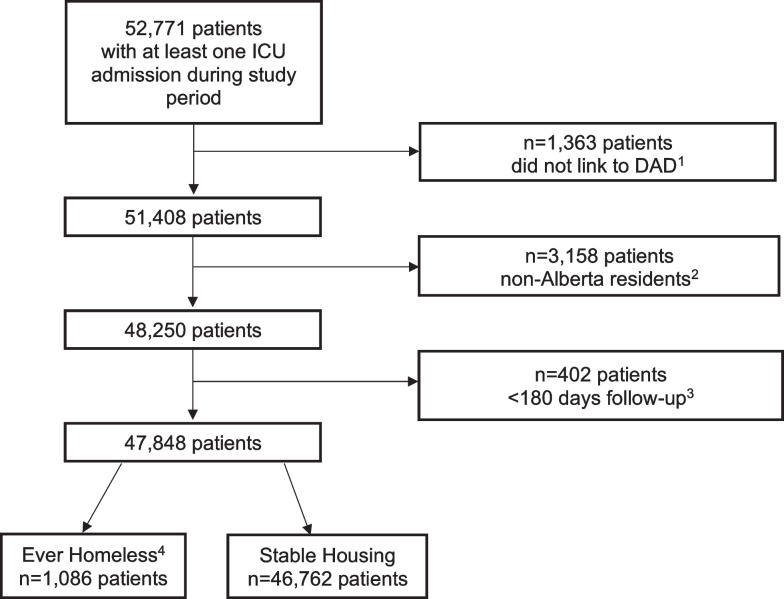
- Among 47,848 unique ICU patients, 2.3% (n = 1086) experienced homelessness; the proportion was consistent across the study period (range 2.2–3.2%, p = 0.156) but varied by hospital site (0.5–4.2%, p < 0.001).
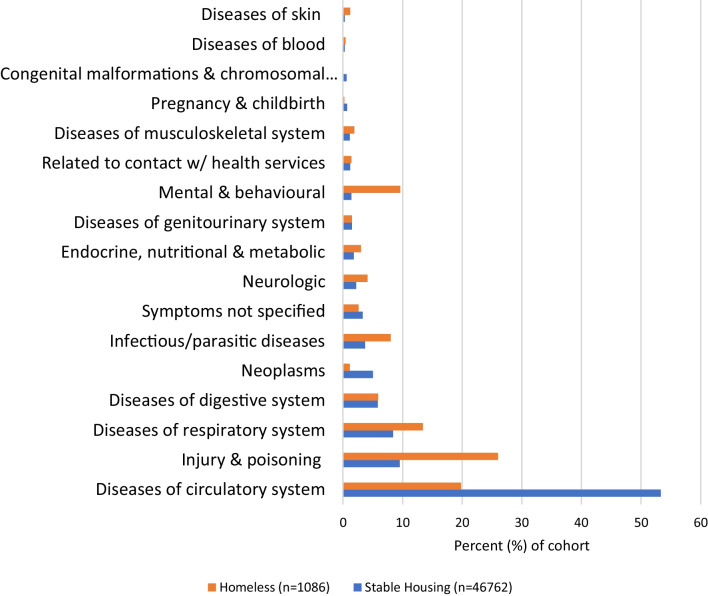
- Patients experiencing homelessness were younger (median 50 vs 63 years), more often admitted for medical reasons (59.5% vs 26.2%), had fewer comorbidities (Charlson 0: 43.9% vs 29.3%), and more often had mental health diagnoses, especially substance use disorder (44.6% vs 7.5%) and attempted suicide (21.5% vs 4.0%).
- After adjustment, ICU processes of care were mostly similar; patients experiencing homelessness were more likely to receive invasive mechanical ventilation (adjusted OR 1.5, 95% CI 1.3–1.8), with no differences in noninvasive ventilation, vasoactive medications, or CRRT.
- Among survivors, homelessness was associated with longer hospital stay (10.1 days longer, 95% CI 8.6–11.6, p < 0.001), higher 30-day ED visits (adjusted OR 2.3, 95% CI 2.0–2.6, p < 0.001), and higher 30-day readmission (adjusted OR 2.1, 95% CI 1.8–2.4, p < 0.001); they were less likely to die in ICU (adjusted OR 0.5, 95% CI 0.4–0.6) or hospital (adjusted OR 0.5, 95% CI 0.4–0.7).
Methods
- Retrospective population-based cohort of adults ≥18 years admitted to any of 31 ICUs in 14 Alberta hospitals between January 2015 and April 2018; excluded ICU stays <24 h, non-Alberta residents, and those without ≥180 days follow-up after index hospital discharge.
- Exposure was housing status; homelessness was defined by no fixed address/postal code T1T1T1, ICD-10-CA code Z59.0, or shelter postal code. Data came from eCritical Alberta linked deterministically to the Discharge Abstract Database and National Ambulatory Care Reporting System.
- Outcomes included ICU processes of care, ICU/hospital length of stay, 30-day hospital readmission and ED visits, hospital adverse events, and ICU/hospital mortality. Comparisons used chi-squared/Wilcoxon tests and multivariable linear/logistic regression adjusted for age, sex, Charlson comorbidity index, and ICU admission diagnosis (Stata v17, α = 0.05).
Limitations
- Paper-stated: homelessness is complex and fluid but was simplified to a binary variable; the validated case definition was specific but not sensitive, so some patients may have been misclassified as having stable housing.
- Paper-stated: retrospective population-based data precluded evaluating the complex relationship between mental health and outcomes; the cohort predates COVID-19, so it is unclear whether incidence and consequences of homelessness have changed.
- Evident from text: APACHE II had missing data, mostly for coronary care unit patients (cohort n = 27,789; homeless n = 922; stable housing n = 26,867), and the authors caution its interpretation because it excludes cardiac care units.
Model-written summary. Check it against the paper before relying on it.
Integrity signals
Registry
Cites
Statistics
Figures
Verification
Claims the paper makes
0 Valid · 0 Not valid · 17 Not checked · 66 Own results and interpretations
A result the paper reports from its own data — it cites no other source for it, so there is none to check. The quote shows it is in the paper.
In the paper
“our study found that patients experiencing homelessness did not differ from patients who had stable housing on the APACHE II score on admission to the ICU (should be interpreted with caution as this excludes patients admitted to cardiac care units)”
§ Critical illness among patients experiencing homelessness: a retrospective cohort study > Discussion
hedged- Asserted: passes — The authors put it forward as true.
- Checkable: passes — It can be checked against evidence.
- Load-bearing: passes — The paper’s conclusions depend on it.
- Based: passes — The paper gives a reason why it holds.
A result the paper reports from its own data — it cites no other source for it, so there is none to check. The quote shows it is in the paper.
In the paper
“or be readmitted to hospital (OR = 2.1, 95% CI 1.8–2.4, p < 0.001) within 30 days”
- Also stated in: § Primary outcome (healthcare resource utilization) · plain
“Hospital readmission within 30 days post-hospital discharge | 7693 (16.1) | 293 (27.0) | 7400 (15.8) | 2.0 (1.7 to 2.3) | 2.1 (1.8 to 2.4)”
§ Critical illness among patients experiencing homelessness: a retrospective cohort study > Abstract > Results
plainstates an association- Asserted: passes — The authors put it forward as true.
- Checkable: passes — It can be checked against evidence.
- Load-bearing: passes — The paper’s conclusions depend on it.
- Based: passes — The paper gives a reason why it holds.
- Rests on an assumption not shown here.
- Also stated in: § Primary outcome (healthcare resource utilization) · plain
A result the paper reports from its own data — it cites no other source for it, so there is none to check. The quote shows it is in the paper.
In the paper
“ICU mortality n (%) | 3700 (7.7) | 60 (5.5) | 3640 (7.8) | 0.7 (0.5 to 0.9) | 0.5 (0.4 to 0.6)”
§ Critical illness among patients experiencing homelessness: a retrospective cohort study > Results > Primary outcome (healthcare resource utilization)
plainstates an association- Asserted: passes — The authors put it forward as true.
- Checkable: passes — It can be checked against evidence.
- Load-bearing: passes — The paper’s conclusions depend on it.
- Based: passes — The paper gives a reason why it holds.
- Rests on an assumption not shown here.
A result the paper reports from its own data — it cites no other source for it, so there is none to check. The quote shows it is in the paper.
In the paper
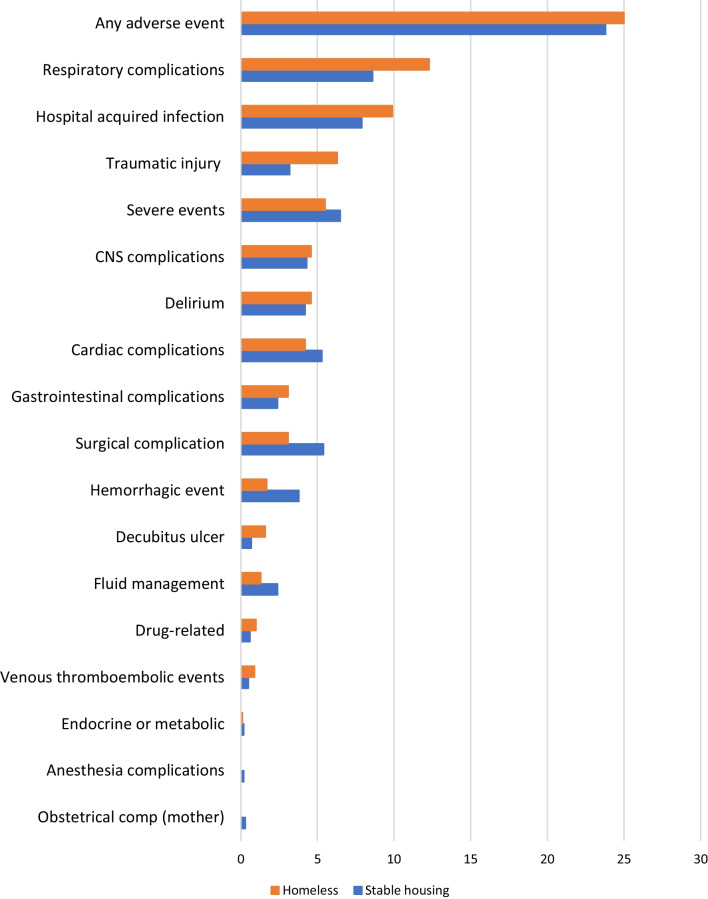
“Hospital adverse event n (%) | 11,392 (23.8) | 271 (25.0) | 11,121 (23.8) | 1.1 (0.9 to 1.2) | 1.1 (0.9 to 1.2)”
§ Critical illness among patients experiencing homelessness: a retrospective cohort study > Results > Primary outcome (healthcare resource utilization)
plain- Asserted: passes — The authors put it forward as true.
- Checkable: passes — It can be checked against evidence.
- Load-bearing: passes — The paper’s conclusions depend on it.
- Based: passes — The paper gives a reason why it holds.
- Rests on an assumption not shown here.
A result the paper reports from its own data — it cites no other source for it, so there is none to check. The quote shows it is in the paper.
In the paper
“There were no differences in the proportion of patients who experienced a hospital adverse event between patients experiencing homelessness and those who had stable housing (Table 2).”
§ Critical illness among patients experiencing homelessness: a retrospective cohort study > Results > Secondary outcomes (patient safety and hospital and ICU mortality)
plain- Asserted: passes — The authors put it forward as true.
- Checkable: passes — It can be checked against evidence.
- Load-bearing: unclear — It is unclear whether the paper’s conclusions depend on it.
- Based: passes — The paper gives a reason why it holds.
56 more claims
Create a free account to see all 83 claims and to verify the 39 references still open.
- Probably not a substantial claim. 17
- It may state two separate claims as one. 9
- The quote only partly states this claim. 2
Self-check
Percentages, sums and reported differences re-computed from the paper’s own numbers.
Each contradiction between two passages listed here was confirmed by an independent check.
Rated minor: it would not touch a result — a value no result rests on, a p-value that stays on the same side of the significance level, or a conflict that is clerical, resolved elsewhere in the paper, or outside its own findings.
In the paper
§ Critical illness among patients experiencing homelessness: a retrospective cohort study > Results > Primary outcome (healthcare resource utilization)
“there were no differences in the proportion of patients receiving noninvasive mechanical ventilation, vasoactive medications or continuous renal replacement therapy (Table 2).”
§ Critical illness among patients experiencing homelessness: a retrospective cohort study > Results > Primary outcome (healthcare resource utilization)
“| Noninvasive ventilation n (%) | 3613 (7.5) | 76 (6.9) | 3537 (7.5) | 0.9 (0.7 to 1.2) | 0.7 (0.6 to 0.9) |”
Rated minor: it would not touch a result — a value no result rests on, a p-value that stays on the same side of the significance level, or a conflict that is clerical, resolved elsewhere in the paper, or outside its own findings.
In the paper
§ Critical illness among patients experiencing homelessness: a retrospective cohort study > Results > Participants
“Of those experiencing homelessness, 37.7% (n = 409) were identified using postal codes and 97.4% (n = 1058) were identified using ICD-10 codes. (Percent is greater than 100 because 127 patients were identified using both methods.)”
§ Critical illness among patients experiencing homelessness: a retrospective cohort study > Results > Participants
“2.3% (1086) of patients experienced homelessness and 97.7% (46,762) had stable housing”
Rated minor: it would not touch a result — a value no result rests on, a p-value that stays on the same side of the significance level, or a conflict that is clerical, resolved elsewhere in the paper, or outside its own findings.
In the paper
§ Critical illness among patients experiencing homelessness: a retrospective cohort study > Results > Primary outcome (healthcare resource utilization)
“| Vasoactive medications n (%) | 16,531 (34.3) | 414 (37.5) | 16,117 (34.2) | 0.1 (0.0 to 0.3) | 1.0 (0.9 to 1.1) |”
§ Critical illness among patients experiencing homelessness: a retrospective cohort study > Results > Primary outcome (healthcare resource utilization)
“| Variable | Cohort (n = 47,848) | Homeless (n = 1086) | Stable Housing (n = 46,762) | Crude OR/mean difference (95% CI) | Adjusted OR/mean differencea (95% CI) |”
Rated minor: it would not touch a result — a value no result rests on, a p-value that stays on the same side of the significance level, or a conflict that is clerical, resolved elsewhere in the paper, or outside its own findings.
In the paper
“| Invasive ventilation n (%) | 20,471 (42.4) | 695 (63.0) | 19,776 (41.9) | 2.3 (2.1 to 2.6) | 1.5 (1.3 to 1.8) |”
§ Critical illness among patients experiencing homelessness: a retrospective cohort study > Results > Primary outcome (healthcare resource utilization)
Reported 63 · recomputed 63.996317
Citations
Cites
(2002) · Journal of Urban Health: Bulletin of the New York Academy of Medicine · doi:10.1093/jurban/79.suppl_1.s141 · Cited by 701
Folsom, D. P., Hawthorne, W., Lindamer, L., Gilmer, T., Bailey, A., Golshan, S., Garcia, P., Unützer, J., Hough, R., & Jeste, D. V. (2005) · American Journal of Psychiatry · doi:10.1176/appi.ajp.162.2.370 · Cited by 551
Hospitalization Costs Associated with Homelessness in New York City
Salit, S. A., Kuhn, E. M., Hartz, A. J., Vu, J. M., & Mosso, A. L. (1998) · New England Journal of Medicine · doi:10.1056/nejm199806113382406 · Cited by 340
Hwang, S. W., Chambers, C., Chiu, S., Katic, M., Kiss, A., Redelmeier, D. A., & Levinson, W. (2013) · American Journal of Public Health · doi:10.2105/ajph.2013.301369 · Cited by 239 · cited 1×
“It has been found that patients experiencing homelessness have heightened care intensity and longer hospital stays resulting in an increased cost of $2559–$2907 per hospital admission when compared to patients that are stably housed of similar age and sex [4, 22, 25, 26, 47].”
BackgroundPiat, M., Polvere, L., Kirst, M. J., Voronka, J., Zabkiewicz, D., Plante, M., Isaak, C. A., Nolin, D., Nelson, G. B., & Goering, P. N. (2014) · Urban Studies · doi:10.1177/0042098014548138 · Cited by 228
Somerville, P. (2013) · Housing, Theory and Society · doi:10.1080/14036096.2012.756096 · Cited by 226
Martins, D. C. (2008) · Public Health Nursing · doi:10.1111/j.1525-1446.2008.00726.x · Cited by 210
Hwang, S. W., Weaver, J., Aubry, T., & Hoch, J. S. (2011) · Medical Care · doi:10.1097/mlr.0b013e318206c50d · Cited by 193 · cited 2×
“One study found that ICU hospital days, acute care days and costs were substantially greater among the homeless population compared to the stable housed population [26].”
BackgroundNooe, R. M., & Patterson, D. A. (2010) · Journal of Human Behavior in the Social Environment · doi:10.1080/10911350903269757 · Cited by 170
Homelessness: a proposal for a global definition and classification
Springer, S. (2000) · Habitat International · doi:10.1016/s0197-3975(00)00010-2 · Cited by 145
Research works printed but not linked: 6
- Rodrigue S. Hidden homelessness in Canada. Statistics Canada. 2016:1–13. · doi:10.59962/9780774833264-004
- Echenberg H Defining and enumerating homelessness in Canada 2020 montreal library of parliament research publications
- Institute of Medicine Committee on health care for homeless people QIoMCoHCfHP. Homelessness, health, and human needs 1988 Washington Washington: National Academy Press
- Bassuk EL The homelessness problem. Housing the homeless 2017 London Routledge 253 261 · doi:10.4324/9780203789728-18
- Horn M Increasing homelessness: evidence of housing market failure in Australia Just Policy A J Aust Soc Policy 2002 25 26 31
- Garrett DG The business case for ending homelessness: having a home improves health, reduces healthcare utilization and costs Am Health Drug Benefits 2012 5 1 17 19 24991307 PMC4046466
Cited by
Still being checked.
Metadata
- Authors
- Sauro, K. M., O’Rielly, C. M., Kersen, J., Soo, A., Bagshaw, S. M., & Stelfox, H. T.
- Affiliations
- University of Calgary (CA)
- Alberta Health Services (CA)
- Corresponding author
- Sauro, K. M.
- Venue
- Critical Care
- Published
- 2023-12-06
- Volume
- 27
- Issue
- 1
- Pages
- 477-477
- ISSN
- 1364-8535 (ISSN-L)
- PMC
- PMC10699027
- OpenAlex
- W4389396579
- Semantic Scholar
- 829e425f0cc7118556e2679289be69ef01839696
- Cited by
- 6
- References
- 38
- Citations by year
- 2026: 2 · 2025: 4
- FWCI
- 1.35
- Type
- journal article
- Language
- en
- Open access
- gold
- doi.org
- Licence
- cc-by
- creativecommons.org/licenses/by/4.0 (tdm)
- creativecommons.org/licenses/by/4.0 (vor)
- Locations
- Critical Care (publishedVersion, cc-by)
- PubMed Central (publishedVersion, cc-by)
- PubMed (publishedVersion)
- Libraries and Cultural Resources (University of Calgary) (submittedVersion)
- Funders
- Alberta Health Services
- Topics
- Social Sciences › Sociology and Political Science › Homelessness and Social Issues
- Health Sciences › Medicine › Emergency Medicine › Emergency and Acute Care Studies
- Health Sciences › Nursing › Leadership and Management › Hospital Admissions and Outcomes
- Keywords
- homelessness, critical illness, intensive care unit admission, health care utilization, hospital readmission, emergency department visits, length of hospital stay, housing status, intensive care unit discharge
- MeSH terms
- Adult, Alberta, Ill-Housed Persons, Humans, Retrospective Studies, Cohort Studies, Critical Illness
About these checks
Registry, retraction, Cites and statistics results are computed, not judged, with one exception: a printed reference that no index lists is read once by a model before it counts as a citation error. Claims are extracted by a model and kept only when their quote appears verbatim in the text; each cited source is then checked, with a model’s help, for whether it says what the claim relies on. Those verdicts can be wrong — read the claim’s quote and the cited source before relying on one.
A language model drew the claims from the paper on 2026-11-25, under version 3 of the claim definition (model deepseek-v4.1-flash, prompt extract-v3).
A second model labelled each claim on 2026-11-25 (model jev-1.13-20260917, definition revision gold-guideline-v0.2).
Statistics and arithmetic are recomputed, not judged.
Confidence bands are shown only for fields calibrated on our annotated test set. None is calibrated yet, so no band is shown.
What counts as a claim ›How we measure confidence ›How we check this ›
Are you an author, or do you see a problem with this page? Request a review
How to cite
Cite CoChat for the checks on this page, and the paper for its own findings.
- This page
- CoChat. (2026). Citation check: Critical illness among patients experiencing homelessness: a retrospective cohort study. https://app.cochat.ai/papers/10.1186/s13054-023-04753-7
- The paper
- Sauro, K. M., O’Rielly, C. M., Kersen, J., Soo, A., Bagshaw, S. M., & Stelfox, H. T. (2023). Critical illness among patients experiencing homelessness: a retrospective cohort study. Critical Care. https://doi.org/10.1186/s13054-023-04753-7
Data sources
Bibliographic data: Semantic Scholar, OpenAlex, Crossref.
Contains information from the Semantic Scholar Academic Graph Datasets, made available under the ODC Attribution License (ODC-BY 1.0).
Semantic Scholar’s data is described in: Kinney, R., et al. (2023). The Semantic Scholar Open Data Platform. arXiv:2301.10140.
