

Whole-genome sequence analysis of a Pan African set of samples reveals archaic gene flow from an extinct basal population of modern humans into sub-Saharan populations
Open accessThe DOI matches its Crossref record; 82 of the 82 references it cites were found in a registry or an index.
Abstract
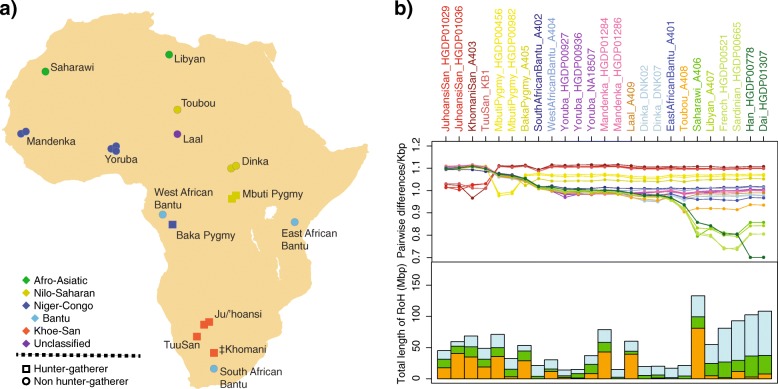
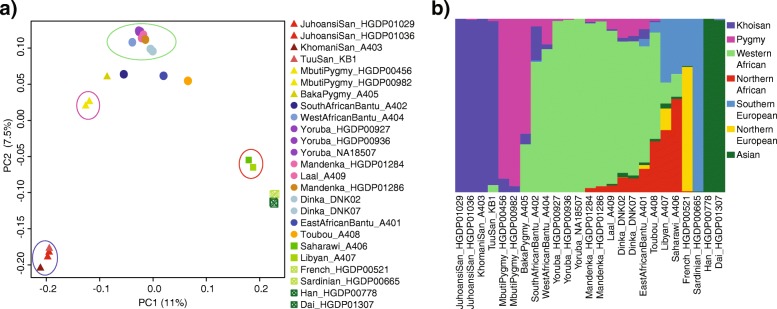
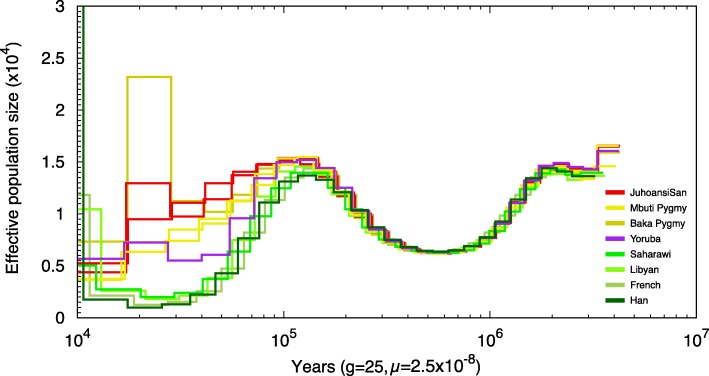
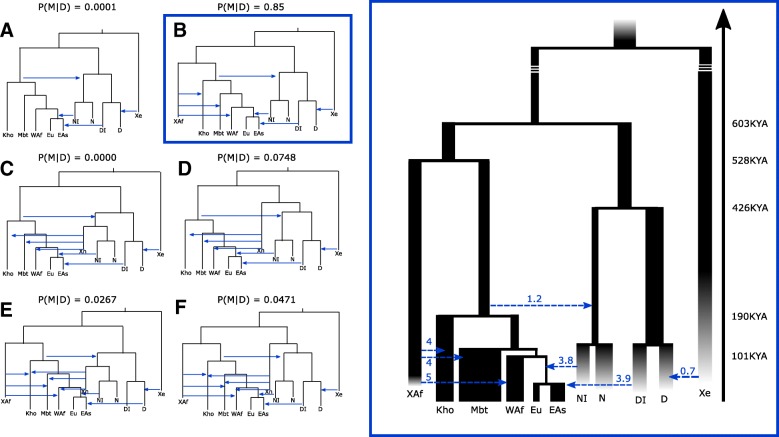
BACKGROUND: Population demography and gene flow among African groups, as well as the putative archaic introgression of ancient hominins, have been poorly explored at the genome level. RESULTS: Here, we examine 15 African populations covering all major continental linguistic groups, ecosystems, and lifestyles within Africa through analysis of whole-genome sequence data of 21 individuals sequenced at deep coverage. We observe a remarkable correlation among genetic diversity and geographic distance, with the hunter-gatherer groups being more genetically differentiated and having larger effective population sizes throughout most modern-human history. Admixture signals are found between neighbor populations from both hunter-gatherer and agriculturalists groups, whereas North African individuals are closely related to Eurasian populations. Regarding archaic gene flow, we test six complex demographic models that consider recent admixture as well as archaic introgression. We identify the fingerprint of an archaic introgression event in the sub-Saharan populations included in the models (~ 4.0% in Khoisan, ~ 4.3% in Mbuti Pygmies, and ~ 5.8% in Mandenka) from an early divergent and currently extinct ghost modern human lineage. CONCLUSION: The present study represents an in-depth genomic analysis of a Pan African set of individuals, which emphasizes their complex relationships and demographic history at population level.
Overview
The claims and statistics of this paper haven’t been checked yet.
Free: it reads the open-access text and checks the first 5 claims that cite a source we can check. Create a free account to check every claim.
Integrity signals
Registry
Cites
Statistics
Figures
Verification
Claims the paper makes
The claims and statistics of this paper haven’t been checked yet.
Free: it reads the open-access text and checks the first 5 claims that cite a source we can check. Create a free account to check every claim.
Claims other papers make about this one
Each is checked against this paper’s own text: does it say what the citing paper says it does?
In the citing paper
“The joint site frequency spectrum (jSFS) has been previously used as input to the DL for comparing complex demographic models (Lorente-Galdos et al., 2019; Mondal et al., 2019).”
From The genomic history of the Aegean palatial civilizations (2021) · cites this paper as Lorente-Galdos et al., 2019
Self-check
Percentages, sums and reported differences re-computed from the paper’s own numbers.
The self-check needs the paper’s full text.
Citations
Cites
Fast and accurate short read alignment with Burrows-Wheeler transform
Li, H., & Durbin, R. (2009) · Bioinformatics · doi:10.1093/bioinformatics/btp324 · Cited by 58,607
A framework for variation discovery and genotyping using next-generation DNA sequencing data
DePristo, M. A., Banks, E., Poplin, R., Garimella, K. V., Maguire, J. R., Hartl, C., Philippakis, A. A., del Angel, G., Rivas, M. A., Hanna, M., et al. (2011) · Nature Genetics · doi:10.1038/ng.806 · Cited by 11,456
Fast model-based estimation of ancestry in unrelated individuals
Alexander, D. H., Novembre, J., & Lange, K. (2009) · Genome Research · doi:10.1101/gr.094052.109 · Cited by 9,898
Markov Chain Monte Carlo in Practice
(1995) · Chapman & Hall/CRC eBooks · doi:10.1201/b14835 · Cited by 7,757
A draft sequence of the Neandertal genome
Green, R. E., Krause, J., Briggs, A. W., Maricic, T., Stenzel, U., Kircher, M., Patterson, N., Li, H., Zhai, W., Fritz, M. H.-Y., et al. (2010) · Science · doi:10.1126/science.1188021 · Cited by 4,318
The Jackknife and the Bootstrap for General Stationary Observations
Kunsch, H. R. (1989) · The Annals of Statistics · doi:10.1214/aos/1176347265 · Cited by 3,342
Ancient Admixture in Human History
Patterson, N., Moorjani, P., Luo, Y., Mallick, S., Rohland, N., Zhan, Y., Genschoreck, T., Webster, T., & Reich, D. (2012) · Genetics · doi:10.1534/genetics.112.145037 · Cited by 2,848
Inference of human population history from individual whole-genome sequences
Li, H., & Durbin, R. (2011) · Nature · doi:10.1038/nature10231 · Cited by 2,590
The complete genome sequence of a Neanderthal from the Altai Mountains
Prüfer, K., Racimo, F., Patterson, N., Jay, F., Sankararaman, S., Sawyer, S., Heinze, A., Renaud, G., Sudmant, P. H., de Filippo, C., et al. (2014) · Nature · doi:10.1038/nature12886 · Cited by 2,254
The Galaxy platform for accessible, reproducible and collaborative biomedical analyses: 2016 update
Afgan, E., Baker, D., van den Beek, M., Blankenberg, D., Bouvier, D., Čech, M., Chilton, J., Clements, D., Coraor, N., Eberhard, C., et al. (2016) · Nucleic Acids Research · doi:10.1093/nar/gkw343 · Cited by 2,148
Research works printed but not linked: 1
- Archaeology, Language, and the African Past. By Roger Blench. Lanham: AltaMira Press; 2006. p. 388. ISBN 978-0-7591-0466-2 (paperback).
Cited by
Identifying and Interpreting Apparent Neanderthal Ancestry in African Individuals
Chen, L., Wolf, A. B., Fu, W., Li, L., & Akey, J. M. (2020) · Cell · doi:10.1016/j.cell.2020.01.012 · Cited by 254
“The higher signal of Neanderthal ancestry in African individuals is not entirely unexpected, as recent studies have suggested that assumptions about Neanderthal ancestry in Africans may have led to underestimates (Lorente-Galdos et al., 2019; Petr et al., 2019).”
BackgroundA weakly structured stem for human origins in Africa
Ragsdale, A. P., Weaver, T. D., Atkinson, E. G., Hoal, E. G., Möller, M., Henn, B. M., & Gravel, S. (2023) · Nature · doi:10.1038/s41586-023-06055-y · Cited by 159
Dating the skull from Broken Hill, Zambia, and its position in human evolution
Grün, R., Pike, A. W. G., McDermott, F. P., Eggins, S. M., Mortimer, G. E., Aubert, M., Kinsley, L., Joannes‐Boyau, R., Rumsey, M. S., Denys, C., et al. (2020) · Nature · doi:10.1038/s41586-020-2165-4 · Cited by 115
Fan, S., Spence, J. P., Feng, Y., Hansen, M. E. B., Terhorst, J., Beltrame, M. H., Ranciaro, A., Hirbo, J. B., Beggs, W. R., Thomas, N., et al. (2023) · Cell · doi:10.1016/j.cell.2023.01.042 · Cited by 111
The contribution of Neanderthal introgression to modern human traits
Reilly, P. F., Tjahjadi, A., Miller, S. L., Akey, J. M., & Tucci, S. (2022) · Current Biology · doi:10.1016/j.cub.2022.08.027 · Cited by 101
Archaic hominin introgression into modern human genomes
Gökçümen, Ö. (2019) · American Journal of Physical Anthropology · doi:10.1002/ajpa.23951 · Cited by 100
The genomic history of the Aegean palatial civilizations
Clemente, F., Unterländer, M., Dolgova, O., Amorim, C. E. G., Coroado-Santos, F., Neuenschwander, S., Ganiatsou, E., Cruz Dávalos, D. I., Anchieri, L., Michaud, F., et al. (2021) · Cell · doi:10.1016/j.cell.2021.03.039 · Cited by 98
Sanchez, T., Cury, J., Charpiat, G., & Jay, F. (2021) · Molecular Ecology Resources · doi:10.1111/1755-0998.13224 · Cited by 77
“Villanea and Schraiber (2019) also applied MLP on summary statistics to discriminate between multiple scenarios of archaic introgression and two other studies added an ABC step to address a similar task (Lorente-Galdos et al., 2019; Mondal et al., 2019).”
BackgroundMethodWidespread somatic L1 retrotransposition in normal colorectal epithelium
Nam, C. H., Youk, J., Kim, J. Y., Lim, J., Park, J. W., Oh, S. A., Lee, H. J., Park, J. W., Won, H., Lee, Y., et al. (2023) · Nature · doi:10.1038/s41586-023-06046-z · Cited by 74
The most frequent HLA alleles around the world: A fundamental synopsis
Sanchez‐Mazas, A., Nunes, J. M., Di, D., Alanís-Domínguez, E., Gerbault, P., Faye, N. K., Almawi, W. Y., Andreani, M., Arrieta‐Bolaños, E., Augusto, D. G., et al. (2024) · Best Practice & Research Clinical Haematology · doi:10.1016/j.beha.2024.101559 · Cited by 74
Evolutionary Genetics and Admixture in African Populations
Pfennig, A., Petersen, L. N., Kachambwa, P., & Lachance, J. (2023) · Genome Biology and Evolution · doi:10.1093/gbe/evad054 · Cited by 69
Heterogeneity in Palaeolithic Population Continuity and Neolithic Expansion in North Africa
Serra-Vidal, G., Lucas-Sánchez, M., Fadhlaoui‐Zid, K., Bekada, A., Zalloua, P., & Comas, D. (2019) · Current Biology · doi:10.1016/j.cub.2019.09.050 · Cited by 55
Self-citationRefining models of archaic admixture in Eurasia with ArchaicSeeker 2.0
Yuan, K., Ni, X., Liu, C., Pan, Y., Deng, L., Zhang, R., Gao, Y., Ge, X., Liu, J., Ma, X., et al. (2021) · Nature Communications · doi:10.1038/s41467-021-26503-5 · Cited by 52
Denisovan introgression has shaped the immune system of present-day Papuans
Vespasiani, D. M., Jacobs, G. S., Cook, L. E., Brucato, N., Leavesley, M., Kinipi, C., Ricaut, F.-X., Cox, M. P., & Gallego Romero, I. (2022) · PLOS Genetics · doi:10.1371/journal.pgen.1010470 · Cited by 46
“Modern humans are known to have interbred with Neanderthals [1], Denisovans [2] and possibly other archaic hominins [3].”
Revisiting the demographic history of Central African populations from a genetic perspective
Breton, G., Fortes‐Lima, C., & Schlebusch, C. M. (2021) · Human Population Genetics and Genomics · doi:10.47248/hpgg2101010004 · Cited by 43
Human OMICs and Computational Biology Research in Africa: Current Challenges and Prospects
Hamdi, Y., Zass, L. J., Othman, H., Radouani, F., Allali, I., Hanachi, M., Okeke, C. J., Chaouch, M., Tendwa, M. B., Samtal, C., et al. (2021) · OMICS A Journal of Integrative Biology · doi:10.1089/omi.2021.0004 · Cited by 42
“Finally, recent colonial history further contributed to this diversification (de Wit et al., 2010), and new studies covering ethnolinguistic groups with little or no prior representation are continuously being published (Busby et al., 2016; Lorente-Galdos et al., 2019).”
BackgroundChoi, J., Kim, S., Kim, J., Son, H., Yoo, S., Kim, C.-U., Park, Y. J., Moon, S., Cha, B., Jeon, M. C., et al. (2023) · Science Advances · doi:10.1126/sciadv.adg6319 · Cited by 39
Our Tangled Family Tree: New Genomic Methods Offer Insight into the Legacy of Archaic Admixture
Ahlquist, K. D., Bañuelos, M. M., Funk, A., Lai, J., Rong, S., Villanea, F. A., & Witt, K. E. (2021) · Genome Biology and Evolution · doi:10.1093/gbe/evab115 · Cited by 38
The long walk to African genomics
Tucci, S., & Akey, J. M. (2019) · Genome biology · doi:10.1186/s13059-019-1740-1 · Cited by 40
Esteller-Cucala, P., Maceda, I., Børglum, A. D., Demontis, D., Faraone, S. V., Cormand, B., & Lao, Ó. (2020) · Scientific Reports · doi:10.1038/s41598-020-65322-4 · Cited by 38
The deep population history in Africa
Hollfelder, N., Breton, G., Sjödin, P., & Jakobsson, M. (2021) · Human Molecular Genetics · doi:10.1093/hmg/ddab005 · Cited by 29
“The divergence between the ancestors of the Khoe–San and the ancestors of the rest of modern humans is estimated to between 340 000 and 200 000 ya (31,42,49,62), and with younger estimates (160 000–90 000) based on the MSMC cross-coalescence approach (19,21,52,63).”
A structured coalescent model reveals deep ancestral structure shared by all modern humans
Cousins, T., Scally, A., & Durbin, R. (2025) · Nature Genetics · doi:10.1038/s41588-025-02117-1 · Cited by 27
Advances in integrative African genomics
Zhang, C., Hansen, M. E. B., & Tishkoff, S. A. (2021) · Trends in Genetics · doi:10.1016/j.tig.2021.09.013 · Cited by 27
“[26] generated 22 WGS genomes from African individuals from populations spanning a broad range of ethnic, cultural, and linguistic groups.”
BackgroundAli, A. A., Aalto, M., Jonasson, J., & Osman, A. (2020) · Scientific Reports · doi:10.1038/s41598-020-62645-0 · Cited by 24
Linguistic capacity was present in the Homo sapiens population 135 thousand years ago
Miyagawa, S., DeSalle, R., Nóbrega, V. A., Nitschke, R., Okumura, M., & Tattersall, I. (2025) · Frontiers in Psychology · doi:10.3389/fpsyg.2025.1503900 · Cited by 23
Genome Tunisia Project: paving the way for precision medicine in North Africa
Hamdi, Y., Trabelsi, M., Ghedira, K., Boujemaa, M., Ayed, I. B., Charfeddine, C., Souissi, A., Rejeb, I., Rebai, W. K., Hkimi, C., et al. (2024) · Genome Medicine · doi:10.1186/s13073-024-01365-w · Cited by 17
“However, North African populations are among the most understudied African populations, with no data available on WGS for individuals from Tunisia, Algeria, and Mauritania, while very few are available for individuals from Morocco, Libya, and Egypt [12–16].”
BackgroundThe genomic prehistory of peoples speaking Khoisan languages
Pakendorf, B., & Stoneking, M. (2020) · Human Molecular Genetics · doi:10.1093/hmg/ddaa221 · Cited by 18
“Khoisan-speaking groups are also the first to branch off in genomic studies of African or world-wide populations (16,19,20,23), with their divergence from other populations dated to 160–300 kya (Table 1).”
BackgroundInfluentialArchaic hominin admixture and its consequences for modern humans
Tagore, D., & Akey, J. M. (2024) · Current Opinion in Genetics & Development · doi:10.1016/j.gde.2024.102280 · Cited by 17
A Partial Neandertal Foot From the Late Middle Paleolithic of Amud Cave, Israel
Pearson, O. M., Pablos, A., Rak, Y., & Hovers, E. (2020) · PaleoAnthropology · doi:10.4207/pa.2020.art144 · Cited by 15
The Impact of Collaborative Research: A Case Study in a Developing Country
Abbas, M. A., & Saab, S. S. (2020) · International Symposium on Multidisciplinary Studies and Innovative Technologies (ISMSIT) · doi:10.1109/ismsit50672.2020.9254613 · Cited by 15
“[60] 29 12 96.”
Recovering signatures of archaic hominin introgression using ancestral recombination graphs
Zhang, Y., Biddanda, A., Johnson, S., O’Dushlaine, C., & Moorjani, P. (2026) · Science · doi:10.1126/science.aef8874 · Cited by 15
Schroeder, L. (2020) · American Anthropologist · doi:10.1111/aman.13410 · Cited by 14
Cousins, T., & Durvasula, A. (2025) · Molecular Biology and Evolution · doi:10.1093/molbev/msaf041 · Cited by 13
“Instead, recent studies suggest that humans descend from two (or more) divergent populations that admixed together prior to the OOA event ( Lorente-Galdos et al. 2019; Ragsdale and Gravel 2019; Durvasula and Sankararaman 2020; Wang et al. 2020; Fan et al. 2023; Ragsdale et al. 2023; Cousins et al.…”
Haddish, K., Chierto, E., Vella, G. D., Lacerenza, D., Raddi, S., Aneli, S., Bogale, A. L., Kidane, E. M., Yizengaw, A., Getaneh, Y., et al. (2021) · Forensic Science International Genetics · doi:10.1016/j.fsigen.2021.102618 · Cited by 13
Multiple Sources of Uncertainty Confound Inference of Historical Human Generation Times
Ragsdale, A. P., & Thornton, K. (2023) · Molecular Biology and Evolution · doi:10.1093/molbev/msad160 · Cited by 13
“…that human population structure within Africa extending hundreds of thousands of years into the past has shaped present-day genetic variation (Hammer et al., 2011; Hsieh et al., 2016; Hey et al., 2018; Ragsdale and Gravel, 2019; Lorente-Galdos et al., 2019; Durvasula and Sankararaman, 2020).”
BackgroundRevisiting the out of Africa event with a deep-learning approach
Montinaro, F., Pankratov, V., Yelmen, B., Pagani, L., & Mondal, M. (2021) · The American Journal of Human Genetics · doi:10.1016/j.ajhg.2021.09.006 · Cited by 15
Biogeographic Perspectives on Human Genetic Diversification
Hünemeier, T. (2024) · Molecular Biology and Evolution · doi:10.1093/molbev/msae029 · Cited by 11
“Additionally, other studies indicate admixing events between pre-out-of-Africa H. sapiens populations and “ghost” populations (Lorente-Galdos et al. 2019; Durvasula and Sankararaman 2020), with significant gen-etic contributions from these unsampled populations to the human species.”
BackgroundMethods for detecting introgressed archaic sequences
Sankararaman, S. (2020) · Current Opinion in Genetics & Development · doi:10.1016/j.gde.2020.05.026 · Cited by 11
Brasil, M. F., Monson, T. A., Taylor, C. E., Yohler, R. M., & Hlusko, L. J. (2022) · American Journal of Biological Anthropology · doi:10.1002/ajpa.24634 · Cited by 10
Tran, L., Sun, C. K., Struck, T. J., Sajan, M., & Gutenkunst, R. N. (2024) · Molecular Biology and Evolution · doi:10.1093/molbev/msae077 · Cited by 10
“…such as random forest (RF) and multilayer perceptron (MLP) with AFS as training data for demographic model selection and demographic parameter inference (Sheehan and Song 2016; Smith et al. 2017; Lorente-Galdos et al. 2019; Mondal et al. 2019; Villanea and Schraiber 2019; Sanchez et al. 2021).”
MethodSerradell, J. M., Lorenzo-Salazar, J. M., Flores, C., Lao, Ó., & Comas, D. (2024) · Genome biology · doi:10.1186/s13059-024-03341-4 · Cited by 11
“These observations support the results obtained by Ragsdale et al. [31], where reticulated population substructure tens of thousands years ago could explain some of the genetic diversity previously attributed to archaic introgression [19, 22].”
BackgroundMethodResultInfluentialSelf-citationGhosts of extinct apes: genomic insights into African hominid evolution
Foley, R., & Lahr, M. M. (2024) · Trends in Ecology & Evolution · doi:10.1016/j.tree.2023.12.009 · Cited by 9
Bondzi‐Simpson, A., Ribeiro, T., Coburn, N. G., & Hallet, J. I. (2023) · The American Journal of Surgery · doi:10.1016/j.amjsurg.2023.08.009 · Cited by 8
The genomic echoes of the last Green Sahara on the Fulani and Sahelian people
D’Atanasio, E., Risi, F., Ravasini, F., Montinaro, F., Hajiesmaeil, M., Bonucci, B., Pistacchia, L., Amoako-Sakyi, D., Bonito, M., Onidi, S., et al. (2023) · Current Biology · doi:10.1016/j.cub.2023.10.075 · Cited by 8
Human biology and ancient DNA: exploring disease, domestication and movement
Houldcroft, C. J., Rifkin, R. F., & Underdown, S. (2019) · Annals of Human Biology · doi:10.1080/03014460.2019.1629536 · Cited by 8
“…the complicated demographic history of Africa through means of aDNA where possible and through more focused efforts to sequence modern DNA from more representative populations across the African continent, an approach other researchers are already taking to heart (Lorente-Galdos et al. 2019).”
BackgroundAncient tree-topologies and gene-flow processes among human lineages in AfricaPreprint
Breton, G., Sjödin, P., Zervakis, P., Laurent, R., Froment, A., Sjöstrand, A. E., Hewlett, B. S., Barreiro, L. B., Perry, G. H., Soodyall, H., et al. (2024) · bioRxiv (Cold Spring Harbor Laboratory) · doi:10.1101/2024.07.15.603519 · Cited by 8
Self-citation“Rigorous and Systematic Qualitative Data Analysis in Biological Anthropology”
Wutich, A., Nelson, R. G., DuBois, L. Z., Astorino, C. M., Knudson, K. J., Reynolds, A. W., Riley, E. P., Smith, R. W. A., VanSickle, C., Carroll, S. R., et al. (2024) · American Journal of Biological Anthropology · doi:10.1002/ajpa.70008 · Cited by 6
On the Impact of Multi-Authorship Scholarly Publications
Abbas, M. A., & Saab, S. S. (2020) · IEEE International Conference on Advent Trends in Multidisciplinary Research and Innovation (ICATMRI) · doi:10.1109/icatmri51801.2020.9398438 · Cited by 6
Breton, G., Johansson, A., Sjödin, P., Schlebusch, C. M., & Jakobsson, M. (2021) · BMC Bioinformatics · doi:10.1186/s12859-021-04407-x · Cited by 6
Genome-wide genealogies reveal deep admixtures forming modern humansPreprint
Loya, H., Hinch, A. G., Palamara, P. F., Speidel, L., & Myers, S. (2026) · bioRxiv (Cold Spring Harbor Laboratory) · doi:10.64898/2026.04.17.719197 · Cited by 7
Genetic Divergence Within Southern Africa During the Later Stone Age
Al-Hindi, D. R., Reynolds, A. W., & Henn, B. M. (2022) · Vertebrate paleobiology and paleoanthroplogy series/Vertebrate paleobiology and paleoanthropology series · doi:10.1007/978-3-031-07426-4_3 · Cited by 5
Reconstructing our past ˸ deep learning for population genetics
Sanchez, T. (2022) · theses.fr (ABES) · doi:10.70675/04f9d082z60afz4a05z988ezd8d0a1eb1753 · Cited by 5
Searching for archaic contribution in Africa
Santander, C. G., Montinaro, F., & Capelli, C. (2019) · Annals of Human Biology · doi:10.1080/03014460.2019.1624823 · Cited by 4
Grazzini, C., Spera, G., Morelli, S., Castellana, D., Cosenza, G., Baccini, M., Cereda, G., & Pilli, E. (2025) · Expert Systems with Applications · doi:10.1016/j.eswa.2025.129662 · Cited by 3
Osman, A., & Jonasson, J. (2022) · BMC Medical Genomics · doi:10.1186/s12920-022-01220-0 · Cited by 3
GHIST 2024: The First Genomic History Inference Strategies Tournament
Struck, T. J., Vaughn, A. H., Daigle, A., Ray, D. D., Noskova, E., Sequeira, J. J., Antonets, S., Alekseevskaya, E., Grigoreva, E., Raines, E., et al. (2025) · Molecular Biology and Evolution · doi:10.1093/molbev/msaf257 · Cited by 2
Sparks, A., Swart, Y., Kinnear, C. J., van der Spuy, G. D., Tromp, G., Glanzmann, B., & Möller, M. (2025) · Aspects of Molecular Medicine · doi:10.1016/j.amolm.2025.100098 · Cited by 1
Singular or plural Oldowan tool-makers during the Lower Pleistocene in eastern Africa?
Prat, S. (2025) · Comptes Rendus Palevol · doi:10.5852/cr-palevol2025v24a27 · Cited by 1
Adaptive Archaic Introgression
Dolgova, O., & Lao, Ó. (2024) · Oxford University Press eBooks · doi:10.1093/med/9780197676592.003.0007 · Cited by 1
The Genetic Legacy of Introgression from Two Deeply Divergent Lineages in the Genus Homo
Rogers, A. R., Islam, M. T., Brand, C. M., & Webster, T. H. (2026) · bioRxiv · doi:10.64898/2026.03.22.713509
“Interbreeding was doc-32 umented not only in Eurasia, but also in African populations, where the source population was often obscure [9, 17, 21].”
Nagar, S. D., Conley, A. B., & Jordan, I. K. (2019) · Elsevier eBooks · doi:10.1016/b978-0-12-801238-3.11468-0
Application of genome assembly methods to human and non-human primate genomics
Kuderna, L. F. K. (2020) · Repositori digital de la UPF (Universitat Pompeu Fabra)
Self-citationPorto, M., & Iago (2021) · Tesis Doctorals en Xarxa (Consorci de Serveis Universitaris de Catalunya)
Incremento del uso de la información genómica en la atención médica en Colombia - Programa ORIGEN-
Ceferino, M. L. (2021) · Repositorio Universidad de Caldas
Human Evolution: The Genomic Evidence
Comas, D., & Calafell, F. (2022) · Evolutionary studies · doi:10.1007/978-981-19-3246-5_9
Self-citationGrine, F. E. (2022) · Vertebrate paleobiology and paleoanthroplogy series/Vertebrate paleobiology and paleoanthropology series · doi:10.1007/978-3-031-07426-4_13
Palaeogenomics of Extinct and Archaic Hominins
Gilbert, M. T. P., & Lalueza‐Fox, C. (2023) · Wiley eBooks · doi:10.1002/9781119592112.ch32
Biogeographical Ancestry Prediction via an Innovative Panel: Difficult Task or Complex Phenomenon?
Grazzini, C., Spera, G., Castellana, D., Morelli, S., Pilli, E., Baccini, M., & Cereda, G. (2025) · Springer eBooks · doi:10.1007/978-3-031-95995-0_60
Osman, A., & Jonasson, J. (2022) · Figshare · doi:10.6084/m9.figshare.19425081
Osman, A., & Jonasson, J. (2022) · Figshare · doi:10.6084/m9.figshare.19425078
Breton, G., Johansson, A., Sjödin, P., Schlebusch, C. M., & Jakobsson, M. (2021) · Figshare · doi:10.6084/m9.figshare.16779439
Breton, G., Johansson, A., Sjödin, P., Schlebusch, C. M., & Jakobsson, M. (2021) · Figshare · doi:10.6084/m9.figshare.16779430
Serradell, J. M., Lorenzo-Salazar, J. M., Flores, C., Lao, Ó., & Comas, D. (2024) · DIGITAL.CSIC (Spanish National Research Council (CSIC)) · doi:10.6084/m9.figshare.26756104
Self-citationSerradell, J. M., Lorenzo-Salazar, J. M., Flores, C., Lao, Ó., & Comas, D. (2024) · DIGITAL.CSIC (Spanish National Research Council (CSIC)) · doi:10.6084/m9.figshare.26410044
Self-citationSerradell, J. M., Lorenzo-Salazar, J. M., Flores, C., Lao, Ó., & Comas, D. (2024) · DIGITAL.CSIC (Spanish National Research Council (CSIC)) · doi:10.6084/m9.figshare.26756101
Self-citationBreton, G., Johansson, A., Sjödin, P., Schlebusch, C. M., & Jakobsson, M. (2021) · Figshare · doi:10.6084/m9.figshare.16779433
Breton, G., Johansson, A., Sjödin, P., Schlebusch, C. M., & Jakobsson, M. (2021) · Figshare · doi:10.6084/m9.figshare.16779424
Genetic inference of deep hominin evolutionary history using the sequentially Markovian coalescent
Cousins, T. (2024) · Apollo (University of Cambridge) · doi:10.17863/cam.118455
Osman, A., & Jonasson, J. (2022) · Figshare · doi:10.6084/m9.figshare.19425075
Serradell, J. M., Lorenzo-Salazar, J. M., Flores, C., Lao, Ó., & Comas, D. (2024) · DIGITAL.CSIC (Spanish National Research Council (CSIC)) · doi:10.6084/m9.figshare.26756107
Self-citationSerradell, J. M., Lorenzo-Salazar, J. M., Flores, C., Lao, Ó., & Comas, D. (2024) · DIGITAL.CSIC (Spanish National Research Council (CSIC)) · doi:10.6084/m9.figshare.26756110
Self-citationBreton, G., Johansson, A., Sjödin, P., Schlebusch, C. M., & Jakobsson, M. (2021) · Figshare · doi:10.6084/m9.figshare.16779436
Osman, A., & Jonasson, J. (2022) · Figshare · doi:10.6084/m9.figshare.19425090
Breton, G., Johansson, A., Sjödin, P., Schlebusch, C. M., & Jakobsson, M. (2021) · Figshare · doi:10.6084/m9.figshare.16779427
Serradell, J. M., Lorenzo-Salazar, J. M., Flores, C., Lao, Ó., & Comas, D. (2024) · DIGITAL.CSIC (Spanish National Research Council (CSIC)) · doi:10.6084/m9.figshare.26409853
Self-citationBreton, G., Johansson, A., Sjödin, P., Schlebusch, C. M., & Jakobsson, M. (2021) · Figshare · doi:10.6084/m9.figshare.16779415
Hybridisation in Primates: Cryptic Admixture and Adaptive Introgression
Kendall, C. J. R. (2025) · TSpace (University of Toronto)
Attentive-SPIDNA: Attention-based neural networks for population geneticsPreprint
Sanchez, T., Jobic, P., Regan, C., Verdu, P., Charpiat, G., & Jay, F. (2026) · bioRxiv (Cold Spring Harbor Laboratory) · doi:10.64898/2026.04.15.718687
“…population structure in Africa, with or without the additional hypothesis of gene-flow from ancient non-Homo sapiens lineages (Lachance et al, 2012; Lorente-Galdos et al, 2019; Ragsdale et al, 2023; Fan et al, 2023; Breton et al, 2024), explains consistently our results for the onset of the…”
Der moderne Mensch: Homo sapiens
Graw, J. (2026) · Springer eBooks · doi:10.1007/978-3-662-72246-6_3
Grazzini, C., Morelli, S., Castellana, D., Pilli, E., Cereda, G., & Lusa, L. (2026) · Springer eBooks · doi:10.1007/978-3-032-30881-8_73
Vespasiani, D. M., Jacobs, G. S., Cook, L. E., Brucato, N., Leavesley, M., Kinipi, C., Ricaut, F.-X., Cox, M. P., & Romero, I. G. (2022) · doi:10.1371/journal.pgen.1010470.r002
Metadata
- Authors
- Lorente-Galdos, B., Lao, O., Serra-Vidal, G., Santpere, G., Kuderna, L. F. K., Arauna, L. R., Fadhlaoui-Zid, K., Pimenoff, V. N., Soodyall, H., Zalloua, P., Marques-Bonet, T., & Comas, D.
- Affiliations
- Universitat Pompeu Fabra (ES)
- University of Helsinki (FI)
- National Health Laboratory Service (ZA)
- Lebanese American University (LB)
- Corresponding author
- Comas, David
- ORCID
- Venue
- Genome Biology
- Published
- 2019-04-26
- Volume
- 20
- Issue
- 1
- Pages
- 77-77
- ISSN
- 1465-6906 (ISSN-L)
- 1474-760X
- PMC
- PMC6485163
- OpenAlex
- W2944257565
- Cited by
- 77
- References
- 82
- Citations by year
- 2026: 4 · 2025: 8 · 2024: 10 · 2023: 9 · 2022: 11 · 2021: 18 · 2020: 11 · 2019: 6
- FWCI
- 6.91
- Type
- journal article
- Language
- en
- Open access
- gold
- doi.org
- Licence
- cc-by
- creativecommons.org/licenses/by/4.0/ (tdm)
- Locations
- Genome biology (publishedVersion, cc-by)
- PubMed Central (publishedVersion, cc-by)
- PubMed (publishedVersion)
- RECERCAT (Consorci de Serveis Universitaris de Catalunya) (publishedVersion, other-oa)
- Repositori digital de la UPF (Universitat Pompeu Fabra) (publishedVersion, cc-by)
- DIGITAL.CSIC (Spanish National Research Council (CSIC)) (submittedVersion, cc-by)
- Dipòsit Digital de la Universitat de Barcelona (Universitat de Barcelona) (submittedVersion, cc-by)
- DOAJ (DOAJ: Directory of Open Access Journals) (submittedVersion, cc-by-sa)
- Työväentutkimus Vuosikirja (submittedVersion)
- Funders
- Universitat Pompeu Fabra
- Centre International de Recherches Médicales de Franceville
- National Institute of Mental Health (U01MH106874)
- Topics
- Life Sciences › Biochemistry, Genetics and Molecular Biology › Genetics › Forensic and Genetic Research
- Social Sciences › Anthropology › Pleistocene-Era Hominins and Archaeology
- Life Sciences › Biochemistry, Genetics and Molecular Biology › Genetics › Genetic diversity and population structure
- Keywords
- introgression, sub-Saharan African populations, hunter-gatherers, farmers, admixture, effective population size, genetic diversity, Khoisan, North African populations, demography, ghost lineages
- MeSH terms
- Whole Genome Sequencing, Africa, Humans, Population Density, Genetic Variation, Black People, Gene Flow, Phylogeography, Human Migration
About these checks
Registry, retraction, Cites and statistics results are computed, not judged, with one exception: a printed reference that no index lists is read once by a model before it counts as a citation error. Claims are extracted by a model and kept only when their quote appears verbatim in the text; each cited source is then checked, with a model’s help, for whether it says what the claim relies on. Those verdicts can be wrong — read the claim’s quote and the cited source before relying on one.
Statistics and arithmetic are recomputed, not judged.
Confidence bands are shown only for fields calibrated on our annotated test set. None is calibrated yet, so no band is shown.
What counts as a claim ›How we measure confidence ›How we check this ›
Are you an author, or do you see a problem with this page? Request a review
Data sources
Bibliographic data: Semantic Scholar, OpenAlex, Crossref.
Contains information from the Semantic Scholar Academic Graph Datasets, made available under the ODC Attribution License (ODC-BY 1.0).
Semantic Scholar’s data is described in: Kinney, R., et al. (2023). The Semantic Scholar Open Data Platform. arXiv:2301.10140.
