

Removing reference bias and improving indel calling in ancient DNA data analysis by mapping to a sequence variation graph
Open accessPublished version of a preprint
The DOI matches its Crossref record; 54 of the 54 references it cites were found in a registry or an index; 17 of the 20 sources its claims cite were checked for support.
Abstract
Abstract Background During the last decade, the analysis of ancient DNA (aDNA) sequence has become a powerful tool for the study of past human populations. However, the degraded nature of aDNA means that aDNA molecules are short and frequently mutated by post-mortem chemical modifications. These features decrease read mapping accuracy and increase reference bias, in which reads containing non-reference alleles are less likely to be mapped than those containing reference alleles. Alternative approaches have been developed to replace the linear reference with a variation graph which includes known alternative variants at each genetic locus. Here, we evaluate the use of variation graph software to avoid reference bias for aDNA and compare with existing methods. Results We use to align simulated and real aDNA samples to a variation graph containing 1000 Genome Project variants and compare with the same data aligned with to the human linear reference genome. Using leads to a balanced allelic representation at polymorphic sites, effectively removing reference bias, and more sensitive variant detection in comparison with , especially for insertions and deletions (indels). Alternative approaches that use relaxed parameter settings or filter alignments can also reduce bias but can have lower sensitivity than , particularly for indels. Conclusions Our findings demonstrate that aligning aDNA sequences to variation graphs effectively mitigates the impact of reference bias when analyzing aDNA, while retaining mapping sensitivity and allowing detection of variation, in particular indel variation, that was previously missed.
Overview
CoChat Summary
TL;DR
The paper shows that mapping ancient DNA reads to a variation graph with `vg` largely removes reference bias and improves indel detection compared with standard `bwa aln` mapping. On both simulated and 34 real ancient human samples, `vg` gives more balanced allele representation and higher sensitivity, though at a cost of longer runtime and greater memory use.
Key findings
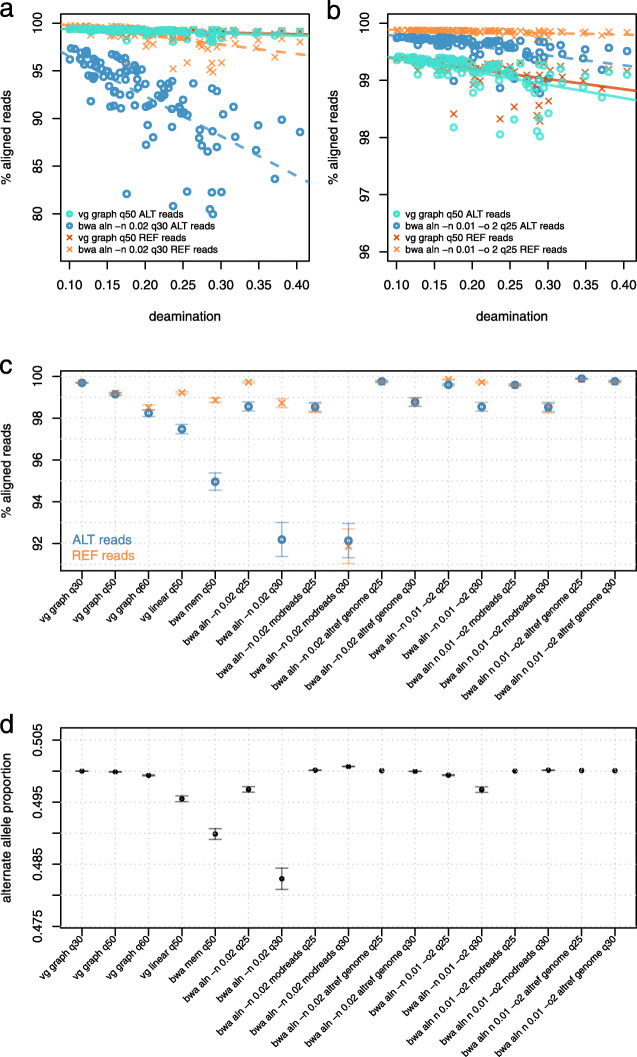
- In simulation, `bwa aln -n 0.02` produced an average alternate-allele fraction of 0.48267 (95% CI [0.48095, 0.48438]), while `vg` gave 0.49988 (95% CI [0.49984, 0.49991]), essentially eliminating reference bias.
- On the high-coverage Yamnaya sample, `vg` recovered an alternate-allele read fraction of 0.4925 (95% CI [0.4914, 0.4937]) versus 0.4742 for `bwa aln -n 0.02` and 0.4773 for `bwa aln -n 0.01 -o 2`.
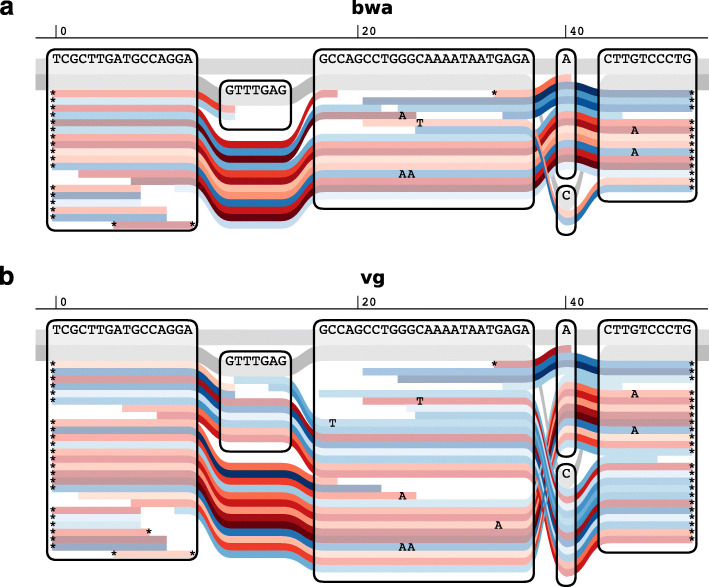
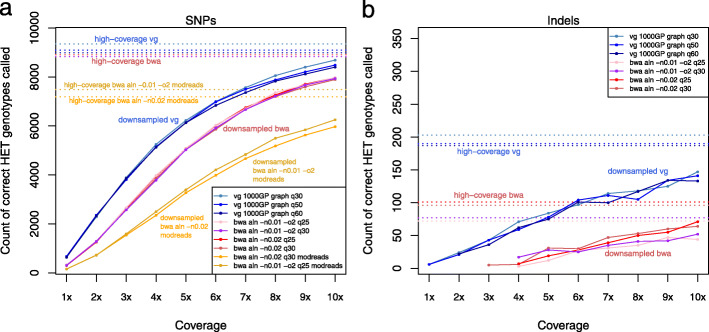
- At 4× coverage, `vg` recovered about 13% more heterozygotes than `bwa aln` in the downsampling experiment; for indels, `vg` recovered approximately twice as many as `bwa aln` at high coverage and even more at lower coverage.
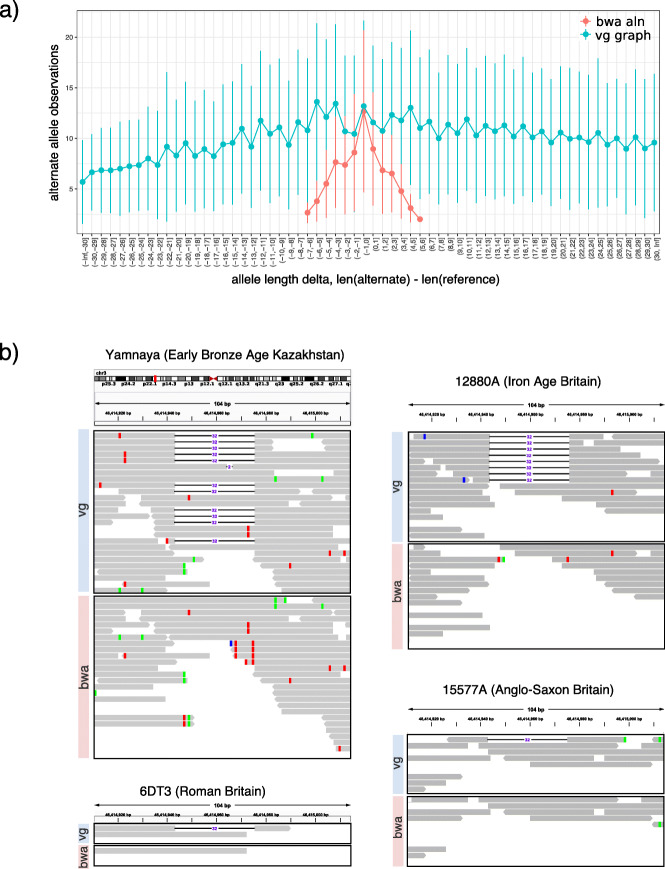
- `bwa aln` failed to detect indels longer than 7 bp, whereas `vg` recovered indels up to at least 18 bp in the PCA/indel analysis; the CCR5 delta 32 deletion was detected in the 4900-year-old Yamnaya sample and three more recent ancient British samples.
Methods
- Compared `vg` mapping to a 1000 Genomes Project variation graph against `bwa aln` mapping to the GRCh37/hs37d5 linear reference using both simulated reads and 34 previously published ancient human samples spanning multiple archaeological contexts and sequencing strategies.
- Simulations generated 50-bp reads across chromosome 11 Human Origins SNP sites, added alternate alleles to half the reads, and introduced post-mortem deamination based on damage profiles from 102 ancient genomes; additional microbial-read simulations tested false alignments.
- Main analyses included allele-balance and mapping-accuracy comparisons, D-statistics, PCA, variant calling with bcftools/FreeBayes, and downsampling of the high-coverage Yamnaya individual to test recovery at lower coverage.
Limitations
- The paper states that `vg` alignment takes about 5× longer than bwa aln -n 0.01 -o 2 and 29× longer than bwa mem, and requires substantially more memory for indexing and mapping.
- It notes that mapping quality scores are not directly comparable between `vg` and `bwa aln`, so comparisons depend on chosen thresholds.
- It also states that the graph approach relies on a graph built from present-day human variation, so it is not appropriate for archaic populations such as Neanderthals and Denisovans; this is a limitation the paper explicitly discusses.
Model-written summary. Check it against the paper before relying on it.
Integrity signals
Registry
Cites
Statistics
Figures
Verification
Claims the paper makes
13 Valid · 0 Not valid · 1 Not checked · 59 Own results and interpretations
The cited sources support only part of this claim — read each source’s verdict below.
In the paper
“Reads containing the alternate allele are less likely to map than reads containing the reference allele, creating a potentially strong bias against non-reference variation”
§ Removing reference bias and improving indel calling in ancient DNA data analysis by mapping to a sequence variation graph > Background
What the sources say
- Partly supportedcites [9] Prüfer K Stenzel U Hofreiter M Pääbo S Kelso J Green RE Computational challenges in the analysis of ancient DNA Genome Biol 2010 11 5 47 10.1186/gb-2010-11-5-r47 PMC2898072 20441577 sourceExperimental — accuracy not yet measured
The Results section (‘Pairwise differences’; page not provided) says highly divergent reads can fail to be identified or aligned, biasing measured differences downward. This supports the general mechanism of bias against differences from a reference, but the paper does not specifically compare mapping rates for reads carrying alternate versus reference alleles. (LLM, conf=0.83)
- Supportedcites [10] Günther T Nettelblad C The presence and impact of reference bias on population genomic studies of prehistoric human populations PLoS Genet 2019 15 7 1008302 10.1371/journal.pgen.1008302 PMC6685638 31348818 source
The Introduction says reads carrying an alternative allele have mismatches to the reference and lower mapping scores than reads carrying the reference allele. The Results (Mapping quality filtering) report fewer alternative-allele reads than expected after mapping, supporting the claimed bias. Page numbers are not provided in our copy. (LLM, conf=0.94)
hedgedstates a cause- Asserted: passes — The authors put it forward as true.
- Checkable: passes — It can be checked against evidence.
- Load-bearing: passes — The paper’s conclusions depend on it.
- Based: passes — The paper gives a reason why it holds.
- Partly supported
Every source the paper cites for this claim was checked and supports it.
In the paper
“An alternative way to improve read mapping and avoid reference bias is to map reads to a sequence graph that represents both reference and alternate alleles at known variable sites [18].”
§ Removing reference bias and improving indel calling in ancient DNA data analysis by mapping to a sequence variation graph > Background
What the sources say
- Supportedcites [18] Paten B Novak AM Eizenga JM Garrison E Genome graphs and the evolution of genome inference Genome Res 2017 27 5 665 76 10.1101/gr.214155.116 28360232 PMC5411762 source
In “Reference allele bias” (page unavailable), the paper says richer references that represent population variation should mitigate bias by permitting more read mappings. “Genome inference with genome graphs” (page unavailable) says a graph contains many of a sample’s specific variants. Together, these support mapping reads to a graph containing alternative alleles as a way to improve mapping and reduce reference bias. (LLM, conf=0.88)
plainstates a cause- Asserted: passes — The authors put it forward as true.
- Checkable: passes — It can be checked against evidence.
- Load-bearing: passes — The paper’s conclusions depend on it.
- Based: passes — The paper gives a reason why it holds.
- Supported
The cited sources support only part of this claim — read each source’s verdict below.
In the paper
“However, despite its superior sensitivity, the Peyrégne et al. strategy comes at a cost of reduced accuracy in the mapping of reads containing the reference allele, as we demonstrate below.”
§ Removing reference bias and improving indel calling in ancient DNA data analysis by mapping to a sequence variation graph > Results > Evaluating reference bias in aDNA using simulation
What the sources say
- Partly supportedcites [15] Peyrégne S Slon V Mafessoni F De Filippo C Hajdinjak M Nagel S Nickel B Essel E Le Cabec A Wehrberger K Nuclear DNA from two early neandertals reveals 80,000 years of genetic continuity in Europe Sci Adv 2019 5 6 5873 10.1126/sciadv.aaw5873 PMC6594762 31249872 sourceExperimental — accuracy not yet measured
The Results (page unavailable) say that aligning to an alternative Neandertal reference recovered additional sequences, supporting the strategy’s increased sensitivity. The Methods (page unavailable) describe excluding reads that aligned to different positions in the two references, but neither passage reports reduced mapping accuracy for reads carrying the reference allele. The citing sentence says that its authors demonstrate that cost below. (LLM, conf=0.85)
boostedstates a cause- Asserted: passes — The authors put it forward as true.
- Checkable: passes — It can be checked against evidence.
- Load-bearing: passes — The paper’s conclusions depend on it.
- Based: passes — The paper gives a reason why it holds.
- Partly supported
Every source the paper cites for this claim was checked and supports it.
In the paper
“Finally, reads mapped with vg continue to show terminal deamination damage, which is used as a standard diagnostic for the presence of true ancient DNA, as seen in mapDamage [28] plots, although levels are slightly reduced (Additional file 1: Fig. S12).”
§ Removing reference bias and improving indel calling in ancient DNA data analysis by mapping to a sequence variation graph > Results > Aligning ancient samples to the 1000GP variation graph
What the sources say
- Supportedcites [28] Jónsson H Ginolhac A Schubert M Johnson PL Orlando L mapdamage2. 0: fast approximate bayesian estimates of ancient dna damage parameters Bioinformatics 2013 29 13 1682 4 10.1093/bioinformatics/btt193 23613487 PMC3694634 source
The citation identifies mapDamage as the tool used for the plots, not as the source of the vg mapping result or the slightly reduced damage levels. The Introduction says mapDamage identifies nucleotide misincorporation patterns driven largely by cytosine deamination and describes these patterns as a way to authenticate ancient DNA; the Abstract likewise says they distinguish ancient sequences from modern contaminants. (LLM, conf=0.90)
plainstates an association- Asserted: passes — The authors put it forward as true.
- Checkable: passes — It can be checked against evidence.
- Load-bearing: unclear — It is unclear whether the paper’s conclusions depend on it.
- Based: passes — The paper gives a reason why it holds.
- Supported
Every source the paper cites for this claim was checked and supports it.
In the paper
“which can have a significant effect on population genetic inference and implications for many aDNA studies [9, 10]”
§ Removing reference bias and improving indel calling in ancient DNA data analysis by mapping to a sequence variation graph > Background
What the sources say
- Supportedcites [9] Prüfer K Stenzel U Hofreiter M Pääbo S Kelso J Green RE Computational challenges in the analysis of ancient DNA Genome Biol 2010 11 5 47 10.1186/gb-2010-11-5-r47 PMC2898072 20441577 source
The Results (Divergence triangulation) explain that alignment to a reference genome can selectively miss highly diverged ancient reads, making an extinct species appear more closely related to the genome used for identification. The Discussion says ancient-DNA shotgun projects depend heavily on the availability of a closely related reference genome, supporting the claim's broader implications. (LLM, conf=0.88)
- Supportedcites [10] Günther T Nettelblad C The presence and impact of reference bias on population genomic studies of prehistoric human populations PLoS Genet 2019 15 7 1008302 10.1371/journal.pgen.1008302 PMC6685638 31348818 source
The Discussion reports that reference bias can affect heterozygosity, allele sharing, and ancestry estimates, although its effects vary by analysis. The Conclusion says it is pervasive in ancient DNA data and can create spurious population-genomic results, supporting the claim's implications for many aDNA studies. (LLM, conf=0.93)
plainstates a possible cause- Asserted: passes — The authors put it forward as true.
- Checkable: passes — It can be checked against evidence.
- Load-bearing: passes — The paper’s conclusions depend on it.
- Based: passes — The paper gives a reason why it holds.
- Supported
35 more claims · 3 with their cited sources checked
Create a free account to see all 73 claims and every source verdict.
- Probably not a substantial claim. 4
- It may state two separate claims as one. 29
- The quote only partly states this claim. 1
Claims other papers make about this one
Each is checked against this paper’s own text: does it say what the citing paper says it does?
The cited source doesn’t support the claim as written.
In the citing paper
“For example, Martiniano et al. [9] find that the more relaxed parameters -n 0.02 -l 1024 -o 2 work best for BWA aln [10]”
From <tt>SAFARI</tt> : pangenome alignment of ancient DNA using purine/pyrimidine encodings (2025) · cites this paper as [9]
Checked by a reasoning model — may be wrong.
Experimental — accuracy not yet measuredThe source backs part of the claim, not all of it — or backs it for a different population, condition or comparison.
In the citing paper
“Crucially, the incorporation of more variation helps mitigate reference bias, and this mitigation has been shown to improve the alignment of both modern and aDNA reads [9, 16].”
From <tt>SAFARI</tt> : pangenome alignment of ancient DNA using purine/pyrimidine encodings (2025) · cites this paper as [9]
Experimental — accuracy not yet measuredThe cited source says what the claim attributes to it.
In the citing paper
“Pangenome graphs (also known as genome graphs or variation graphs) are relatively new data structures which have been shown to help to improve the alignment of aDNA [9].”
From <tt>SAFARI</tt> : pangenome alignment of ancient DNA using purine/pyrimidine encodings (2025) · cites this paper as [9]
Citations
Cites
R: A Language and Environment for Statistical Computing
R Core Team (2025) · doi:10.32614/r.manuals · Cited by 352,181
The Sequence Alignment/Map format and SAMtools
Li, H., Handsaker, B., Wysoker, A., Fennell, T., Ruan, J., Homer, N., Marth, G., Abecasis, G., Durbin, R., & 1000 Genome Project Data Processing Subgroup (2009) · Bioinformatics · doi:10.1093/bioinformatics/btp352 · Cited by 62,041 · cited 1×
“In order to estimate D-statistics and Principal Component Analyses, we generated pileups for each individual [48] at 1233553 SNPs from the Human Origins dataset using samtools mpileup, disabling base quality score recalibration and imposing a minimum base quality filter of q20.”
MethodSelf-citationCutadapt removes adapter sequences from high-throughput sequencing reads
Martin, M. (2011) · EMBnet.journal · doi:10.14806/ej.17.1.200 · Cited by 33,889
A global reference for human genetic variation
The 1000 Genomes Project Consortium, authors, C., Auton, A., Abecasis, G. R., Steering committee, Altshuler, D. M., Durbin, R. M., Abecasis, G. R., Bentley, D. R., Chakravarti, A., et al. (2015) · Nature · doi:10.1038/nature15393 · Cited by 18,247
Self-citationSecond-generation PLINK: rising to the challenge of larger and richer datasets
Chang, C. C., Chow, C. C., Tellier, L. C., Vattikuti, S., Purcell, S. M., & Lee, J. J. (2015) · Gigascience · doi:10.1186/s13742-015-0047-8 · Cited by 12,709
Principal components analysis corrects for stratification in genome-wide association studies
Price, A. L., Patterson, N. J., Plenge, R. M., Weinblatt, M. E., Shadick, N. A., & Reich, D. (2006) · Nature Genetics · doi:10.1038/ng1847 · Cited by 10,248
Population Structure and Eigenanalysis
Patterson, N., Price, A. L., & Reich, D. (2006) · PLoS Genetics · doi:10.1371/journal.pgen.0020190 · Cited by 5,280
A draft sequence of the Neandertal genome
Green, R. E., Krause, J., Briggs, A. W., Maricic, T., Stenzel, U., Kircher, M., Patterson, N., Li, H., Zhai, W., Fritz, M. H.-Y., et al. (2010) · Science · doi:10.1126/science.1188021 · Cited by 4,318
circlize implements and enhances circular visualization in R
Gu, Z., Gu, L., Eils, R., Schlesner, M., & Brors, B. (2014) · Bioinformatics · doi:10.1093/bioinformatics/btu393 · Cited by 4,246
Haplotype-based variant detection from short-read sequencing
Garrison, E., & Marth, G. (2012) · arXiv · doi:10.48550/arxiv.1207.3907 · Cited by 3,700 · cited 3×
“Bioinformatics 31(13), 2202–2204 (2015) [52] Garrison, E.”
MethodInfluentialSelf-citation
Research works printed but not linked: 1
- Li H Handsaker B Wysoker A Fennell T Ruan J Homer N Marth G Abecasis G Durbin R The Sequence Alignment/Map format and SAMtools Bioinformatics 2009 25 16 2078 9 10.1093/bioinformatics/btp352 19505943 PMC2723002 · DOI · Paper page
Cited by
Graph pangenome captures missing heritability and empowers tomato breeding
Zhou, Y., Zhang, Z., Bao, Z., Li, H., Lyu, Y., Zan, Y., Wu, Y., Cheng, L., Fang, Y., Wu, K., et al. (2022) · Nature · doi:10.1038/s41586-022-04808-9 · Cited by 511
The Human Pangenome Project: a global resource to map genomic diversity
Wang, T., Antonacci-Fulton, L., Howe, K., Lawson, H. A., Lucas, J. K., Phillippy, A. M., Popejoy, A. B., Asri, M., Carson, C., Chaisson, M. J. P., et al. (2022) · Nature · doi:10.1038/s41586-022-04601-8 · Cited by 494
Self-citationGenetic load: genomic estimates and applications in non-model animals
Bertorelle, G., Raffini, F., Bosse, M., Bortoluzzi, C., Iannucci, A., Trucchi, E., Morales, H. E., & van Oosterhout, C. (2022) · Nature Reviews Genetics · doi:10.1038/s41576-022-00448-x · Cited by 306
Three assays for in-solution enrichment of ancient human DNA at more than a million SNPs
Rohland, N., Mallick, S., Mah, M., Maier, R., Patterson, N., & Reich, D. (2022) · Genome Research · doi:10.1101/gr.276728.122 · Cited by 163
“This reflects the fact that when sequences perfectly match the reference genome sequence, they will have a higher probability of aligning with high mapping quality and thus of passing the mapping filters used to allow sequences into analysis (Günther and Nettelblad 2019; Martiniano et al. 2020).”
MethodThe Allen Ancient DNA Resource (AADR): A curated compendium of ancient human genomes
Mallick, S., Micco, A., Mah, M., Ringbauer, H., Lazaridis, I., Olalde, I., Patterson, N., & Reich, D. (2023) · bioRxiv (Cold Spring Harbor Laboratory) · doi:10.1101/2023.04.06.535797 · Cited by 153
“There are also differences around computational processing of raw sequencing data, which can produce batch effects across studies [14, 15].”
BackgroundThe Need for a Human Pangenome Reference Sequence
Miga, K. H., & Wang, T. (2021) · Annual Review of Genomics and Human Genetics · doi:10.1146/annurev-genom-120120-081921 · Cited by 137
Reference flow: reducing reference bias using multiple population genomes
Chen, N.-C., Solomon, B., Mun, T., Iyer, S., & Langmead, B. (2021) · Genome biology · doi:10.1186/s13059-020-02229-3 · Cited by 139
“This can ultimately lead to confounding of scientific results, especially for analyses concerned with hypervariable regions [2], allele-specific effects [3–6], ancient DNA analysis [7, 8], or epigenenomic signals [9].”
BackgroundJin, S., Han, Z., Hu, Y., Si, Z., Dai, F., He, L., Cheng, Y., Li, Y., Zhao, T., Fang, L., et al. (2023) · Molecular Plant · doi:10.1016/j.molp.2023.02.004 · Cited by 98
Inference of natural selection from ancient DNA
Dehasque, M., Ávila-Arcos, M. C., Díez-del-Molino, D., Fumagalli, M., Guschanski, K., Lorenzen, E. D., Malaspinas, A.-S., Marques-Bonet, T., Martin, M. D., Murray, G. G. R., et al. (2020) · Evolution Letters · doi:10.1002/evl3.165 · Cited by 70
Pangenome graphs and their applications in biodiversity genomics
Secomandi, S., Gallo, G. R., Rossi, R., Fernandes, C., Jarvis, E. D., Bonisoli‐Alquati, A., Gianfranceschi, L., & Formenti, G. (2025) · Nature Genetics · doi:10.1038/s41588-024-02029-6 · Cited by 100
“A more comprehensive comparison between the extinct species and its living relative will help identify the genetic variation underlying lost traits and functions, which are essential information for any de-extinction and restoration efforts 14,121 .”
InfluentialSystematic benchmark of ancient DNA read mapping
Oliva, A., Tobler, R., Cooper, A., Llamas, B., & Souilmi, Y. (2021) · Briefings in Bioinformatics · doi:10.1093/bib/bbab076 · Cited by 63
Deep-time paleogenomics and the limits of DNA survival
Dalén, L., Heintzman, P. D., Kapp, J. D., & Shapiro, B. (2023) · Science · doi:10.1126/science.adh7943 · Cited by 64
“Replacing linear single-species reference genomes with multi-species variation graphs that incorporate variants from several genomes (52), for example, can increase the number of reads that map to a reference genome.”
BackgroundVilaça, S. T., Piccinno, R., Rota‐Stabelli, O., Gabrielli, M., Benazzo, A., Matschiner, M., Soares, L. S., Bolten, A. B., Bjorndal, K. A., & Bertorelle, G. (2021) · Molecular Ecology · doi:10.1111/mec.16113 · Cited by 46
Cali, D. S., Kanellopoulos, K., Lindegger, J., Bingöl, Z., Kalsi, G. S., Zuo, Z., Fırtına, C., Cavlak, M. B., Kim, J. S., Ghiasi, N. M., et al. (2022) · Proceedings - International Symposium on Computer Architecture/Proceedings · doi:10.1145/3470496.3527436 · Cited by 85
Unravelling reference bias in ancient DNA datasets
Dolenz, S., van der Valk, T., Jin, C., Oppenheimer, J., Sharif, M. B., Orlando, L., Shapiro, B., Dalén, L., & Heintzman, P. D. (2024) · Bioinformatics · doi:10.1093/bioinformatics/btae436 · Cited by 33
“A wide range of mapping software and aDNA-specific mapping parameters to optimize sequence yield have been explored (Schubert et al. 2012, Martiniano et al. 2020, Poullet and Orlando 2020, Oliva et al. 2021).”
BackgroundGenomic insights into domestication and genetic improvement of fruit crops
Wang, R., Li, X., Sun, M., Xue, C., Korban, S. S., & Wu, J. (2023) · PLANT PHYSIOLOGY · doi:10.1093/plphys/kiad273 · Cited by 33
The population genomic legacy of the second plague pandemic
Gopalakrishnan, S., Ebenesersdóttir, S. S., Lundstrøm, I. K. C., Turner‐Walker, G., Moore, K. H. S., Luisi, P., Margaryan, A., Martin, M. D., Ellegaard, M. R., Magnússon, Ó. Þ., et al. (2022) · Current Biology · doi:10.1016/j.cub.2022.09.023 · Cited by 30
“23–26 This would result in underestimation of F ST between ancient groups, and overestimation of F ST between ancient and modern groups, but would have less impact on eigenvector values for ancient samples obtained from projection onto a PCA based on genotypes from contemporary individuals.”
Sanoussi, N., Coscollá, M., Ofori-Anyinam, B., Otchere, I. D., Antonio, M., Niemann, S., Parkhill, J., Harris, S. R., Yeboah‐Manu, D., Gagneux, S., et al. (2021) · Microbial Genomics · doi:10.1099/mgen.0.000437 · Cited by 28
HaploCart: Human mtDNA haplogroup classification using a pangenomic reference graph
Rubin, J. D., Vogel, N. A., Gopalakrishnan, S., Sackett, P. W., & Renaud, G. (2023) · PLoS Computational Biology · doi:10.1371/journal.pcbi.1011148 · Cited by 30
Measuring, visualizing, and diagnosing reference bias with biastools
Lin, M.-J., Iyer, S., Chen, N.-C., & Langmead, B. (2024) · Genome biology · doi:10.1186/s13059-024-03240-8 · Cited by 41
“This can lead to confounded measurements and incorrect results, especially for analyses of hypervariable regions [4], allele-specific effects [10, 33, 34, 38], ancient DNA analysis [17, 26], or epigenenomic signals [16].”
Shifting Baselines to Thresholds: Reframing Exploitation in the Marine Environment
Atmore, L. M., Aiken, M., & Furni, F. (2021) · Frontiers in Marine Science · doi:10.3389/fmars.2021.742188 · Cited by 39
VeChat: correcting errors in long reads using variation graphs
Luo, X. L., Kang, X., & Schönhuth, A. (2022) · Nature Communications · doi:10.1038/s41467-022-34381-8 · Cited by 27
A survey of sequence-to-graph mapping algorithms in the pangenome era
Cui, Y., Peng, C., Xia, Z., Yang, C., & Guo, Y. (2025) · Genome biology · doi:10.1186/s13059-025-03606-6 · Cited by 28
“To overcome these limitations, many studies have focused on understanding and minimizing the impact of reference bias [7, 8, 10, 11].”
KAGE: fast alignment-free graph-based genotyping of SNPs and short indels
Grytten, I., Rand, K. D., & Sandve, G. K. (2022) · Genome biology · doi:10.1186/s13059-022-02771-2 · Cited by 27
“Furthermore, since reads are more likely to be correctly mapped when they are similar to the reference, reads supporting variant-alleles may be underrepresented among the mapped reads, resulting in a bias towards the reference alleles, a problem referred to as reference bias [5].”
BackgroundMultispecies pangenomes reveal a pervasive influence of population size on structural variation
Edwards, S. V., Fang, B., Khost, D. E., Kolyfetis, G. E., Cheek, R. G., DeRaad, D. A., Chen, N. X., Fitzpatrick, J. W., McCormack, J. E., Funk, W. C., et al. (2025) · Science · doi:10.1126/science.adw1931 · Cited by 35
Self-citationKoptekin, D., Yapar, E., Vural, K. B., Sağlıcan, E., Altınışık, N. E., Malaspinas, A., Alkan, C., & Somel, M. (2025) · Genome biology · doi:10.1186/s13059-024-03462-w · Cited by 22
“Hence, non-reference allele-carrying reads tend to be either unmapped or assigned lower mapping quality scores than the reference allele-carrying reads, and thus removed when filtering reads by a minimal mapping quality score [2, 3].”
Genome graphs detect human polymorphisms in active epigenomic state during influenza infection
Groza, C., Chen, X., Pacis, A., Simon, M.-M., Pramatarova, A., Aracena, K. A., Pastinen, T., Barreiro, L. B., & Bourque, G. (2023) · Cell Genomics · doi:10.1016/j.xgen.2023.100294 · Cited by 18
“that graph-only peaks are enriched in reads that were previously unmapped in the reference genome, as expected from previous applications of genome graphs.(28,35) These additional reads push peaks above the significance threshold.”
BackgroundVogel, N. A., Rubin, J. D., Swartz, M., Vlieghe, J., Sackett, P. W., Pedersen, A. G., Pedersen, M. W., & Renaud, G. (2023) · Methods in Ecology and Evolution · doi:10.1111/2041-210x.14214 · Cited by 20
“These components combined form euka's pangenomic reference graph, enabling robust mapping of aDNA by capturing each taxon's genetic variation (Martiniano et al., 2020 ).”
BackgroundIntrogressions lead to reference bias in wheat RNA-seq analysis
Coombes, B., Lux, T. M., Akhunov, E., & Hall, A. J. W. (2024) · BMC Biology · doi:10.1186/s12915-024-01853-w · Cited by 13
“For example, the field of graph genomes is developing rapidly [40, 41], including methods to align RNA-seq reads to a graph genome [42].”
MethodMarques, A. G., Rubinacci, S., Malaspinas, A., Delaneau, O., & da Mota, B. S. (2024) · Scientific Reports · doi:10.1038/s41598-024-56584-3 · Cited by 17
The QChip1 knowledgebase and microarray for precision medicine in Qatar
Rodríguez-Flores, J. L., Badji, R. M., Robay, A., Temanni, R., Syed, N., Markovic, M., Alkhayat, E., Qafoud, F., Nawaz, Z., Badii, R., et al. (2022) · npj Genomic Medicine · doi:10.1038/s41525-021-00270-0 · Cited by 13
Ancient dolphin genomes reveal rapid repeated adaptation to coastal waters
Louis, M., Korlević, P., Nykänen, M., Archer, F. I., Berrow, S., Brownlow, A. C., Lorenzen, E. D., O’Brien, J. M., Post, K., Racimo, F., et al. (2023) · Nature Communications · doi:10.1038/s41467-023-39532-z · Cited by 15
“1), which is a coastal western North Atlantic (WNA) individual, with relaxed parameters in BWA 28,29 and (ii) the killer whale reference genome (GenBank GCA_000331955.”
The Assembled Genome of the Stroke-Prone Spontaneously Hypertensive Rat
Kalbfleisch, T., Ela, N. H. A., Li, K., Brashear, W. A., Kochan, K. J., Hillhouse, A., Zhu, Y., Dhande, I. S., Kline, E. J., Hudson, E., et al. (2022) · Hypertension · doi:10.1161/hypertensionaha.122.20140 · Cited by 12
Three Reagents for in-Solution Enrichment of Ancient Human DNA at More than a Million SNPsPreprint
Rohland, N., Mallick, S., Mah, M., Maier, R., Patterson, N. J., & Reich, D. (2022) · bioRxiv (Cold Spring Harbor Laboratory) · doi:10.1101/2022.01.13.476259 · Cited by 14
Improving data archiving practices in ancient genomics
Bergström, A. (2024) · Scientific Data · doi:10.1038/s41597-024-03563-y · Cited by 14
“Methods using variation graphs, incorporating genetic variation from multiple individuals, can reduce reference bias during read mapping 60 .”
MethodRavasini, F., Kabral, H., Solnik, A., de Gennaro, L., Montinaro, F., Hui, R., Delpino, C., Finocchi, S., Giroldini, P., Mei, O., et al. (2024) · Genome biology · doi:10.1186/s13059-024-03430-4 · Cited by 14
Pan-genome de Bruijn graph using the bidirectional FM-index
Depuydt, L., Renders, L., Abeel, T., & Fostier, J. (2023) · BMC Bioinformatics · doi:10.1186/s12859-023-05531-6 · Cited by 14
Fast alignment of reads to a variation graph with application to SNP detection
Monsu, M., & Comin, M. (2021) · Berichte aus der medizinischen Informatik und Bioinformatik/Journal of integrative bioinformatics · doi:10.1515/jib-2021-0032 · Cited by 14
“Reads containing the alternate allele are less likely to map than reads containing the reference allele, creating a potentially strong bias against non-reference variation, which can have a significant effect on population genetic inference and implications for many ancient DNA studies [6, 7].”
BackgroundKim, J.-H., Mizuno, F., Matsushita, T., Matsushita, M., Aoto, S., Ishiya, K., Kamio, M., Naka, I., Hayashi, M., Kurosaki, K., et al. (2024) · Journal of Human Genetics · doi:10.1038/s10038-024-01295-w · Cited by 12
“7.17 [43] with parameters “ -l 16500 -n 0.01 -o 2 ” , the recommended parameters for ancient DNA [44].”
InfluentialTracing the evolutionary history of the CCR5delta32 deletion via ancient and modern genomes
Ravn, K., Cobuccio, L., Muktupavela, R., Meisner, J., Danielsen, L. S., Benros, M. E., Korneliussen, T. S., Sikora, M., Willerslev, E., Allentoft, M. E., et al. (2025) · Cell · doi:10.1016/j.cell.2025.04.015 · Cited by 17
Ancient genomes illuminate Eastern Arabian population history and adaptation against malaria
Martiniano, R., Haber, M., Almarri, M. A., Mattiangeli, V., Kuijpers, M. C. M., Chamel, B., Breslin, E. M., Littleton, J., Almahari, S., Aloraifi, F., et al. (2024) · Cell Genomics · doi:10.1016/j.xgen.2024.100507 · Cited by 14
Self-citationColombo, G., Traverso, L., Mazzocchi, L., Grugni, V., Migliore, N. R., Capodiferro, M. R., Lombardo, G., Flores, R., Karmin, M., Rootsi, S., et al. (2022) · Genes · doi:10.3390/genes13020220 · Cited by 8
Self-citationPangenome-aware DeepVariantPreprint
Asri, M., Chang, P.-C., Mier, J. C., Sirén, J., Eskandar, P., Kolesnikov, A., Cook, D. E., Brambrink, L., Hickey, G., Novak, A. M., et al. (2025) · bioRxiv (Cold Spring Harbor Laboratory) · doi:10.1101/2025.06.05.657102 · Cited by 12
“Using different combinations of sequencing platforms and read mappers, we could achieve up to 6.4% reduction in errors compared to linear-reference-based DV in chromosome 16 ( Supplementary Figure 16, Supplementary Tables 8 and 9 ).”
InfluentialA Pangenome Approach to Detect and Genotype TE Insertion Polymorphisms
Groza, C., Bourque, G., & Goubert, C. (2022) · Methods in molecular biology · doi:10.1007/978-1-0716-2883-6_5 · Cited by 8
Filtering out the noise: metagenomic classifiers optimize ancient DNA mapping
Ravishankar, S., Pérez, V., Davidson, R., Roca‐Rada, X., Lan, D. M., Souilmi, Y., & Llamas, B. (2024) · Briefings in Bioinformatics · doi:10.1093/bib/bbae646 · Cited by 11
On the ancestry and evolution of the extinct dire wolf
Gedman, G. L., Morrill, K. M., Oppenheimer, J., Hyseni, C., Cassatt‐Johnstone, M., Lucaci, A. G., Alexandre, N. M., Troy, W., Chao, J. C., Fedrigo, O. D., et al. (2026) · Cell Genomics · doi:10.1016/j.xgen.2026.101306 · Cited by 14
“48 However, even pangenomes cannot capture haplotypes absent from their represented paths.”
Günther, T., Goldberg, A., & Schraiber, J. G. (2025) · G3 Genes Genomes Genetics · doi:10.1093/g3journal/jkaf172 · Cited by 11
“…bias in re-sequencing studies employing short sequencing reads (Orlando et al. 2013; Gopalakrishnan et al. 2017; Günther and Nettelblad 2019; Martiniano et al. 2020; Chen et al. 2021; Oliva et al. 2021; Gopalakrishnan et al. 2022; Prasad et al. 2022; Thorburn et al. 2023; Dolenz et al.…”
InfluentialMoyers, B. A., Loupe, J. M., Felker, S. A., Lawlor, J. M. J., Anderson, A. G., Rodríguez-Nunez, I., Bunney, W. E., Bunney, B. G., Cartagena, P. M., Sequeira, A., et al. (2024) · Genome Research · doi:10.1101/gr.278601.123 · Cited by 7
“The use of graph structures to represent personalized genomes or pangenomes (Smith et al. 2013; Paten et al. 2017) can reduce reference allele bias (Garrison et al. 2018; Martiniano et al. 2020; Chen et al. 2021).”
The genomic footprints of migration: how ancient DNA reveals our history of mobility
Williams, M. P., & Huber, C. D. (2025) · Genome biology · doi:10.1186/s13059-025-03664-w · Cited by 11
“…co-analysis of ancient DNA across capture technologies have been developed [62, 63], and some technologies show no observable technical bias [63, 64], researchers should exercise caution when integrating ancient DNA data from different technological sources as SNP capture has demonstrated…”
Resolving the source of branch length variation in the Y chromosome phylogeny
Swiel, Y., Kelso, J. F., & Peyrégne, S. (2025) · Genome biology · doi:10.1186/s13059-024-03468-4 · Cited by 8
“…diversity in the reference to which sequence reads are aligned, known as ’pan-genomes’, have been shown to reduce the effect of reference bias when used as a reference for short-read mapping [25, 26] and could potentially maximise the amount of the Y chromosome that is accessible for comparison.”
VariantStore: an index for large-scale genomic variant search
Pandey, P., Gao, Y., & Kingsford, C. (2021) · Genome biology · doi:10.1186/s13059-021-02442-8 · Cited by 9
Vogel, N. A., Rubin, J. D., Pedersen, A. G., Sackett, P. W., Pedersen, M. W., & Renaud, G. (2024) · Molecular Biology and Evolution · doi:10.1093/molbev/msae203 · Cited by 9
“…graphs are reference data structures that mitigate reference bias by representing multiple genomic sequences simultaneously (Garrison et al. 2018; Martiniano et al. 2020; Sirén et al. 2021). soibean ’s input is a FASTQ file consisting of aDNA fragments that have been previously classified to a…”
Species-specific Loss of Genetic Diversity and Inbreeding Following Agricultural Intensification
Nolen, Z. J., Jamelska, P., Lara, A. S. T., Wahlberg, N., & Runemark, A. (2026) · Genome Biology and Evolution · doi:10.1093/gbe/evag235 · Cited by 7
Oliva, A., Foare, R., Campbell, P. M., Twine, N. A., Bauer, D. C., & Johar, A. (2025) · Biomolecules · doi:10.3390/biom15040582 · Cited by 5
“Guided by the methodology outlined in Martiniano et al. [33], we implemented a stringent Minor Allele Frequency (MAF) filter, excluding variants with MAF below 0.01.”
InfluentialMinimizing Reference Bias with an Impute-First ApproachPreprint
Vaddadi, K., Mun, T., & Langmead, B. (2023) · bioRxiv (Cold Spring Harbor Laboratory) · doi:10.1101/2023.11.30.568362 · Cited by 5
“Reference bias occurs when reads containing non-reference alleles fail to align to their true point of origin, leading to inaccurate results for analyses concerned with hypervariable regions [1], allele-specific effects [2–5], ancient DNA [6, 7] or epigenomics [8].”
BackgroundLandscape of structural variants reveals insights for local adaptations in the Asian corn borer
Peng, Y., Mao, K., Zhang, Z., Ping, J., Jin, M., Liu, X., Wu, C., Zhao, C., Wang, P., Duan, X., et al. (2024) · Cell Reports · doi:10.1016/j.celrep.2024.114928 · Cited by 6
The Oxford Handbook of Archaeology and Language
Robbeets, M., & Hudson, M. (2025) · Oxford University Press eBooks · doi:10.1093/oxfordhb/9780192868350.001.0001 · Cited by 6
Elalouf, J., Palacio, P., Bon, C., Berthonaud, V., Maksud, F., Stafford, T. W., & Hitte, C. (2022) · Ecology and Evolution · doi:10.1002/ece3.9238 · Cited by 3
“The alignment was performed using BWA version 0.7 (Li & Durbin, 2009) with the aln option recommended for ancient DNA, including disabled seed (−l 1024) and permissive parameters (−n 0.01 −o 2; Schubert et al., 2012, Martiniano et al., 2020).”
MethodInfluentialLeveraging allelic imbalance in accessible chromatin to prioritize putative causal variants
Morilla, L. M., Amoaning, R. E., Luo, S., Moharam, R. G., Huang, C., & Yip, S. P. (2026) · Trends in Genetics · doi:10.1016/j.tig.2025.12.008 · Cited by 5
GWAS SVatalog: a visualization tool to aid fine-mapping of GWAS loci with structural variations
Chirmade, S., Wang, Z., Mastromatteo, S., Sanders, E., Thiruvahindrapuram, B., Nalpathamkalam, T., Pellecchia, G., Fan, L., Keenan, K., Patel, R. V., et al. (2025) · Heredity · doi:10.1038/s41437-025-00809-2 · Cited by 5
A map of canine sequence variation relative to a Greenland wolf outgroup
Nguyen, A. K., Schall, P. Z., & Kidd, J. M. (2024) · Mammalian Genome · doi:10.1007/s00335-024-10056-1 · Cited by 6
“…allele has been reported previously, particularly when analyzing short-read data associated with ancient DNA (Gunther and Nettelblad 2019; Günther and Schraiber 2024; Martiniano et al. 2020; Orlando et al. 2013; Swiel et al. 2024) or allele-specific RNA-sequencing analysis (Ste-venson et al. 2013).”
GrAnnoT, a tool for efficient and reliable annotation transfer through pangenome graph
Marthe, N., Zytnicki, M., & Sabot, F. (2025) · Peer Community Journal · doi:10.24072/pcjournal.651 · Cited by 10
A compendium of methods: Searching allele specific expression via RNA sequencing
Niharika, N., Asthana, S., Yadav, H. N., Sharma, N., & Singh, V. K. (2024) · Gene · doi:10.1016/j.gene.2024.149102 · Cited by 2
PG-SCUnK: measuring pangenome graph representativeness using single-copy and universal K-mers
Cumer, T., Milia, S., Leonard, A. S., & Pausch, H. (2025) · BMC Bioinformatics · doi:10.1186/s12859-025-06355-2 · Cited by 5
Ancient genomes illuminate Eastern Arabian population history and adaptation against malariaPreprint
Martiniano, R., Haber, M., Almarri, M. A., et al. (2023) · bioRxiv (Cold Spring Harbor Laboratory) · doi:10.1101/2023.10.01.559299 · Cited by 2
Self-citationKAGE 2: Fast and accurate genotyping of structural variation using pangenomesPreprint
Grytten, I., Rand, K. D., & Sandve, G. K. (2023) · bioRxiv (Cold Spring Harbor Laboratory) · doi:10.1101/2023.12.23.572333 · Cited by 4
Three decades of rat genomics: approaching the finish(ed) line
Kalbfleisch, T., Smith, M. L., Ciosek, J. L., Li, K., & Doris, P. A. (2024) · Physiological Genomics · doi:10.1152/physiolgenomics.00110.2024 · Cited by 1
Historical comparative linguistics and language classification
Barlow, R., & Campbell, L. R. (2025) · Oxford University Press eBooks · doi:10.1093/oxfordhb/9780192868350.013.3 · Cited by 3
Archaeolinguistics of the languages of the Andes
Urban, M., Barbieri, C., & Rademaker, K. (2025) · Oxford University Press eBooks · doi:10.1093/oxfordhb/9780192868350.013.33 · Cited by 1
Niger-Congo archaeolinguistics, including Bantu
Bostoen, K. A. G., Coutros, P. R., & Schlebusch, C. M. (2025) · Oxford University Press eBooks · doi:10.1093/oxfordhb/9780192868350.013.30 · Cited by 11
Archaeolinguistics of Papuan languages
Schapper, A., Gaffney, D., & Brucato, N. (2025) · Oxford University Press eBooks · doi:10.1093/oxfordhb/9780192868350.013.26 · Cited by 3
Indo-European archaeolinguistics
Lubotsky, A., & Pronk, T. (2025) · Oxford University Press eBooks · doi:10.1093/oxfordhb/9780192868350.013.18 · Cited by 2
Austronesian archaeolinguistics
Spriggs, M., Geraghty, P., & Liu, Y.-C. (2025) · Oxford University Press eBooks · doi:10.1093/oxfordhb/9780192868350.013.25 · Cited by 3
Vesakoski, O., Salmela, E., & Piezonka, H. (2025) · Oxford University Press eBooks · doi:10.1093/oxfordhb/9780192868350.013.19 · Cited by 5
Ravasini, F., Barbaro, C. C., Scheib, C. L., Tambets, K., Metspalu, M., Cruciani, F., Trombetta, B., & D’Atanasio, E. (2025) · Genome Biology and Evolution · doi:10.1093/gbe/evaf149 · Cited by 4
“2012; Martiniano et al. 2020; Ravasini et al. 2024).”
Application and research advances of the hybridization capture sequencing technology
Chen, M., Luo, J., Kuang, W., & Li, Y. (2025) · Scientia Sinica Vitae · doi:10.1360/ssv-2024-0303 · Cited by 1
Bayesian phylogenetics for language prehistory— and archaeology
Heggarty, P., & Powell, A. (2025) · Oxford University Press eBooks · doi:10.1093/oxfordhb/9780192868350.013.11 · Cited by 3
Moyers, B. A., Loupe, J. M., Felker, S. A., Lawlor, J. M. J., Anderson, A. G., Rodríguez-Nunez, I., Bunney, W. E., Bunney, B. G., Cartagena, P. M., Sequeira, A., et al. (2023) · bioRxiv (Cold Spring Harbor Laboratory) · doi:10.1101/2023.10.06.561245 · Cited by 1
“The use of graph structures to represent personalized genomes or pangenomes (Li et al. 2020; Paten et al. 2017) can reduce reference allele bias (Garrison et al. 2018; Martiniano et al. 2020; Chen et al. 2021).”
Design of Worst-Case-Optimal Spaced SeedsPreprint
Rahmann, S., & Zentgraf, J. (2023) · bioRxiv (Cold Spring Harbor Laboratory) · doi:10.1101/2023.11.20.567826 · Cited by 2
“…of reference bias has been the construction of pangenomes that represent not only a single linear sequence, but a large collection of possible genome sequences [6] of a species that can be compactly represented by a branching graph, such that known sequence variants are included in the pangenome.”
Resolving the source of branch length variation in the Y chromosome phylogenyPreprint
Swiel, Y., Kelso, J. F., & Peyrégne, S. (2024) · bioRxiv (Cold Spring Harbor Laboratory) · doi:10.1101/2024.07.05.602100 · Cited by 1
<tt>SAFARI</tt> : pangenome alignment of ancient DNA using purine/pyrimidine encodings
Rubin, J., van Waaij, J., Kraft, L., Sirén, J., Sackett, P. W., & Renaud, G. (2025) · NAR Genomics and Bioinformatics · doi:10.1093/nargab/lqaf170 · Cited by 1
“Pangenome graphs (also known as genome graphs or variation graphs) are relatively new data structures which have been shown to help to improve the alignment of aDNA [ 9 ].”
InfluentialImproving data archiving practices in ancient genomicsPreprint
Bergström, A. (2023) · bioRxiv (Cold Spring Harbor Laboratory) · doi:10.1101/2023.05.15.540553
Tracing the evolutionary path of the CCR5delta32 deletion via ancient and modern genomesPreprint
Ravn, K., Cobuccio, L., Muktupavela, R. A., Meisner, J., Benros, M. E., Korneliussen, T. S., Sikora, M., Willerslev, E., Allentoft, M. E., Irving-Pease, E. K., et al. (2023) · medRxiv · doi:10.1101/2023.06.15.23290026
Co-Dominant InDel Marker for Identifying Burley Tobacco
Zhang, K. K., Wang, C., Li, H.-J., et al. (2023) · International Conference on Bioinformatics and Biomedical Technology (ICBBT) · doi:10.1145/3608164.3608181
Archaeolinguistics: Combining archaeology, genes, and language
Robbeets, M. (2025) · Oxford University Press eBooks · doi:10.1093/oxfordhb/9780192868350.013.1 · Cited by 2
Guo, J., Fan, Z., Yang, W., & Wang, C. (2025) · Oxford University Press eBooks · doi:10.1093/oxfordhb/9780192868350.013.24
Iversen, R., & Riede, F. (2025) · Oxford University Press eBooks · doi:10.1093/oxfordhb/9780192868350.013.35
(2025) · Oxford University Press eBooks · doi:10.1093/oxfordhb/9780192868350.002.0006
(2025) · Oxford University Press eBooks · doi:10.1093/oxfordhb/9780192868350.002.0011
Palaeosiberian archaeolinguistics
Potter, B. A., & Vajda, E. J. (2025) · Oxford University Press eBooks · doi:10.1093/oxfordhb/9780192868350.013.21 · Cited by 1
Prehistoric language change in social context
Bakker, P. (2025) · Oxford University Press eBooks · doi:10.1093/oxfordhb/9780192868350.013.8 · Cited by 1
Pagel, M. D. (2025) · Oxford University Press eBooks · doi:10.1093/oxfordhb/9780192868350.013.2 · Cited by 2
Archaeolinguistics and the languages of hunter-gatherers
Evans, N. (2025) · Oxford University Press eBooks · doi:10.1093/oxfordhb/9780192868350.013.13 · Cited by 2
Transeurasian archaeolinguistics
Robbeets, M., Hudson, M. J., & Ning, C. (2025) · Oxford University Press eBooks · doi:10.1093/oxfordhb/9780192868350.013.20 · Cited by 2
Robbeets, M., & Hudson, M. J. (2025) · Oxford University Press eBooks · doi:10.1093/oxfordhb/9780192868350.013.37
Robbeets, M., & Hudson, M. J. (2025) · Oxford University Press eBooks · doi:10.1093/oxfordhb/9780192868350.002.0009 · Cited by 1
The relationship between genetics, language, and culture
Mace, R. H. (2025) · Oxford University Press eBooks · doi:10.1093/oxfordhb/9780192868350.013.12
Cultural reconstruction: How to infer the cultural environment of ancestral speakers
Epps, P. L., & Khanina, O. (2025) · Oxford University Press eBooks · doi:10.1093/oxfordhb/9780192868350.013.5 · Cited by 3
Evans, B. (2025) · Oxford University Press eBooks · doi:10.1093/oxfordhb/9780192868350.013.4
Archaeology and language change in the Bronze Age
Hudson, M. J., Bjørn, R., & Spengler, R. N. (2025) · Oxford University Press eBooks · doi:10.1093/oxfordhb/9780192868350.013.15
Metadata
- Authors
- Martiniano, R., Garrison, E., Jones, E. R., Manica, A., & Durbin, R.
- Affiliations
- University of Cambridge (GB)
- University of California, Santa Cruz (US)
- Corresponding author
- Durbin, Richard
- Venue
- Genome Biology
- Published
- 2020-09-17
- Volume
- 21
- Issue
- 1
- Pages
- 250-250
- ISSN
- 1465-6906 (ISSN-L)
- 1474-760X
- PMC
- PMC7499850
- OpenAlex
- W3086246013
- Semantic Scholar
- ccf0385d81e1e12c7a62e1ee51f22ca6d24c68c9
- Cited by
- 128
- References
- 54
- Citations by year
- 2026: 10 · 2025: 56 · 2024: 20 · 2023: 15 · 2022: 17 · 2021: 8 · 2020: 2
- FWCI
- 3.40
- Type
- journal article
- Language
- en
- Open access
- gold
- doi.org
- Licence
- cc-by
- creativecommons.org/licenses/by/4.0 (tdm)
- creativecommons.org/licenses/by/4.0 (vor)
- Locations
- Genome biology (publishedVersion, cc-by)
- PubMed Central (publishedVersion, cc-by)
- PubMed (publishedVersion)
- Liverpool John Moores University (acceptedVersion)
- DOAJ (DOAJ: Directory of Open Access Journals) (submittedVersion, cc-by-sa)
- Apollo (University of Cambridge) (submittedVersion, cc-by)
- Apollo (cc-by)
- Apollo
- Funders
- Wellcome Trust (WT207492, 207492/Z/17/Z, WT206194)
- Topics
- Life Sciences › Biochemistry, Genetics and Molecular Biology › Molecular Biology › Genomics and Phylogenetic Studies
- Life Sciences › Biochemistry, Genetics and Molecular Biology › Genetics › Forensic and Genetic Research
- Physical Sciences › Mathematics › Theoretical Computer Science › Algorithms and Data Compression
- Keywords
- ancient DNA, reference bias, variation graphs, indel calling, sequence alignment, VG, BWA, variant calling
- MeSH terms
- DNA, Ancient, Humans, Reference Standards, Genome, Human, Sequence Analysis, DNA, INDEL Mutation
About these checks
Registry, retraction, Cites and statistics results are computed, not judged, with one exception: a printed reference that no index lists is read once by a model before it counts as a citation error. Claims are extracted by a model and kept only when their quote appears verbatim in the text; each cited source is then checked, with a model’s help, for whether it says what the claim relies on. Those verdicts can be wrong — read the claim’s quote and the cited source before relying on one.
The claim verdicts this report counts are experimental: their accuracy is not yet measured.
A language model drew the claims from the paper on 2026-10-11, under version 3 of the claim definition (model deepseek-v4.1-flash, prompt extract-v3).
A second model labelled each claim on 2026-10-11 (model jev-1.13-20260917, definition revision gold-guideline-v0.2).
Cited sources are checked with a language model’s help (gpt-6-sol).
Statistics and arithmetic are recomputed, not judged.
Confidence bands are shown only for fields calibrated on our annotated test set. None is calibrated yet, so no band is shown.
What counts as a claim ›How we measure confidence ›How we check this ›
Are you an author, or do you see a problem with this page? Request a review
Data sources
Bibliographic data: Semantic Scholar, OpenAlex, Crossref.
Contains information from the Semantic Scholar Academic Graph Datasets, made available under the ODC Attribution License (ODC-BY 1.0).
Semantic Scholar’s data is described in: Kinney, R., et al. (2023). The Semantic Scholar Open Data Platform. arXiv:2301.10140.
