

The DOI matches its Crossref record; 29 of the 29 references it cites were found in a registry or an index.
Increased risk of type I errors in cluster randomised trials with small or medium numbers of clusters: a review, reanalysis, and simulation study
Open accessAbstract
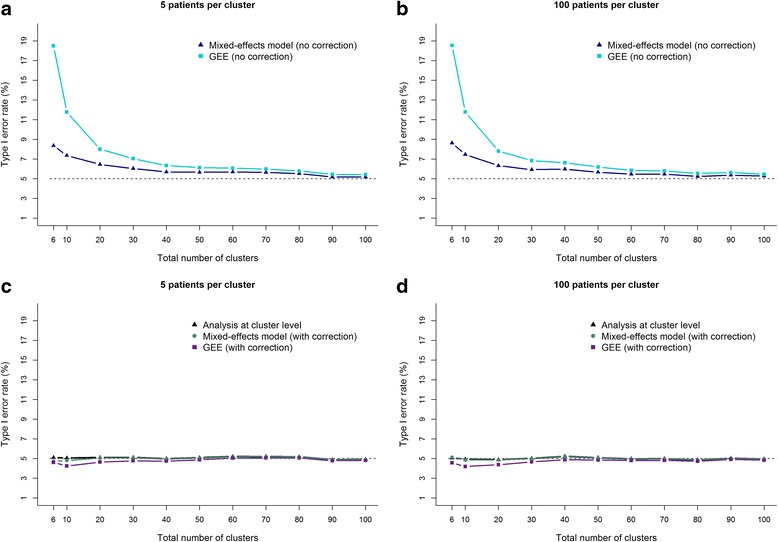
BACKGROUND: Cluster randomised trials (CRTs) are commonly analysed using mixed-effects models or generalised estimating equations (GEEs). However, these analyses do not always perform well with the small number of clusters typical of most CRTs. They can lead to increased risk of a type I error (finding a statistically significant treatment effect when it does not exist) if appropriate corrections are not used. METHODS: We conducted a small simulation study to evaluate the impact of using small-sample corrections for mixed-effects models or GEEs in CRTs with a small number of clusters. We then reanalysed data from TRIGGER, a CRT with six clusters, to determine the effect of using an inappropriate analysis method in practice. Finally, we reviewed 100 CRTs previously identified by a search on PubMed in order to assess whether trials were using appropriate methods of analysis. Trials were classified as at risk of an increased type I error rate if they did not report using an analysis method which accounted for clustering, or if they had fewer than 40 clusters and performed an individual-level analysis without reporting the use of an appropriate small-sample correction. RESULTS: Our simulation study found that using mixed-effects models or GEEs without an appropriate correction led to inflated type I error rates, even for as many as 70 clusters. Conversely, using small-sample corrections provided correct type I error rates across all scenarios. Reanalysis of the TRIGGER trial found that inappropriate methods of analysis gave much smaller P values (P ≤ 0.01) than appropriate methods (P = 0.04-0.15). In our review, of the 99 trials that reported the number of clusters, 64 (65 %) were at risk of an increased type I error rate; 14 trials did not report using an analysis method which accounted for clustering, and 50 trials with fewer than 40 clusters performed an individual-level analysis without reporting the use of an appropriate correction. CONCLUSIONS: CRTs with a small or medium number of clusters are at risk of an inflated type I error rate unless appropriate analysis methods are used. Investigators should consider using small-sample corrections with mixed-effects models or GEEs to ensure valid results.
Overview
The claims and statistics of this paper haven’t been checked yet.
Run the check — free, no account needed. It reads the open-access text and checks the sources it cites.
Integrity signals
Registry
Cites
Statistics
Figures
Verification
Claims the paper makes
The claims and statistics of this paper haven’t been checked yet.
Run the check — free, no account needed. It reads the open-access text and checks the sources it cites.
Self-check
Percentages, sums and reported differences re-computed from the paper’s own numbers.
The self-check needs the paper’s full text.
Citations
Cites
Longitudinal data analysis using generalized linear models
LIANG, K.-Y., & ZEGER, S. L. (1986) · Biometrika · doi:10.1093/biomet/73.1.13 · Cited by 18,550
Multilevel and Longitudinal Modeling Using Stata
Rabe-Hesketh, S., & Skrondal, A. (2005) · Biometrics · doi:10.1111/j.1541-0420.2006.00588_16.x · Cited by 4,626
Small sample inference for fixed effects from restricted maximum likelihood
Kenward, M. G., & Roger, J. H. (1997) · Biometrics · doi:10.2307/2533558 · Cited by 4,552
Consort 2010 statement: extension to cluster randomised trials
Campbell, M. K., Piaggio, G., Elbourne, D. R., Altman, D. G., & for the CONSORT Group (2012) · BMJ · doi:10.1136/bmj.e5661 · Cited by 3,510
Design and Analysis of Cluster Randomization Trials in Health Research
DONNER, A. P., & Klar, N. S. (2000) · Cited by 1,236
Hayes, R., & Moulton, L. H. (2009) · Chapman & Hall/CRC eBooks · doi:10.1201/9781584888178 · Cited by 881
Design and analysis of group-randomized trials: a review of recent methodological developments
Murray, D. M., Varnell, S. P., & Blitstein, J. L. (2004) · American Journal of Public Health · doi:10.2105/ajph.94.3.423 · Cited by 677
A Note on the Efficiency of Sandwich Covariance Matrix Estimation
Kauermann, G., & Carroll, R. J. (2001) · Journal of the American Statistical Association · doi:10.1198/016214501753382309 · Cited by 630
Design and Analysis of Cluster Randomization Trials in Health Research.
Flynn, T. N. (2001) · International Journal of Epidemiology · doi:10.1093/ije/30.2.407-a · Cited by 479
A Practical Guide to Cluster Randomised Trials in Health Services Research
Eldridge, S. M., & Kerry, S. (2012) · Wiley eBooks · doi:10.1002/9781119966241 · Cited by 356
Self-citationSmall‐Sample Adjustments for Wald‐Type Tests Using Sandwich Estimators
Fay, M. P., & Graubard, B. (2001) · Biometrics · doi:10.1111/j.0006-341x.2001.01198.x · Cited by 289
Eldridge, S. M., Ashby, D., Feder, G. S., Rudnicka, A. R., & Ukoumunne, O. C. (2004) · Clinical Trials · doi:10.1191/1740774504cn006rr · Cited by 288
Self-citationJairath, V., Kahan, B. C., Gray, A. J., Doré, C. J., Mora, A., James, M. W., Stanley, A. J., Everett, S. M., Bailey, A. A., Dallal, H. J., et al. (2015) · The Lancet · doi:10.1016/s0140-6736(14)61999-1 · Cited by 257
Self-citationIvers, N. M., Taljaard, M., Dixon, S., Bennett, C., McRae, A., Taleban, J., Skea, Z., Brehaut, J. C., Boruch, R. F., Eccles, M. P., et al. (2011) · BMJ · doi:10.1136/bmj.d5886 · Cited by 193
Li, P., & Redden, D. T. (2014) · Statistics in Medicine · doi:10.1002/sim.6344 · Cited by 189
Cluster randomised trials in the medical literature: two bibliometric surveys
Bland, M. (2004) · BMC Medical Research Methodology · doi:10.1186/1471-2288-4-21 · Cited by 187
How to Design, Analyse and Report Cluster Randomised Trials in Medicine and Health Related Research
Campbell, M. J., & Walters, S. J. (2014) · Wiley eBooks · doi:10.1002/9781118763452 · Cited by 178
Pan, W., & Wall, M. M. (2002) · Statistics in Medicine · doi:10.1002/sim.1142 · Cited by 176
Li, P., & Redden, D. T. (2015) · BMC Medical Research Methodology · doi:10.1186/s12874-015-0026-x · Cited by 142
Design and Analysis of Group-Randomized Trials: A Review of Recent Practices
Varnell, S. P., Murray, D. M., Janega, J. B., & Blitstein, J. L. (2004) · American Journal of Public Health · doi:10.2105/ajph.94.3.393 · Cited by 140
A comparison of two bias-corrected covariance estimators for generalized estimating equations
Lu, B., Preisser, J. S., Qaqish, B. F., Suchindran, C., Bangdiwala, S. I., & Wolfson, M. (2007) · Biometrics · doi:10.1111/j.1541-0420.2007.00764.x · Cited by 118
Substantial risks associated with few clusters in cluster randomized and stepped wedge designs
Taljaard, M., Teerenstra, S., Ivers, N. M., & Fergusson, D. A. (2016) · Clinical Trials · doi:10.1177/1740774516634316 · Cited by 96
Huang, S., Fiero, M. H., & Bell, M. L. (2016) · Clinical Trials · doi:10.1177/1740774516643498 · Cited by 75
Are missing data adequately handled in cluster randomised trials? A systematic review and guidelines
Diaz‐Ordaz, K., Kenward, M. G., Cohen, A., Coleman, C. L., & Eldridge, S. M. (2014) · Clinical Trials · doi:10.1177/1740774514537136 · Cited by 61
Self-citationDiaz-Ordaz, K., Froud, R., Sheehan, B., & Eldridge, S. (2013) · BMC Medical Research Methodology · doi:10.1186/1471-2288-13-127 · Cited by 47
Self-citationJohnson, J. L., Kreidler, S. M., Catellier, D., Murray, D. M., Muller, K. E., & Glueck, D. H. (2015) · Statistics in Medicine · doi:10.1002/sim.6565 · Cited by 29
Jairath, V., Kahan, B., Gray, A., Doré, C., Mora, A., Dyer, C., Stokes, E., Llewelyn, C., Bailey, A., Dallal, H., et al. (2013) · Transfusion Medicine Reviews · doi:10.1016/j.tmrv.2013.04.001 · Cited by 24
Self-citationKahan, B. C., Jairath, V., Murphy, M. F., & Doré, C. J. (2013) · Trials · doi:10.1186/1745-6215-14-206 · Cited by 18
Self-citationWhy does clustering matter in orthodontic trials?
Harrison, J. E., & Burnside, G. (2012) · European Journal of Orthodontics · doi:10.1093/ejo/cjs026 · Cited by 7
Research works printed but not linked: 1
- Murray DM. Design and analysis of group-randomised trials. London: Oxford University Press; 1998.
Cited by
Sorted by citations
Consensus in the delphi method: What makes a decision change?
Barrios, M., Guilera, G., Nuño, L., & Gómez‐Benito, J. (2020) · Technological Forecasting and Social Change · doi:10.1016/j.techfore.2020.120484 · Cited by 434
Cluster randomized trials with a small number of clusters: which analyses should be used?
Leyrat, C., Morgan, K. E., Leurent, B., & Kahan, B. C. (2018) · International Journal of Epidemiology · doi:10.1093/ije/dyx169 · Cited by 244
Self-citationde Silva, V. A., Suraweera, C., Ratnatunga, S. S., Dayabandara, M., Wanniarachchi, N., & Hanwella, R. (2016) · BMC Psychiatry · doi:10.1186/s12888-016-1049-5 · Cited by 227
Family-led rehabilitation after stroke in India (ATTEND): a randomised controlled trial
Lindley, R. I., Anderson, C. S., Billot, L., Förster, A., Hackett, M. L., Harvey, L. A., Jan, S., Li, Q., Huiqin, L. I. U., Langhorne, P., et al. (2017) · The Lancet · doi:10.1016/s0140-6736(17)31447-2 · Cited by 151
Frampton, G. K., Shepherd, J., Pickett, K., Griffiths, G., & Wyatt, J. C. (2020) · Trials · doi:10.1186/s13063-020-04358-3 · Cited by 119
Metadata
- Authors
- Kahan, B. C., Forbes, G., Ali, Y., Jairath, V., Bremner, S., Harhay, M. O., Hooper, R., Wright, N., Eldridge, S. M., & Leyrat, C.
- Affiliations
- Queen Mary University of London (GB)
- Western University (CA)
- Brighton and Sussex Medical School (GB)
- University of Pennsylvania (US)
- Inserm (FR)
- Corresponding author
- Kahan, Brennan C.
- ORCID
- Venue
- Trials
- Published
- 2016-09-06
- Volume
- 17
- Issue
- 1
- Pages
- 438-438
- ISSN
- 1745-6215 (ISSN-L)
- PMC
- PMC5013635
- OpenAlex
- W2515120484
- Cited by
- 185
- References
- 29
- Citations by year
- 2026: 10 · 2025: 11 · 2024: 22 · 2023: 12 · 2022: 16 · 2021: 35 · 2020: 26 · 2019: 16 · 2018: 13 · 2017: 15 · 2016: 9
- FWCI
- 17.86
- Type
- journal article
- Language
- en
- Open access
- gold
- doi.org
- Licence
- Locations
- Trials (publishedVersion, cc-by)
- PubMed Central (publishedVersion, cc-by)
- PubMed (publishedVersion)
- LSHTM Research Online (London School of Hygiene and Tropical Medicine) (acceptedVersion)
- Sussex Research Online (University of Sussex) (submittedVersion, cc-by)
- Figshare (submittedVersion, cc-by)
- Research Portal (King's College London) (submittedVersion, other-oa)
- Queen Mary Research Online (Queen Mary University of London) (submittedVersion, cc-by)
- Funders
- National Institute for Health and Care Research (NIHR-CTF-2014-03-05)
- National Institutes of Health
- National Heart, Lung, and Blood Institute (F31HL127947)
- Topics
- Physical Sciences › Mathematics › Statistics and Probability › Statistical Methods in Clinical Trials
- Physical Sciences › Mathematics › Statistics and Probability › Statistical Methods and Bayesian Inference
- Social Sciences › Decision Sciences › Statistics, Probability and Uncertainty › Meta-analysis and systematic reviews
- Keywords
- type I error, small sample correction, mixed models, generalized estimating equations, small number of clusters, clustering, statistical power
- MeSH terms
- Computer Simulation, Data Interpretation, Statistical, Humans, Risk, Cluster Analysis, Randomized Controlled Trials as Topic
About these checks
Registry, retraction, Cites and statistics results are computed, not judged, with one exception: a printed reference that no index lists is read once by a model before it counts as a citation error. Claims are extracted by a model and kept only when their quote appears verbatim in the text; each cited source is then checked, with a model’s help, for whether it says what the claim relies on. Those verdicts can be wrong — read the claim’s quote and the cited source before relying on one.
Statistics and arithmetic are recomputed, not judged.
Confidence bands are shown only for fields calibrated on our annotated test set. None is calibrated yet, so no band is shown.
What counts as a claim ›How we measure confidence ›How we check this ›
Are you an author, or do you see a problem with this page? Request a review
