

Subversion of allocation concealment in a randomised controlled trial: a historical case study.
Open accessThe DOI matches its Crossref record; 17 of the 19 references it cites were found in a registry or an index.
Abstract
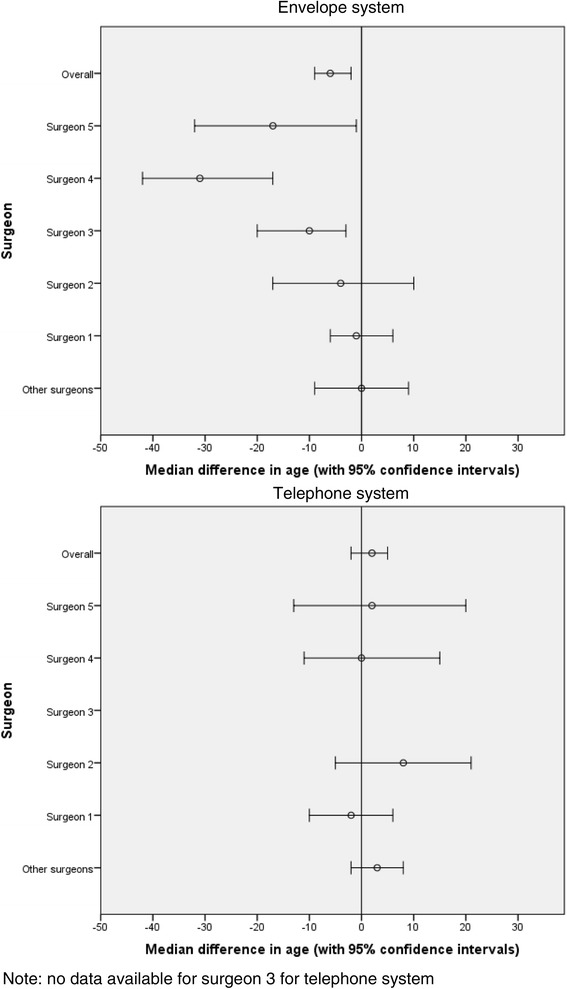
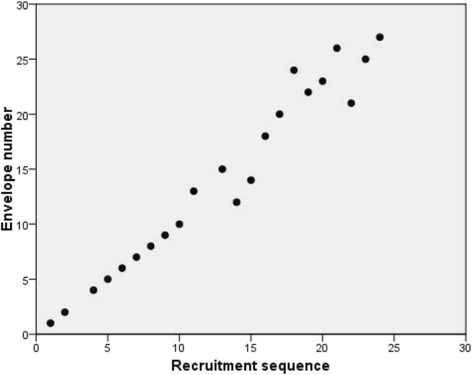
BACKGROUND: If the randomisation process within a trial is subverted, this can lead to selection bias that may invalidate the trial's result. To avoid this problem, it is recommended that some form of concealment should be put into place. Despite ongoing anecdotal concerns about their susceptibility to subversion, a surprising number of trials (over 10%) still use sealed opaque envelopes as the randomisation method of choice. This is likely due in part to the paucity of empirical data quantifying the potential effects of subversion. In this study we report a historical before and after study that compares the use of the sealed envelope method with a more secure centralised telephone allocation approach in order to provide such empirical evidence of the effects of subversion. METHODS: This was an opportunistic before and after study set within a multi-centre surgical trial, which involved 654 patients from 28 clinicians from 23 centres in the UK and Ireland. Two methods of randomly allocating subjects to alternative treatments were adopted: (a) a sealed envelope system administered locally, and (b) a centralised telephone system administered by the trial co-ordination centre. Key prognostic variables were compared between randomisation methods: (a) age at trial entry, a key prognostic factor in the study, and (b) the order in which 'randomisation envelopes' were matched to subjects. RESULTS: The median age of patients allocated to the experimental group with the sealed envelope system, was significantly lower both overall (59 vs 63 years, p < 0.01) and in particular for three clinicians (57 vs 72, p < 0.01; 33 vs 69, p < 0.001; 47 vs 72, p = 0.03). No differences in median age were found between the allocation groups for the centralised system. CONCLUSIONS: Due to inadequate allocation concealment with the sealed envelope system, the randomisation process was corrupted for patients recruited from three clinicians. Centralised randomisation ensures that treatment allocation is not only secure but seen to be secure. Where this proves to be impossible, allocation should at least be performed by an independent third party. Unless it is an absolute requirement, the use of sealed envelopes should be discontinued forthwith.
Overview
The claims and statistics of this paper haven’t been checked yet.
Free: it reads the open-access text and checks the first 5 claims that cite a source we can check. Create a free account to check every claim.
Integrity signals
Registry
Cites
Statistics
Figures
Verification
Claims the paper makes
The claims and statistics of this paper haven’t been checked yet.
Free: it reads the open-access text and checks the first 5 claims that cite a source we can check. Create a free account to check every claim.
Claims other papers make about this one
Each is checked against this paper’s own text: does it say what the citing paper says it does?
The source backs part of the claim, not all of it — or backs it for a different population, condition or comparison.
In the citing paper
“Baseline tables that appear to have a problem could occur for a range of non-fraudulent reasons. These include planned or unplanned factors to do with randomisation, such as dynamic randomisation to create highly comparable groups, or subversion of the random allocation. 18”
From Automated detection of over- and under-dispersion in baseline tables in randomised controlled trials. (2022) · cites this paper as [18]
Experimental — accuracy not yet measured
Self-check
Percentages, sums and reported differences re-computed from the paper’s own numbers.
The self-check needs the paper’s full text.
Citations
Cites
Moher, D., Hopewell, S., Schulz, K. F., Montori, V., Gotzsche, P. C., Devereaux, P. J., Elbourne, D., Egger, M., & Altman, D. G. (2010) · BMJ · doi:10.1136/bmj.c869 · Cited by 8,883 · cited 1×
“It also underlines the recommendation in the Consolidated Standards of Reporting Trials (CONSORT) statement on the reporting of randomised controlled trials that a full description be given of the actual methods used to generate and conceal trial allocations [14].”
MethodSchulz (1995) · doi:10.1001/jama.1995.03520290060030 · Cited by 5,634
Clinical Trials: A Practical Approach.
Hill, I. D., & Pocock, S. J. (1984) · Biometrics · doi:10.2307/2531186 · Cited by 2,930
Bias in treatment assignment in controlled clinical trials
Chalmers, T. C., Celano, P., Sacks, H. S., & Smith, H. (1983) · New England Journal of Medicine · doi:10.1056/nejm198312013092204 · Cited by 864
Kunz, R., & Oxman, A. D. (1998) · BMJ · doi:10.1136/bmj.317.7167.1185 · Cited by 770
Subverting Randomization in Controlled Trials
Schulz, K. F. (1995) · JAMA: The Journal of the American Medical Association · doi:10.1001/jama.1995.03530180050029 · Cited by 516
Randomisation and baseline comparisons in clinical trials
Altman, D. G., & Doré, C. J. (1990) · The Lancet · doi:10.1016/0140-6736(90)90014-v · Cited by 508 · cited 2×
“Altman and Dore 1990 [4]) because in a properly randomised trial any differences in baseline are most likely due to chance, Berger [8] argues strongly that baseline testing still has a role in order to detect possible allocation subversion.”
BackgroundMethodSelection Bias and Covariate Imbalances in Randomized Clinical Trials
Berger, V. W. (2005) · Wiley eBooks · doi:10.1002/0470863641 · Cited by 255 · cited 3×
“Altman and Dore 1990 [4]) because in a properly randomised trial any differences in baseline are most likely due to chance, Berger [8] argues strongly that baseline testing still has a role in order to detect possible allocation subversion.”
BackgroundResultHewitt, C., Hahn, S., Torgerson, D. J., Watson, J., & Bland, J. M. (2005) · BMJ · doi:10.1136/bmj.38413.576713.ae · Cited by 176 · cited 1×
“A methodological study [11] that compared the significance levels of trials that mainly used sealed envelopes with those who used more secure, third-party, randomisation systems found that trials using less secure procedures had significantly smaller p values than those using a more secure allocation method.”
ResultSelf-citationAltman, D. G. (1991) · BMJ · doi:10.1136/bmj.302.6791.1481 · Cited by 172
Research works printed but not linked: 1
- Turner J Russell D Russell I Gemmell LW France B Bride M Edwards AE Baseline imbalance in a randomised trial: a cautionary tale Care Critically Ill 2006 22 2 1 4
Cited by
Study designs: Part 4 – Interventional studies
Aggarwal, R., & Ranganathan, P. (2019) · Perspectives in Clinical Research · doi:10.4103/picr.picr_91_19 · Cited by 138
Nicklas, J. Y., Diener, O., Leistenschneider, M., Sellhorn, C., Schön, G., Winkler, M. S., Daum, G., Schwedhelm, E., Schröder, J., Fisch, M. M., et al. (2020) · British Journal of Anaesthesia · doi:10.1016/j.bja.2020.04.094 · Cited by 86
Baseline testing in cluster randomised controlled trials: should this be done?
Bolzern, J. E., Mitchell, A. S., & Torgerson, D. J. (2019) · BMC Medical Research Methodology · doi:10.1186/s12874-019-0750-8 · Cited by 44
Self-citationVorland, C. J., Brown, A. W., Dawson, J., Dickinson, S., Golzarri‐Arroyo, L., Hannon, B. A., Heo, M., Heymsfield, S. B., Jayawardene, W. P., Kahathuduwa, C. N., et al. (2021) · International Journal of Obesity · doi:10.1038/s41366-021-00909-z · Cited by 43
Envelope use and reporting in randomised controlled trials: A guide for researchers
Clark, L., Dean, A., Mitchell, A. S., & Torgerson, D. J. (2020) · Research Methods in Medicine & Health Sciences · doi:10.1177/2632084320957204 · Cited by 34
Self-citationHicks, A., Fairhurst, C. M., & Torgerson, D. J. (2017) · Journal of Clinical Epidemiology · doi:10.1016/j.jclinepi.2017.10.001 · Cited by 34
Self-citationComparing Effects of Treatment: Controlling for Confounding
Yan, H., Karmur, B. S., & Kulkarni, A. V. (2019) · Neurosurgery · doi:10.1093/neuros/nyz509 · Cited by 28
Huang, D., Zhou, S., Yu, Z., Chen, J., & Xie, H. (2021) · Journal of Clinical Anesthesia · doi:10.1016/j.jclinane.2020.110156 · Cited by 23
Quality of reporting and risk of bias: a review of randomised trials in occupational health
Tikka, C., Verbeek, J. H. A. M., Ijaz, S., Hoving, J. L., Boschman, J. S., Hulshof, C. T. J., & de Boer, A. G. E. M. (2021) · Occupational and Environmental Medicine · doi:10.1136/oemed-2020-107038 · Cited by 16
Clark, L., Burke, L., Carr, R. M., Coleman, E., Roberts, G., & Torgerson, D. J. (2021) · Journal of Clinical Epidemiology · doi:10.1016/j.jclinepi.2021.09.009 · Cited by 15
Self-citationStudy designs: Part 5 – interventional studies (II)
Aggarwal, R., & Ranganathan, P. (2019) · Perspectives in Clinical Research · doi:10.4103/picr.picr_138_19 · Cited by 15
“In a multicenter trial in the UK and Ireland,[2] the method of”
MethodRobinson, A.-L., Schmeiser, G., Robinson, Y., & Olerud, C. (2018) · Trials · doi:10.1186/s13063-018-2690-8 · Cited by 14
A Single-Centered Randomized Controlled Trial of Primary Pediatric Intensivists and Nurses
Edwards, J. D., Williams, E. P., Wagman, E. K., McHale, B. L., Malone, C. T., & Kernie, S. G. (2022) · Journal of Intensive Care Medicine · doi:10.1177/08850666221090421 · Cited by 13
Ojo, S. O., Bailey, D. P., Chater, A., & Hewson, D. J. (2022) · Frontiers in Public Health · doi:10.3389/fpubh.2022.832374 · Cited by 13
Probst, H., & Ramlaul, A. (2020) · Springer eBooks · doi:10.1007/978-3-030-37944-5_12 · Cited by 11
Barnett, A. (2022) · F1000Research · doi:10.12688/f1000research.123002.1 · Cited by 7
Toerper, M. F., Haukoos, J. S., Hopkins, E., Rowan, S. E., Lyons, M. S., Galbraith, J. W., Hsieh, Y., White, D. A. E., Levin, S., Hinson, J. S., et al. (2024) · Clinical Trials · doi:10.1177/17407745241301998 · Cited by 7
Choosing and evaluating randomisation methods in clinical trials: a qualitative study
Bruce, C. L., Iflaifel, M., Montgomery, A. A., Ogollah, R. O., Sprange, K., & Partlett, C. (2024) · Trials · doi:10.1186/s13063-024-08005-z · Cited by 8
Mitchell, A. S., Moe‐Byrne, T., Cunningham‐Burley, R., Dean, A., Rangan, A., Roche, J., & Torgerson, D. J. (2019) · Journal of Evaluation in Clinical Practice · doi:10.1111/jep.13313 · Cited by 7
Self-citationInference in response‐adaptive clinical trials when the enrolled population varies over time
Russo, M., Ventz, S., Wang, V., & Trippa, L. (2021) · Biometrics · doi:10.1111/biom.13582 · Cited by 4
“We refer to Sheth et al. (2016), Kennedy et al. (2017), and Villar et al. (2018) for some examples, and to Berger (2005, 2018) for a broader discussion on bias in randomized clinical trials.”
BackgroundUsing pairwise randomisation to reduce the risk of bias
Fairhurst, C. M., Hewitt, C. E., & Torgerson, D. J. (2019) · Research Methods in Medicine & Health Sciences · doi:10.1177/2632084319884178 · Cited by 3
Self-citationChepkirui, M., Kimego, D., Nzioki, C., Jowi, E. A., Opondo, C., & Agweyu, A. (2025) · Pilot and Feasibility Studies · doi:10.1186/s40814-025-01610-y · Cited by 1
Ren, B., Ferrari, F., Fortini, S., Ventz, S., & Trippa, L. (2025) · Biometrika · doi:10.1093/biomet/asaf047 · Cited by 1
“False positives are also controlled at the 𝛼 level in relevant scenarios where the samples of the ID and/or the ED are not independent and identically distributed, for example, when the RCT population varies over time (e.g., Russo et al., 2023; Kennedy et al., 2017).”
Assessment of the Risk of Bias
Moon, K., & Rao, S. C. (2021) · Springer eBooks · doi:10.1007/978-3-030-71921-0_4 · Cited by 2
Resuscitation Plus Special Issue: Cardiac arrest research
Couper, K., Masterson, S., & Nehme, Z. (2023) · Resuscitation Plus · doi:10.1016/j.resplu.2023.100416 · Cited by 1
DEPOSEIN: Take with a grain of salt
Shivaprasad, A., Rai, P., Gogia, B., & Tremont‐Lukats, I. W. (2020) · Neuro-Oncology · doi:10.1093/neuonc/noaa181
Perumal, M., Latib, A. I. A., Samy, M. P., Abidin, M. R. B. Z., Nagandran, E., Wan, T. S., Francis, P. J., & Foo, C. Y. (2022) · Trials · doi:10.1186/s13063-022-06810-y
Zsidai, B., Horváth, A., Karlsson, J., & Senorski, E. H. (2024) · Springer eBooks · doi:10.1007/978-3-031-77563-5_7
Role of recruitment bias in stepped-wedge cluster randomised controlled trials: a systematic review
Yakimova, A., Wiggins, F., Kanaan, M. N., Keding, A., & Torgerson, D. J. (2025) · BMJ Open · doi:10.1136/bmjopen-2024-096281
“52 72 80 Although the use of sealed envelopes is more likely to lead to the subversion in allocation concealment than a centralised computer system, 84 we considered the use of opaque sealed envelopes (as reported in the trial) as concealed allocation, 52 while in one trial 72 no information…”
Self-citationPerumal, M., Latib, A. I. A., Samy, M. P., Zainal Abidin, M. R. B., Nagandran, E., Wan, T. S., Francis, P. J., & Foo, C. Y. (2022) · Figshare · doi:10.6084/m9.figshare.21341114
Perumal, M., Latib, A. I. A., Samy, M. P., Zainal Abidin, M. R. B., Nagandran, E., Wan, T. S., Francis, P. J., & Foo, C. Y. (2022) · Figshare · doi:10.6084/m9.figshare.21341126
Bruce, C. L., Iflaifel, M., Montgomery, A., Ogollah, R. O., Sprange, K., & Partlett, C. (2024) · Figshare · doi:10.6084/m9.figshare.26695713
Bruce, C. L., Iflaifel, M., Montgomery, A., Ogollah, R. O., Sprange, K., & Partlett, C. (2024) · Figshare · doi:10.6084/m9.figshare.25449049
Perumal, M., Latib, A. I. A., Samy, M. P., Zainal Abidin, M. R. B., Nagandran, E., Wan, T. S., Francis, P. J., & Foo, C. Y. (2022) · Figshare · doi:10.6084/m9.figshare.21341123
Perumal, M., Latib, A. I. A., Samy, M. P., Zainal Abidin, M. R. B., Nagandran, E., Wan, T. S., Francis, P. J., & Foo, C. Y. (2022) · Figshare · doi:10.6084/m9.figshare.21341120
Perumal, M., Latib, A. I. A., Samy, M. P., Zainal Abidin, M. R. B., Nagandran, E., Wan, T. S., Francis, P. J., & Foo, C. Y. (2022) · Figshare · doi:10.6084/m9.figshare.21341129
Bruce, C. L., Iflaifel, M., Montgomery, A., Ogollah, R. O., Sprange, K., & Partlett, C. (2024) · Figshare · doi:10.6084/m9.figshare.26695710
Bruce, C. L., Iflaifel, M., Montgomery, A. A., Ogollah, R. O., Sprange, K., & Partlett, C. (2024) · Figshare · doi:10.6084/m9.figshare.25449133
Perumal, M., Latib, A. I. A., Samy, M. P., Zainal Abidin, M. R. B., Nagandran, E., Wan, T. S., Francis, P. J., & Foo, C. Y. (2022) · Figshare · doi:10.6084/m9.figshare.21341117
Burgoine, K. L., Okello, F., Abongo, G., Akot, E., Isabirye, L., Caleb, D., Nakiyemba, A., Napyo, A. K., Hagmann, C. F., Namuyonga, J., et al. (2026) · BMC Medical Research Methodology · doi:10.1186/s12874-026-02765-9
“Even this method carries a potential for subversion if fixed or very small block sizes are used, as these can make upcoming allocations predictable, or if envelopes are unsealed, trans-lucent, or otherwise inadequately secured, allowing staff to visualise or tamper with assignments [6].”
Bruce, C. L., Montgomery, A. A., Ndungu, A. W., Ogollah, R. O., & Partlett, C. (2026) · F1000Research · doi:10.12688/f1000research.177973.1
Wang, B., Wang, X. L., Ni, C., Xie, J., Wu, S., Wu, Y., Shen, Y., Dong, Z., Lv, W., & He, Y. Y. (2026) · BMC Medical Research Methodology · doi:10.1186/s12874-026-02877-2
“…like sequentially numbered opaque sealed envelopes (SNOSE) or interactive web response systems (IWRS)—can successfully concealing pre-generated allocation sequences [7, 13], generating sufficiently unpredictable sequences remains a frequently overlooked aspect of randomization integrity [1, 7].”
Metadata
- Authors
- Kennedy, A. D. M., Torgerson, D. J., Campbell, M. K., & Grant, A. M.
- Affiliations
- University of Aberdeen (GB)
- University of York (GB)
- Corresponding author
- Campbell, Marion K.
- Venue
- Trials
- Published
- 2017-05-02
- Volume
- 18
- Issue
- 1
- Pages
- 204-204
- ISSN
- 1745-6215 (ISSN-L)
- PMC
- PMC5414185
- OpenAlex
- W2611769110
- Cited by
- 44
- References
- 19
- Citations by year
- 2026: 3 · 2025: 3 · 2024: 7 · 2023: 2 · 2022: 11 · 2021: 6 · 2020: 4 · 2019: 6 · 2018: 1 · 2017: 1
- FWCI
- 2.28
- Type
- journal article
- Language
- en
- Open access
- gold
- doi.org
- Licence
- cc-by
- Locations
- Trials (publishedVersion, cc-by)
- PubMed Central (publishedVersion, cc-by)
- PubMed (publishedVersion)
- White Rose Research Online (University of Leeds, The University of Sheffield, University of York) (acceptedVersion)
- Aberdeen University Research Archive (Aberdeen University) (submittedVersion)
- DOAJ (DOAJ: Directory of Open Access Journals) (submittedVersion, cc-by-sa)
- Topics
- Physical Sciences › Mathematics › Statistics and Probability › Statistical Methods in Clinical Trials
- Social Sciences › Decision Sciences › Statistics, Probability and Uncertainty › Meta-analysis and systematic reviews
- Physical Sciences › Mathematics › Statistics and Probability › Advanced Causal Inference Techniques
- Keywords
- allocation concealment, selection bias, prognostic factors, surgical trials
- MeSH terms
- Adult, Age Factors, Aged, Confidentiality, Female, United Kingdom, Humans, Male, Middle Aged, Random Allocation, Telephone, Selection Bias, Age Distribution
About these checks
Registry, retraction, Cites and statistics results are computed, not judged, with one exception: a printed reference that no index lists is read once by a model before it counts as a citation error. Claims are extracted by a model and kept only when their quote appears verbatim in the text; each cited source is then checked, with a model’s help, for whether it says what the claim relies on. Those verdicts can be wrong — read the claim’s quote and the cited source before relying on one.
Statistics and arithmetic are recomputed, not judged.
Confidence bands are shown only for fields calibrated on our annotated test set. None is calibrated yet, so no band is shown.
What counts as a claim ›How we measure confidence ›How we check this ›
Are you an author, or do you see a problem with this page? Request a review
Data sources
Bibliographic data: Semantic Scholar, OpenAlex, Crossref.
Contains information from the Semantic Scholar Academic Graph Datasets, made available under the ODC Attribution License (ODC-BY 1.0).
Semantic Scholar’s data is described in: Kinney, R., et al. (2023). The Semantic Scholar Open Data Platform. arXiv:2301.10140.
