

Measurement training and feedback system for implementation of evidence-based treatment for adolescent externalizing problems: protocol for a randomized trial of pragmatic clinician training
Open accessThe DOI matches its Crossref record; 45 of the 45 references it cites were found in a registry or an index.
Abstract
Background: Innovations in clinical training and support that enhance fidelity to evidence-based treatment (EBT) for adolescent behavior problems are sorely needed. This study will develop an online training system to address this gap: Measurement Training and Feedback System for Implementation (MTFS-I). Using procedures intended to be practical and sustainable, MTFS-I is designed to increase two aspects of therapist behavior that are fundamental to boosting EBT fidelity: therapist self-monitoring of EBT delivery, and therapist utilization of core techniques of EBTs in treatment sessions. This version of MTFS-I focuses on two empirically supported treatment approaches for adolescent conduct and substance use problems: family therapy and cognitive behavioral therapy (CBT). Methods/design: MTFS-I expands on conventional measurement feedback systems for client outcomes by adding training in observational coding to promote EBT self-monitoring and focusing on implementation of EBT treatment techniques. It has two primary components. (1) The training component, delivered weekly in two connected parts, involves self-monitored learning modules containing brief clinical descriptions of core EBT techniques and mock session coding exercises based on 5–8 min video segments that illustrate delivery of core techniques. (2) The feedback component summarizes aggregated therapist-reported data on EBT techniques used with their active caseloads. MTFS-I is hosted online and requires approximately 20 min per week to complete for each treatment approach. This randomized trial will first collect data on existing delivery of family therapy and CBT techniques for youth in outpatient behavioral health sites (Baseline phase). It will then randomize site clinicians to two study conditions (Implementation phase): Training Only versus Training + Feedback + Consultation. Therapists will choose whether to train in family therapy, CBT, or both. Study aims will compare clinician performance across study phase and between study conditions on MTFS-I uptake, reliability and accuracy in EBT self-monitoring, and utilization of EBT techniques in treatment sessions (based on observer coding of audiotapes). Discussion: Study contributions to implementation science and considerations of MTFS-I sustainability are discussed. Trial registration: ClinicalTrials.gov, NCT03722654. Registered on 29 October 2018.
Overview
The claims and statistics of this paper haven’t been checked yet.
Free: it reads the open-access text and checks the first 5 claims that cite a source we can check. Create a free account to check every claim.
Integrity signals
Registry
Cites
Statistics
Figures
Verification
Claims the paper makes
The claims and statistics of this paper haven’t been checked yet.
Free: it reads the open-access text and checks the first 5 claims that cite a source we can check. Create a free account to check every claim.
Claims other papers make about this one
Each is checked against this paper’s own text: does it say what the citing paper says it does?
The cited source says what the claim attributes to it.
In the citing paper
“Site clinicians will be trained for 6 hours. The session will feature video-based training [117,118] in Fam-AID modules and techniques. Thereafter, consultation at each site will include bimonthly live consultation with a protocol expert focused on equipoise between protocol fidelity and case tailoring, along with continuous feedback from therapist- and observer-report fidelity data, which is ema”
From Family Support Protocol for Adolescent Internalizing Disorders: Protocol for a Pre-Post Quantitative Treatment Development Study (2024) · cites this paper as [118]
Self-check
Percentages, sums and reported differences re-computed from the paper’s own numbers.
The self-check needs the paper’s full text.
Citations
Cites
Diagnostic and Statistical Manual of Mental Disorders
American Psychiatric Association (2013) · doi:10.1176/appi.books.9780890425596 · Cited by 116,369
Intraclass correlations: Uses in assessing rater reliability.
Shrout, P. E., & Fleiss, J. L. (1979) · Psychological Bulletin · doi:10.1037/0033-2909.86.2.420 · Cited by 24,532
Diagnostic and Statistical Manual of Mental Disorders, 5th ed.
Carter, M. J. (2014) · Therapeutic Recreation Journal · Cited by 15,169
Introducing Multilevel Modeling
Kreft, I., & de Leeuw, J. (1998) · doi:10.4135/9781849209366 · Cited by 2,997
Beidas, R. S., & Kendall, P. C. (2010) · Clinical Psychology: Science and Practice · doi:10.1111/j.1468-2850.2009.01187.x · Cited by 1,085
A stage model of behavioral therapies research: getting started and moving on from stage I.
Rounsaville, B. J., Carroll, K. M., & Onken, L. S. (2001) · Clinical Psychology: Science and Practice · doi:10.1093/clipsy.8.2.133 · Cited by 846
A Stage Model of Behavioral Therapies Research: Getting Started and Moving on From Stage I
Rounsaville, B. J., Carroll, K. M., & Onken, L. S. (2001) · Clinical Psychology: Science and Practice · doi:10.1093/clipsy/8.2.133 · Cited by 846
Chorpita, B. F., & Daleiden, E. L. (2009) · Journal of Consulting and Clinical Psychology · doi:10.1037/a0014565 · Cited by 687
Statistical analysis and optimal design for cluster randomized trials.
Raudenbush, S. W. (1997) · Psychological Methods · doi:10.1037/1082-989x.2.2.173 · Cited by 636
Statistical power and optimal design for multisite randomized trials.
Raudenbush, S. W., & Liu, X. (2000) · Psychological Methods · doi:10.1037/1082-989x.5.2.199 · Cited by 593
Research works printed but not linked: 3
- Substance Abuse and Mental Health Services Administration (SAMHSA) Identifying mental health and substance use problems of children and adolescents: a guide for child-serving organizations 2011
- Dwyer AM Neusteter SR Lachman P Data-driven decisionmaking for strategic justice reinvestment: Urban Institute, Justice Policy Center 2012
- Raudenbush SW Spybrook J Congdon R Liu X-f Martinez A Bloom H Optimal design software for multi-level and longitudinal research (Version 3.01) [Software] 2011
Cited by
Hogue, A., Bobek, M., MacLean, A., Miranda, R., Wolff, J. C., & Jensen‐Doss, A. (2020) · Cognitive and Behavioral Practice · doi:10.1016/j.cbpra.2019.12.002 · Cited by 32
Self-citationSibley, M. H., Bickman, L., Coxe, S. J., Graziano, P. A., & Martin, P. (2020) · Behavior Therapy · doi:10.1016/j.beth.2020.10.007 · Cited by 18
Hadfield, H., Glendenning, S., Bee, P., & Wittkowski, A. (2019) · Journal of Child and Family Studies · doi:10.1007/s10826-019-01535-0 · Cited by 24
Hogue, A., Porter, N., Bobek, M., MacLean, A., Bruynesteyn, L., Jensen‐Doss, A., Dauber, S. E., & Henderson, C. E. (2021) · Administration and Policy in Mental Health and Mental Health Services Research · doi:10.1007/s10488-021-01152-4 · Cited by 17
Self-citationHogue, A., MacLean, A., Bobek, M., Porter, N., Bruynesteyn, L., Jensen‐Doss, A., & Henderson, C. E. (2022) · Journal of Clinical Child & Adolescent Psychology · doi:10.1080/15374416.2022.2051529 · Cited by 13
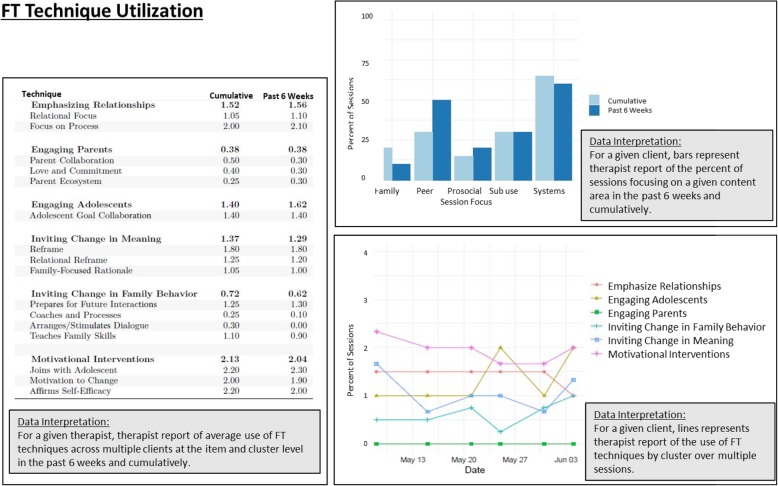
“Two different sample versions of MTFS-I feedback reports can be found in Hogue, Dauber et al. (2019) and Hogue et al. (2019), respectively.”
BackgroundSelf-citation
Metadata
- Authors
- Hogue, A., Bobek, M., MacLean, A., Porter, N., Jensen-Doss, A., & Henderson, C. E.
- Affiliations
- Sam Houston State University (US)
- Corresponding author
- Hogue, Aaron
- Venue
- Trials
- Published
- 2019-12
- Volume
- 20
- Issue
- 1
- Pages
- 700-700
- ISSN
- 1745-6215 (ISSN-L)
- PMC
- PMC6905067
- OpenAlex
- W2996092063
- Cited by
- 9
- References
- 44
- Citations by year
- 2025: 1 · 2024: 1 · 2023: 1 · 2022: 2 · 2021: 1 · 2020: 2 · 2019: 1
- FWCI
- 2.04
- Type
- journal article
- Language
- en
- Open access
- gold
- doi.org
- Licence
- cc-by
- creativecommons.org/licenses/by/4.0/ (tdm)
- creativecommons.org/licenses/by/4.0/ (vor, 9 d)
- Locations
- Trials (publishedVersion, cc-by)
- Europe PMC (PubMed Central) (publishedVersion, cc-by)
- PubMed Central (publishedVersion, cc-by)
- PubMed (publishedVersion)
- DOAJ (DOAJ: Directory of Open Access Journals) (submittedVersion)
- Funders
- Foundation for the National Institutes of Health (R34MH117212)
- Topics
- Health Sciences › Health Professions › General Health Professions › Health Policy Implementation Science
- Social Sciences › Psychology › Clinical Psychology › Psychotherapy Techniques and Applications
- Social Sciences › Psychology › Clinical Psychology › Counseling Practices and Supervision
- Keywords
- adolescent externalizing problems, measurement feedback, observational coding, family therapy, cognitive behavioral therapy, conduct problems, adolescent substance use, implementation science
- MeSH terms
- Formative Feedback, Professional Practice Gaps, Adolescent, Adolescent Behavior, Age Factors, Attitude of Health Personnel, Family Therapy, Humans, Health Knowledge, Attitudes, Practice, Psychotherapy, Time Factors, United States, Multicenter Studies as Topic, Cognitive Behavioral Therapy, Randomized Controlled Trials as Topic, Treatment Outcome, Conduct Disorder, Substance-Related Disorders
About these checks
Registry, retraction, Cites and statistics results are computed, not judged, with one exception: a printed reference that no index lists is read once by a model before it counts as a citation error. Claims are extracted by a model and kept only when their quote appears verbatim in the text; each cited source is then checked, with a model’s help, for whether it says what the claim relies on. Those verdicts can be wrong — read the claim’s quote and the cited source before relying on one.
Statistics and arithmetic are recomputed, not judged.
Confidence bands are shown only for fields calibrated on our annotated test set. None is calibrated yet, so no band is shown.
What counts as a claim ›How we measure confidence ›How we check this ›
Are you an author, or do you see a problem with this page? Request a review
Data sources
Bibliographic data: Semantic Scholar, OpenAlex, Crossref.
Contains information from the Semantic Scholar Academic Graph Datasets, made available under the ODC Attribution License (ODC-BY 1.0).
Semantic Scholar’s data is described in: Kinney, R., et al. (2023). The Semantic Scholar Open Data Platform. arXiv:2301.10140.
